
Transforming Sam Daniel’s Property with a Wooden Fence in Danbury, TX
A finished, stained wood privacy fence enclosing the back lawn and pool garden area of Sam Daniel’s Danbury property, with small cap-mounted light fixtures along the top — plus what pressure-treatment category actually means for a fence like this.
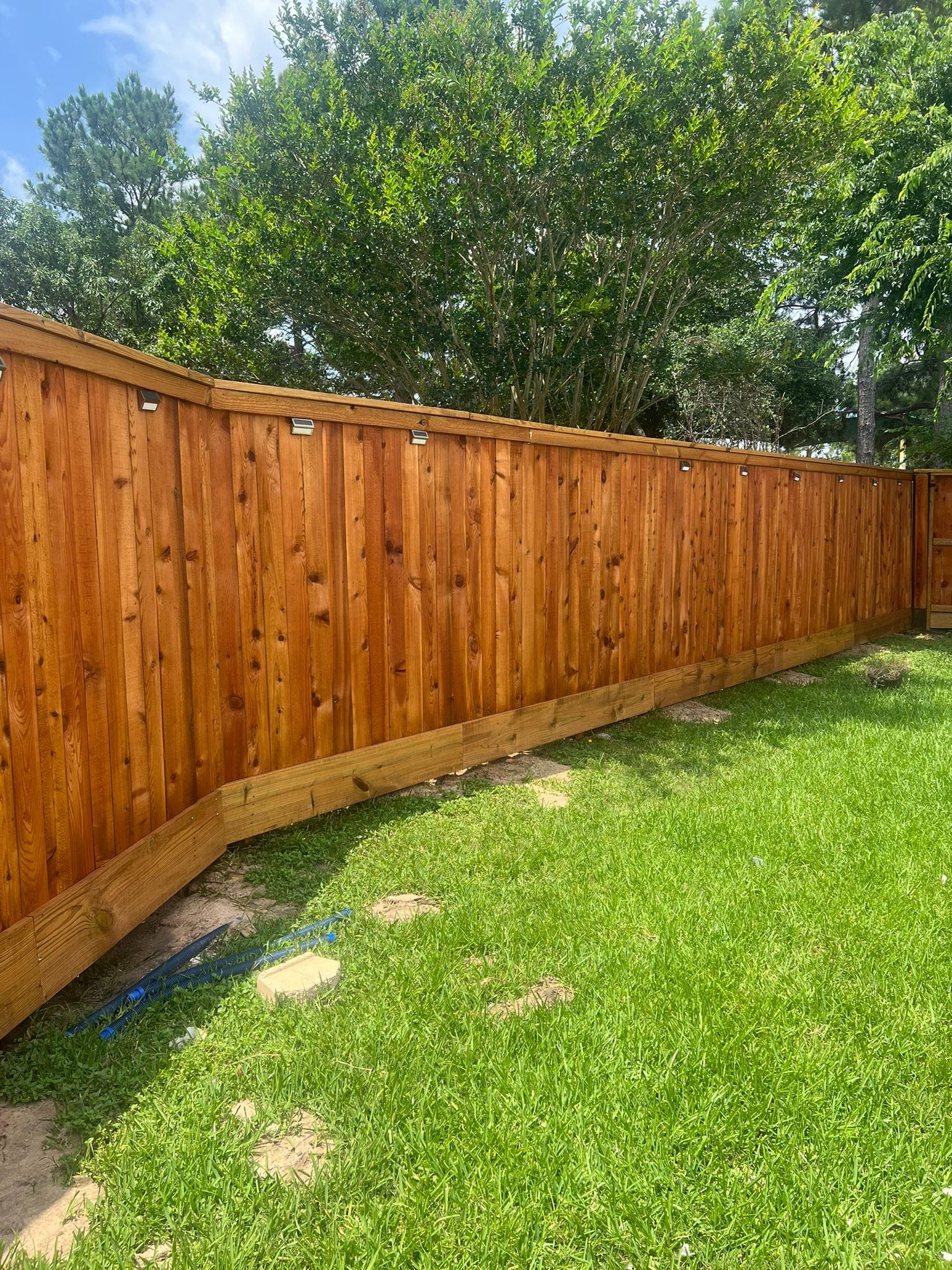
These photos document a finished, stained wood privacy fence enclosing the back lawn and a pool garden area of Sam Daniel’s property in Danbury, TX, with small cap-mounted light fixtures spaced along the top. The wood species isn’t specified here. This job sits outside the Galveston program’s service-area allowlist (Danbury is in Brazoria County), so no city or county ordinance is cited for it — the facts below are general, sourced wood-fence information that applies to a fence like this anywhere in Texas.
Sources: Southern Forest Products Association, Pressure-Treated Southern Pine (2019 ed.), Table 3-1; Texas Utilities Code Ch. 251; Texas811 homeowner pages. Checked October 24, 2026 (same citations used on /transforming-prince-singh-dhoats-property-in-rosharon/). This job sits outside the Galveston program’s service-area allowlist, so no city or county ordinance is cited for it.
A finished privacy fence, two parts of the property
The two photos attached to this project show completed work, not work in progress: a stained wood privacy fence enclosing the back lawn under mature shade trees, with small cap-mounted light fixtures spaced evenly along the top of the fence, and a second section of the same style enclosing a pool garden area. Both photos show a flat cap board on top and a trim board along the bottom.
The wood species isn’t named here — see wood fence installation and cedar vs. pressure-treated pine for how material choices compare.
What a pressure-treated wood fence actually means
Whatever species this fence is built from, its decay resistance comes from which AWPA use-category the lumber was pressure-treated to — not from the species alone. The Southern Forest Products Association’s treatment tables set a UC3A (coated) or UC3B (uncoated) minimum for above-ground, exposed fence boards and rails, and a higher UC4A minimum for posts that sit in ground contact, a harsher decay exposure than the boards face.
The stain visible in both photos adds a surface-level moisture and UV barrier on top of whichever treatment category the lumber already has — it’s a maintenance layer, not a substitute for the underlying treatment.
Wood privacy fence board & post estimator
This project’s own linear footage wasn’t published, so the number below is just a starting point — enter your own run to see about how many boards and posts a solid privacy fence like this one takes. It’s arithmetic, not a manufacturer spec.
Board count: linear feet × 12 ÷ board width, rounded up (edge-to-edge, no gap). Post count: one post per spacing interval, plus one. All arithmetic, not a manufacturer figure. Not this specific project’s measured footage.

Planning a wood privacy fence
- Comparing materials? See wood fence installation and cedar vs. pressure-treated pine.
- Digging new post holes? See calling 811 before a fence goes in — it applies statewide.
- In the Galveston area? See every area we serve — this particular project was outside that area.
What customers say on Google
5.091 Google reviews · read them all on Google
Amazing work will go ahead and recommend everyone in friends and family We installed 8ft tall double sided stained cedar wood fence in our backyard, it’s really looks great, installed perfectly nice finishing and cost effective, thanks mustang fencing.
I have hired Mustang fencing services to fix my backyard fencing. Good wood to used. I really like theirs work. Best of luck
Excellent work. They came in handy after the hurricane hit our backyard. Friendly people too.
Reviews shown word for word from the Mustang Fencing Services Google Business Profile (Galveston), captured 2026-10-19.
Questions we get about this
What do these photos show for Sam Daniel’s Danbury fence project?
What wood species is this fence built from?
Does staining replace the pressure treatment?
Do new fence post holes need an 811 call?
Does Mustang Fencing serve Danbury?
Sources
Checked October 24, 2026. Rules change, so confirm with the City before you build.
- Southern Forest Products Association, Pressure-Treated Southern Pine (2019 ed.) — Table 3-1, AWPA use categories: UC3A/UC3B for above-ground fence boards and rails vs. UC4A for posts in ground contact.
- Texas811, Homeowner / DIYer — Statewide one-call requirement: notify 811 at least 48 hours before digging, including new fence post holes.
- Texas Utilities Code, Chapter 251 (Underground Facility Damage Prevention) — 48-hour minimum, 14-day maximum advance notice before excavation (251.151); civil penalty for noncompliance (251.201).
Planning a wood privacy fence?
We’ll talk through material and treatment options and give you a written estimate before any fence order.