
Cedar vs Pressure-Treated Pine Fence: What Really Differs on the Gulf Coast
Cedar costs more and moves less. Pressure-treated pine costs less, but it can arrive wet from treatment and shrink as it dries. The real decision is which wood goes where: the boards you see, and the posts that sit in wet ground.
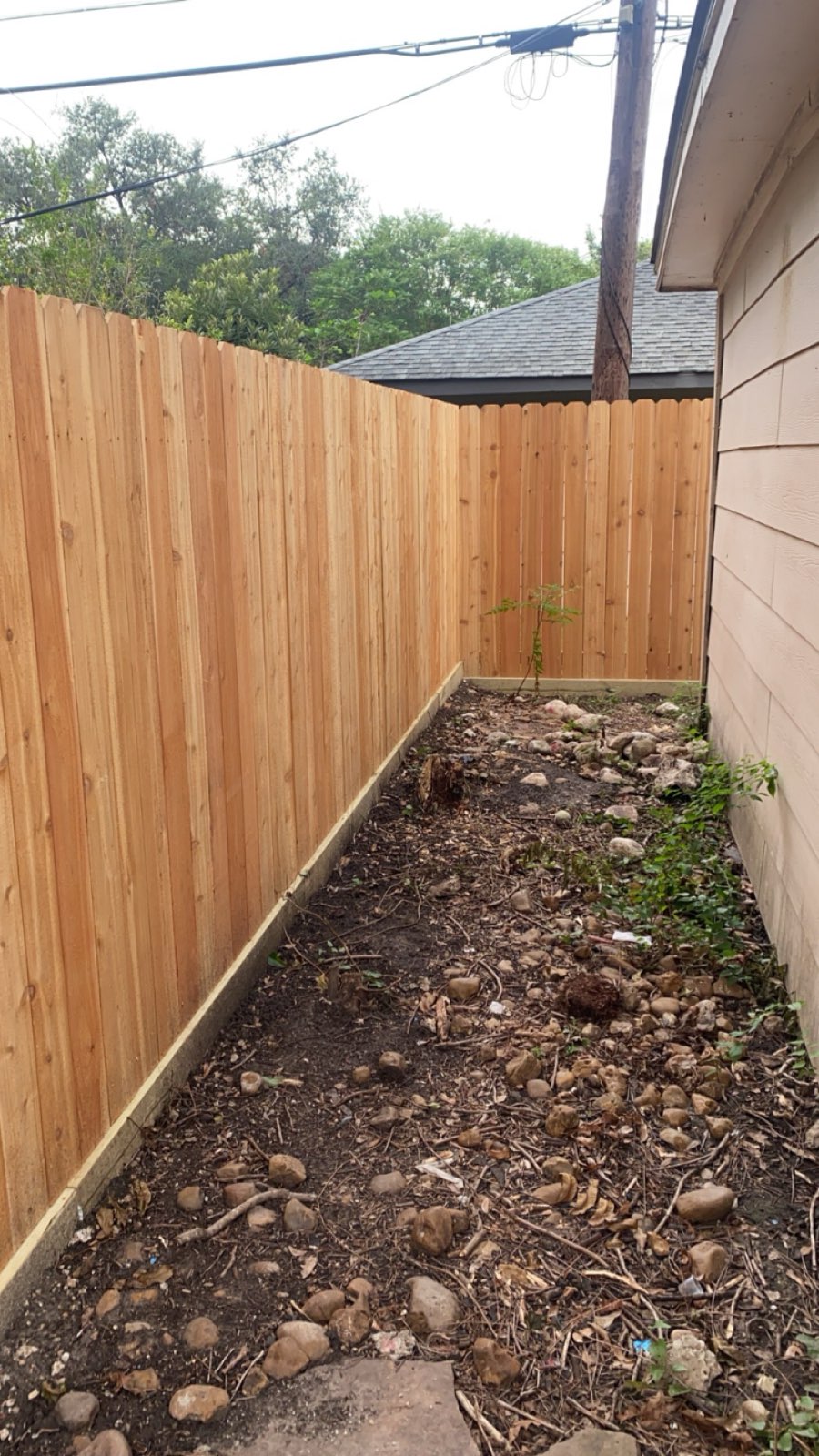
Cedar heartwood is rated decay-resistant by the USDA Wood Handbook, and it shrinks less: about 5.0% across the grain from green to oven-dry, against 7.4–7.7% for the southern pines. Pressure-treated pine has little natural decay resistance, so it depends on its treatment. Waterborne-treated lumber keeps shrinking after it is installed unless it was kiln-dried after treatment (KDAT). For most Galveston fences, the question isn’t which wood is “better”. It’s where each belongs. Posts in the ground need ground-contact treatment (AWPA UC4A) whichever boards you choose.
Sources: USDA Forest Products Laboratory, Wood Handbook FPL-GTR-282 (2021): Table 4-3, Eq. 4-9, Table 13-1, Ch. 15 and Table 15-6. The 7/32″ figure is arithmetic: 5.5″ × 7.4% × (1 − 14 ÷ 30) = 0.217″.
Cedar and pressure-treated pine, side by side
| Cedar (western redcedar) | Pressure-treated southern pine | |
|---|---|---|
| Natural decay resistance of the heartwood | Resistant | Slightly or non-resistant. That’s why it is treated. |
| Sapwood (the pale outer wood) | Low resistance, like almost every species | This is the part the treatment penetrates best |
| Shrinkage across the grain, green to oven-dry | 5.0% | 7.4–7.7% |
| Movement after installation | Less, and it starts later (below about 22% moisture) | More. Wet waterborne-treated lumber shrinks as it dries unless it is KDAT |
| Stains around plain steel fasteners | Yes: tannins plus iron leave black stains | No black stain. Iron just rusts, leaving a brown mark |
| In the ground | Rated for above-ground use; question cedar posts in soil | Needs UC4A (ground-contact) treatment |
| Material cost | Higher | Lower |
USDA Wood Handbook FPL-GTR-282 (2021): Table 14-1 and p. 14-5 (decay), Table 4-3 (shrinkage), Table 13-5 note b (cedar shrinkage starts near 22%), Ch. 15 (waterborne treatment and KDAT), Table 15-6 (use categories), Ch. 16 (iron stain).
Rot: what the ratings actually say
The USDA Forest Products Laboratory groups the heartwood of common woods by natural decay resistance. Cedars, including western redcedar, sit in the resistant group. The southern pines sit in the slightly or non-resistant group, which is why pine fence lumber is pressure-treated. Two footnotes matter on the island:
- Humid climates are harder on wood. The Handbook notes that decay resistance may be lower in ground contact and in warm, humid climates. That describes Galveston.
- Only heartwood earns the rating. The Handbook says untreated sapwood of essentially all species has low resistance to decay. On a cedar board, the pale streaks are sapwood. A board that is mostly sapwood doesn’t carry cedar’s rating.
Where the wood sits matters as much as the species. The Handbook says heartwood in the resistant group generally gives satisfactory service above ground. For wood in contact with the ground it points to the very resistant group, and says the other groups usually need preservative treatment. Cedar is a good board wood. Setting cedar posts in wet soil is the one choice worth questioning.
For treated pine, the treatment has to match the use. The American Wood Protection Association (AWPA) use categories, summarized in the Handbook, put fence pickets and rails in UC3B (above ground, fully exposed to weather) and fence posts in UC4A (ground contact). The end tag on treated lumber shows the preservative, the retention and the use category. Check it on the posts. A board treated for above-ground use isn’t a post.
Movement: why a new pine fence opens gaps
Wood shrinks as it dries below its fiber saturation point, which the Handbook approximates as 30% moisture. Almost all of that shrinkage happens across the width of a board. Flat-sawn boards shrink most in the tangential direction, and that is the number the Handbook tabulates:
- western redcedar 5.0% from green to oven-dry, young-growth redwood 4.9%
- loblolly pine 7.4%, longleaf 7.5%, slash 7.6%, shortleaf 7.7%
Pressure treatment matters too. Waterborne preservatives are pushed into the wood with water, and the Handbook says some drying and shrinkage will occur after installation unless the wood is kiln-dried after treatment. The Handbook abbreviates that as KDAT. “Dry” lumber under the American Softwood Lumber Standard is 19% moisture or less.
Outdoors, wood settles toward the moisture of the air around it. The Handbook’s outdoor table doesn’t list Galveston. The nearest Gulf Coast cities in it, New Orleans and Mobile, sit at about 13–15% year-round, and it recommends about 12% for exterior wood in damp, warm coastal areas at installation. So on the island, most of the movement in a new fence is the first drying. The seasons add little: a swing of about 1.3 points in New Orleans works out to about 0.02″ on a 5½″ pine board (Table 13-5).
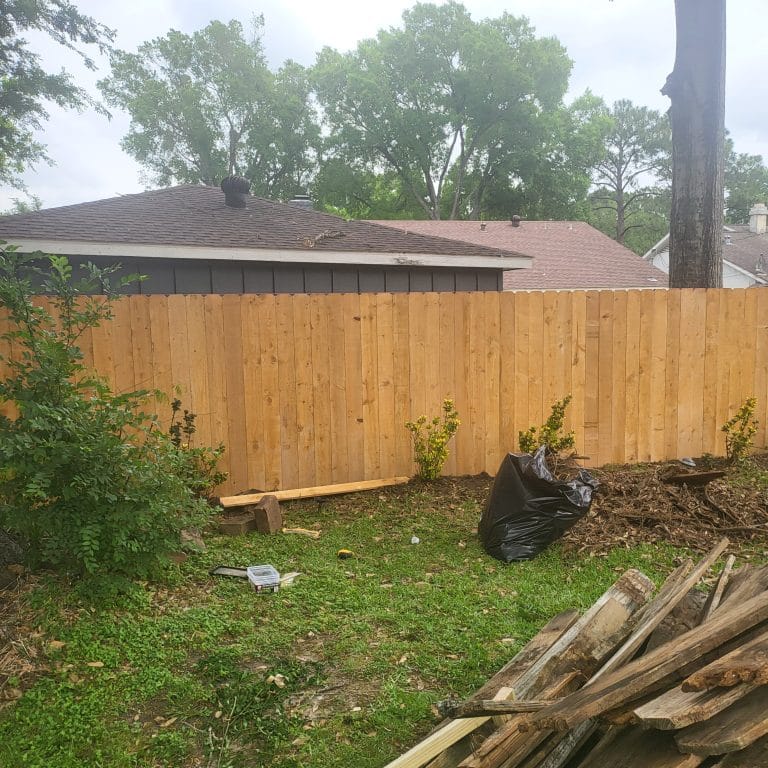
The arithmetic, using the Handbook’s Eq. 4-9: a 5½″ loblolly board that goes up wet and dries to 14% loses about 0.22″ of width, a little under 1/4″. A 5½″ western redcedar board under the same conditions loses about 0.10″, because it shrinks less and only starts shrinking at about 22%. That is why a butted privacy fence of wet-treated pine can show daylight between boards after its first season, and why many buyers choose board-on-board, whose overlap covers the gap. For how pine behaves after installation, see pressure-treated pine pros and cons.
How much each wood shrinks across the grain
Tangential shrinkage from green to oven-dry, percent of the green width
How much will each board shrink?
Pick the wood, the board width and how wet it is when it goes up. The estimator uses the USDA Wood Handbook’s shrinkage data to show how much narrower each board gets as it dries to outdoor moisture, and so how wide a gap opens between butted boards.
Arithmetic only, from the USDA Forest Products Laboratory Wood Handbook (FPL-GTR-282, 2021). Shrinkage from green to a moisture content x is S0 × (1 − x ÷ 30) (Eq. 4-9), where S0 is the species’ tangential shrinkage from Table 4-3 (flat-sawn boards shrink mostly across their width). Western redcedar and redwood are assumed to start shrinking at 22% (Table 13-5, note b). The Handbook doesn’t list Galveston; nearby Gulf Coast cities in its outdoor table sit at about 13–15% moisture year-round, so 14% is the default. Real boards vary by roughly ±15% from these averages. An estimate for planning, not a guarantee.
Fasteners: the detail that shows first
The fasteners behave differently in each wood, and on the coast they are often the first thing to look wrong.
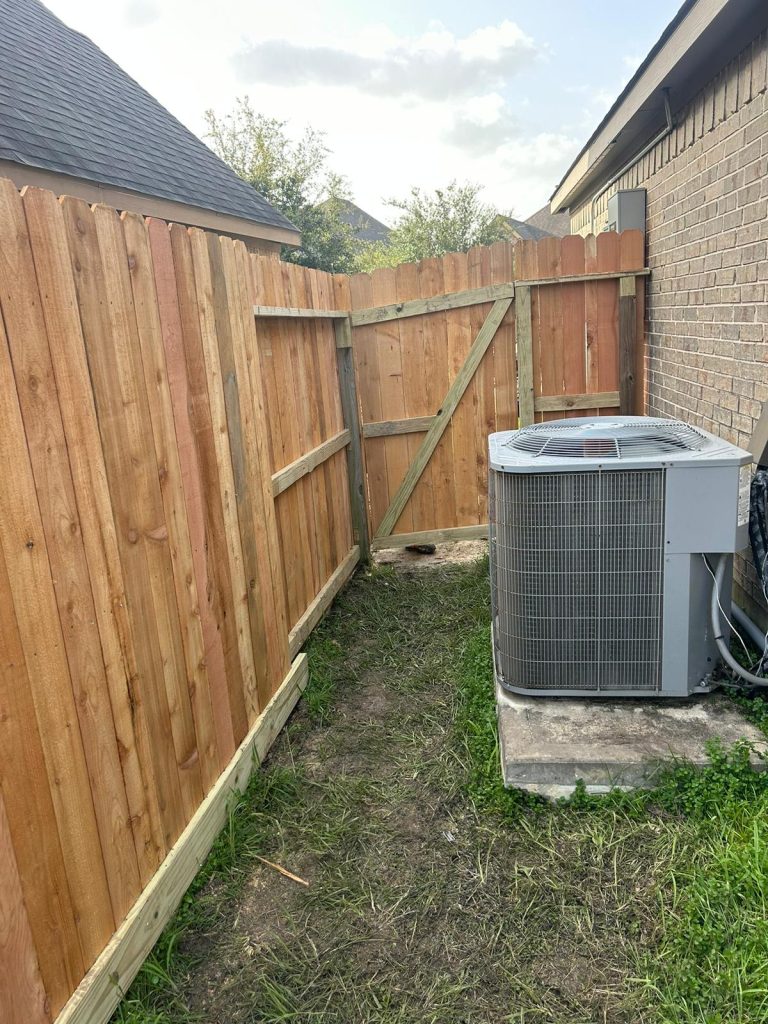
- Cedar and redwood are high in tannins. The Handbook says to expect iron stain, black streaks around each nail, when plain carbon-steel fasteners are used on them. It calls stainless steel safe from iron stain. If stainless can’t be used, it says high-quality hot-dip galvanized fasteners (ASTM A153) are far less likely to stain. It also notes that iron stain on cedar from the wrong fasteners is common, “even when contractors do the work.”
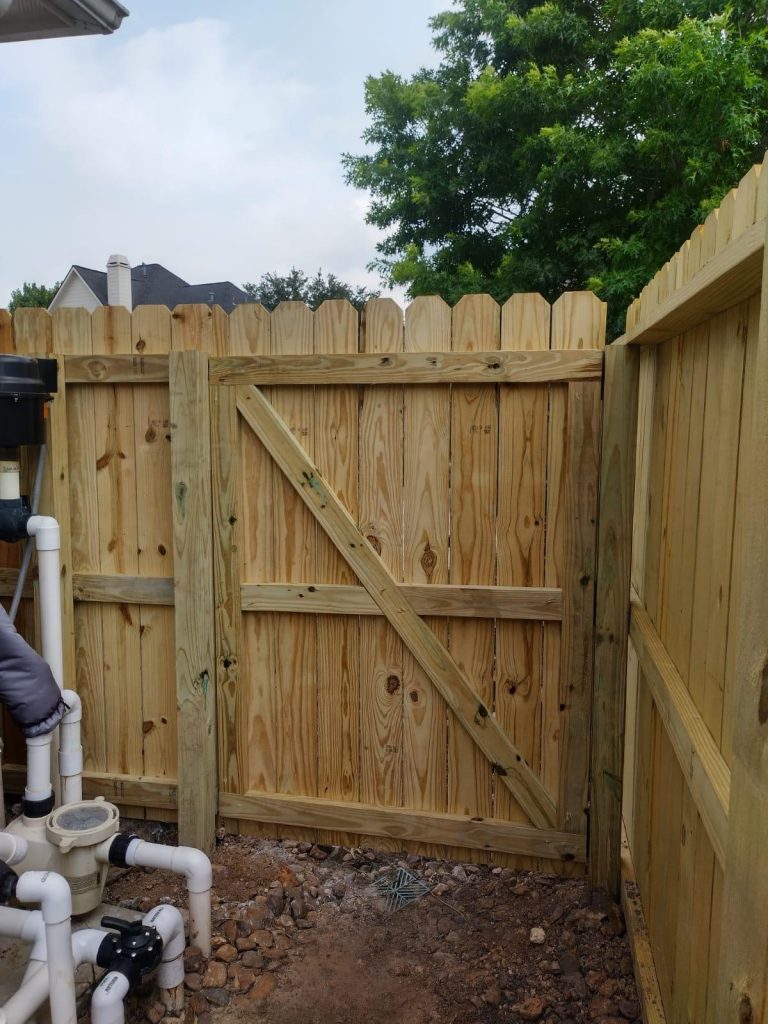
- Pine lacks those tannins, so a steel fastener only rusts and leaves a brown mark. But treated pine carries copper-based preservatives, which corrode ordinary steel in wet conditions. In the Handbook’s testing, 300-series stainless steel nails performed well in wood treated with copper azole and alkaline copper quaternary (ACQ).
- Mixed metals: the Handbook warns that a connector and its fastener should be the same metal. Otherwise galvanic corrosion can speed up on one of them. That applies to hinges, latches and post brackets as well.
So the fastener spec belongs in any cedar-vs-pine quote. Ask what the boards will be fastened with, and whether it is rated for treated lumber.
Which one fits your project?
- Budget first, or you plan to paint or stain: pressure-treated pine, with UC4A posts. The Handbook notes that waterborne preservatives are used where paintability is needed. New treated wood has to dry before it takes a finish. See when to stain a new pressure-treated fence and stain vs paint.
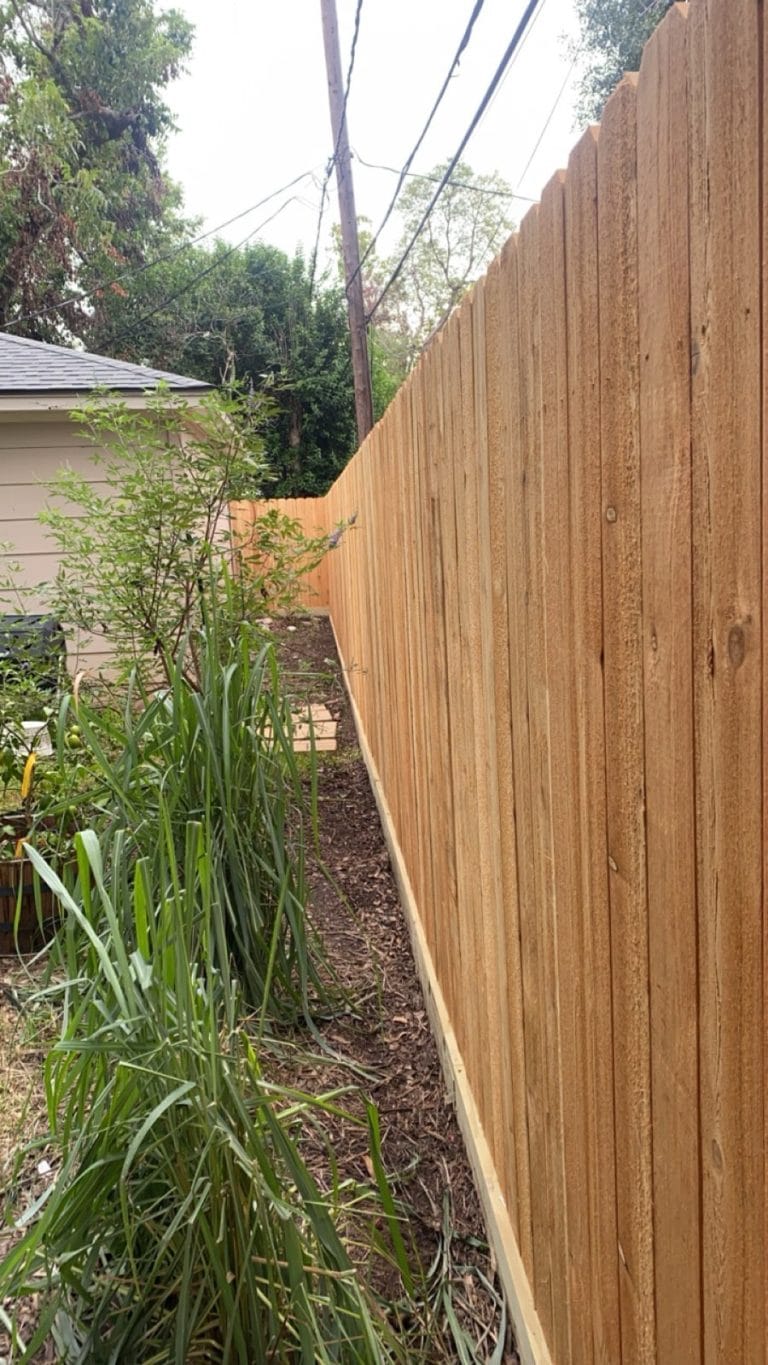
- A natural wood look, with less shrinking and fewer gaps: cedar boards and rails on treated or steel posts (build B above), with stainless or hot-dip galvanized fasteners. See cedar fences and whether cedar needs sealing here.
- No see-through gaps with pine: board-on-board, or ask whether the lumber is KDAT so most of the shrinking has happened before it goes up.
- Posts near salt or brackish water, such as bulkhead lines and canal lots on Tiki Island or in Bayou Vista: the AWPA table has a separate category, UC5C, for salt or brackish water and the adjacent mud zone on the Gulf Coast, used for marine piles and bulkheads. An ordinary UC4A fence post isn’t rated for that exposure. Ask how the posts will be treated, or consider non-wood posts.
Weighing redwood too? Read redwood vs cedar. For the full species overview, styles and a board-count planner, see wood fences and southern pine fences. If wood isn’t a must, compare wood or vinyl in salt air.
What changes the price
We give a written price after a free on-site visit. For the same fence, what moves it between cedar and pine:
- Species. Cedar boards cost more than pressure-treated pine.
- Style. Board-on-board uses more boards than a butted privacy fence: about 3 per foot vs 2.2 with 5½″ boards.
- Posts. Treated pine, or galvanized steel with wood panels.
- Fasteners and hardware. Stainless and hot-dip galvanized cost more than plain steel, and they are what keeps cedar from staining.
- Finish. Whether the fence will be stained or sealed, and when.
For typical numbers see wood fence cost per foot. For service life, see how long a wood fence lasts in Galveston. Financing is available through the providers on our financing page, subject to credit approval.
What Galveston customers say
5.091 Google reviews · read them all on Google
Great work. Fast service. Very friendly. I recommend using this company to replace your fence.
Installed Stained cedar wood fence yesterday by mustang fencing, thanks for the beautiful work.
I chose Mustang Fencing for my backyard due to their reputation for quality and security. Their wood fencing exceeded my expectations, durable and visually appealing. The customer service was top-notch, and the installation was quick and efficient.
Reviews shown word for word from the Mustang Fencing Services Google Business Profile (Galveston), captured 2026-09-27.
Questions we get about this
Is pressure-treated pine good for fences?
Is cedar or pressure-treated pine better for a fence in Galveston?
Will a pressure-treated pine fence shrink or warp after it’s built?
Can cedar posts go in the ground?
Can I mix cedar boards with pine posts?
Does cedar need to be sealed at all?
What should I check on the lumber tag?
Sources
Checked September 26, 2026. Rules change, so confirm with the City before you build.
- USDA Forest Products Laboratory, Wood Handbook: Wood as an Engineering Material, FPL-GTR-282 (2021) — Table 4-3 shrinkage values and Eq. 4-9; Table 13-1 outdoor equilibrium moisture content; Table 13-2 recommended moisture content; Table 13-5 dimensional change coefficients; Table 14-1 and p. 14-5 decay resistance; Chapter 15 waterborne preservatives, KDAT and end tags; Table 15-6 AWPA use categories; Chapter 8 fastener corrosion; Chapter 16 iron stain.
- City of Galveston Land Development Regulations, §2.501 — residential fence heights: 8 ft; front yard 4 ft solid or 5 ft if at least 60% transparent.
- City of Galveston Fence Permit Application (Rev. 03/2023) — the historic district, Cedar Lawn and 1,000 ft mean-high-tide questions.
Deciding between cedar and pine?
We’ll walk the line with you, talk through boards, posts and fasteners for your lot, and give you a written price. Free on-site estimates across Galveston County.