
Wood Ranch-Rail Fencing: What the Lumber Spec Actually Calls For
A ranch-rail fence looks simple -- posts and a few horizontal rails -- but there is a real construction spec behind it. The USDA’s own Texas fence standard sets a minimum rail size and post spacing for this exact fence type, and names which post species can skip pressure treatment altogether. Here is what that spec says, rail count by rail count, plus a planner for a specific property.
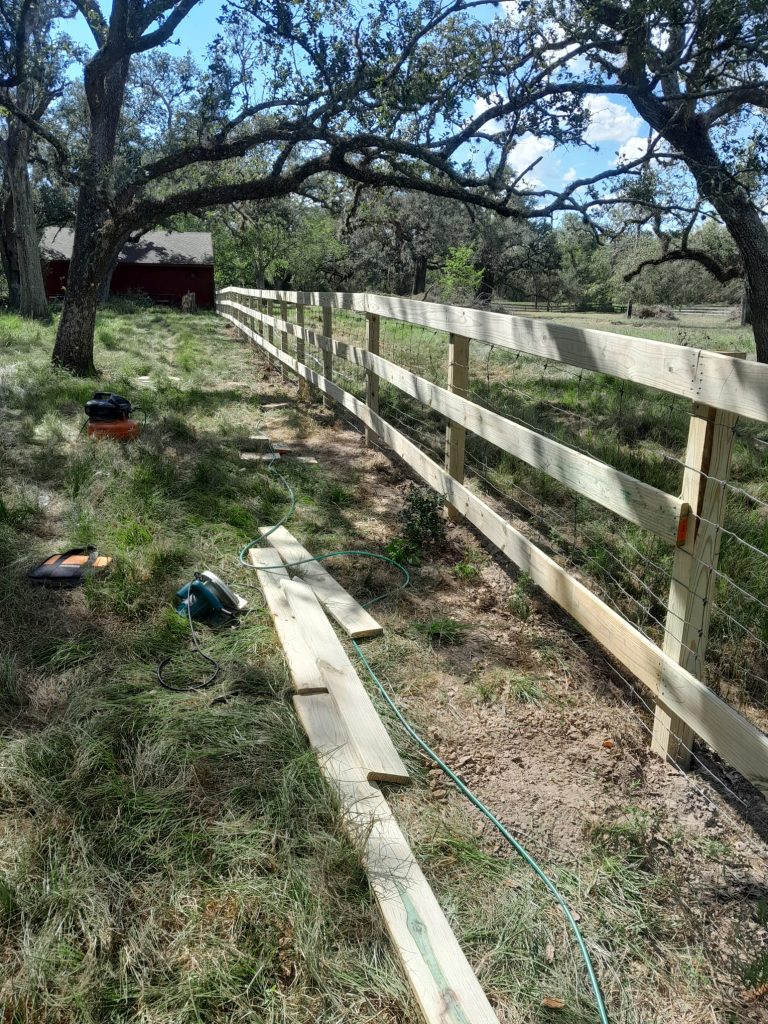
A wood ranch-rail fence is just posts and horizontal rails, but the USDA’s NRCS Texas fence spec still sets real minimums for it: rails at least 1×6 (nominal), well-seasoned or kiln-dried to resist warping, cut to an 8-foot span; posts at least 4 inches in diameter or 4 inches square, set no more than 8 feet on-center. Those numbers hold whether the fence has two rails, three or four -- more rails close the visual gaps, they don’t change the lumber size. The same spec treats posts and rails differently on pressure treatment: posts need it (Federal Spec. TT-W-571i, .4 lb/ft³ retention) unless the species is cedar, mesquite, Bois d’arc, catalpa or black locust, which the spec names as exceptions.
Source: USDA NRCS, Practice Specification Fence (Code 382), Texas, March 2021 -- "Other / Wooden Board" fence-type row and POSTS section.
What a wood ranch-rail fence actually is
Ranch rail is the open style: posts set in a line with two, three or four horizontal rails running between them and no boards filling the gaps. It is the style people picture on a horse or cattle property, but it is also used on larger residential lots to mark a boundary without blocking the view. Mustang builds it in treated pine most often, with cedar available where the look or the lower maintenance is worth the cost.
What makes it a "wood" ranch-rail fence rather than the vinyl version (see our post & rail vinyl fence page for that material) is exactly what you’d expect -- sawn lumber instead of extruded PVC rails, which changes the maintenance and the construction numbers but not the basic look. For how this style compares to other ranch and farm fencing choices, see our farm & ranch fencing hub and ranch fence vs. farm fence.
Which posts actually need pressure treatment
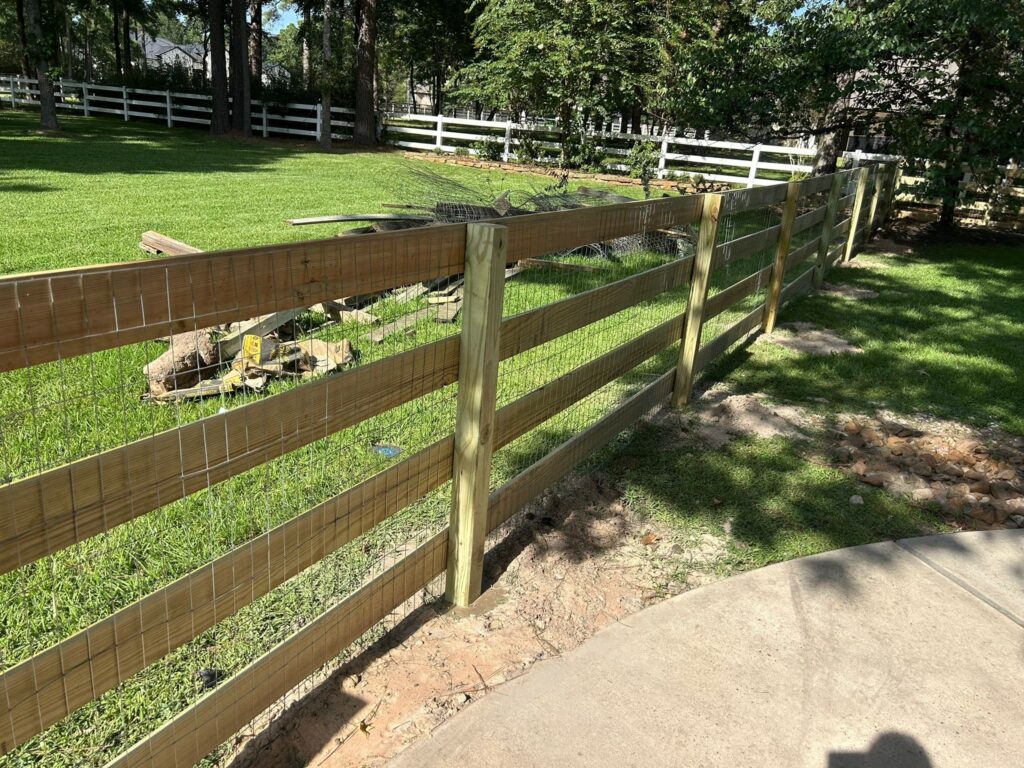
The same NRCS Texas spec treats posts differently by species. Its general POSTS section requires wood posts to be "new, sound, and treated by a method to ensure complete penetration of sapwood," specifically to Federal Specification No. TT-W-571i at a .4 retention -- except for cedar, mesquite, Bois d’arc, catalpa, and black locust, which the spec names outright as exceptions. Treated pine, the species Mustang sets most often, is not on that list, so pine posts get the treatment; a cedar post can skip it under this spec.
That exception is written for posts specifically. The rails get their own, separate line in the Wooden Board row: "non-durable wood must be preservative pressure treated for UC3B, Above Ground, Exposed Use" -- a lighter, above-ground category than the posts’ ground-contact treatment, and worded more loosely (by durability, not by naming species). The spec does not publish a burial depth for this particular fence type -- that number appears only under its barbed-wire and high-tensile wire rows, not the Wooden Board row, so none is stated here.

NRCS Texas "Wooden Board" fence spec, at a glance
| Component | Minimum | Notes |
|---|---|---|
| Rails | 1×6 nominal, 8 ft long | Well-seasoned or kiln-dried to resist warping; non-durable species need UC3B (above-ground) treatment |
| Posts | 4 in. diameter or 4 in. square | Species not named as an exception (e.g. pine) need Fed. Spec. TT-W-571i, .4 retention |
| Post spacing | Max. 8 ft on-center | No burial depth published for this fence type in the source |
| Post treatment exception | Cedar, mesquite, Bois d’arc, catalpa, black locust | Named for posts specifically, in the spec’s general POSTS section |
USDA NRCS, Practice Specification Fence (Code 382), Texas, March 2021, pp.10-11 and POSTS section.
Where Galveston’s own rules fit in
Inside Galveston city limits, any fence -- ranch rail included -- still has to fit the City’s own height ladder under LDR §2.501/§2.601. An open rail fence like this one clears the 60%-transparent test by a wide margin, which is covered in depth on our post & rail vinyl page rather than repeated here. Whether a given rail count or height also counts as a legally "sufficient fence" for keeping livestock in under Texas’s open-range stock law is a separate question with its own numbers -- see ranch fence vs. farm fence for that specific legal test.
Wood ranch-rail planner
Pick a rail count and a species. This checks it against the NRCS Texas fence spec's own minimum lumber numbers for this fence type -- a planning aid, not a design or a quote.
Lumber and spacing: USDA NRCS Practice Specification Fence (Code 382), Texas, March 2021, "Other / Wooden Board" row. Post treatment exception: same document, POSTS section. A planning aid, not a design -- an on-site visit confirms the actual rail count, species and spacing for a given property.
What Galveston customers say
5.091 Google reviews · read them all on Google
White PVC fence. Beautifully done! Thanks Mustang it's really looks perfect.
had an excellent experience with mustang fencing From the initial consultation to the final installation, the team was professional, punctual, and attentive to detail. They helped me choose the perfect fence style to match my property and ensured everything was installed with precision. The quality of materials is top-notch, and the fence has completely transformed the look and security of my home. I highly recommend mustang services to anyone looking for reliable and high-quality fencing services!
I am so pleased with the fence!! Your solution was exactly the right one and the team did a highly professional job. Frankly, I was amazed at how clean the job site was at the completion of the project. Feel free to list me as a reference and a very happy customer. Thanks again and please let the men know That I appreciate their hard work and quality craftsmanship.
Reviews shown word for word from the Mustang Fencing Services Google Business Profile (Galveston), captured 2026-10-19.
Questions we get about this
What size lumber does a wood ranch-rail fence use?
Does a wood ranch-rail fence need pressure-treated posts?
Do the rails need pressure treatment too?
2-rail, 3-rail or 4-rail: what’s the difference?
Can wire mesh be added to a wood ranch-rail fence?
Does Galveston’s fence-height rule apply to a ranch-rail fence?
Sources
Checked October 23, 2026. Rules change, so confirm with the City before you build.
- USDA NRCS, Practice Specification Fence (Code 382), Texas, March 2021 — "Other / Wooden Board" fence-type row (rail size, post size, spacing) and POSTS section (treatment requirement and species exceptions).
- City of Galveston Land Development Regulations, §2.501 and §2.601 — Residential and nonresidential fence heights and the 60% transparency test; §2.601.C.1.b wire-mesh restriction.
- Texas Agriculture Code, Chapter 143 (Texas Legislative Council, retrieved 2026-09-26) — Referenced by name only for the "sufficient fence" legal test; the figures themselves are covered on the linked ranch fence vs. farm fence page, not restated here.
Planning a wood ranch-rail fence?
We’ll check rail count, species and layout against the property, then build it to the spec above. Free on-site estimates across Galveston County.

