
Post & Rail Vinyl Fencing in Galveston: The Open-Rail Style, and What City Code Actually Says
Post & rail (also called ranch rail) uses two or three horizontal PVC rails between posts, with no boards or pickets filling the gaps. That openness is the whole point -- it defines a boundary without blocking the view, and it clears Galveston’s transparency test by a wide margin. Here is what the style actually is, the one place local code restricts it, why it still can’t serve as a pool barrier, and a checker for a specific property.
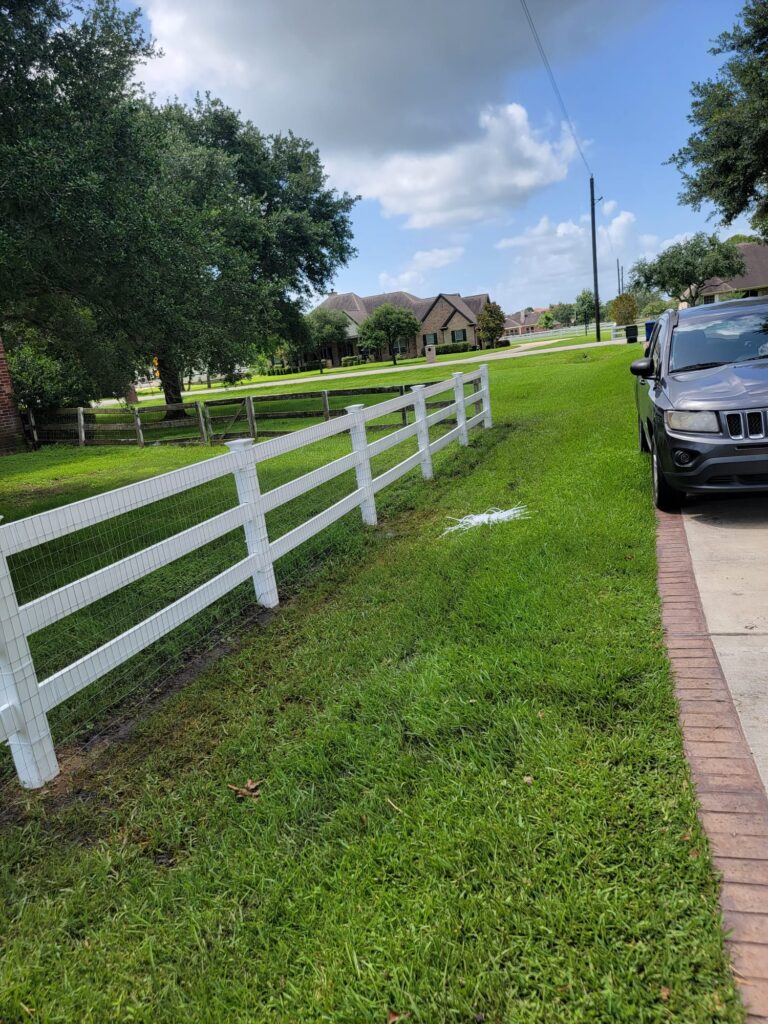
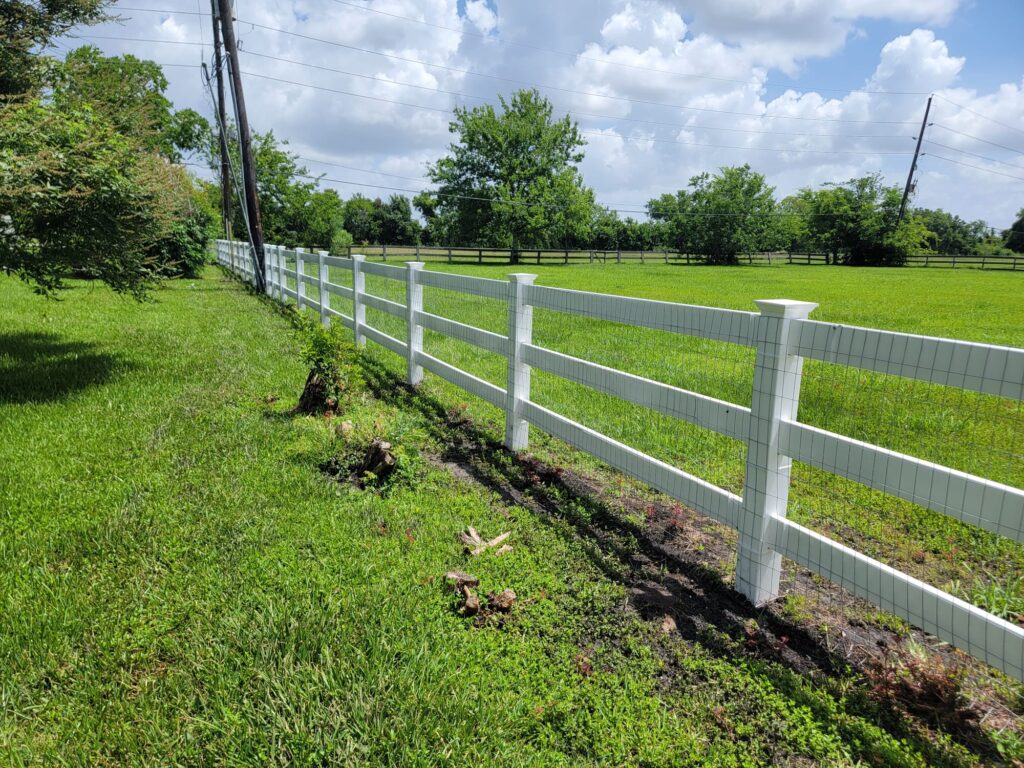
A post & rail vinyl fence uses two or three horizontal PVC rails running between posts, with no boards or pickets filling the gaps -- the same rigid-PVC material (ASTM F964, which names "fencing and railing" directly) as every other vinyl style, just without panel infill. Because it is almost entirely open, it comfortably clears Galveston’s 60% transparency test (LDR §2.501), which lets a single-family front yard reach 5 ft instead of the 4 ft cap that applies to a solid fence. It is a common pick for marking a large lot or pasture boundary without blocking the view, and is often paired with wire mesh behind the rails to help hold in pets -- though that combination still is not a pool barrier, and wire mesh backing is not allowed at all on a nonresidential or mixed-use fence visible from a public street.
Sources: ASTM F964 scope statement; City of Galveston LDR §2.501 and §2.601; 2021 ISPSC §305.2.2.
What post & rail vinyl fencing actually is
Post & rail -- also sold as ranch rail -- is built from the same rigid PVC covered by ASTM F964, the specification that governs "rigid poly (vinyl chloride) (PVC) exterior profiles for use in assembling agricultural, commercial, and residential fencing and railing." The difference from privacy, semi-privacy or picket vinyl is simply what fills the space between posts: nothing but two or three horizontal rails, with wide open gaps above, below and between them. There is no panel, no boards and no steel-reinforced infill to speak of -- the structural job is carried by the posts and rails alone.
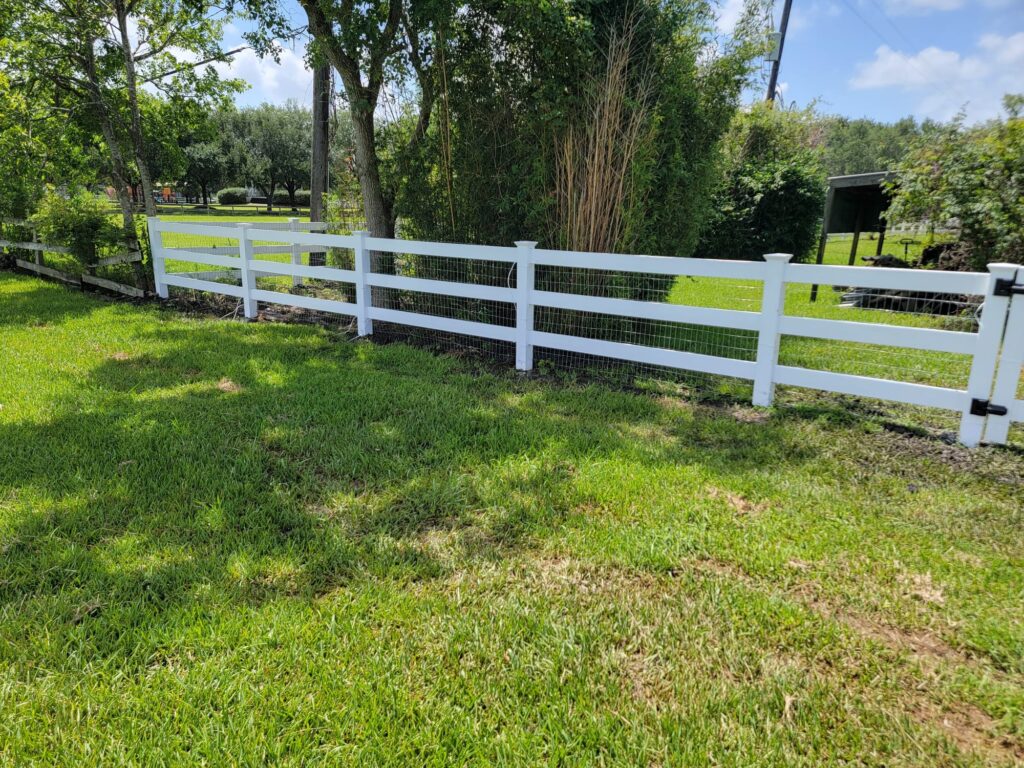
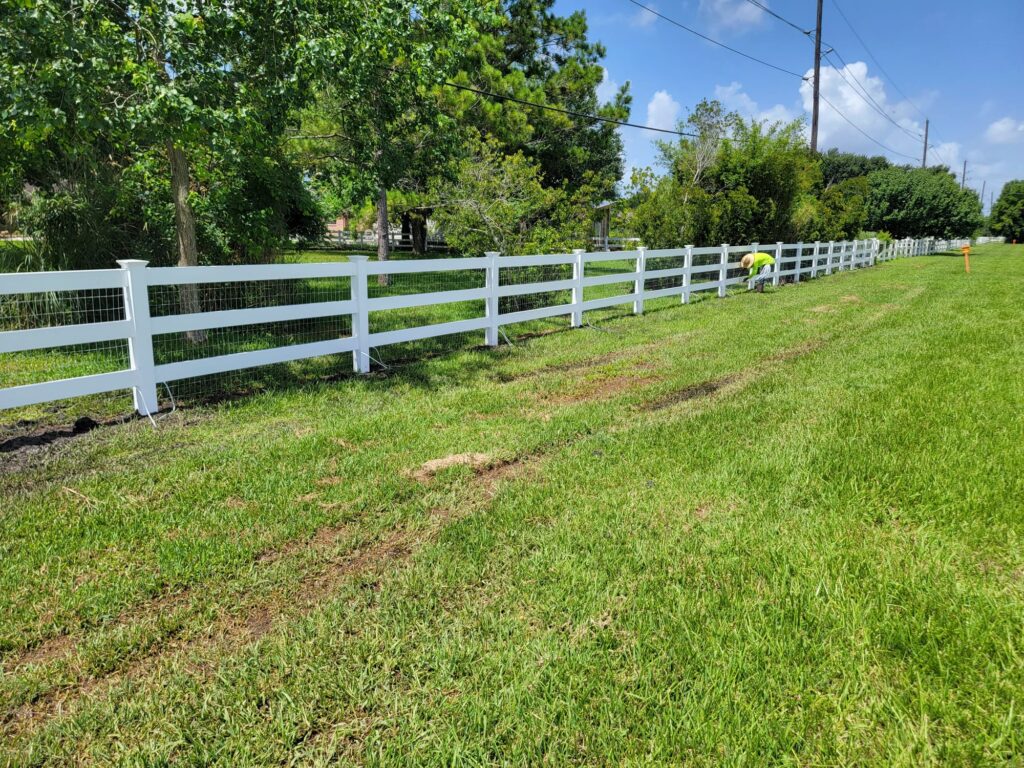
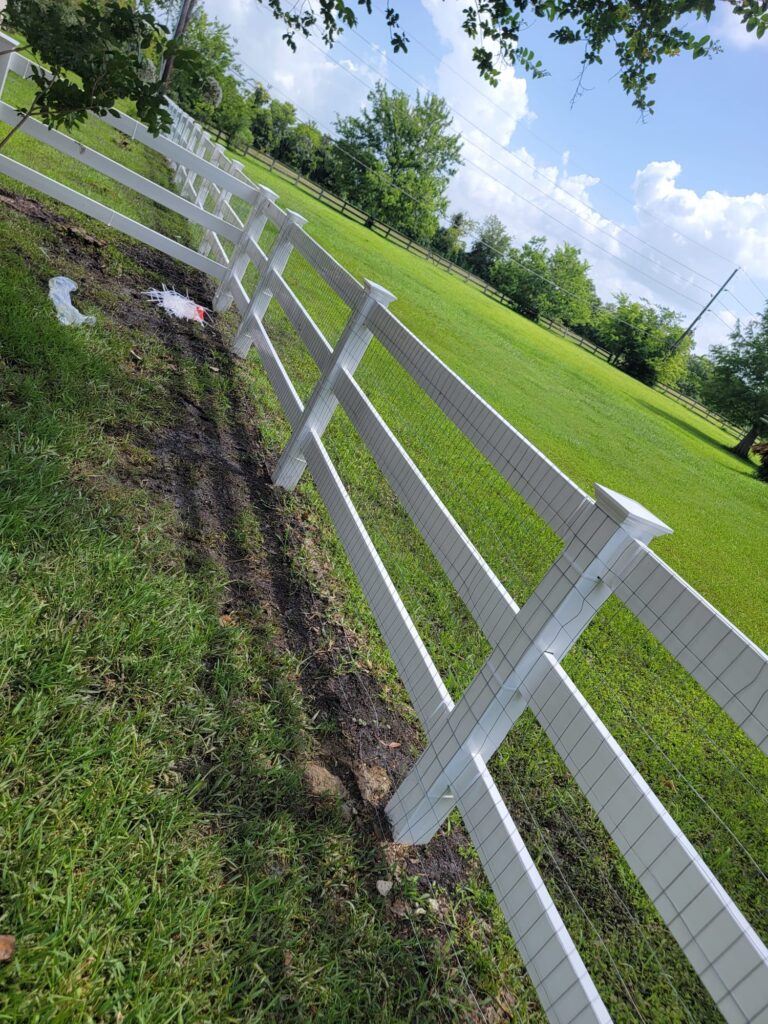
That makes it a practical choice for a large residential lot, a pasture edge or a long property-line run where the goal is to mark a boundary and keep livestock or pets roughly contained, not to block sightlines. Several of the photos on this page show a common field add-on: wire mesh fastened behind the rails to close the gaps for smaller animals. That mesh is a separate product from the vinyl rail system itself, and -- as covered below -- it is not allowed everywhere. For the full vinyl style lineup (privacy, semi-privacy, picket) and the shared slope-installation detail, see our vinyl fence guide; for livestock-specific fencing options, see farm & ranch fencing and ranch fence vs. farm fence.
Where Galveston code treats this style differently
Height in the City of Galveston turns on how transparent a fence is, and post & rail is about as transparent as a fence gets. LDR §2.501.B caps a solid front-yard fence at 4 ft, but allows 5 ft for a single-family property (6 ft for single-family-attached or multifamily) once the fence is at least 60% transparent. A rails-only layout, with nothing filling the space above, below or between the rails, reads well past that 60% mark -- so a front-yard post & rail fence can typically be built to the taller limit, not the solid-fence cap. Anywhere else on a residential lot the limit is 8 ft regardless of style (LDR §2.501.B.1).
For a nonresidential or mixed-use property, height is a flat 8 ft (12 ft for a tennis-court fence) under §2.601.B, with no transparency bonus to claim. There is one material rule worth knowing if the fence is visible from a public street: §2.601.C.1.b bans "barbed or razor wire ... or welded wire or chicken wire" on that kind of fence. The wire mesh some homeowners add behind post & rail for pet containment falls squarely in that category -- fine on a residential fence, where this subsection does not apply, but not allowed on a street-facing nonresidential or mixed-use one.
Where post & rail fits, at a glance
| Where the fence is | Height limit | Wire-mesh backing |
|---|---|---|
| Residential front yard (single-family) | 5 ft once the fence clears 60% transparent (LDR §2.501.B.2) -- post & rail typically does | Allowed; no restriction in §2.501 |
| Residential front yard (attached / multifamily) | 6 ft under the same transparency rule (§2.501.B.3) | Allowed |
| Residential, elsewhere on the lot | 8 ft (§2.501.B.1) | Allowed |
| Nonresidential/mixed-use, visible from a public street | 8 ft (12 ft tennis-court fence) -- §2.601.B | Prohibited -- §2.601.C.1.b bans welded wire or chicken wire |
| Pool barrier (any of the above) | Not applicable as the barrier itself | Does not change the result -- rail gaps still fail the 4 in. sphere test |
City of Galveston Land Development Regulations §2.501, §2.601; 2021 ISPSC §305.2.2 (required by the City’s pool permit).
Why post & rail can’t be the pool barrier
The 2021 International Swimming Pool and Spa Code, which the City’s pool permit requires, sets a simple opening test: no gap in the barrier may allow a 4-inch sphere to pass through (§305.2.2), on top of a 48-inch minimum height. A 2- or 3-rail post & rail fence is built around open gaps many times larger than that, by design -- adding a third rail narrows the gaps but does not come close to closing them to 4 inches. Wire mesh tacked on behind the rails is aimed at keeping out pets, not at meeting a certified pool-barrier spec, and this page does not treat it as one. If the property needs a pool enclosure, that fence has to be a different style built and spaced to the ISPSC spacing rules -- see our pool fence code guide and pool fence installation. Post & rail can still do the rest of the job: marking the property line and the non-pool portions of the yard.
Post & rail planning checker
Answer three questions about the property. This checks the result against Galveston’s own transparency, material and pool-barrier rules -- it’s a planning aid, not a permit review.
Height and transparency basis: City of Galveston LDR §2.501 (residential) and §2.601 (nonresidential/mixed-use). Wire-mesh basis: LDR §2.601.C.1.b. Pool basis: 2021 ISPSC §305.2.2 (required by the City’s pool permit). A planning aid, not a permit review or a quote.
What Galveston customers say
5.091 Google reviews · read them all on Google
White PVC fence. Beautifully done! Thanks Mustang it's really looks perfect.
had an excellent experience with mustang fencing From the initial consultation to the final installation, the team was professional, punctual, and attentive to detail. They helped me choose the perfect fence style to match my property and ensured everything was installed with precision. The quality of materials is top-notch, and the fence has completely transformed the look and security of my home. I highly recommend mustang services to anyone looking for reliable and high-quality fencing services!
I am so pleased with the fence!! Your solution was exactly the right one and the team did a highly professional job. Frankly, I was amazed at how clean the job site was at the completion of the project. Feel free to list me as a reference and a very happy customer. Thanks again and please let the men know That I appreciate their hard work and quality craftsmanship.
Reviews shown word for word from the Mustang Fencing Services Google Business Profile (Galveston), captured 2026-10-19.
Questions we get about this
What is a post & rail vinyl fence?
How tall can a post & rail vinyl fence be in a Galveston front yard?
Can wire mesh be added behind a post & rail vinyl fence?
Can post & rail vinyl fencing be used as a pool barrier?
Does post & rail need less wind-rated post spacing than a privacy fence?
Is post & rail vinyl fencing a good choice for a horse or livestock boundary?
Sources
Checked October 23, 2026. Rules change, so confirm with the City before you build.
- City of Galveston Land Development Regulations, §2.501 and §2.601 — Residential and nonresidential fence heights and transparency; §2.601.C.1.b bans welded wire or chicken wire on a street-facing nonresidential/mixed-use fence.
- ASTM F964-13 (scope) — Rigid PVC exterior profiles for agricultural, commercial and residential fencing and railing; wind load/loadbearing not addressed.
- CertainTeed Bufftech vinyl fence installation guide — Post hole size and depth, concrete-fill requirement (stated as repeated across panel styles); no post-centers table published for post & rail.
- 2021 International Swimming Pool and Spa Code, Section 305 — 48 in. minimum height; §305.2.2 bans any opening that passes a 4 in. sphere.
- City of Galveston Swimming Pool Permit Application — New pools must comply with the 2021 ISPSC.
Planning a post & rail vinyl fence?
We’ll check the lot type, street visibility and any pool-barrier need, then spec the fence to fit. Free on-site estimates across Galveston County.

