
What Are Texas’s Pool Fence and Pool Barrier Code Requirements?
It depends on whose pool it is. Texas’s pool statute covers apartment, condo and HOA pools. A private backyard pool in Galveston follows the pool code the City requires, the 2021 ISPSC. Here are both, side by side, with a checker for your fence.
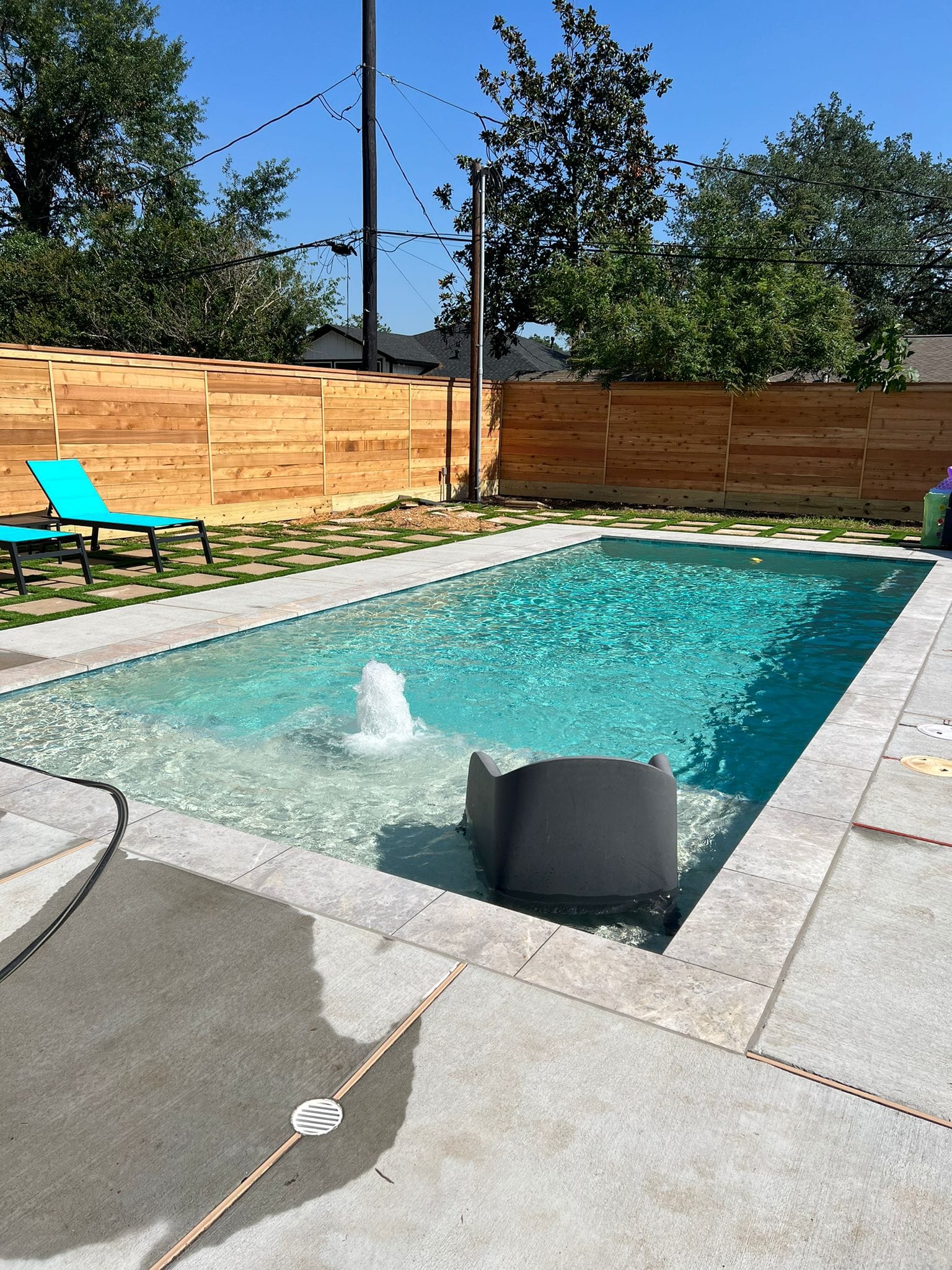
Two different rules apply in Texas. Health and Safety Code Chapter 757 covers pools owned or maintained by a multiunit rental complex (apartments, condominium projects) or a property owners’ association. It does not cover a single-family home. A private pool at a Galveston home follows the City’s pool permit, which requires the 2021 International Swimming Pool and Spa Code (ISPSC). Both want a barrier at least 48 in high with self-closing, self-latching gates that open away from the pool. They differ on latch height and chain link.
Sources: Texas Health and Safety Code 757.002–757.004; 2021 ISPSC sections 305.2 and 305.3 (ICC model text); City of Galveston swimming pool permit application.
Which pool barrier rule applies to your pool?
Start with who owns the pool, because Texas has no single statewide barrier rule for every pool.
- Apartment, condo and HOA pools: Health and Safety Code Chapter 757. Section 757.002 says the chapter “applies only to” a pool owned, controlled or maintained by the owner of a multiunit rental complex or by a property owners association, plus the doors and windows of rental dwellings that open into that pool yard. A multiunit rental complex means two or more dwelling units under common ownership or management on the same or adjacent lots, and it includes a condominium project. It does not include a facility renting rooms to overnight guests, or “a single-family home or adjacent single-family homes that are not part of a condominium project” (757.001).
- A private pool at a house in Galveston: the 2021 ISPSC. The City of Galveston’s swimming pool permit application says new pools “must comply with the 2021 International Swimming Pool and Spa Code (ISPSC)” and asks for a site plan, survey, fence location and height, self-closing gates, UL 2017 alarms on doors and windows under 48 in, and a construction fence. It also notes that “a separate fence permit is required for new fencing.”
- Other cities in Galveston County adopt their own codes. Check with the city where the pool is.
That distinction matters most for chain link, and for how high the gate latch goes. For commercial and community pools, see commercial pool fencing and apartment and multifamily fencing. For a home, see pool fence installation in Galveston.
The two rules side by side
| Requirement | 2021 ISPSC (private home, Galveston permit) | HSC Chapter 757 (apartment, condo, HOA pool) |
|---|---|---|
| Height | At least 48 in, measured on the side away from the pool, and for 3 ft out (305.2.1) | At least 48 in, measured from the ground on the side away from the pool (757.003(b)) |
| Openings | No 4 in sphere through (305.2.2) | No 4 in sphere under; through, 4 in or 1¾ in depending on rail spacing (757.003(c)–(e)) |
| Gap at the bottom | Up to 2 in over grass or gravel; 4 in over a solid surface (305.2.1) | No 4 in sphere under the enclosure (757.003(c)) |
| Rails less than 45 in apart | Rails on the pool side; gaps up to 1¾ in (305.2.5) | Openings may not pass a 1¾ in sphere (757.003(e)) |
| Chain link | Allowed if openings are 1¾ in or less, or slats bring them to that (305.2.7) | Prohibited for a new enclosure built after January 1, 1994 (757.003(f)) |
| Diagonal members | Openings up to 1¾ in, no more than 45° from vertical (305.2.8) | Prohibited below 49 in on a new enclosure built after January 1, 1994 (757.003(f)) |
| Gates | Open outward, self-closing, self-latching, able to take a lock (305.3) | Self-closing, self-latching, lockable, open outward (757.004(a)) |
| Outside latch release | Residential: at least 54 in (305.3.3) | At least 60 in, with two lower options (757.004(b), (c)) |
| Things to climb | Equipment outside the barrier at least 36 in away (305.2.9) | Permanent equipment may not be readily available for climbing over (757.003(i)) |
| House wall as barrier | Alarms on doors and low windows, or another 305.4 option | Only if its doors and windows meet 757.006 and 757.007 (757.003(j)) |
ISPSC 2021 section 305 (ICC model text; Galveston may amend it). Texas Health and Safety Code 757.003–757.004, quoted from the official text.
Is chain link legal around a pool in Texas?
For an apartment, condo or HOA pool, no, not for a new enclosure. Section 757.003(f) says “the use of chain link fencing materials is prohibited entirely for a new pool yard enclosure that is constructed after January 1, 1994.” The same subsection bars diagonal members lower than 49 in on new enclosures.
For a private home under the model 2021 ISPSC, chain link is allowed if its openings are not more than 1¾ in, or if slats fastened at the top and bottom reduce them to that (305.2.7). Check the mesh opening on the product sheet before you count on it. Some Texas cities amend the ISPSC, so ask the City before you rely on chain link. More on this in can I use chain link around my pool?
Rails, pickets and the 45-inch rule
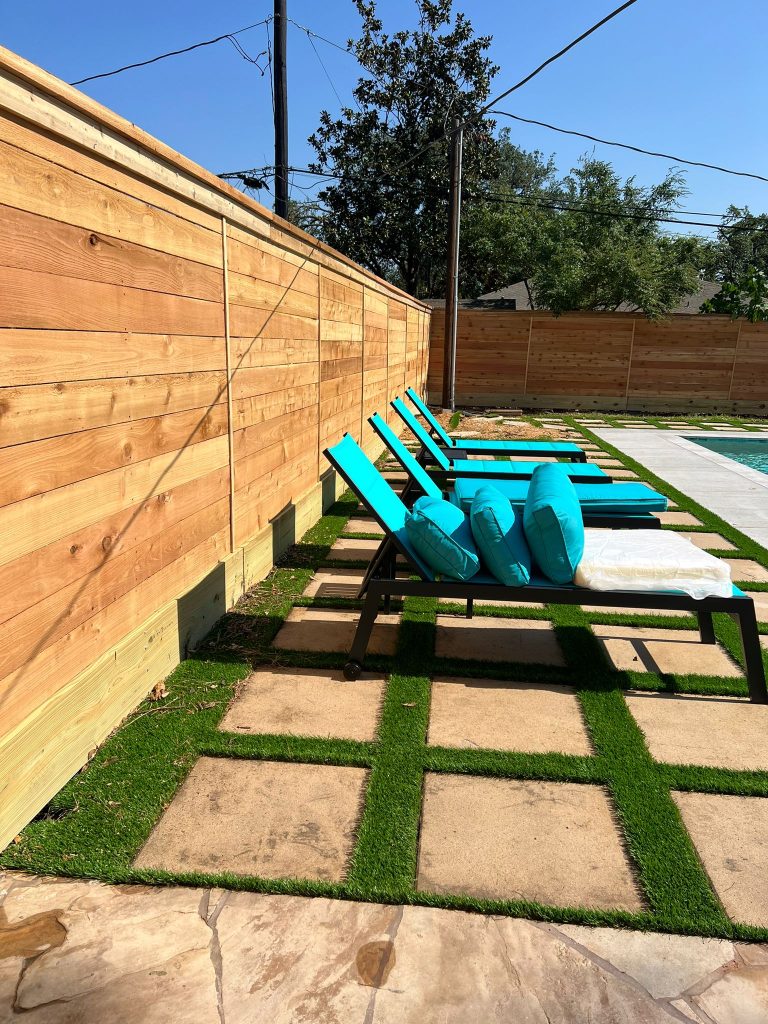
Most pool fences are pickets on horizontal rails: aluminum, steel, iron or wood. Both rules treat close rails as a ladder. Measure from the top of one rail to the top of the next:
- 45 in or more apart: gaps between pickets can be up to 4 in (ISPSC 305.2.6; HSC 757.003(d)).
- Less than 45 in apart: gaps must shrink to 1¾ in (ISPSC 305.2.5; HSC 757.003(e)). The ISPSC also wants those rails on the pool side of the fence.
Decorative cutouts are capped at 1¾ in under both rules. A solid fence, such as a board fence or a wall, may not have indentations or protrusions that form handholds or footholds beyond normal construction tolerances. For metal options, see pool-code aluminum fence and is aluminum fencing code-compliant for a pool?
Pool barrier checker
Enter the numbers for your fence and gate. The checker compares them with the rule that applies to your pool: the 2021 ISPSC for a private home in Galveston, or Texas Health and Safety Code Chapter 757 for an apartment, condo or HOA pool. It does not replace a permit review.
ISPSC 2021 sections 305.2.1, 305.2.2, 305.2.5–305.2.7 and 305.3–305.3.3 (model code); Texas Health and Safety Code 757.003 and 757.004. Chapter 757’s lower-latch options (on the pool side at least 3 in below the top with no opening over ½ in within 18 in, or 42 in when the gate needs a key, card or combination on both sides) and the pre-1994 rules in 757.005 are not modeled. Galveston may amend the ISPSC; the City’s building division has the final word.
Gates, latches and the house wall
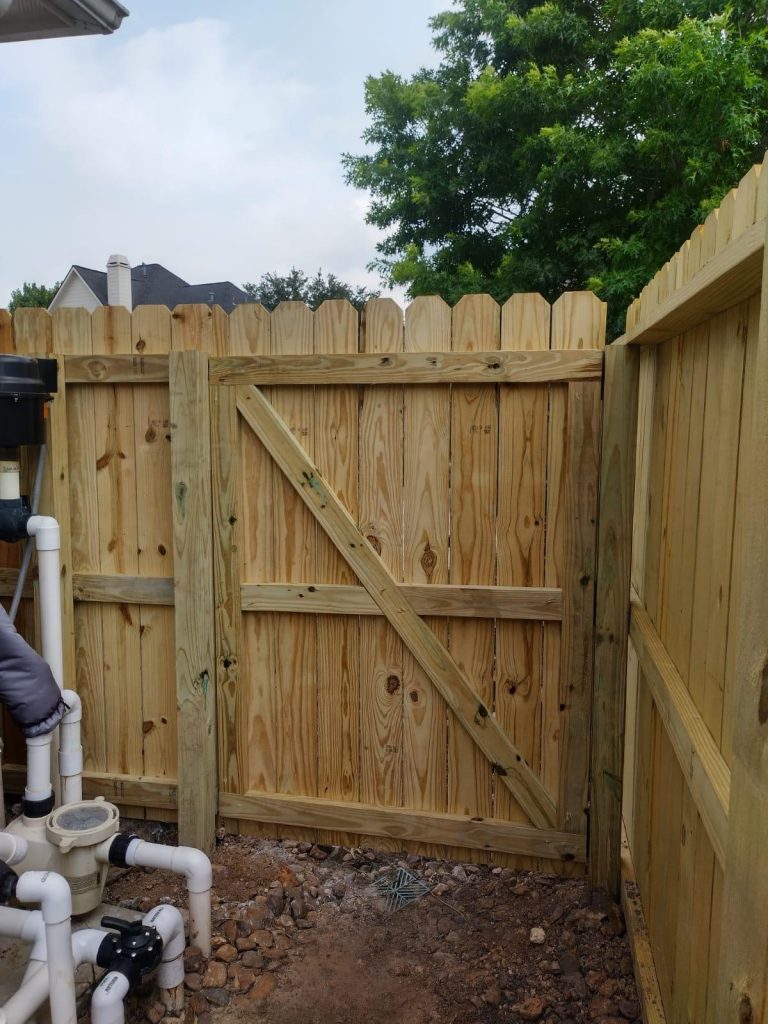
Under both rules, pedestrian gates in a pool barrier open outward, away from the pool, and are self-closing and self-latching. Both want the gate able to take a lock. The gap under the gate is part of the barrier too. Under the ISPSC it’s no more than 2 in over grass or gravel and 4 in over a solid surface, measured on the side away from the pool. See how much gap to leave under a gate for where to measure it.
Where they differ is the latch. The ISPSC puts an outside latch release at a residential pool at least 54 in above the ground (52 to 54 in at public pools). A release that is only on the pool side must sit at least 3 in below the top of the gate. Chapter 757 puts the latch at least 60 in high, unless it is on the pool side only, 3 in below the top, with no opening over ½ in within 18 in of the latch; or at 42 in or higher if the gate opens only by key, card or combination on both sides.
A house wall can be part of the barrier, but then its doors and low windows need protection. The ISPSC lists options starting with UL 2017 water hazard entrance alarms, and Galveston’s permit form asks for alarms on doors and windows under 48 in. More in does my pool gate need to be self-closing and self-latching? and do I need a pool fence if my backyard is already fenced?
Minimum latch release heights, in inches
Measured from the ground. Barrier height is 48 in under both rules (dashed line).
Planning a pool fence in Galveston
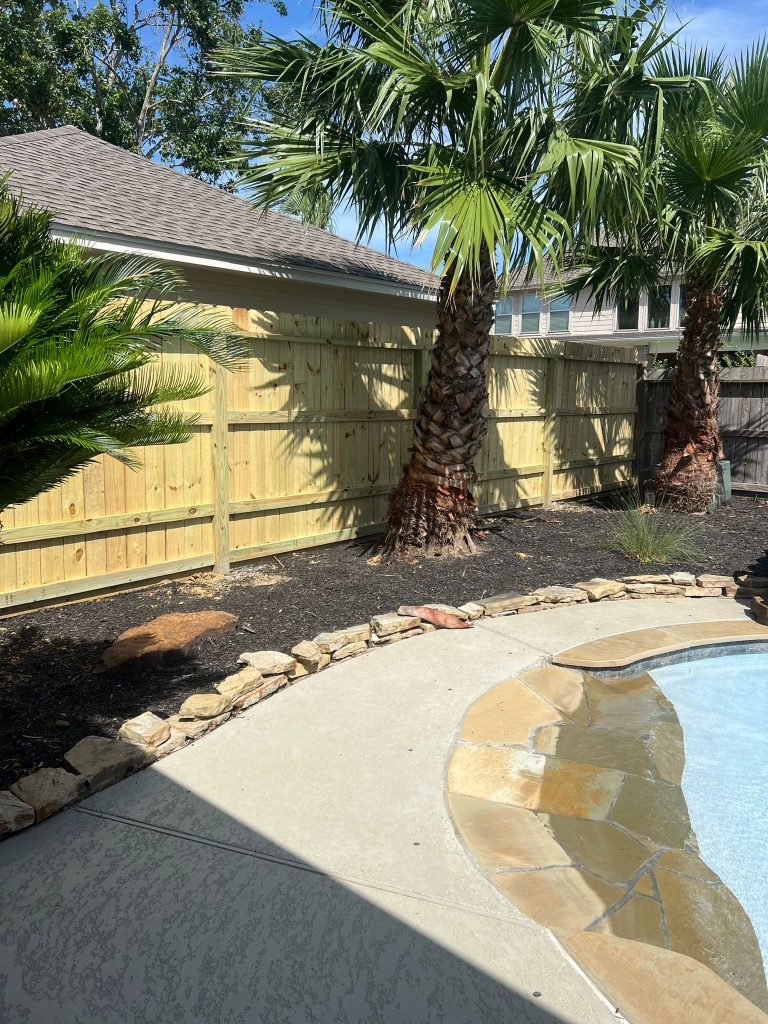
- Confirm which rule applies. A house: the City pool permit and the 2021 ISPSC. An apartment, condo or HOA pool: Chapter 757, and the City’s commercial pool requirements.
- Draw the barrier on the site plan, including where the house wall forms part of it, every gate and which way it swings, and where the pump and heater sit.
- Pick the barrier type with the gap rules in mind: rail spacing for pickets, mesh size for chain link, no footholds on a solid fence.
- Specify the gate hardware: self-closing hinges, a self-latching latch at the right height, and room for a lock.
- Apply for the fence permit as well: the pool permit form says new fencing needs a separate one. See fence and gate permits on Galveston Island.
What Galveston customers say
5.091 Google reviews · read them all on Google
"Mustang Fencing Service did an amazing job on my new fence! The team was professional, efficient, and communicative. The quality of the materials is outstanding, and they finished on time and within budget. Highly recommend them for any fencing needs!"
“I had a fantastic experience with Mustang Fencing Services. Their professionalism and commitment to delivering high-quality work were impressive. The team demonstrated excellent time management, completing the project on schedule without compromising on the quality of the materials or craftsmanship. I highly recommend them for anyone looking for reliable and efficient fencing services!”
Excellent service and quality! Professional, on time, and great craftsmanship. Highly recommend!
Reviews shown word for word from the Mustang Fencing Services Google Business Profile (Galveston), captured 2026-09-27.
Questions we get about this
What is the Texas law for pool fences?
How tall does a pool fence have to be in Texas?
Is chain link allowed around a pool in Texas?
How high does a pool gate latch have to be?
Which way should a pool gate swing?
Do I need a permit for a pool fence in Galveston?
Sources
Checked September 27, 2026. Rules change, so confirm with the City before you build.
- Texas Health and Safety Code, Chapter 757: Pool Yard Enclosures — 757.001 (definitions), 757.002 (applies only to multiunit rental complex and property owners association pools), 757.003 (enclosure: 48 in, openings, chain link and diagonals on new enclosures after 1994), 757.004 (gates and latch heights), 757.005 (pre-1994 enclosures).
- International Swimming Pool and Spa Code 2021, Section 305 Barrier Requirements — 305.2.1 (48 in; bottom clearance 2 in / 4 in), 305.2.2 (4 in sphere), 305.2.5–305.2.8 (rails, chain link 1¾ in, diagonals), 305.2.9 (36 in equipment clear zone), 305.3 and 305.3.3 (gates and latch release), 305.4 (house wall).
- City of Galveston, Swimming Pool Permit Application — Must comply with the 2021 ISPSC; site plan, survey, fence location and height, self-closing gates, UL 2017 alarms, construction fence; separate fence permit for new fencing.
- Texas Property Code, Section 202.022 — An HOA may not prohibit a compliant pool enclosure of mesh or clear panels in metal frames up to 6 ft; may not ban black mesh in metal frames.
Fencing a pool?
We’ll measure the pool yard, mark the barrier, gates and equipment on a plan, and put the height, gap sizes and gate hardware on a written quote you can take to the City. Free on-site estimates across Galveston County.