
Straight answers from a local fence and gate contractor serving Galveston and Brazoria Counties.
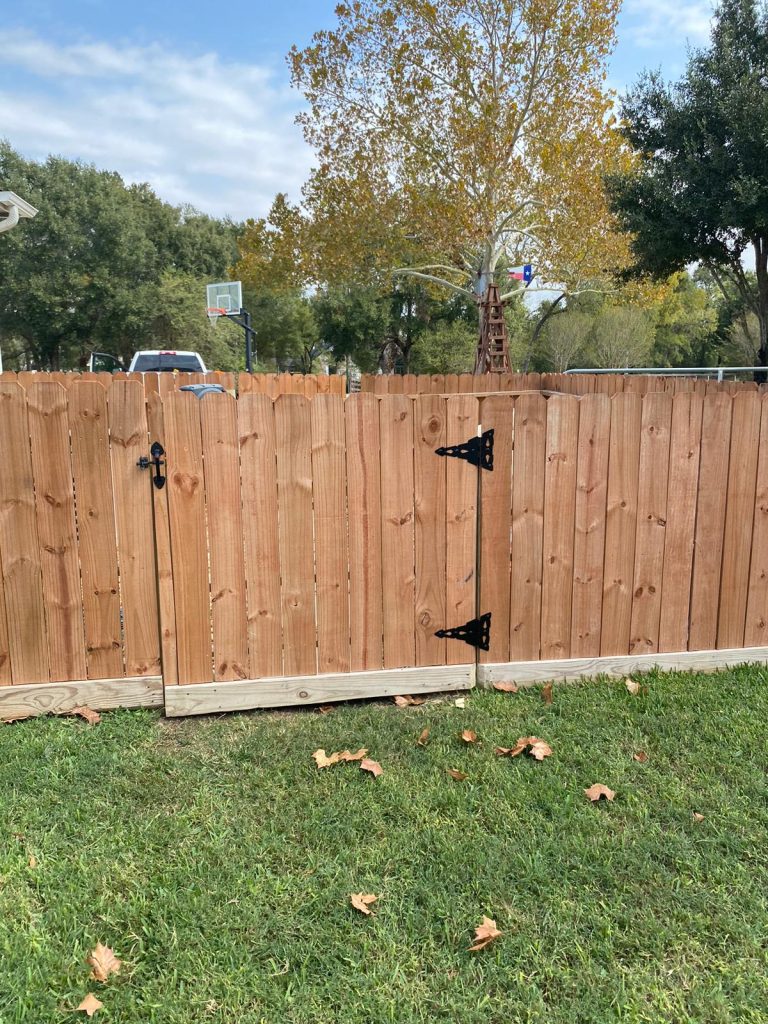
Choosing between a wood and a metal gate often comes down to matching the existing fence, but on the Gulf Coast, it’s also a genuine longevity question — the two materials fail for very different reasons in this climate, and knowing which failure mode a property is more exposed to helps make the call.
How Wood Fails Here
Wood’s vulnerability on the coast is moisture, in two forms: direct rain and constant ambient humidity. A wood gate absorbs moisture from the air even between rain events, which drives the swelling-and-shrinking cycle that eventually causes cupping, splitting, and popped fasteners. The base of the gate and the exposed end grain at any cuts are especially vulnerable, since that’s where moisture collects and takes longest to dry. With consistent sealing on a tighter-than-inland schedule (roughly every 1-2 years rather than 2-3), a wood gate can hold up well for a genuinely long time — but that maintenance isn’t optional the way it might be inland.
How Metal Fails Here
Metal’s vulnerability is corrosion, driven by salt air rather than humidity alone. Airborne salt dissolves into the moisture film on a metal surface and accelerates rust dramatically compared to an identical gate inland. The deciding factor for metal isn’t really “wood vs. metal” as much as it is finish quality: a galvanized-and-powder-coated steel or iron gate holds up very differently than an unfinished or poorly painted one in the same location. Aluminum sidesteps most of this corrosion risk entirely, at some cost to raw strength.
The Honest Trade-Off
Neither material is maintenance-free on the Gulf Coast — the real choice is which maintenance routine a homeowner would rather commit to. Wood asks for a sealing schedule; metal (other than aluminum) asks for a rinse-and-inspect routine focused on rust prevention. Both, done consistently, result in a gate that lasts. Both, neglected, fail faster here than they would somewhere drier and further from salt air.
Matching, Not Just Choosing
For many homeowners, this decision is already made by the existing fence — a wood privacy fence generally calls for a matching wood gate, and an iron or aluminum fence calls for a matching metal gate. Where there’s flexibility (a stand-alone gate, a fence being fully replaced), the maintenance-commitment question above is usually the more honest way to decide than material cost alone.
Ready for a real number for your property? Request a free on-site estimate from Mustang Fencing Services.