
How does aluminum fencing hold up to Gulf Coast salt air and hurricane-force wind?
Two separate questions, two separate answers. Salt air: aluminum has no iron content, so it doesn’t rust the way steel or wrought iron does — a manufacturer’s published finish is tested to thousands of hours of salt-spray exposure. Wind: Galveston Island sits in the Gulf Coast’s higher-wind zone on the state’s own map, and a fence’s real capacity comes down to the specific product’s rated loads and post spacing, not the material alone.
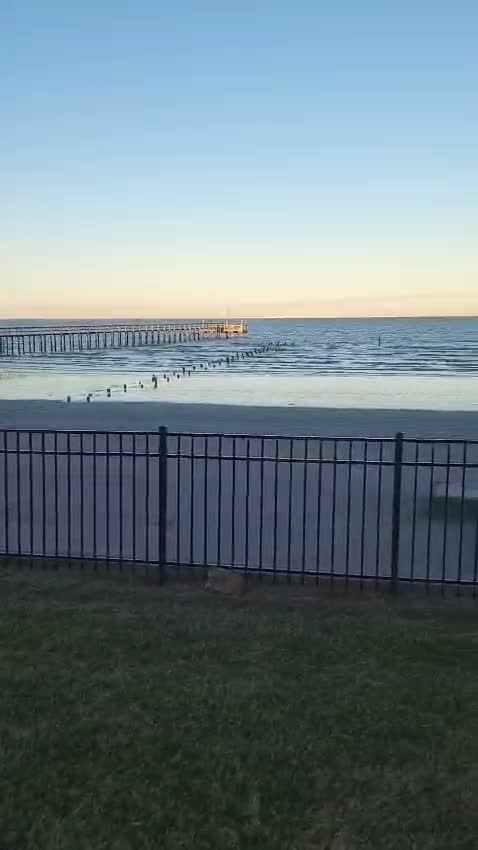
Aluminum doesn’t rust in salt air because it has no iron content to corrode — that’s the real structural advantage over steel or wrought iron near the Gulf. Wind performance is a separate question: Galveston Island itself sits in the Texas Department of Insurance’s higher-wind “seaward” zone (130 mph design wind speed), and a fence’s actual wind capacity comes down to the specific product’s rated loads, post spacing and embedment — not the material alone. One manufacturer’s published spec shows what a correctly built system is designed to hold.
Sources: Texas Department of Insurance, Galveston County wind zone map; Ultra Aluminum Fence, Rail and Gate Specifications §1.05, §2.03, §1.03; Ultra Aluminum written guarantee and cleaning guidelines.
Why salt air is a real corrosion test — and where aluminum stands
Coastal salt air is a genuine corrosion test for metal fencing — airborne salt accelerates rust on any iron-based metal, which is why steel and wrought iron near the water typically need closer inspection and more frequent touch-up than the same fence inland. Aluminum has no iron content, so there’s nothing in the metal itself for that process to attack. One manufacturer’s published spec puts real numbers on how its finish holds up under accelerated testing: the cured powder-coat finish (AAMA 2604) is tested to 3,000 hours of salt-spray exposure (ASTM B117) and 3,000 hours of 100% humidity (ASTM D2247), plus five years of outdoor exposure in south Florida facing south at a 45-degree angle, with only slight fade and chalk allowed — no adhesion loss, cracking or crazing.
That’s one manufacturer’s tested finish level, not a property of “aluminum fencing” in general — AAMA publishes lower finish tiers too (2603), so it’s worth asking which level a specific product actually meets before assuming they’re all the same.
Wind performance is about the product, not just the metal
A fence’s actual capacity against wind comes down to the specific product’s engineering, not just “aluminum” as a material. One manufacturer’s published structural spec requires its top and hand rails to withstand 100 pounds per linear foot applied horizontally together with 100 pounds per linear foot applied vertically, or a 200-pound concentrated load at any point — and requires an assembled fence section to carry 1,000 pounds of vertical load at the midpoint of any horizontal rail. Posts are spaced no more than 71½ inches on-center, set in concrete footers. Those numbers are one manufacturer’s minimum, not a universal standard every aluminum fence meets automatically — ask for the specific product’s spec sheet, especially on an exposed waterfront lot.
Aluminum fence coastal & wind-exposure checker
Answer for your property. This checks one manufacturer’s published numbers against your setup — pair it with that product’s actual spec sheet and your installer’s wind-load confirmation for an exposed lot.
Texas Department of Insurance Galveston County wind zone map (legacy 2006 IBC/IRC speeds); Ultra Aluminum Fence, Rail & Gate Specifications §1.03, §2.02, §2.04, §3.02; manufacturer cleaning guidance. One product’s numbers, not a universal code — confirm with your installer and the City.
What customers say
5.091 Google reviews · read them all on Google
Seems to have helped out a after hurricane beryl we all appreciate it thank you!
We just installed iron gate and it looks amazing thank you very much mustang fencing .
Mustang’s team installed iron fence for me and did an absolutely incredible job! I would recommend this company to anyone I know!
Reviews shown word for word from the Mustang Fencing Services Google Business Profile (Galveston), captured 2026-10-19.
Questions we get about this
What wind speed does Galveston design against?
Does salt air make aluminum fencing rust?
Is aluminum fencing hurricane-proof?
Does the finish need extra care near the water?
What hardware should I ask for on a coastal aluminum fence?
Sources
Checked October 19, 2026. Rules change, so confirm with the City before you build.
- Texas Department of Insurance, Galveston County Wind Zone Map — Seaward zone (incl. City of Galveston): 130 mph 3-second gust; Inland II zone (League City, Texas City, Dickinson, Santa Fe, Kemah, etc.): 110 mph. Legacy 2006 IBC/IRC speeds; current codes use a site-specific ASCE 7 number.
- Ultra Aluminum Manufacturing, Fence, Rail and Gate Specifications (Section 32 31 19) — Top/hand rail load ratings; 1,000 lb assembled-section load at rail midpoint; 71.5 in max post spacing; stainless steel fasteners; AAMA 2604 finish tested to ASTM B117 (3,000 hr salt spray) and ASTM D2247 (3,000 hr humidity), 5-yr south Florida outdoor exposure.
- Ultra Aluminum Manufacturing, written guarantee and cleaning guidelines — Written guarantee against rust and coating defects; explicitly excludes “extreme environmental conditions such as coastal installations” from guaranteed performance/appearance unless the published cleaning guidelines are followed.
Want fencing built for Galveston’s wind and salt?
A free on-site estimate confirms the right post spacing, hardware and finish for your specific lot’s exposure.