
What Drives the Cost of Farm and Ranch Fencing?
A ranch fence quote isn’t a residential per-foot number stretched over more acres. Extension-service fencing guides and Texas’s own fence law show why: how long a straight run gets, how many corners and gates it has, and what’s being fenced in or out all change how much bracing the fence actually needs. Below is what drives that, with a planner for one run of your own.
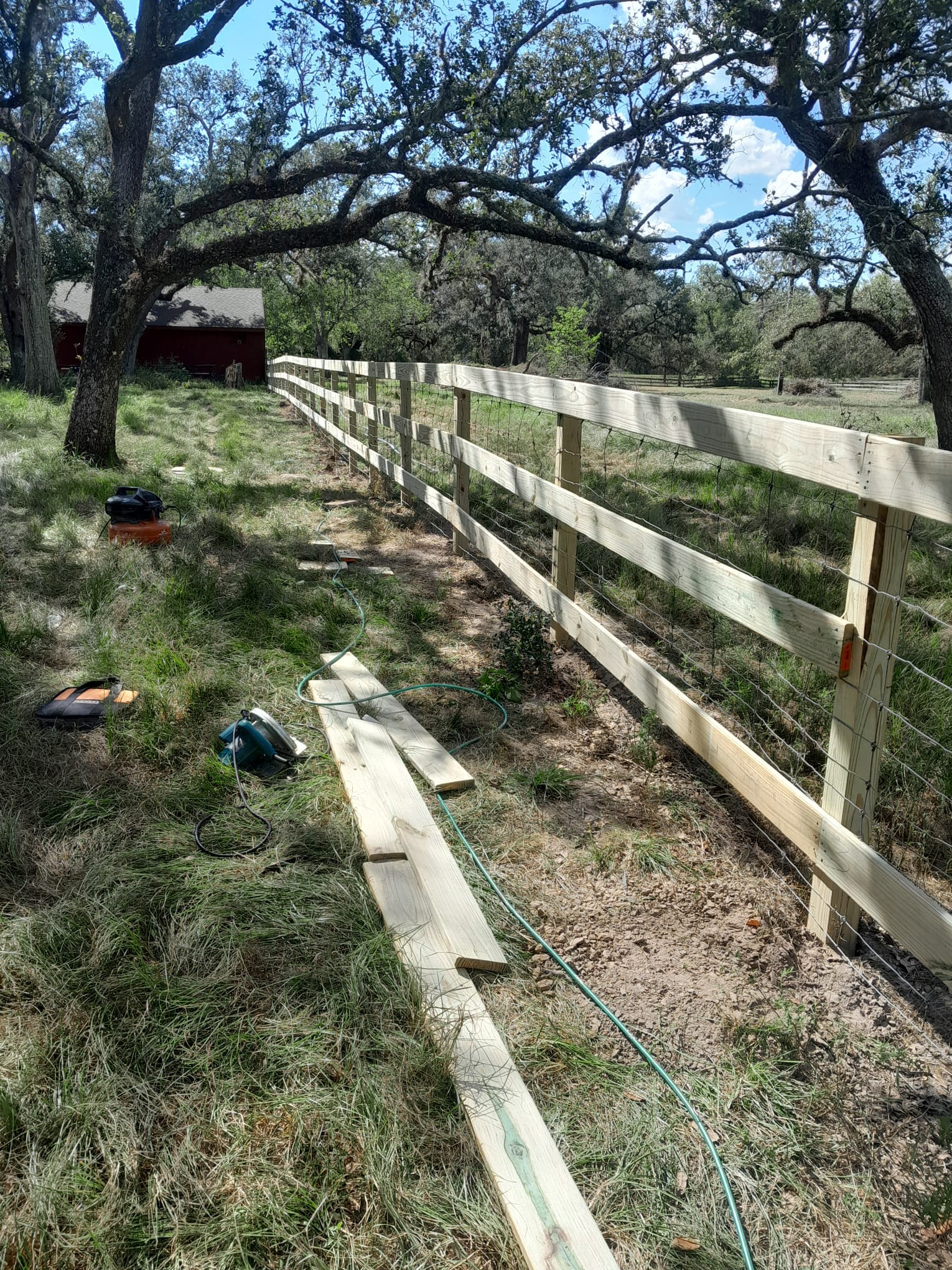
Ranch and farm fence pricing works differently from a residential quote mainly because of what a long run and its corners actually demand structurally, not just how many feet of material it takes. Extension-service fencing guides put real numbers on that: an end or corner brace has to resist thousands of pounds of wire tension on its own, a span over 200 feet needs a stronger double-span brace, and a run past 650 feet needs added bracing partway along it. None of that shows up in a flat per-foot price — it’s exactly what a walk-through quote is pricing. Texas’s own fence statutes add a separate layer: a specific minimum height for a fence around cultivated cropland, and a gate-spacing rule that doesn’t apply to pasture fencing generally. Mustang Fencing Services builds farm and ranch fencing across the rural parts of Galveston and Brazoria Counties, priced after walking the actual property.
Sources: Univ. of Georgia Cooperative Extension Bulletin 1192; Texas Agriculture Code §143.028.
Why the pricing model is different from a backyard fence
A typical residential quote prices a short, defined perimeter per linear foot. Ranch and farm fencing often covers far more ground — a quarter-mile or more per side isn’t unusual — so the things that matter to the total cost shift: how the run is braced, how many gates and corners interrupt it, and how hard the terrain is to work, matter more than they do on a suburban lot. For what’s actually included in a full installation, see our farm and ranch fence installation page covering materials, gates, and the rural parts of the two counties we serve.
The reason a walk-through quote beats a national per-foot average isn’t guesswork — it’s that the bracing a run needs is itself a function of its length and corner count, as the next sections show.
What actually drives the cost up or down
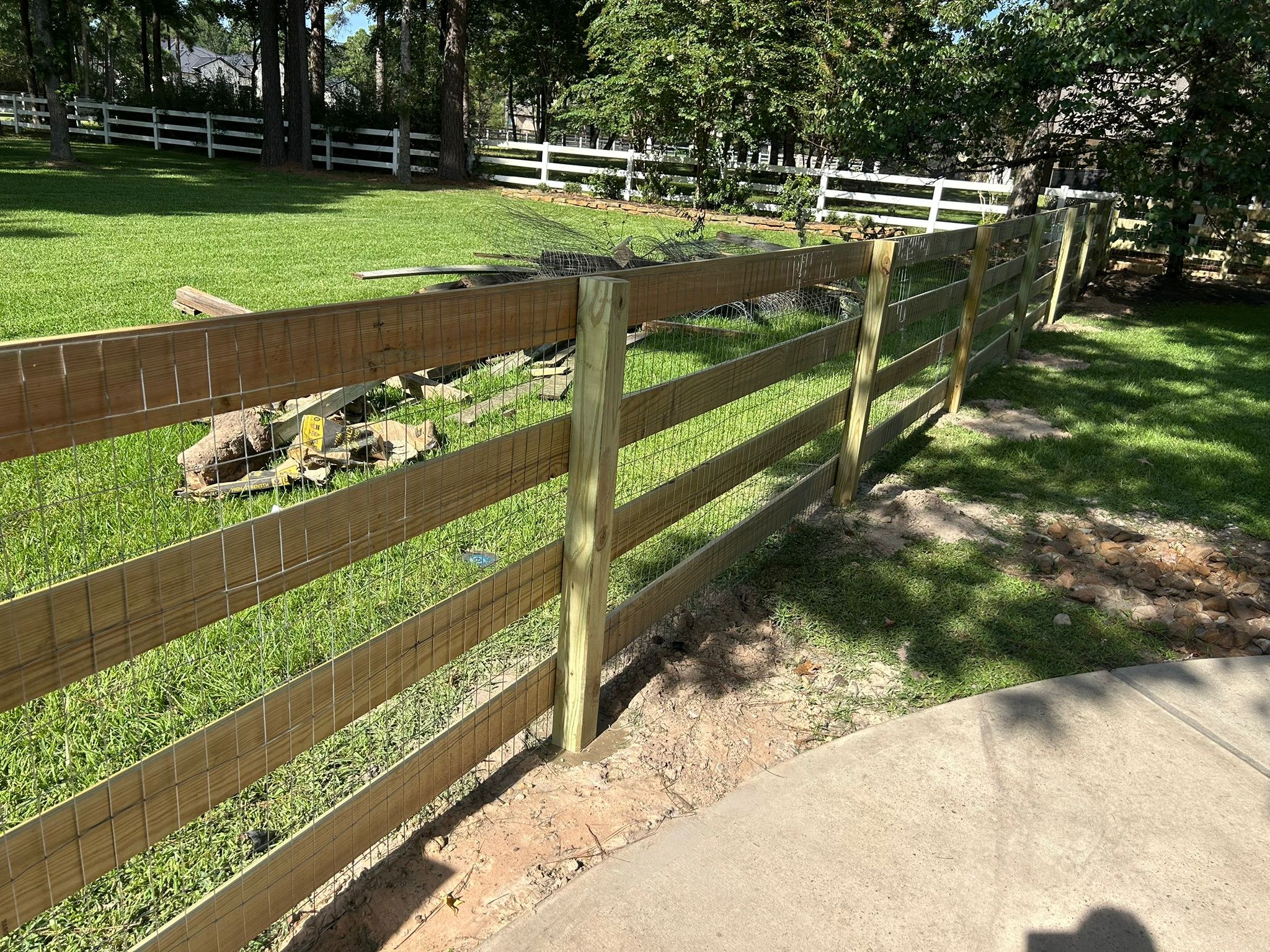
Fence style is the first lever: a simple two- or three-rail design is generally the most economical way to cover a long perimeter, while adding wire mesh for smaller-animal containment adds material and labor on top of it. From there, extension-service fencing guides point to the structural factors that scale with the property rather than the yard:
- Corners and gates. Every one needs its own braced post assembly, built to hold thousands of pounds of wire tension (see the drawing below) — a rural property with multiple vehicle and equipment gates adds several of these.
- Run length. A straight run over 650 feet needs added bracing partway along it, and any single span over 200 feet needs a stronger double-span brace at that point.
- Terrain and access. Uneven ground, tree clearing, or difficult equipment access add labor time — the same factors a residential quote accounts for, just usually over a much longer run.
- Post material and spacing. Treated wood, steel, or a mix, and how far apart posts are set, both affect material cost and how well the fence holds up against livestock pressure over time.
What a ranch fence quote is actually pricing
| Cost driver | What changes the price | Source |
|---|---|---|
| Fence style | Open rail is the most economical per foot; added wire mesh for small-animal containment adds material + labor | Industry practice |
| Corners & gates | Each one needs a braced post assembly rated to hold thousands of pounds of wire tension | UGA Extension B1192 |
| Run length | Runs over 650 ft need added mid-run bracing; any span over 200 ft needs a stronger double-span brace | UGA Extension B1192 |
| Post spacing (legal minimum) | A 3-wire barbed-wire fence must have posts no more than 30 ft apart to count as a “sufficient fence” in an open-range county | Texas Ag Code §143.028 |
| Terrain & access | Uneven ground, tree clearing or difficult equipment access add labor time, usually over a longer run than a residential lot | Industry practice |
A walk-through quote accounts for all five at once on the actual property — a single national per-foot figure can’t.
Ranch fence line planner
Enter one straight run’s total length to see roughly how many braced post assemblies that run alone would need — the part of a ranch fence quote that a flat per-foot number can’t capture. This estimates bracing points only; it doesn’t size posts or replace a walk-through quote.
Based on Univ. of Georgia Extension Bulletin 1192: a run longer than 650 ft between corner posts should get a braced line-post assembly every 650 ft, since each end/corner brace resists roughly 3,000-4,500 lb of wire tension on its own. Doesn’t count existing corners or gates on an irregular lot, and isn’t a substitute for a walk-through quote.
What Galveston customers say
5.091 Google reviews · read them all on Google
had an excellent experience with mustang fencing From the initial consultation to the final installation, the team was professional, punctual, and attentive to detail. They helped me choose the perfect fence style to match my property and ensured everything was installed with precision. The quality of materials is top-notch, and the fence has completely transformed the look and security of my home. I highly recommend mustang services to anyone looking for reliable and high-quality fencing services!
I am so pleased with the fence!! Your solution was exactly the right one and the team did a highly professional job. Frankly, I was amazed at how clean the job site was at the completion of the project. Feel free to list me as a reference and a very happy customer. Thanks again and please let the men know That I appreciate their hard work and quality craftsmanship.
True professionalism is very rare in this day and age, these guys live upto their word and deliver on their service! Our fence was down in the July storm and these guys came and gave a reasonable quote, after confirming I received a time line and they delivered! Will recommend them to everyone I know who needs fencing done.
Reviews shown word for word from the Mustang Fencing Services Google Business Profile (Galveston), captured 2026-10-12.
Questions we get about this
Is ranch rail fencing cheaper per foot than a residential privacy fence?
Do rural Galveston or Brazoria County properties need a fence permit?
Does Texas law set a minimum height for a ranch or pasture fence?
What does the law require for gates on a long fence run?
Can wire mesh be added to an existing ranch rail fence later?
Sources
Checked October 14, 2026. Rules change, so confirm with the City before you build.
- Texas Agriculture Code, Chapter 143 — Fences; Range Restrictions — §143.001-.002 (cultivated-land fence height & gate spacing), §143.028 (open-range “sufficient fence” test), §143.072 (counties excluded from a cattle stock-law vote — Galveston is not one).
- Univ. of Georgia Cooperative Extension Bulletin 1192, “Fences for Horses” — Perimeter/cross-fence/paddock heights, H-brace anatomy, wire tension figures, 650-ft line-post bracing and 200-ft double-span rules.
- Univ. of Tennessee Extension PB1541, “Planning & Building Fences on the Farm” — Cattle, sheep and swine fence height and construction guidance.
- Texas A&M AgriLife Extension AGEC-PU-114, “A Landowner’s Guide to Fence Law in Texas” — Explains the open-range/closed-range (stock law) distinction and why it isn’t centrally published county by county.
Planning or pricing a farm or ranch fence in Galveston or Brazoria County?
We’ll walk the property, count the corners, gates and long spans that actually drive the bracing above, and give you a written quote from that — not a per-foot guess. Free on-site estimates across Galveston and Brazoria Counties.