
Cantilever vs V-Track Slide Gates on Sand, Shell and Flood-Prone Driveways
Both are slide gates, but they carry their weight in different places. A V-track gate rolls on wheels along a rail on the ground. A cantilever gate hangs from rollers on posts beside the opening and never touches the drive. On a coastal lot, that difference decides most of what follows.
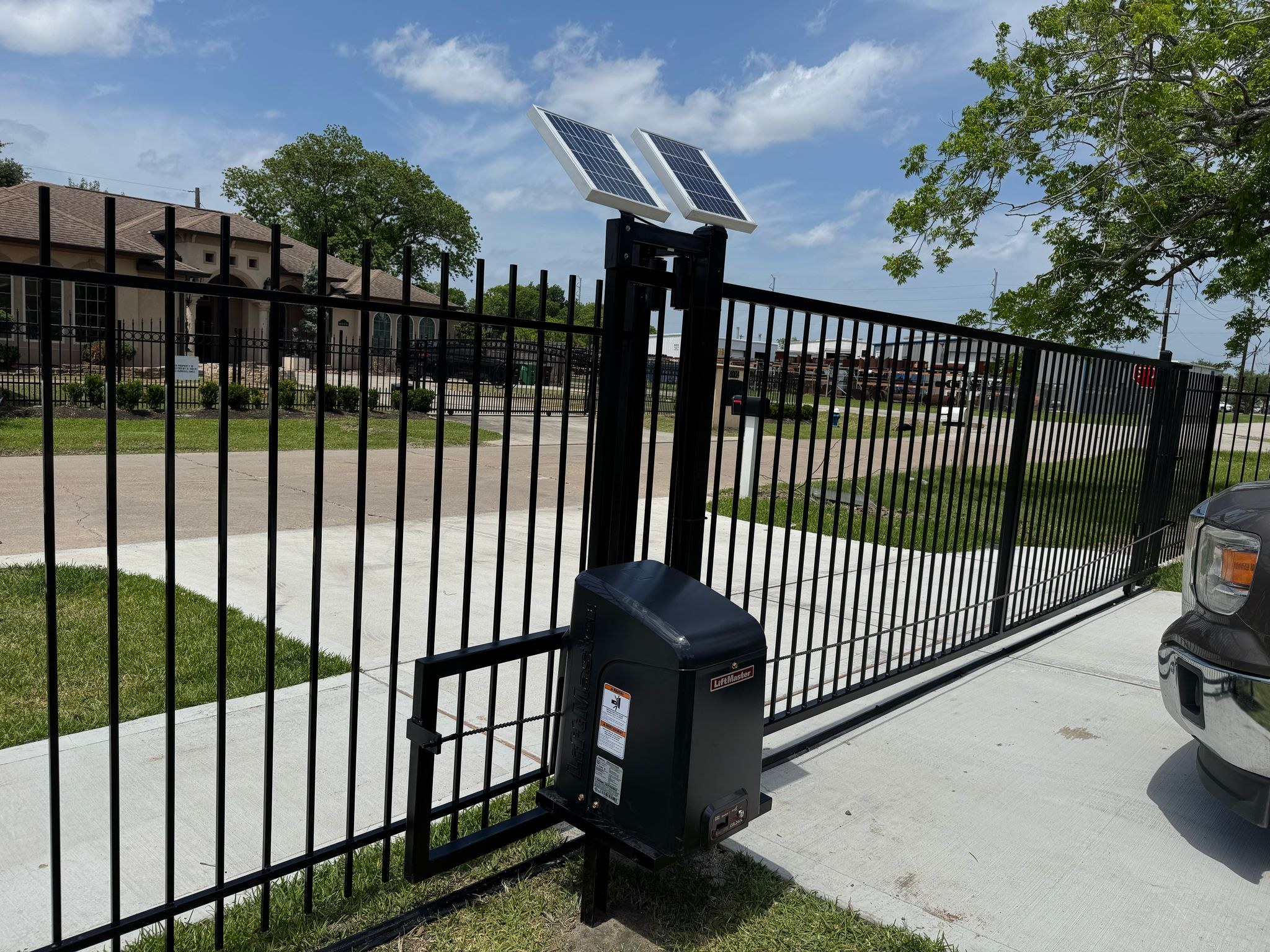
If the gate crosses sand, shell, gravel or a spot that floods, a cantilever gate is usually the better fit, because nothing sits on the ground to fill with debris. A V-track gate needs less fence line and less hardware, but its rail has to be installed level along the whole travel and kept clean. The deciding measurement is the straight, clear fence line beside the opening: a cantilever gate needs room for the opening plus a tail of at least 40% of it.
Sources: CLFMI Guide for Specifying Chain Link Fence and Gates, Sec. 32 31 13; iDeal Aluminum V-Track Install Instructions.
Two ways to carry a sliding gate
Every slide gate needs something to hold up its weight while it moves sideways. The two common answers for driveways are opposites.
A V-track gate rolls on V-grooved wheels along an inverted-angle rail fixed to the ground. The gate is about as long as the opening, and the rail runs under the whole path of travel. iDeal’s instructions put it plainly: the track “must be installed level & affixed to grade” and should be about twice as long as the opening so the gate can slide fully open.
A cantilever gate has no ground track. It hangs from roller assemblies (trucks) mounted on two posts beside the opening, and it carries a counterbalance section, called the tail or back frame, that stays behind the posts. ASTM F1184, the standard for commercial and industrial slide gates, calls these Type II gates, spanning the opening “without top or bottom internal support.” Class 1 has external rollers, the classic chain-link look. Class 2 runs internal rollers inside an enclosed track on the gate’s top or bottom rail.
So the trade is simple to state. The V-track puts its hardware in the drive, where it’s cheap and compact but exposed. The cantilever moves the hardware to the side, which costs fence line and a longer gate but leaves the drive clear.
Why the coast tips the choice
A ground track is a small gutter across your driveway. Whatever the drive sheds ends up in it: shell from a shell drive, blown or washed-in sand, leaves, and whatever a heavy rain carries across the gate line. LiftMaster’s manual for its CSL24UL slide operator lists “debris is on the gate’s track such as mud, rocks, dirt” as one of the causes of the operator detecting an obstruction, sounding its alarm and needing a reset. It also lists “the gate wheel is off the gate rail.”
A cantilever maker, DuraGates, sums up the V-track’s weak points in its catalog: it needs a trench dug along the driveway, the “ground track can be obstructed by objects laying over it,” and “rollers can possibly be derailed.” That’s a competitor talking, so weigh it accordingly, but it matches what the operator manual says goes wrong.
On the island that matters more than it would inland. Many lots are low, some drives are shell or sand, and water crossing the gate line leaves sediment behind. If the gate is going to be automated, the operator is the part that notices first: it pushes against grit, trips its obstruction sensing, and stops. For where the operator and its electronics should sit on a low lot, see our guide to gate openers in a flood zone.
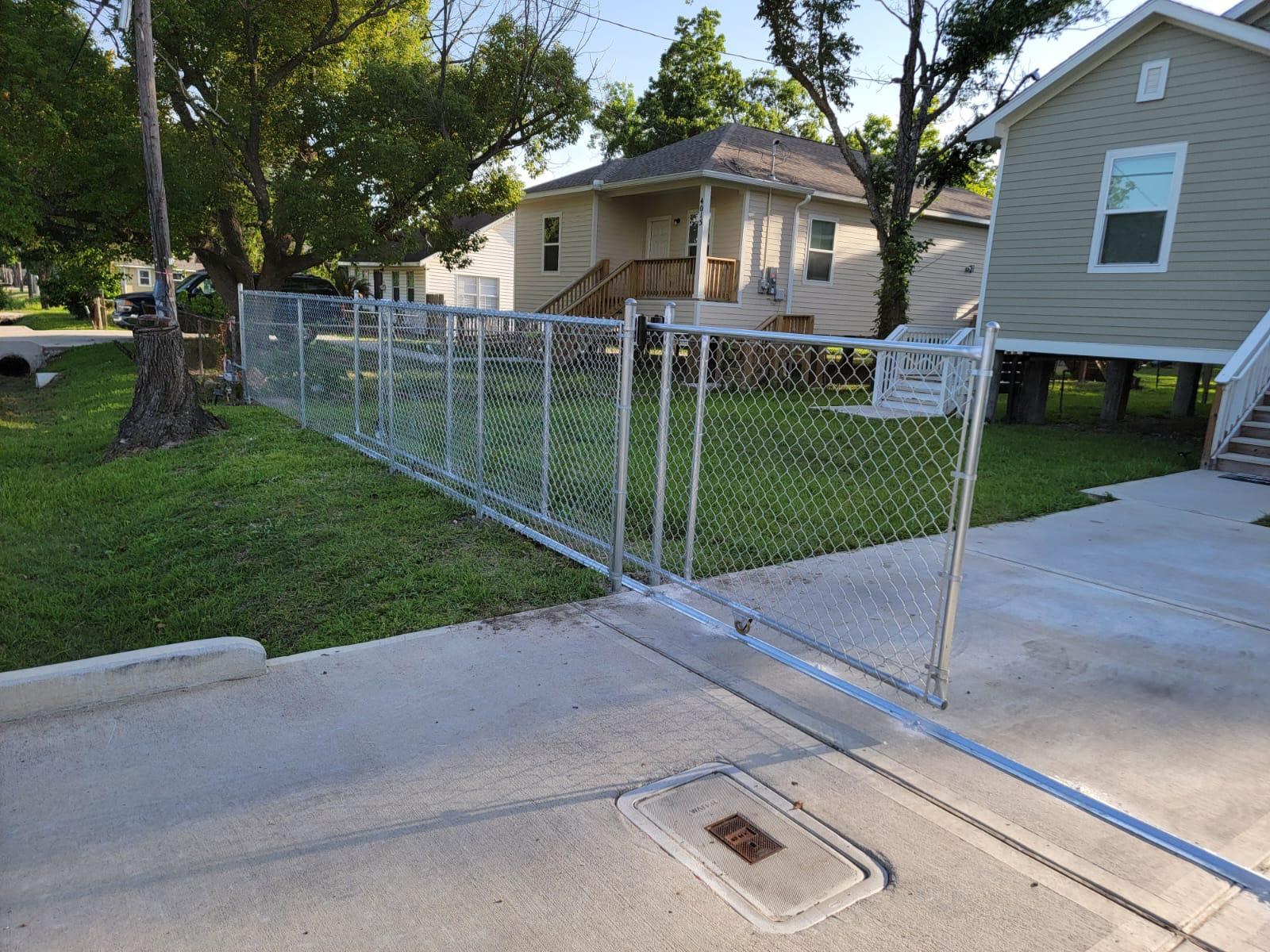
The measurement that decides it: clear fence line
A slide gate has to park somewhere when it’s open, and it parks along the fence line beside the opening. That run has to be straight and free of trees, meter boxes, steps and sharp changes in grade.
- V-track: the gate is roughly the width of the opening, so it needs roughly that much clear line, with the rail running under the opening and the parking run.
- Cantilever: the gate is the opening plus the tail, and the whole thing slides back, so it needs the opening plus the tail. The CLFMI guide sets the back frame at a minimum of 40% of the opening. Makers’ tables often run longer, especially on narrow openings: Anchor’s SURTRAC instructions use a 6′ 6″ overhang for openings of 6 to 10 ft, 7′ 6″ for 11 to 14 ft, 10 ft for 15 to 22 ft and 12 ft for 23 to 30 ft. DuraGates’ catalog puts traditional exposed-roller chain-link cantilevers at a minimum 50% counterbalance.
So on a 16 ft opening, a V-track gate wants about 16 ft of clear line and a 32 ft rail. A cantilever built to Anchor’s table wants about 26 ft of clear line. If you have 20 ft between the gate post and the neighbour’s fence, that settles it before anything else does. Our sliding gate space guide covers the rest of the layout.
Cantilever tail as a share of the opening
Tail (overhang) from Anchor’s SURTRAC table at the top of each opening range, compared with the CLFMI minimum of 40%.
Level ground, slopes and crowned drives
A V-track has to be level from end to end. On a drive that rises toward the house, dips at a gutter or has a crown, that means grading, or a concrete strip poured level for the rail. The strip matters on its own: set it flush with the surface or slightly high. A rail sunk below the surrounding drive becomes a trough that collects sand and holds water.
A cantilever doesn’t care much about the ground under the opening, because it never touches it. DuraGates notes that its carriages must be installed level and in line, but “the ground itself can be at an incline. You just have to install the gate high enough to clear the highest point.” The catch is the gap that leaves at the low point. The CLFMI guide’s 3 inch clearance applies where the grade permits. Over a 6 inch dip you’d have about 9 inches under the gate there, which matters if you’re keeping in a small dog.
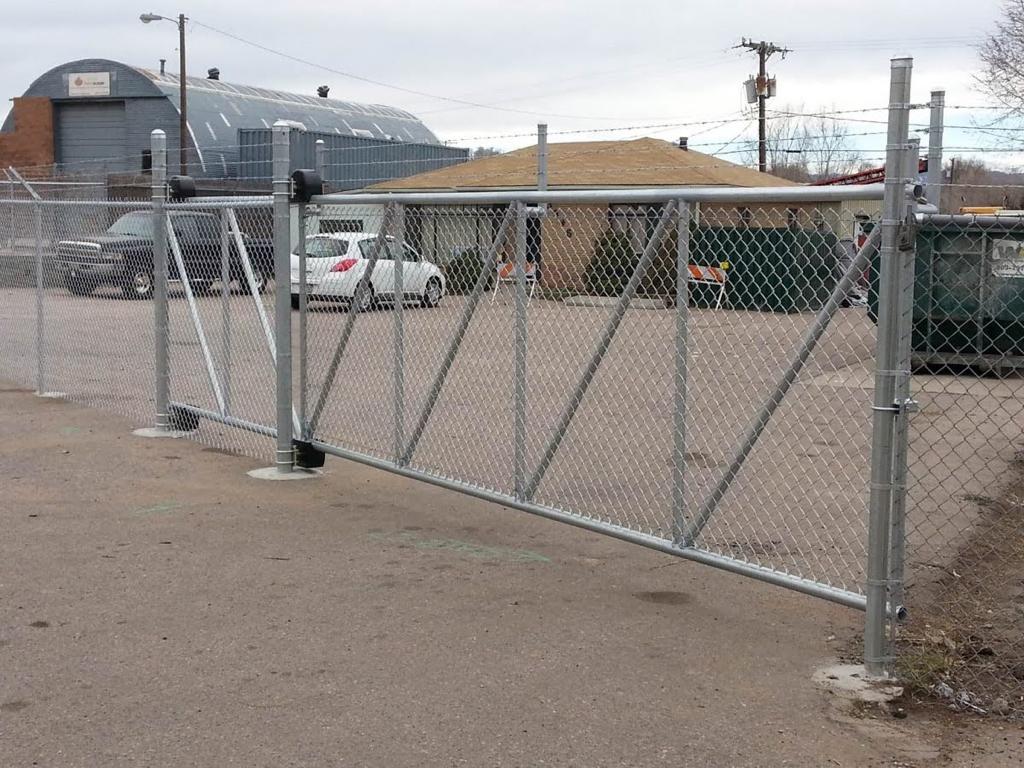
Side by side
| V-track | Cantilever | |
|---|---|---|
| What carries the weight | V-groove wheels on a rail fixed to the ground | Roller trucks on two posts beside the opening |
| Gate length | About the opening width | Opening plus a tail of at least 40% (CLFMI); makers’ tables often more |
| Clear fence line needed | About the opening width | About the opening plus the tail |
| Ground under the opening | Must be level along the whole travel (iDeal) | Can slope; hang the gate to clear the high point |
| Sand, shell, debris | Lands on the rail; operators stop on it (LiftMaster) | Nothing on the ground to foul |
| Work in the drive | Trench or concrete strip for the rail | Post footings beside the opening |
| Safety items | Guard the V-groove wheels; positive stops (DASMA TDS 370) | Guard exposed rollers (CLFMI, DASMA TDS 370); stop bars (Anchor) |
Sources: iDeal V-Track instructions; CLFMI Sec. 32 31 13; Anchor SURTRAC instructions; LiftMaster CSL24UL manual; DASMA TDS 370.
Which slide gate fits your driveway?
Enter what you can measure with a tape and a level. The checker works out how much fence line each system needs and flags the site conditions that decide the choice. It doesn’t price anything.
Planning aid only. Tail lengths use the Anchor SURTRAC cantilever table as one maker’s example (other makers differ, and the CLFMI guide sets 40% of the opening as the minimum back frame). Track length uses iDeal’s rule of twice the opening. Your installer measures the site and the gate maker’s instructions decide.
If the gate will be automated
Either type can be automated, and the same rules apply to both. Galveston adopted the 2021 IRC Appendix AO for automatic vehicular gates at one- and two-family homes, which points to ASTM F2200 for the gate and UL 325 for the operator. Our UL 325 and ASTM F2200 guide covers the details.
Two points are specific to slide gates. First, rollers: DASMA’s rationale for F2200 says “all exposed rollers including both guide wheels and V-grooved rollers must be guarded,” and the CLFMI guide calls for guards on a cantilever’s external rollers. Second, stops: DASMA notes positive stops are required on all horizontal slide gates, and Anchor warns that without its stop bars “gate can roll off track.”
A gate that rolls freely is easier on the operator. The CLFMI guide calls for a cantilever to move with an initial pull of no more than 40 lb, and Anchor says its gates up to 30 ft should move “with one finger.” If a gate needs a shove by hand, the operator will struggle with it too. See electric gate installation for operator choices.
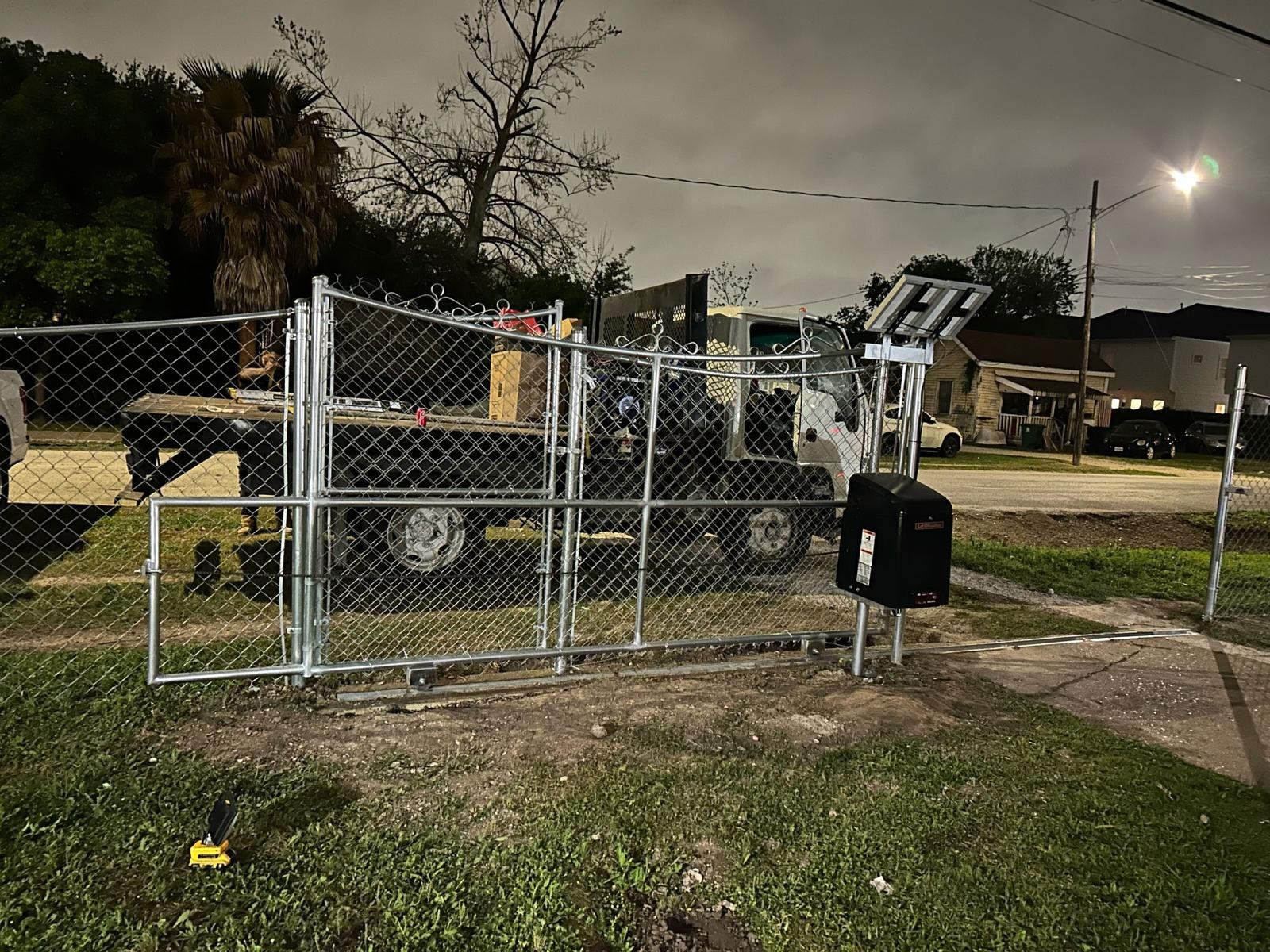
What to ask for in a quote
- Which system, and why for this lot? Ask the installer to point at the high and low points along the gate path.
- For a cantilever: how long is the tail, and does the straight fence line beside the opening have room for the whole gate?
- For a V-track: what is the rail fixed to, and will the strip be level and flush with the drive?
- Where will water go when it rains hard, and does it cross the gate line?
- Roller guards, stop bars and, if automated, the UL 325 listed operator and F2200 gate details.
- For a commercial site, ask for the gate to be specified to ASTM F1184 and the CLFMI guide.
For the gate itself, see sliding gate installation, driveway gates and, for businesses, commercial gates. If a slide gate won’t fit at all, compare the sliding vs swing trade-offs. To see finished chain-link gate work on the island, look at a chain-link fence and gate project in Galveston.
What Galveston customers say
5.089 Google reviews · read them all on Google
They did an excellent job installing our new gate everything looks clean, sturdy, and professionally finished. The team was on time, easy to work with, and made sure everything was working properly before they left. Great service and quality workmanship!
Exceptional Service from Mustang Fencing Services – Highly Recommended! We recently had the pleasure of engaging team of Mustang Fencing Services to repair our backyard fence after the damage caused by Hurricane Beryl. From start to finish, they exceeded our expectations. They handled the entire process with professionalism and care, from thoroughly cleaning up debris to installing a brand-new fence with precision. The team was prompt, efficient, and attentive to detail, ensuring that the final product was both sturdy and aesthetically pleasing. The before-and-after transformation speaks volumes about their craftsmanship and dedication to quality. We couldn’t be more satisfied with the result, and we highly recommend Mustang Fencing Services for anyone in need of reliable and professional fencing work. Thank you to the entire team for a job well done!
Mustang fencing services did a fantastic job on my wooden fence and their pricing was really affordable. The whole process of building this was smooth, fast and the fence looks great too in my backyard. I’m really happy with their work and would definitely recommend them.
Reviews shown word for word from the Mustang Fencing Services Google Business Profile (Galveston), captured 2026-09-25.
Questions we get about this
What is the difference between a cantilever gate and a V-track gate?
How much space does a cantilever gate need?
Is a V-track gate a bad idea on a sand or shell driveway?
Can a slide gate go across a sloped driveway?
How long is a V-track for a sliding gate?
Do slide gate rollers need guards?
Sources
Checked September 26, 2026. Rules change, so confirm with the City before you build.
- Chain Link Fence Manufacturers Institute, Guide for Specifying Commercial, Industrial and Security Chain Link Fence and Gates, Sec. 32 31 13 — cantilever back frame minimum 40% of the opening; 40 lb initial pull; 3 in. ground clearance where grade permits; roller guards; F2200/UL 325 for electrically operated gates.
- ASTM F1184, Standard Specification for Industrial and Commercial Horizontal Slide Gates (scope) — Type I overhead slide and Type II cantilever gates; Class 1 external rollers, Class 2 internal rollers. The current edition is F1184-23e1.
- Anchor Fence, SURTRAC Cantilever Slide Gate installation instructions — overhang by opening width; loose-contact guide rollers; stop bars; one-finger operation.
- iDeal Aluminum Products, V-Track Install Instructions — track level and affixed to grade along the whole travel; track twice as long as the opening.
- DuraGates, Sliding Gate Systems catalog (2023) — a cantilever-hardware maker’s comparison with V-track (trench, obstruction, derailing); 50% counterbalance for exposed-roller chain-link cantilevers; hanging a cantilever over an incline.
- DASMA TDS 370, Rationale Behind the Provisions of ASTM F2200 — exposed rollers, including V-grooved rollers, must be guarded; positive stops on all horizontal slide gates.
- LiftMaster CSL24UL slide gate operator installation manual — obstruction alarm causes: debris on the track, wheel off the rail; operator placement near the gate roller.
- City of Galveston Ordinance No. 23-012 (2021 IRC adoption) — adopts IRC Appendix AO, Automatic Vehicular Gates (ASTM F2200 gates, UL 325 operators).
Choosing a slide gate for your lot?
We’ll measure the opening, the fence line beside it and the high and low points along the gate path, and go through which system fits. Free on-site estimates across Galveston Island and Galveston County.