
UL 325 & ASTM F2200: What Makes an Automatic Gate Safe
Two standards decide whether an automatic gate can hurt someone. UL 325 covers the opener and its entrapment protection. ASTM F2200 covers how the gate itself is built. Inside the City of Galveston, the residential code the City adopted in 2023 requires both. Here’s what they mean for the gate you’re buying.
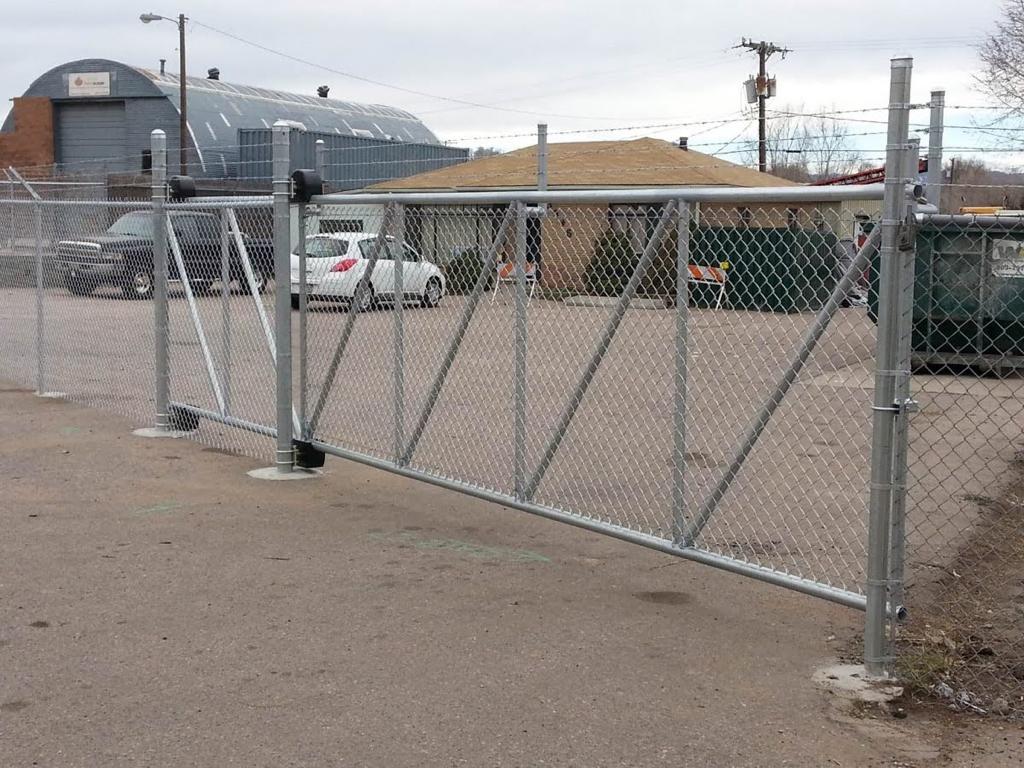
UL 325 is the safety standard gate operators are listed to. For every entrapment zone it requires two independent means of entrapment protection (for example, the opener’s built-in sensing plus a photo eye), and external sensors must be monitored, so the gate won’t run automatically without them. ASTM F2200 covers the gate: on a slide gate, no opening below 72 inches may pass a 2¼-inch ball, exposed rollers 8 feet or lower must be guarded, and there are no latches or sharp protrusions. Inside the City of Galveston, the adopted residential code (2021 IRC Appendix AO) requires both on a home’s automatic driveway gate.
Sources: DASMA TDS 353 (UL 325 7th ed. §32 and Tables 32.1–32.2); ASTM F2200 provisions and entrapment-zone definitions as printed in LiftMaster CSL24UL and CSW24UL installation manuals.
Two standards, two jobs
People say “UL 325 compliant gate” as if it were one thing. It isn’t. An automatic gate is a system: a gate panel, hinges or rollers, an operator (the motor and controller), sensors, controls and signs. Two separate standards cover it.
- UL 325 (Door, Drapery, Gate, Louver, and Window Operators and Systems, 7th edition, last revised September 2025) is the standard gate operators are tested and listed to. It defines usage classes, the kinds of entrapment protection an operator can use, and how many it needs. It also covers warnings and instructions.
- ASTM F2200 (Standard Specification for Automated Vehicular Gate Construction, current edition F2200-24) covers the gate itself: screening of openings, gaps at posts, roller guards, stops, protrusions and pedestrian access. Its scope says automated vehicular gate systems “shall comply with this specification and shall be compliant with UL 325.”
The two work as a pair. A listed operator on a gate that isn’t built to F2200 is still a hazard, and a perfectly built gate with the wrong sensors won’t protect anyone. When you compare quotes, ask about both: the operator’s UL 325 class and the entrapment devices, and whether the gate panel is built to F2200.
One practical note from DASMA: “UL label” isn’t a generic term. Other nationally recognized testing laboratories can also list operators to UL 325, so look for a listing to the standard, not a particular logo. And a listing doesn’t mean the lab “approved” your installation. The manufacturer is responsible for the product, and your installer is responsible for protecting your site’s entrapment zones.
Which UL 325 class your gate falls in
Every vehicular gate operator is marked with the classes it’s intended for. Some are marked for more than one. The class follows the site, not the gate size, so the first thing to settle is where the gate goes, whether that’s a driveway gate at a house or a commercial entrance.
| Class | UL 325 definition (short form) | Typical Galveston-area example |
|---|---|---|
| I | Residential: a residence of one to four single-family units, or its garage or parking area | A driveway gate at a house or duplex |
| II | Commercial or general access: multifamily housing (five or more units), hotels, garages, retail stores and other buildings serving the public | An apartment or condo entry, a hotel lot, a retail yard |
| III | Industrial or limited access: a factory, loading dock or other location not intended to serve the public | A fenced equipment or warehouse yard |
| IV | Restricted access: a guarded industrial location or restricted area where security staff prevent unauthorized access | A guarded secure facility |
Class definitions: UL 325 as quoted in DASMA TDS 353. The examples are ours, for orientation; the operator manufacturer decides which classes an operator is listed for.
The two-device rule, in plain language
UL 325 defines entrapment as “the condition when a person is caught or held in a position that increases the risk of injury.” Section 32.1.1 says a vehicular gate operator must have “a minimum of two independent entrapment protection means … for each entrapment zone,” and must operate only after the minimum number is installed and enabled. The standard recognizes five types:
- Type A, inherent: sensing built into the operator that detects when the gate is blocked.
- Type B1, non-contact: a photoelectric sensor (photo eye) or equivalent.
- Type B2, contact: an edge sensor or equivalent that trips when touched.
- Type C, inherent force limiting: an adjustable clutch or pressure relief. Allowed on swing gates and barrier arms only. A swing gate using it must not exert more than 40 pounds at the leading edge two seconds after starting.
- Type D, hold-to-run: a control someone must hold down for the gate to keep moving. It can’t be combined with automatic closing, and the user must have a full view of the gate.
“Independent” means the two means for a zone can’t be the same type. Two photo eyes don’t count as two means. Most residential and commercial operators have Type A sensing built in, so the second means is usually a photo eye or an edge sensor. DASMA’s FAQ is clear that you don’t need both a photo eye and an edge sensor if the zone is already covered by two different types.
After sensing an obstruction the gate must start reversing within 2 seconds and travel at least 2 inches. If the built-in sensor detects a second hit in a row, the gate must stop, sound an alarm and wait for a hard-wired reset from someone who can see the gate.
Minimum entrapment protection by gate type (UL 325 Tables 32.1 and 32.2)
| Gate type | Types allowed | Opening direction | Closing direction |
|---|---|---|---|
| Horizontal slide | A, B1, B2 or D | 2 | 2 |
| Horizontal swing | A, B1, B2, C or D | 2 (1 if no entrapment zone that way) | 2 (1 if no entrapment zone that way) |
| Vertical pivot | A, B1, B2 or D | 2 | 2 |
| Vertical lift | A, B1, B2 or D | 1 | 2 |
| Horizontal bifold | A, B1, B2 or D | 2 | 2 |
UL 325 7th edition Tables 32.1 and 32.2, reprinted in DASMA TDS 353. The same type of device can’t serve as both means. For a swing gate, if there’s no entrapment zone in one direction, one means is enough that way; the other direction still needs two.
Where the entrapment zones are on a slide gate
LiftMaster’s slide-operator manual puts the rule in one sentence: an entrapment zone exists “if at any point during travel, the gap between the gate and any opposing fixed edge or surface such as posts, walls, pillars, columns or operator itself, is less than 16″ (406 mm) in a location up to 6 ft. (1.8 m) above grade.” On a typical slide gate that gives you three places to protect, shown on sheet S-1: (1) the open end, where the gate’s tail runs toward a wall or along the fence; (2) the support posts and rollers the gate passes; and (3) the leading edge closing onto the receiver post.
Photo eyes are placed across the opening on both sides to cover the closing direction, and another eye or an edge covers the open end. Edge sensors go where the gate can touch someone: the leading and trailing edges and the posts. UL 325 also expects the installer to reduce nuisance trips, such as a car breaking the beam while the gate is still moving. For how much room a slide gate needs to run back, see our sliding gate space guide.
What ASTM F2200 asks of the gate itself
F2200 is where many “we already have a gate, just add a motor” plans run into trouble. The provisions quoted in current operator manuals include:
- No gate that can fall over. A gate must not fall more than 45 degrees from vertical if it comes off its hardware.
- Smooth bottom edges. Bottom protrusions can’t exceed ½ inch, and protrusions aren’t allowed on an automated gate outside the listed exceptions (decorative tops that stay in the gate’s plane are one).
- No latch. An existing latch must be disabled when a manual gate is automated, and no latch may be installed on an automatic gate.
- No walk gate in the panel. A pedestrian gate can’t be built into the vehicular gate or the stretch of fence it covers when open. People get a separate gate, placed so they never meet the moving one.
- Barbed wire and tape up high. Barbed wire must be at least 6 feet above grade and barbed tape at least 8 feet.
Slide gates (Classes I to III) add four more. Openings must be screened from the bottom to the top of the gate or 72 inches, whichever is less, so a 2¼-inch ball can’t pass. That includes the fence section the open gate covers, and any back frame or counterbalance. Weight-bearing rollers 8 feet or lower must be guarded. The gap between the gate frame and the nearest post can’t exceed 2¼ inches when fully open or closed. And positive stops have to limit travel at both ends. DASMA’s rationale for the gap and screening rules cites CPSC injury data: people riding slide gates were pulled into the gap between the moving panel and its support structure and seriously hurt or killed.
The screening rule has the biggest effect on looks. An open ornamental iron or aluminum slide gate usually needs mesh or tighter infill on its lower 6 feet. Settle that before you pick a design. Our sliding gate installation page covers cantilever and track options.
Automating an existing gate, or planning a new one?
We’ll check the panel against ASTM F2200, mark the entrapment zones, and quote the operator and gate together. Free on-site estimates across Galveston Island and Galveston County.
The numbers that shape most gate layouts
Key dimensions from UL 325 and ASTM F2200, in inches, on one scale.
Swing gates: the arc is the hazard
A swing gate’s risk sits in its arc and at its hinges. LiftMaster’s swing-operator manual defines the zones: anywhere up to 6 feet high where, during travel, (a) the gap under the gate is more than 4 inches but less than 16 inches, or (b) the pivot is more than 4 inches from the end of the column it’s mounted to, or any other gap between the moving gate and a fixed object (a wall, curb or berm) is less than 16 inches.
F2200 gives you two ways to design those out. The width of a column covered by the open gate, measured from the pivot’s center line, shouldn’t exceed 4 inches, and the open gate should stay at least 16 inches from walls and other fixed objects. Where a site can’t meet those, the zone must be protected with UL 325 devices instead. Edge sensors go on the inside and outside of the leading edge, plus the bottom edge if the gap under the gate is between 4 and 16 inches anywhere in its arc. Swinging gates also must not open into public access areas, which on a narrow island lot often decides between a swing gate and a slide gate.
Which entrapment protection does my gate need?
Answer a few questions about the gate you’re planning. The checker applies the UL 325 minimums (Tables 32.1 and 32.2) and the ASTM F2200 construction rules summarized on this page, and lists what to ask for in your quote.
Planning aid only, not a compliance determination. It follows the UL 325 7th edition tables as reprinted in DASMA TDS 353, the ASTM F2200 provisions quoted in LiftMaster’s current slide and swing operator manuals, and the swing-gate entrapment-zone definition in those manuals. For a swing gate it assumes the closing direction has an entrapment zone (the leading edge closes toward the other leaf or a post). Every site has its own zones: your installer must identify them, and the operator’s manual lists the only sensor models it accepts.
Controls, walk gates and signs
Some of UL 325’s rules are about the site around the gate, and they’re easy to get wrong on a tight driveway:
- Keypads and buttons must be at least 6 feet from any moving part of the gate, and placed so no one can reach over, under, around or through the gate to use them. Controls only authorized emergency responders can reach are the exception. A reset control must be where the gate is in view.
- People need their own gate. UL 325 operators are for vehicular gates only. Where people walk, give them a separate walk gate placed so they never cross the moving gate’s path.
- Two warning signs at minimum, one visible from each side of the gate.
For keypads, card readers, phone entry and remotes, see our gate automation and access control page.
Existing gates, retrofits and the salt air
Your current operator doesn’t have to be replaced just because the standard changed. DASMA’s FAQ says UL 325 isn’t retroactive. But it recommends replacing operators made before 2000, because they may not be able to accept entrapment devices at all. Two changes do trigger F2200: automating a manual gate means upgrading the gate to the specification, and so does replacing a worn-out operator. Read our guide to converting a manual gate before you assume the old panel can stay as it is.
Since 2016, external sensors are monitored. An operator made in 2016 or later won’t run automatically unless its required photo eyes or edges are connected and working. If a device fails, the operator falls back to hold-to-run or manual operation for that direction. Nobody is allowed to jumper around the monitoring. On the coast that’s the reason to plan sensor mounting and wiring with salt, sand and standing water in mind. It’s also why the manuals tell owners to test the gate every month: it must reverse on contact, or when something breaks a photo eye beam. Our maintenance schedule guide covers what else to check.
What to ask for in a quote
When we price an electric gate or an automatic gate, we walk the opening with you and mark the entrapment zones before choosing hardware. Whoever you hire, a complete quote should state:
- The operator model and the UL 325 class it’s marked for, matched to your site.
- Which entrapment protection covers each zone, in each direction, by device model.
- That the gate panel (and the fence section it covers) is built to ASTM F2200, including screening on a slide gate.
- Where the keypad or reader goes, where the walk gate goes, and where the warning signs go.
- How the gate behaves when power is lost. See automatic gates and power outages.
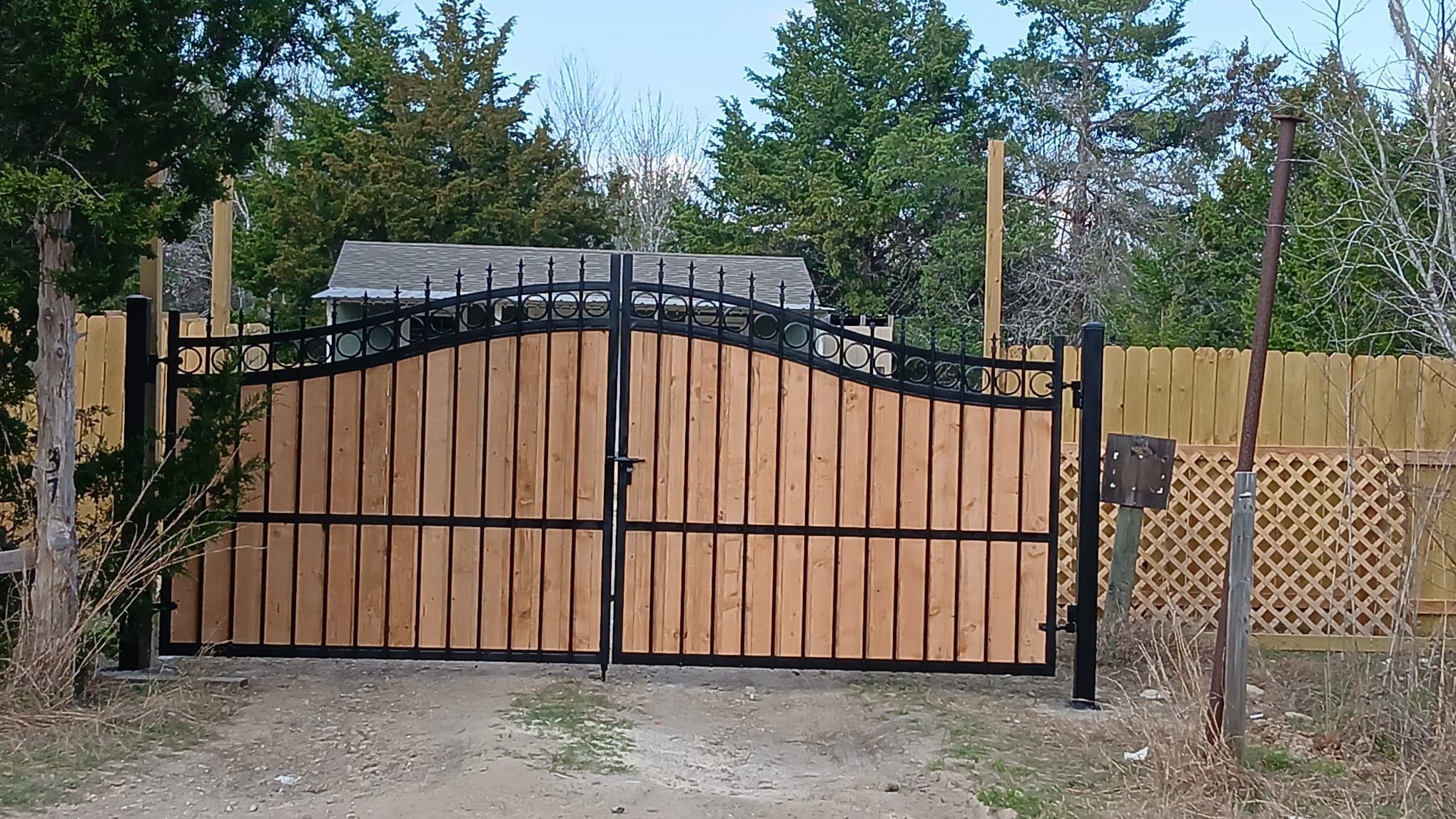
For business and multifamily sites, see commercial gates. To see gate work in town, look at an iron and pine gate project in Galveston.
What Galveston customers say
5.091 Google reviews · read them all on Google
Very professional and friendly. Gotten automatic gates done and they are done to perfection! Thank you
Absolutely loved my fence once i saw the finished product. No hassle, no rude interactions, and no inconveniences everything was just perfect. One of the best fencing companies in Texas
My new fence looks fantastic and has added both privacy and style to my yard. Highly recommend their services for anyone in need of fencing!
Reviews shown word for word from the Mustang Fencing Services Google Business Profile (Galveston), captured 2026-10-05.
Questions we get about this
What is UL 325?
What is ASTM F2200?
Does an automatic driveway gate at a home in Galveston have to meet UL 325 and ASTM F2200?
Do I need both photo eyes and edge sensors?
Why won’t a new gate close automatically when a sensor is unplugged?
Do I have to upgrade my existing gate opener to the current UL 325?
How far from the gate should the keypad be?
Sources
Checked September 24, 2026. Rules change, so confirm with the City before you build.
- UL Standards & Engagement: UL 325, Door, Drapery, Gate, Louver, and Window Operators and Systems — 7th edition (May 19, 2017), most recent revision September 15, 2025; scope.
- ASTM F2200-24, Standard Specification for Automated Vehicular Gate Construction — scope: gate types covered; automated gate systems must comply with F2200 and UL 325.
- DASMA TDS 353, Vehicular Gate Operators and the ANSI/CAN/UL 325 Standard (rev. 1/25) — usage classes, §32.1.1, Tables 32.1 and 32.2, monitoring, reversal, controls and sign requirements.
- DASMA TDS 356, UL 325 and Gate Installations: FAQ — no retroactivity, pre-2000 operators, monitored devices since 2016, controls distance, separate pedestrian gate.
- DASMA TDS 370, Rationale Behind the Provisions of ASTM F2200 — 72″ screening height, 2¼″ gap rationale and CPSC injury data, roller guards, stops.
- LiftMaster CSL24UL Commercial DC Slide Gate Operator installation manual — ASTM F2200 gate construction provisions; slide gate entrapment zone definition; monitored devices.
- LiftMaster CSW24UL Commercial DC Swing Gate Operator installation manual (2022) — swing gate entrapment zone definition; 4″ column and 16″ clearance rules; edge sensor placement.
- City of Galveston Ordinance No. 23-012 (adopted January 26, 2023) — adopts the 2021 International Residential Code with Appendix AO, Automatic Vehicular Gates.
- City of Galveston City Council minutes, January 26, 2023 — adoption of the 2021 International Building Code and 2021 International Residential Code.
- ICC, 2021 International Residential Code, Appendix AO — AO103.1 (ASTM F2200) and AO103.2 (UL 325). The same wording is in 2021 IBC Section 3110.
Planning an automatic gate?
We’ll measure the opening, mark the entrapment zones, and quote the operator, sensors, gate construction and walk gate together. Free on-site estimates across Galveston Island and Galveston County.