
How Much Space Does a Sliding Gate Need?
A sliding gate needs no swing room, but it needs a long, straight, clear strip beside the opening: about the opening’s width for a V-track gate, and the opening plus a counterbalance tail for a cantilever. An automatic gate also needs a clear corridor along its path, a screened fence behind it, and room for the operator, keypad and a walk gate.
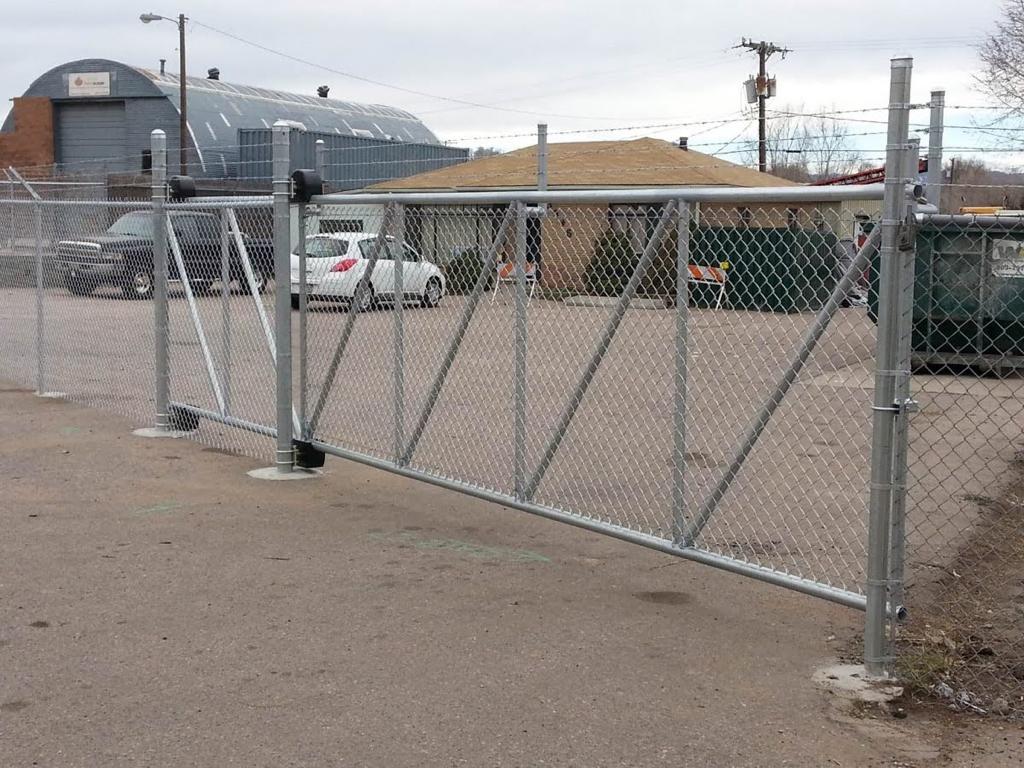
Measure the straight, clear fence line beside the opening. A V-track gate is about as long as the opening, so it needs about the opening’s width to park in, plus a level ground rail twice that long (iDeal). A cantilever gate is the opening plus a tail of at least 40% of the opening (CLFMI); one maker’s table uses a 7 ft 6 in tail for an 11 to 14 ft opening, so a 14 ft opening needs about 21 ft 6 in of clear fence line. If the gate is automated, keep 16 in clear on each side of its path, screen the fence it covers when open to 6 ft, and set the keypad at least 6 ft from the moving gate.
Sources: CLFMI guide specification 32 31 13; Anchor SURTRAC and iDeal V-Track installation instructions; ASTM F2200 and UL 325 provisions as printed in the LiftMaster CSL24UL manual. Read September 27, 2026.
Length: how far the gate runs back
A slide gate opens by moving sideways along the fence line, so the first number is how much straight, clear fence line you have beside the opening, measured from the edge of the opening.
- V-track gate. Rolls on wheels along a rail fixed to the ground. The gate is about as long as the opening, so it needs about the opening’s width to park in. iDeal’s instructions add that the rail must be installed level, fixed to grade, and “twice as long as the opening” so the gate can travel its full length.
- Cantilever gate. Hangs from roller trucks on two posts and never touches the drive. It carries a counterbalance section, the tail, behind the posts. The chain link industry’s guide specification (following ASTM F1184) sets that back frame at “a minimum of 40% of the opening,” and makers’ tables often run longer: Anchor’s SURTRAC table uses 6 ft 6 in for a 6 to 10 ft opening, 7 ft 6 in for 11 to 14 ft, 10 ft for 15 to 22 ft and 12 ft for 23 to 30 ft. Open, the whole gate, tail included, sits beside the fence.
So a 14 ft opening needs about 14 ft of clear fence line for a V-track gate and about 21 ft 6 in for a cantilever on Anchor’s table. Which type suits your ground is a separate question: see our driveway gate page and cantilever vs V-track slide gates.
Clear fence line needed, in feet
Cantilever on Anchor’s tail table vs a V-track gate, for three openings
Width: the corridor along the gate’s path
Length is only half of it. The gate needs a clear lane to travel in, and for an automatic gate that lane is set by safety rules, not just by what the gate would bump into.
- 16 inches each side. ASTM F2200, as printed in the LiftMaster CSL24UL slide operator manual, limits the gap between the gate frame and the fixed object nearest the roadway (usually a post) to 2¼ in when the gate is fully open or fully closed. Other fixed objects more than 16 in from the gate frame are exempt. In practice, anything closer than 16 in to the moving gate (a tree, a meter, a wall, a column) becomes a pinch point.
- Nothing in the path. Parked cars, trash bins, planters, hoses and a V-track’s rail full of shell or sand all stop a slide gate. A drain inlet or a utility pole at the end of a fence run can end the strip sooner than it looks.
- Ground under the path. The chain link guide specification asks for 3 in of ground clearance, grade permitting. A cantilever can cross ground that rises, as long as it is hung high enough to clear the highest point in its path (DuraGates); a V-track rail has to be level.
Slide gate space planner
Enter the opening and the straight, clear fence line you have beside it. The planner works out the run-back length for a cantilever or V-track gate, the clear corridor the path needs, and the extra space an automatic gate takes up. No prices.
Planning aid only. Cantilever tails use the Anchor SURTRAC table as one maker’s example (the CLFMI guide sets 40% of the opening as the minimum back frame); V-track length follows iDeal’s rule of a track twice the opening. Safety provisions from ASTM F2200 and UL 325 as printed in the LiftMaster CSL24UL manual. Read September 27, 2026.
Not sure a slide gate will fit?
We’ll measure the opening, the fence line and the path, and tell you straight whether a slide gate fits or a swing gate makes more sense. Free on-site estimates across Galveston County.
The extra space an automatic slide gate needs
An operator turns the gate into a machine, and the rules in the LiftMaster CSL24UL manual (UL 325 and ASTM F2200) add to the footprint:
- A screened fence behind the gate. Openings must be guarded from the bottom of the gate to 6 ft (or the top of the gate) so a 2¼ in sphere can’t pass, “anywhere in the gate, and in that portion of the adjacent fence that the gate covers in the open position.” Chain link or open pickets along the run-back need a screen or tighter infill.
- Guarded rollers and positive stops. Exposed weight-bearing rollers 8 ft or less above grade must be guarded, and positive stops must limit travel at fully open and fully closed.
- An operator pad. The operator goes inside the property near the gate’s front roller (or near the back of the gate when open), on a concrete pad or a post, with at least 4 in between the gate and the output sprocket.
- A conduit trench. Power runs to the pad underground. The manual says to call the utility locators before trenching; in Texas, powered digging 16 in or deeper needs an 811 ticket. See do you need to call 811 before installing a fence.
- A keypad in the right place. Controls must be at least 6 ft from any moving part of the gate and where nobody can reach through the gate to use them, which usually means a post on the driveway approach.
- A walk gate. A separate pedestrian gate is required; it can’t be built into the automatic gate. See do I need a walk gate with my driveway gate.
More in UL 325 and ASTM F2200 explained and electric gate installation.
Local limits on where the gate can run
- Easements. In the City of Galveston, no permanent structures are allowed in a City-required easement except “fences that allow access as needed to maintain the easement” (LDR 6.308(F)). If the run-back strip crosses a utility or drainage easement, the fence and gate there must still let the City in. See how close to the property line you can build a fence.
- Setback from the road. An HOA may require a driveway gate to sit at least 10 ft back from the right-of-way where the drive meets a road with two marked lanes (Property Code 202.023(c)(4)). That moves the whole run-back strip 10 ft into the lot. See how wide should a driveway gate be.
- Property line. The run-back usually runs along a side boundary, and the tail can end close to it. Know where the line is before the posts go in: do I need a survey before installing a fence.
Space checklist
| V-track | Cantilever | |
|---|---|---|
| Clear fence line | About the opening | Opening + tail (40% minimum; makers’ tables often more) |
| Ground | Level rail twice the opening, kept clean | Can rise; gate hung to clear the highest point |
| Corridor (automated) | 16 in each side, 2¼ in max to the nearest post | 16 in each side, 2¼ in max to the nearest post |
| Fence it covers (automated) | Screened to 6 ft | Screened to 6 ft |
| Also plan for | Operator pad, conduit, keypad 6 ft away, walk gate | Operator pad, conduit, keypad 6 ft away, walk gate |
What Galveston customers say
5.091 Google reviews · read them all on Google
Very professional and friendly. Gotten automatic gates done and they are done to perfection! Thank you
Mustang Fencing exceeded my expectations! Durable and attractive fencing options available. Excellent customer service. Highly recommended for quality fencing solutions.
Excellent service and quality! Professional, on time, and great craftsmanship. Highly recommend!
Reviews shown word for word from the Mustang Fencing Services Google Business Profile (Galveston), captured 2026-10-05.
Questions we get about this
How much room does a sliding gate need?
Does a sliding gate need space in front of the driveway?
Why does the fence behind an automatic slide gate need screening?
Can a slide gate run across a sloped driveway?
What if I don’t have enough straight fence line?
Sources
Checked September 27, 2026. Rules change, so confirm with the City before you build.
- Chain Link Fence Manufacturers Institute, guide specification 32 31 13 Chain Link Fence and Gates — Cantilever back frame at least 40% of the opening (ASTM F1184); 3 in ground clearance, grade permitting; roller guards; 40 lb pull.
- Anchor Fence, SURTRAC Cantilever Slide Gate installation instructions — Overhang (tail) table by opening; stop bars.
- iDeal Aluminum Products, V-Track Install Instructions — Track installed level, fixed to grade, twice as long as the opening.
- LiftMaster CSL24UL slide gate operator installation manual — ASTM F2200 slide gate provisions (6 ft / 2¼ in screening including the covered fence, 2¼ in gap, 16 in exemption, roller guards, positive stops); UL 325 instructions (controls 6 ft from moving parts, separate pedestrian gate); operator placement and 4 in sprocket clearance; call locators before trenching.
- DuraGates, Sliding Gate Systems catalog (2023) — Cantilever on an incline: clear the highest point of ground.
- City of Galveston, Land Development Regulations — 6.308(F): encroachments in required easements limited to fences that allow access to maintain the easement.
- Texas Property Code, Chapter 202 — 202.023(c)(4): an HOA may require a driveway gate at least 10 ft from the right-of-way on a laned roadway.
Is there room for a slide gate?
We’ll measure the opening, the straight fence line beside it, the ground under the path and where the operator and keypad would go, and put it on one written estimate. Free on-site estimates across Galveston County.