
Installing a Chain Link Fence for Waylon Hinze in Galveston, Texas
Waylon Hinze wanted a durable, low-maintenance chain link fence to secure his Galveston property, plus a wide drive gate, without the cost of a solid fence. Here is that job in photos, plus what a chain link fabric order actually specifies under ASTM A392, and how the industry’s own guide specification braces a gate post into the fence line.
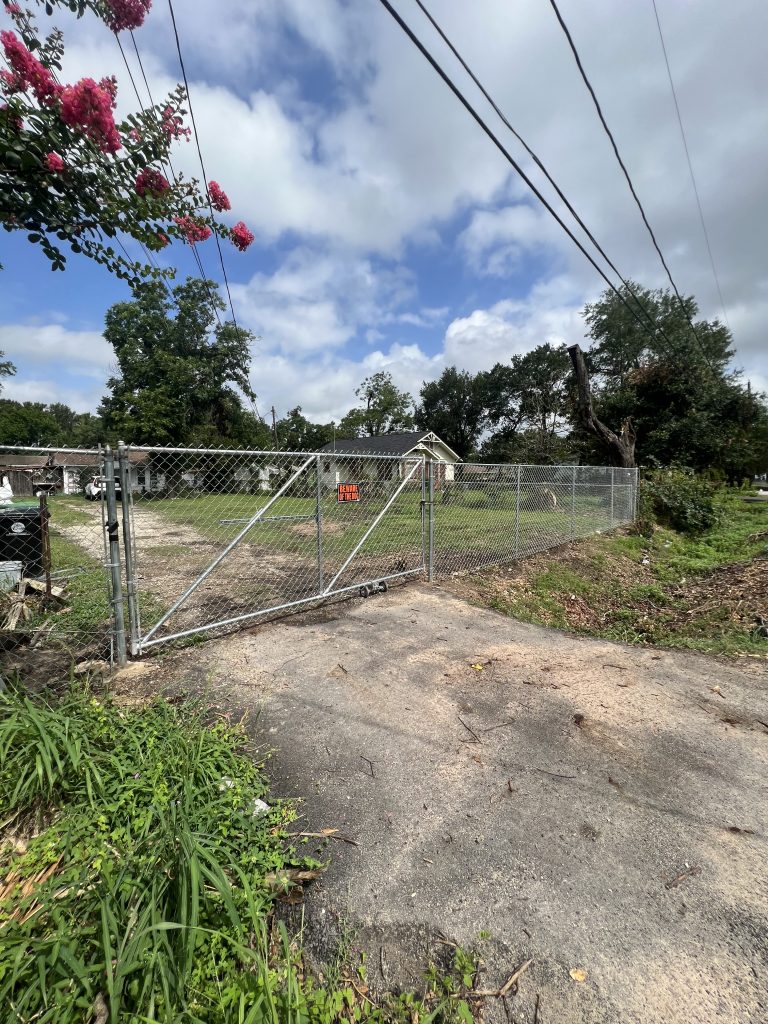
A galvanized chain link fence earns its “durable, low-maintenance” reputation from specifics most buyers never see: the fabric itself is built to ASTM A392 (mesh size, wire gauge, selvage and zinc class are all specified, not assumed), and the posts that take the most load — including gate posts — are braced and trussed into the fence line under the industry’s own guide specification.
Source: ASTM A392, Standard Specification for Zinc-Coated Steel Chain-Link Fence Fabric; CLFMI guide specification 32 31 13, Chain Link Fence and Gates.
The job: a durable, low-maintenance fence and a wide drive gate
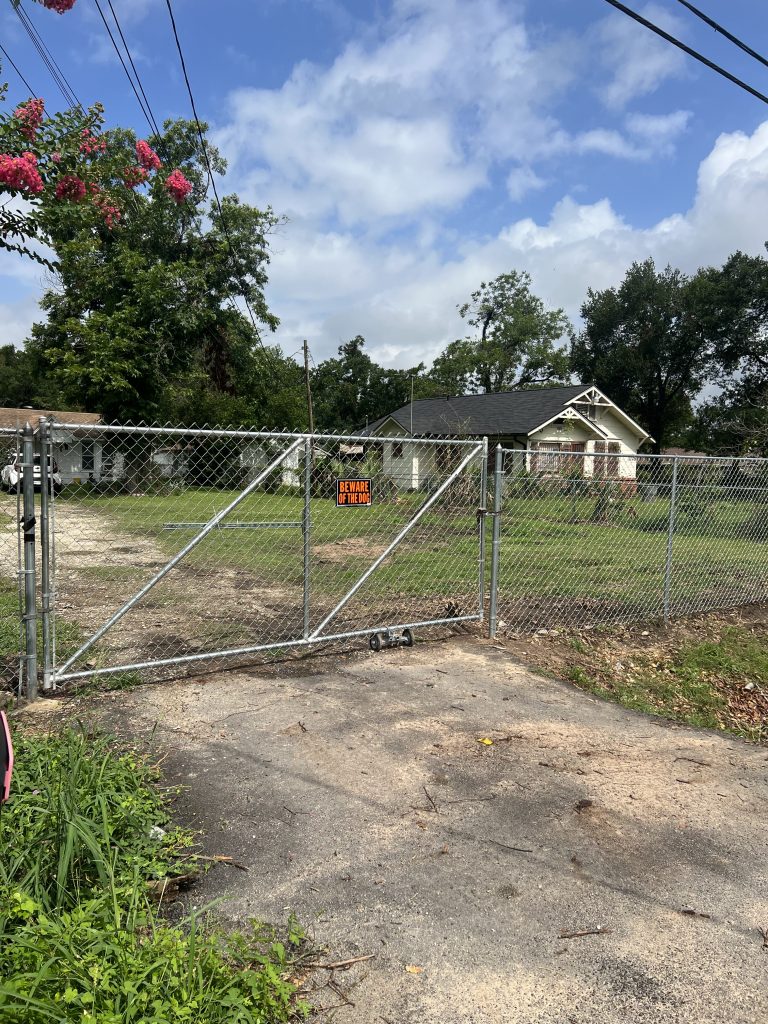
Waylon Hinze asked for a chain link fence to secure his Galveston property that would be durable and low-maintenance without the cost of a solid privacy fence. The job included a wide single-leaf drive gate across the driveway, framed and diagonally braced to carry its own width.
The photos below are from that job.

What “chain link” actually specifies
“Chain link” is not one fixed product — it’s a family of parts, each covered by its own standard. The woven steel mesh itself is governed by ASTM A392, Standard Specification for Zinc-Coated Steel Chain-Link Fence Fabric, which requires the fabric to conform to six things at once: mesh size, wire size, fabric height, selvage, zinc coating weight (Class 1 or Class 2), and breaking strength.
Selvage is the finish on the top and bottom edge of the woven fabric, and A392 allows it to be knuckled or twisted — knuckled rolls the wire ends over into a smooth loop, twisted leaves a sharper spiral point. Either is standard; which one a job gets is a spec choice, not a quality shortcut.
A gate post is not just a bigger line post
Line posts along a straight run of fence mostly resist sideways push from wind on the fabric. A gate post also takes the pull and leverage of a swinging leaf, which is why the industry’s own guide specification treats it differently. CLFMI’s product manual, section 3.2.C, states: “End, corner, pull and gate posts shall be braced and trussed for fence 6 ft. and higher and for fences 5 ft. in height not having a top rail.”
That bracing is a horizontal brace rail plus a diagonal truss rod running from the gate post back to the nearest line post — separate from any bracing on the gate leaf itself. The truss rod is a 3/8 in. steel rod with a pressed-steel tightener, rated to withstand 2,000 lbs of tension (CLFMI §2.7.C, built to ASTM F626). The gate frame itself follows ASTM F900, with frame members spaced no more than 8 ft apart.
Does this post need to be braced and trussed?
Pick the fence height and whether it has a top rail. Answer follows the chain link industry’s own guide specification for end, corner, pull and gate posts. No prices.
CLFMI guide specification 32 31 13, §3.2.C: “End, corner, pull and gate posts shall be braced and trussed for fence 6 ft. and higher and for fences 5 ft. in height not having a top rail.” The brace rail and truss rod are installed per ASTM F567; the truss rod itself is rated for 2,000 lbs of tension (§2.7.C, ASTM F626). A planning aid, not an engineering check.
What customers say on Google
5.091 Google reviews · read them all on Google
We just installed iron gate and it looks amazing thank you very much mustang fencing .
Mustang Fencing Services provides great quality and craftsmanship. Their workforce is competent and efficient, guaranteeing that every project meets the greatest requirements. The materials utilized are strong, and the attention to detail is excellent. Highly suggest to anyone in need of dependable fencing solutions!
Mustang Fencing Services was dependable and honest from start to finish. They stuck to our timeline and budget, and the fence looks fantastic. I appreciate their hard work and would recommend them to anyone.
Reviews shown word for word from the Mustang Fencing Services Google Business Profile (Galveston), captured 2026-10-26.
Questions we get about this
What does a chain link fence fabric spec actually cover?
What is the difference between knuckled and twisted selvage?
Do chain link gate posts need different bracing than line posts?
How strong is the truss rod that braces a gate post?
What standard governs a chain link gate frame?
Sources
Checked October 28, 2026. Rules change, so confirm with the City before you build.
- ASTM A392-11a(2022), Standard Specification for Zinc-Coated Steel Chain-Link Fence Fabric — Fabric requirements: mesh size, wire size, fabric height, selvage (knuckled or twisted), zinc coating weight (Class 1 or 2), breaking strength.
- Chain Link Fence Manufacturers Institute (CLFMI) Product Manual 2, guide specification 32 31 13, Chain Link Fence and Gates — §2.7.C truss rod assembly (ASTM F626, 2,000 lbs tension); §2.9.A swing gate frames (ASTM F900, 8 ft member spacing); §3.2.C terminal/gate post bracing and trussing (ASTM F567).
Planning a chain link fence or gate?
We’ll walk the property, talk through fabric, posts and gate framing, and put it on a written quote.