
Crafting a Custom Cedar Fence and Gate for Wilda Garret in Baytown, Texas
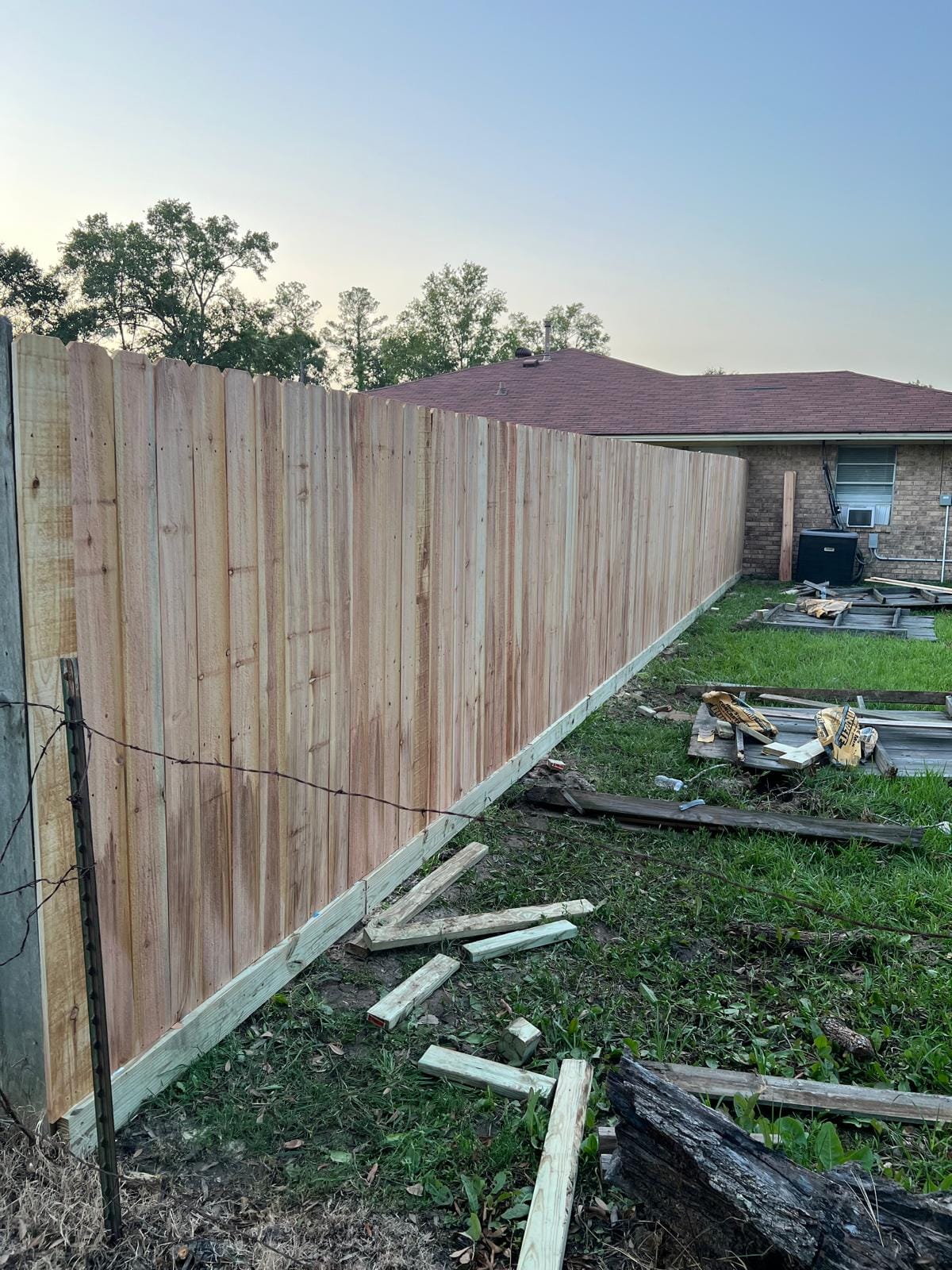
Wilda Garret wanted privacy and curb appeal on her Baytown property. The job: a 91-foot cedar fence with closely spaced boards on a triple-rail frame, plus a matching custom cedar gate. Here it is in photos, plus what the USDA’s own wood-science data says about cedar.

Wilda Garret’s Baytown property got a 91-foot cedar fence with closely spaced boards on a triple-rail frame, plus a matching custom cedar gate with heavy-duty hardware. Cedar heartwood rates “Resistant” on the USDA’s own decay-resistance scale — one tier below the very top class — and, properly finished, holds a stain or paint job for years rather than months.
Source: USDA Forest Products Laboratory, Wood Handbook FPL-GTR-282 (2021), Table 14-1, Chapter 16 and Table 16-2.
The job: a 91-foot cedar fence and matching gate
Wilda Garret’s property in Baytown called for a fence that balanced privacy with curb appeal. The result was a 91-foot cedar fence with closely spaced boards for privacy, built on a triple-rail frame for stability, paired with a custom cedar gate fitted with heavy-duty hardware to match the fence line.
The photos below are from that job.
How cedar’s decay resistance actually ranks
Cedar gets picked for fencing because it holds up outdoors without chemical treatment — but it isn’t the single most decay-resistant wood species. The USDA Forest Products Laboratory grades common woods into four tiers of natural heartwood decay resistance. Cedar (western redcedar, eastern redcedar, Port-Orford and others) lands in the second-highest tier, Resistant, one step below species like black locust and old-growth redwood.
Why the gate hardware matters as much as the boards
A cedar gate’s hardware choice affects more than how it swings. Cedar is rich in natural tannins, and the USDA’s own wood-finishing research is blunt about what happens when plain carbon steel fasteners meet that tannin in the presence of moisture: a black iron stain, common even on otherwise correctly installed work. Stainless steel fasteners avoid the problem entirely; hot-dip galvanized fasteners meeting ASTM A153/A are far less likely to stain than plain carbon steel.
How long a finish holds up on cedar
Once the fence is up, the question becomes upkeep. The USDA doesn’t publish a finish-life figure for fences specifically, but its closest published reference — smooth, vertical-grain cedar siding — gives a useful planning baseline for a cedar fence and gate finished the same way.
Will your hardware stain a cedar gate?
Pick the fastener/hardware material. Based on the USDA Forest Products Laboratory’s wood-finishing research on tannin-rich woods like cedar.
Source: USDA Forest Products Laboratory, Wood Handbook FPL-GTR-282 (2021), Chapter 16 (Finishing).
What customers say on Google
5.091 Google reviews · read them all on Google
had an excellent experience with mustang fencing From the initial consultation to the final installation, the team was professional, punctual, and attentive to detail. They helped me choose the perfect fence style to match my property and ensured everything was installed with precision. The quality of materials is top-notch, and the fence has completely transformed the look and security of my home. I highly recommend mustang services to anyone looking for reliable and high-quality fencing services!
I recently hired Mustang Fencing Services for a fence installation, and I couldn’t be happier with the results. The team was professional, punctual, and very knowledgeable. They provided a detailed estimate and completed the job on time and within budget. Overall highly recommended Mustang fencing services
True professionalism is very rare in this day and age, these guys live upto their word and deliver on their service! Our fence was down in the July storm and these guys came and gave a reasonable quote, after confirming I received a time line and they delivered! Will recommend them to everyone I know who needs fencing done.
Reviews shown word for word from the Mustang Fencing Services Google Business Profile (Galveston), captured 2026-11-06.
Questions we get about this
What size cedar fence was built for Wilda Garret?
Does cedar resist decay well?
Will gate hardware stain a cedar fence?
How long does a finish last on cedar before it needs redoing?
Why use a triple-rail frame with closely spaced boards?
Sources
Checked November 6, 2026. Rules change, so confirm with the City before you build.
- USDA Forest Products Laboratory, Wood Handbook: Wood as an Engineering Material, FPL-GTR-282 (2021) — Table 14-1 (decay-resistance grouping of domestic woods, cedar in the Resistant tier); Chapter 16 (iron stain on tannin-rich wood from plain carbon steel fasteners, and the stainless/hot-dip-galvanized alternative); Table 16-2 (expected finish life for paint and solid-color stain on smooth cedar/redwood siding — the closest published reference for cedar fencing).
Thinking about a cedar fence and gate of your own?
We’ll walk your property, talk through board spacing, framing and gate hardware, and put it on a written quote.