
Does a Cedar Gate Need Extra Room for Wood Movement?
Cedar is more stable than most fence lumber, but it still swells and shrinks as its moisture content changes. Here is the actual arithmetic for sizing the gaps on a wood gate, not just a rule of thumb.
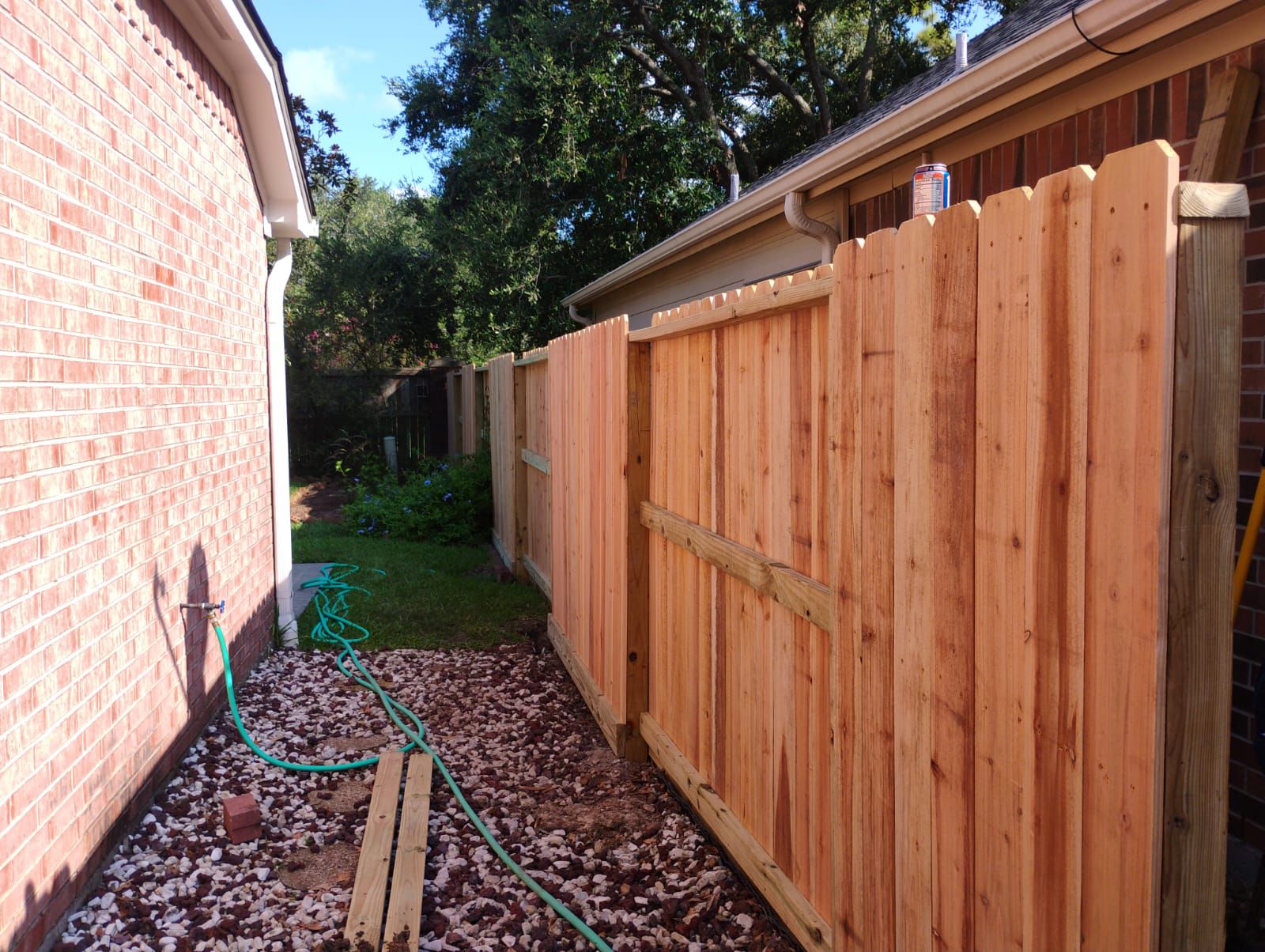
Wood moves with its moisture content, not the temperature directly. Western redcedar shrinks about 5.0% tangentially from green to oven-dry, per the USDA — less than southern pine at roughly 7.4-7.7%, which is why cedar gates stay truer over time. The USDA’s own formula (using a published dimensional-change coefficient) turns that into inches: a 5.5 in-wide flat-grain cedar board moving across an 8%-to-14% moisture swing changes width by about 0.08 in. Spread that over a gate’s hinge and latch gaps, not tightened flush, and the gate keeps working year-round.
Sources: USDA Forest Products Laboratory, Wood Handbook (FPL-GTR-282, 2021), Ch. 4, 8, 13, 16.
Why a cedar gate moves at all
Wood is hygroscopic — it absorbs and releases moisture until it matches the humidity around it (its “equilibrium moisture content,” or EMC). As that internal moisture content rises and falls, the wood swells and shrinks, mostly across its width, not its length. Temperature barely matters directly; humidity does.
The USDA’s own outdoor EMC table doesn’t include a Galveston or Houston row, but its two nearest Gulf Coast entries — Mobile, AL and New Orleans, LA — sit at roughly 13-15% nearly all year, without the sharp summer-to-winter swing a dry continental climate sees. The Handbook’s separate installation table lists 12% average moisture content (9-14% for individual pieces) as the recommended target for exterior wood in a “damp, warm coastal area” like ours. The bigger risk on the Gulf Coast usually isn’t a huge seasonal swing — it’s lumber installed wetter than that recommendation and then drying down to meet it, or a sudden soaking in a tropical system.
Cedar vs. other species: why it matters for a gate
Not all species move the same amount. From the USDA’s shrinkage table (green to oven-dry, tangential — the width direction on a flat-grain board):
- Western redcedar: about 5.0%
- Eastern redcedar: about 4.7%
- Southern pine (loblolly, longleaf, shortleaf, slash): about 7.4% to 7.7%
That’s roughly a third less movement than pressure-treated pine for the same board width — one reason cedar is a common choice for a gate, where a binding or sagging-looking gap is more visible and more annoying than on a long run of fence. See cedar wood fence and cedar vs. redwood for how the species compare for a full fence line.
Gap-sizing calculator for a cedar (or other wood) gate
Estimates how much a board’s width will change across a moisture-content swing, using the USDA’s own method (Eq. 13-3), and a recommended latch-side gap. Not a substitute for checking the finished gate by hand.
Formula: width x coefficient x moisture-content change (USDA Eq. 13-3, Table 13-5). The coefficient is calibrated for a 6%-14% moisture-content range; treat results for swings outside that band as a rougher estimate. No two boards move identically — grain, finish and how long the wood has dried before installation all matter.
Hardware has to move with the wood too
Gap sizing solves half the problem; fasteners solve the other half. The USDA Wood Handbook found that common smooth-shank nails lose a major part of their holding power once the wood they’re driven into goes through cycles of wetting and drying — down to as little as 25% of their original withdrawal resistance. Annularly threaded (ring-shank) and helically threaded (screw-shank) nails hold roughly four times better than smooth nails under the same wet-dry cycling, which is exactly what a gate’s boards and hardware go through every year.
In practice: use ring-shank or screw-shank fasteners (or deck screws) for gate boards and hinge/latch hardware, not smooth common nails, and expect to snug up hinge screws again after the gate’s first full season as the wood reaches its equilibrium moisture content.
What Galveston customers say
5.091 Google reviews · read them all on Google
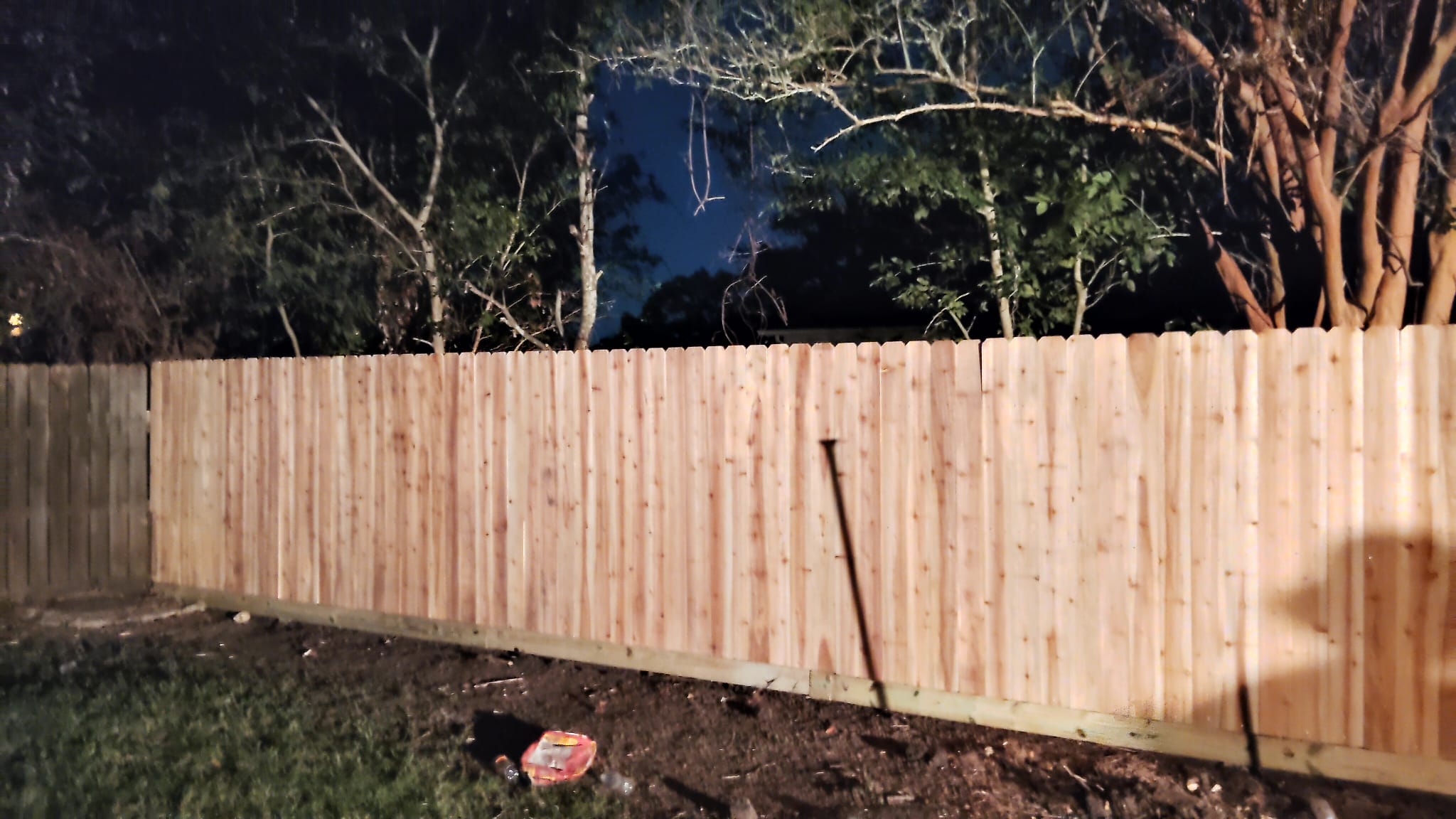
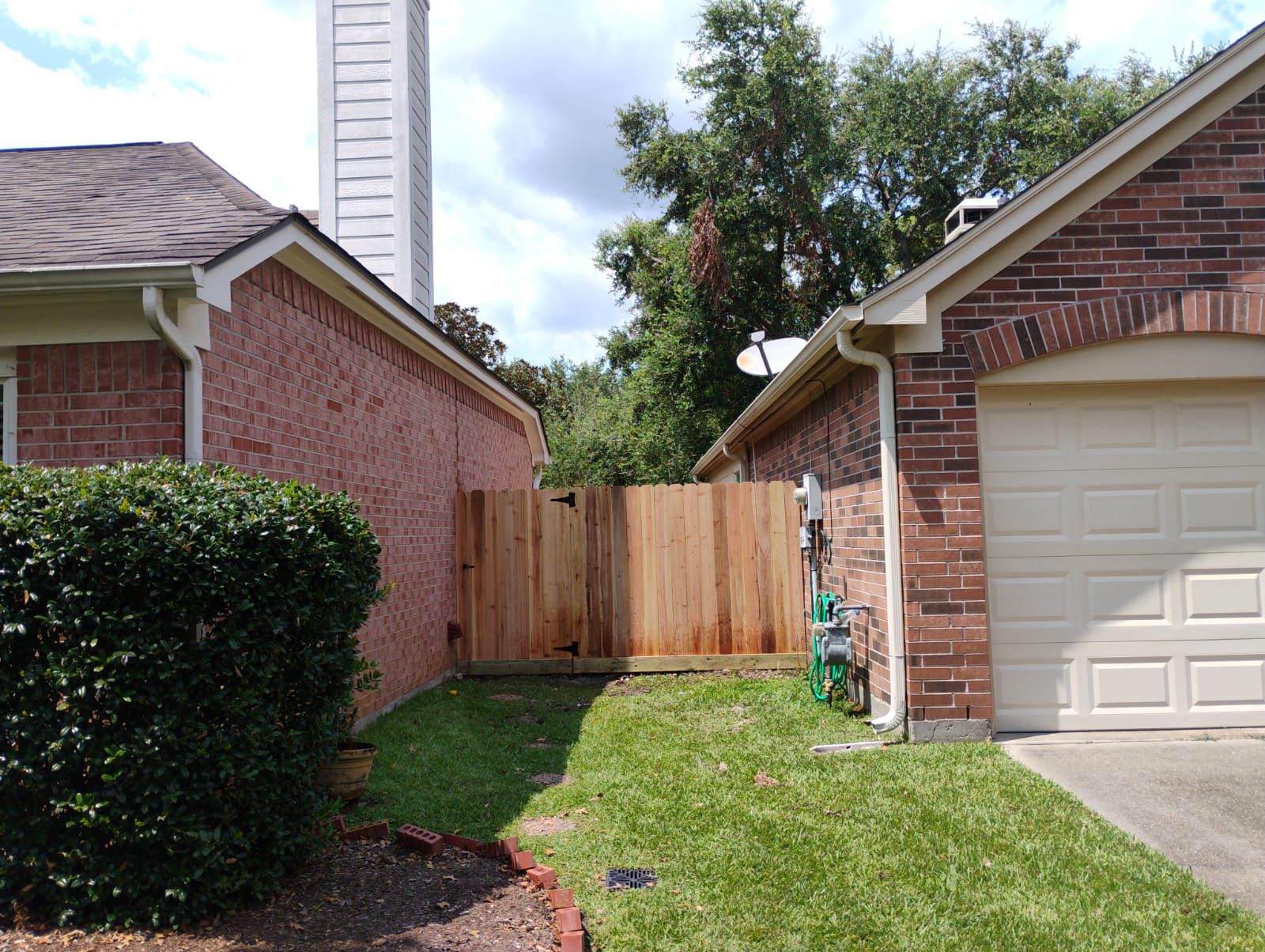
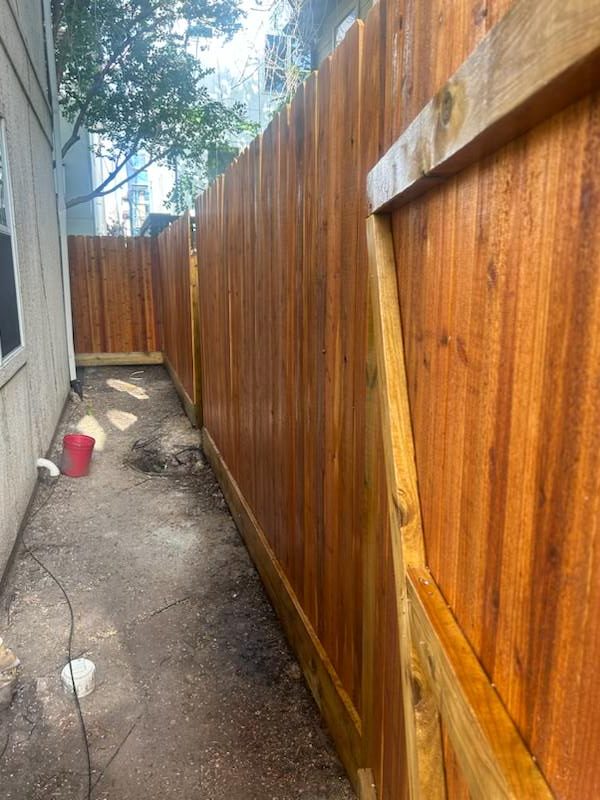
Amazing work will go ahead and recommend everyone in friends and family We installed 8ft tall double sided stained cedar wood fence in our backyard, it’s really looks great, installed perfectly nice finishing and cost effective, thanks mustang fencing.
Installed Stained cedar wood fence yesterday by mustang fencing, thanks for the beautiful work.
I have hired Mustang fencing services to fix my backyard fencing. Good wood to used. I really like theirs work. Best of luck
Reviews shown word for word from the Mustang Fencing Services Google Business Profile (Galveston), captured 2026-10-12.
Questions we get about this
How much gap should I leave on a cedar gate?
Why does my gate bind at some times of year and gap at others?
Does the direction the boards were cut matter?
Is cedar actually better than pine for a gate that won’t bind?
What fasteners should I use on a gate that moves seasonally?
Should I just build the gate tight and plane it later if it binds?
Sources
Checked October 16, 2026. Rules change, so confirm with the City before you build.
- USDA Forest Products Laboratory, Wood Handbook (FPL-GTR-282, 2021) — Ch. 4: shrinkage values (Table 4-3), radial/tangential/longitudinal movement; Ch. 8: fastener withdrawal resistance under moisture cycling; Ch. 13: dimensional-change coefficients (Table 13-5), Eq. 13-3, recommended installation moisture content (Table 13-2), outdoor EMC (Table 13-1); Ch. 16: flat-grain vs. vertical-grain cupping.
- City of Galveston Land Development Regulations, Sec. 2.501(B) — Gate height follows the fence it’s set in: 8 ft side/rear, 4 ft solid or 5 ft (if at least 60% transparent) front yard.
Building or replacing a cedar gate?
We size the gaps for your exact boards and hang the hardware to move with the seasons, not against them. Free on-site estimates across Galveston County.