
Chain Link Fence Gauge Explained: 9 vs 11 vs 11½ Gauge
Gauge is the thickness of the wire, and the scale runs backwards: #9 is heavier than #11. Here is what each gauge actually measures, how much stronger the heavier wire is, which gauges the industry treats as commercial, and why on the coast the zinc coating matters as much as the wire.
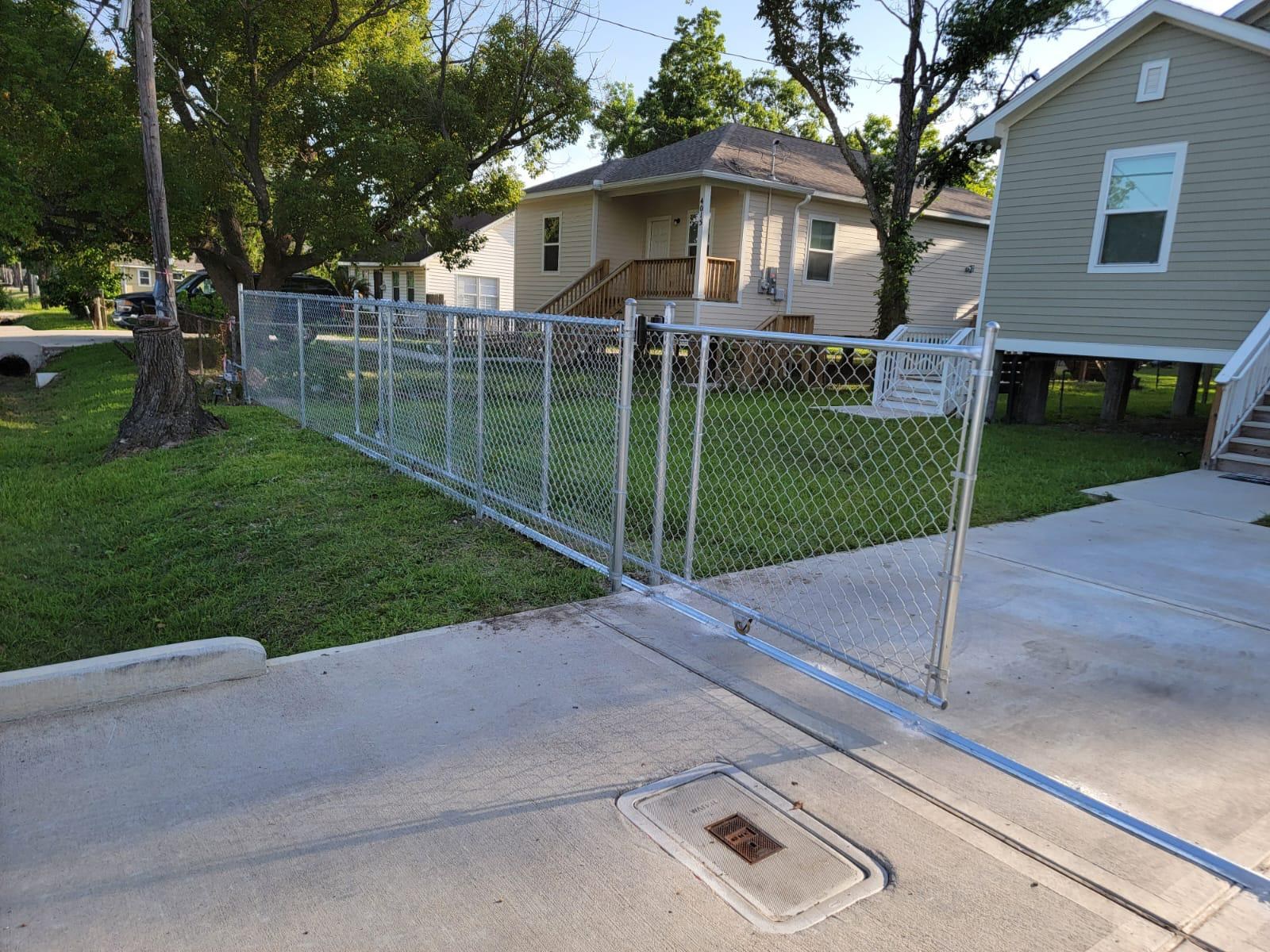
A lower gauge number means thicker wire. #9 gauge chain link is 0.148 inch thick and has a minimum breaking strength of 1,290 lbf. #11 is 0.120 inch and breaks at 850 lbf. That is about 52% more steel and strength for #9. The industry’s commercial spec guide treats #11 in standard 2-inch mesh as not a commercial mesh, and #11 can only be bought with the lighter of the two zinc coatings. Lighter #11 and #11½ fabric is sold for home fences; near salt water, the coating deserves as much attention as the gauge.
Sources: Merchants Metals, Zinc Coated Steel Chain Link Fence Fabric data sheet (ASTM A392 Table 1 values); CLFMI Guide for Specifying Commercial/Industrial Chain Link Fence, Section 32 31 13; Master Halco galvanized chain link limited warranty.
What chain link gauge actually measures
Gauge is the diameter of the steel wire that is woven into the diamond mesh. It isn’t the mesh size, the height or a quality grade. The scale runs backwards: a higher gauge number means thinner wire. Of the gauges on this page, #6 is the heaviest and #11½ the lightest.
The standard for galvanized chain link fabric is ASTM A392. It sets the wire size, mesh size, height, selvage (the knuckled or twisted edges), zinc coating weight and breaking strength. A supplier’s data sheet built on A392, such as Merchants Metals’, lists the three standard galvanized gauges:
- #6 gauge: 0.192 inch (4.88 mm)
- #9 gauge: 0.148 inch (3.76 mm)
- #11 gauge: 0.120 inch (3.05 mm)
You will also see #11½ gauge (0.113 inch) in residential systems. Master Halco’s warranty names it as the lightest fabric it will cover in a residential galvanized system. If a quote says “chain link” with no gauge at all, ask. It is the first number that tells you what you are buying.
9 gauge vs 11 gauge: what the extra 0.028 inch buys
On paper the two wires are close: 0.148 inch against 0.120. But a wire’s strength depends on its cross-section area, and area goes with the square of the diameter. (0.148 ÷ 0.120)² = 1.52, so #9 has about 52% more steel than #11.
The published numbers agree. Merchants Metals lists minimum breaking strengths of 1,290 lbf for #9 and 850 lbf for #11, based on a minimum tensile strength of 75,000 psi. That’s a ratio of 1.52. At the same 75,000 psi basis, #11½ wire (0.113 inch) works out to about 750 lbf. That figure is our arithmetic, not a listed value.
What that means on a fence:
- Impacts and leaning. Heavier wire resists denting from a dog jumping at it, a mower bumping it or storm debris. The mesh also stays tighter between posts.
- Cutting. Thicker wire takes longer to cut, which matters for storage yards and equipment lots.
- Coating options. This is the difference most buyers miss. Both Merchants Metals and CLFMI say #11 fabric comes with a Class 1 zinc coating only. The heavier Class 2 coating is made in #9 and #6.
What gauge doesn’t change is how the fence is framed. A #9 fabric on undersized, badly set posts is still a weak fence. Post size and footings are covered below and on our chain link fence installation page.
Minimum breaking strength by gauge
Pounds-force (lbf). #6, #9 and #11 are listed values; #11½ is arithmetic at the same 75,000 psi basis.
Chain link gauge chart
| Gauge | Wire diameter | Min. breaking strength | Galvanized coating classes | In 2″ commercial mesh (CLFMI) |
|---|---|---|---|---|
| #6 | 0.192″ (4.88 mm) | 2,170 lbf | Class 1 or Class 2 | Available |
| #9 | 0.148″ (3.76 mm) | 1,290 lbf | Class 1 or Class 2 | Available; the basis of CLFMI’s post table |
| #11 | 0.120″ (3.05 mm) | 850 lbf | Class 1 only | “Generally not a commercial/ind./security mesh” |
| #11½ | 0.113″ (2.87 mm) | ≈750 lbf (calculated) | Not listed in our sources | Not listed |
Merchants Metals data sheet (ASTM A392 values), Tables 1–2 and notes; CLFMI Section 32 31 13, Table 1; Master Halco warranty for the #11½ diameter. Class 1 = 1.2 oz/ft² of zinc, Class 2 = 2.0 oz/ft².
What gauge is commercial chain link?
#9 is the working commercial gauge, and #6 is the heavy step up. The Chain Link Fence Manufacturers Institute (CLFMI) publishes a guide for specifying commercial, industrial and security chain link. Its fabric table marks #11 wire in 2-inch mesh as “generally not a commercial/ind./security mesh.” Its line post table is calculated for 2-inch, #9 fabric. For security fences, it points designers to separate CLFMI security documents rather than a lighter fabric.
A lighter fabric can hide in a low bid if the quote doesn’t name the gauge. If two quotes for a storage yard differ a lot, compare the gauge, the zinc class and the post sizes line by line. See commercial chain link fencing for commercial options, or our commercial fencing page if the site needs more than chain link.
Check a chain link spec before you sign
Pick how the fence will be used, how tall it is, how close it sits to salt water, and the coating. The checker applies the fabric and post minimums from the industry documents cited below and compares how long each zinc coating lasts at ISO 9223 corrosion rates.
Fabric and posts: CLFMI Guide for Specifying Commercial/Industrial Chain Link Fence (Section 32 31 13), Tables 1 and 2; Merchants Metals galvanized fabric data sheet (ASTM A392 values); Master Halco galvanized chain link warranty (residential minimums). Zinc life: coating weight ÷ 0.56 oz/ft² per mil (American Galvanizers Association), divided by the ISO 9223 zinc corrosion range for the distance band (AGA, “HDG Corrosion Rates for ISO Categories”). ISO rates come from one-year exposures and run conservative; rain rinsing, shelter and spray direction change real life. This is a comparison, not a prediction or a warranty.
Specing a chain link fence in Galveston County?
We measure, check your HOA and city rules, and quote on site — free.
What gauge is best for a home?
There is no single right answer. Lighter gauges are not just for temporary fencing: Master Halco’s residential warranty covers permanent systems built with #11½ fabric. What the sources support is this:
- #11½ is the floor. Master Halco will warrant a residential galvanized chain link system only with #11½ (0.113 inch) fabric or heavier. Its posts must be at least 16 gauge wall (0.065 inch) and its top rail at least 17 gauge (0.055 inch), per ASTM F761.
- #9 is the upgrade that brings a better coating with it. Beyond the 52% extra steel, #9 is the lighter of the two gauges you can get with Class 2 zinc.
- Large or determined dogs, kids climbing, a fence along a busy alley: these are the cases where the extra breaking strength of #9 earns its cost. For more on pets, see dog-proofing a chain link fence.
On the coast, the coating matters as much as the gauge
Galvanized steel is protected by its zinc, and zinc is used up slowly by the weather. Salt speeds that up. The American Galvanizers Association (AGA) summarizes the ISO 9223 corrosion categories this way:
- C5, “within a few hundred meters of the ocean”: zinc loss of 0.165–0.331 mils a year.
- C4, under 1 km from the ocean or within 100 m of a sheltered shore: 0.082–0.165 mils a year.
- C3, roughly 1–30 km from the ocean depending on wind and cover: 0.028–0.083 mils a year.
Convert the coating weight to thickness with AGA’s figure of 1 mil = 0.56 oz/ft². Class 1 (1.2 oz/ft²) is about 2.1 mils of zinc; Class 2 (2.0 oz/ft²) is about 3.6 mils. Divide by the loss rate and Class 1 fabric within a few hundred meters of the Gulf has roughly 6 to 13 years of zinc; Class 2 roughly 11 to 22. A kilometer or more inland, both last several times longer.
Two honest caveats. The ISO rates come from one-year exposures and run conservative. AGA’s own “tropical marine” average, built partly on Corpus Christi data, is 0.050 mils a year, which sits in the milder C3 range. But AGA also says its lifetime chart doesn’t represent coastal applications. Treat the numbers as a comparison between coatings, not a promise. What’s certain is the warranty language: Master Halco’s galvanized chain link warranty says “use in harsh industrial, coastal or marine environments is not warranted.” Merchants Metals warrants its Class 2 fabric for 25 years against rust failure; read the exclusions for any warranty you are offered.
Near salt water, the practical choices are Class 2 galvanized (which means #9 or #6) or polymer-coated fabric (ASTM F668), where a vinyl jacket covers the metallic coating. CLFMI lists dark green, olive green, brown and black as the standard polymer colors (ASTM F934). See black vinyl-coated vs galvanized and how long chain link lasts.
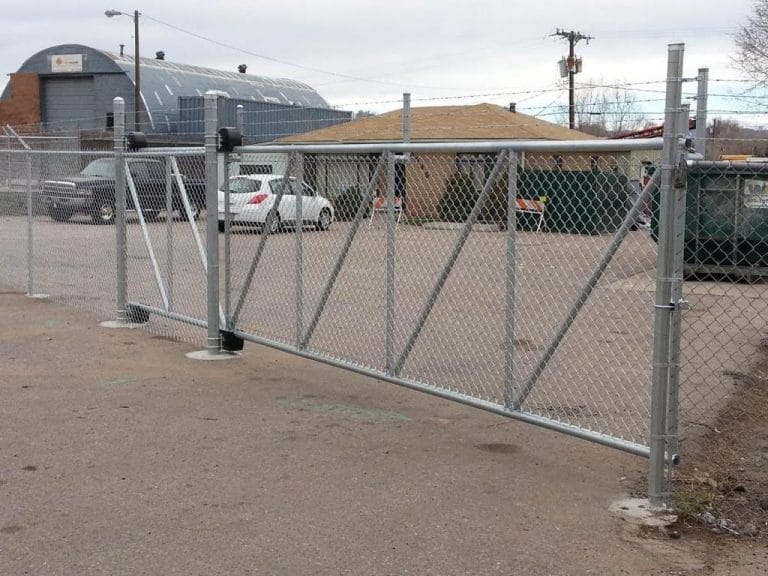
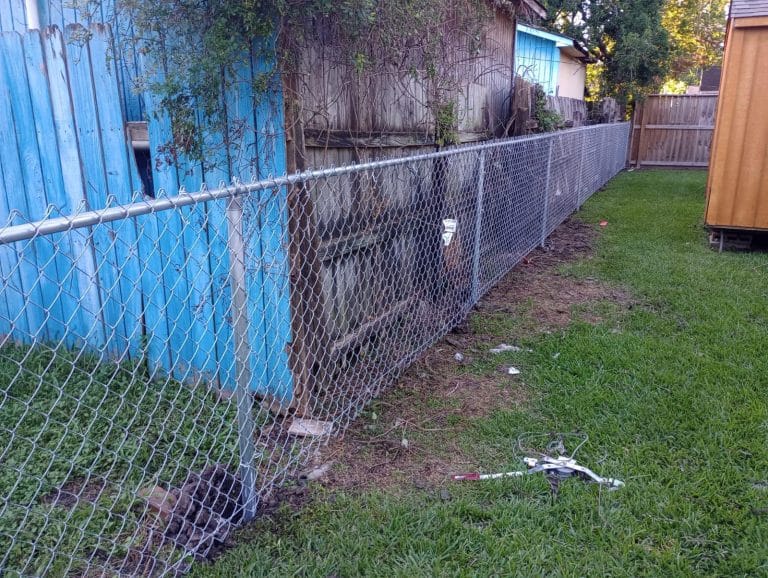
Fence post gauge and size
Posts are specified two ways, and quotes mix them up:
- Residential framework is usually described by wall gauge. Master Halco’s warranty minimum is 16 gauge (0.065 inch) for terminal and line posts and 17 gauge (0.055 inch) for the top rail, meeting ASTM F761. As with wire, a lower gauge number means a thicker wall.
- Commercial framework is described by pipe size and group. CLFMI’s guide specifies ASTM F1043 Group IA (Schedule 40 galvanized pipe per ASTM F1083) or Group IC. Its minimum line post outside diameter rises with height: 1.900″ up to 6 ft, 2.375″ over 6 to 8 ft and 2.875″ over 8 to 12 ft. Terminal posts are generally one size larger. Rails are 1.660″ OD, 2.27 lb/ft for Group IA and 1.84 lb/ft for Group IC.
CLFMI’s post table assumes 2-inch #9 fabric, a 90 mph gust and open terrain (Exposure B). It warns that fences with slats or windscreens, and fences over 8 ft with 1-inch mesh or smaller, need a wind-load analysis. The City of Galveston’s fence permit application and code pages don’t state a design wind speed. Ask your installer what wind speed and exposure the post size and spacing are based on. For footing depth and why slats load the posts, see chain link fence installation, and for storm planning, hurricane-ready fencing.
What Galveston customers say
5.091 Google reviews · read them all on Google
chainlink fence installation by mustang fencing, looks really great, thanks.
Mustang’s team installed iron fence for me and did an absolutely incredible job! I would recommend this company to anyone I know!
1 of my friend recommended mustang fencing, they installed a beautiful iron fence yesterday, we love it.
Reviews shown word for word from the Mustang Fencing Services Google Business Profile (Galveston), captured 2026-10-05.
Questions we get about this
Is 9 gauge or 11 gauge chain link better?
Is 9 gauge thicker than 11 gauge?
What gauge is commercial chain link fence?
What is 11½ gauge chain link?
What gauge should chain link fence posts be?
Does the gauge of vinyl-coated chain link include the coating?
Sources
Checked September 26, 2026. Rules change, so confirm with the City before you build.
- Merchants Metals, Zinc Coated (Galvanized) Steel Chain Link Fence Fabric, technical data sheet (rev. April 2014) — ASTM A392 wire diameters, breaking strengths and 75,000 psi basis; Class 1 and Class 2 coating weights; #11 fabric Class 1 only; mesh and height availability; 25-year Class 2 warranty.
- Chain Link Fence Manufacturers Institute, Guide for Specifying Commercial/Industrial Chain Link Fence, Section 32 31 13 — Fabric table (#11 in 2″ mesh generally not commercial; Class 2 in #9 and #6); polymer-coated gauge = core wire; ASTM F1043 framework groups; line post minimum sizes by height (90 mph basis); wind-load caution.
- Master Halco, 12 Year Limited Warranty, Galvanized Chain-Link Fence System — Residential minimums: 11½ gauge (0.113″) fabric per A392, 16 gauge (0.065″) posts, 17 gauge (0.055″) top rail per F761; coastal and marine use not warranted.
- American Galvanizers Association, HDG Corrosion Rates for ISO Categories C1–C5/X (2021) — ISO 9223 zinc corrosion rates and distance-from-ocean descriptors; AGA tropical marine average; limits of the time-to-first-maintenance chart.
- American Galvanizers Association, Time to First Maintenance Chart for Hot-Dip Galvanized Coatings — Conversion 1 mil = 0.56 oz/ft² of zinc.
- ASTM A392-11a(2022), Standard Specification for Zinc-Coated Steel Chain-Link Fence Fabric — Scope: mesh, wire size, height, selvage, Class 1 or 2 coating weight and breaking strength requirements.
- ASTM F668-25, Standard Specification for Polymer-Coated Steel Chain-Link Fence Fabric — Scope: polymer coatings over zinc- or aluminum-coated wire, coated before weaving; Classes 1, 2a and 2b.
Planning a chain link fence?
We’ll walk the line, talk through gauge, coating and posts for your spot, and give you a written price. Free on-site estimates across Galveston County.