
Keypad vs. Remote Control: Which Gate Access Method Do You Need?
A keypad and a remote transmitter are both just the “primary control” that tells an automatic gate operator to move. Galveston’s adopted building code (2021 IRC Appendix AO, via Ordinance No. 23-012) requires every automated gate to meet ASTM F2200 and use a UL 325-listed operator no matter which one you pick. Here’s what actually differs between them, and what both still need alongside them.
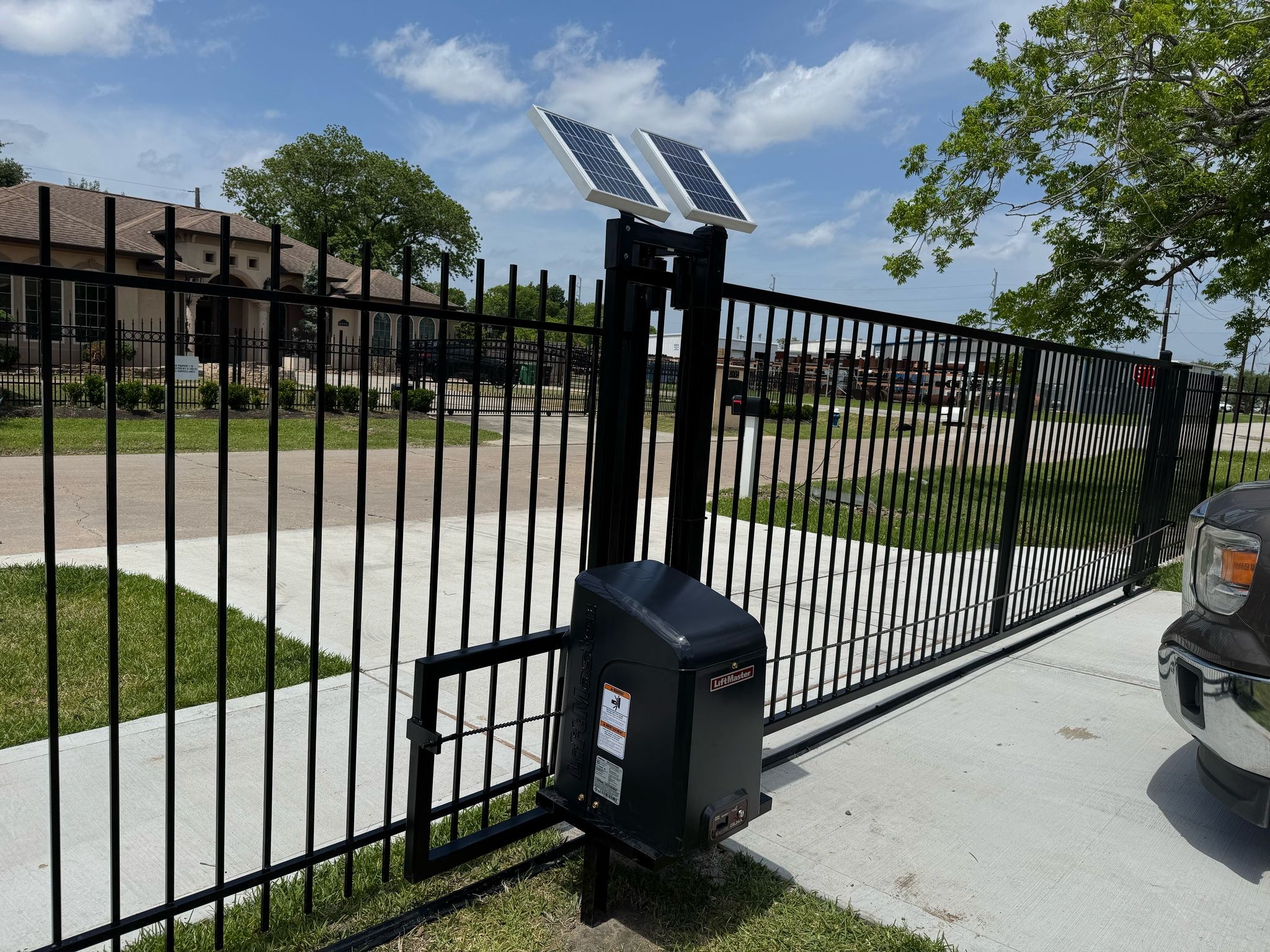
A keypad and a remote transmitter are two different ways to activate the same gate operator — neither one is a safety device, and code treats them the same way on that point. Under the 2021 IRC’s Appendix AO (adopted by Galveston via Ordinance No. 23-012) and ASTM F2200, any automated gate needs a UL 325-listed operator and its own secondary entrapment-protection device, such as a monitored photo-eye or edge sensor, no matter which primary control opens it. Where they actually differ: a keypad is a fixed control that UL 325 requires be mounted with a minimum setback from the gate, and its code can be shared (and has to be managed); a remote isn’t mounted to the property at all, has no code to share, but means reprogramming the receiver if one is lost.
Sources: City of Galveston Ordinance No. 23-012 (2021 IRC Appendix AO); ASTM F2200; UL 325; DASMA Technical Data Sheet #353.
What a keypad and a remote each actually are
A keypad is a fixed numeric entry pad mounted at a post or column near the gate — it stays on the property, and whoever knows the code can get in. See our guide to how many people a keypad code should go to, and how often to change it. A remote transmitter is a handheld clicker, one per vehicle or person, that isn’t mounted anywhere; it has no shared code, but range is limited to roughly line-of-sight and the transmitter itself runs on a battery that eventually needs replacing.
Both are just ways to tell the gate operator to open or close — neither one is the part of the system responsible for keeping a person or vehicle from getting caught in the gate.
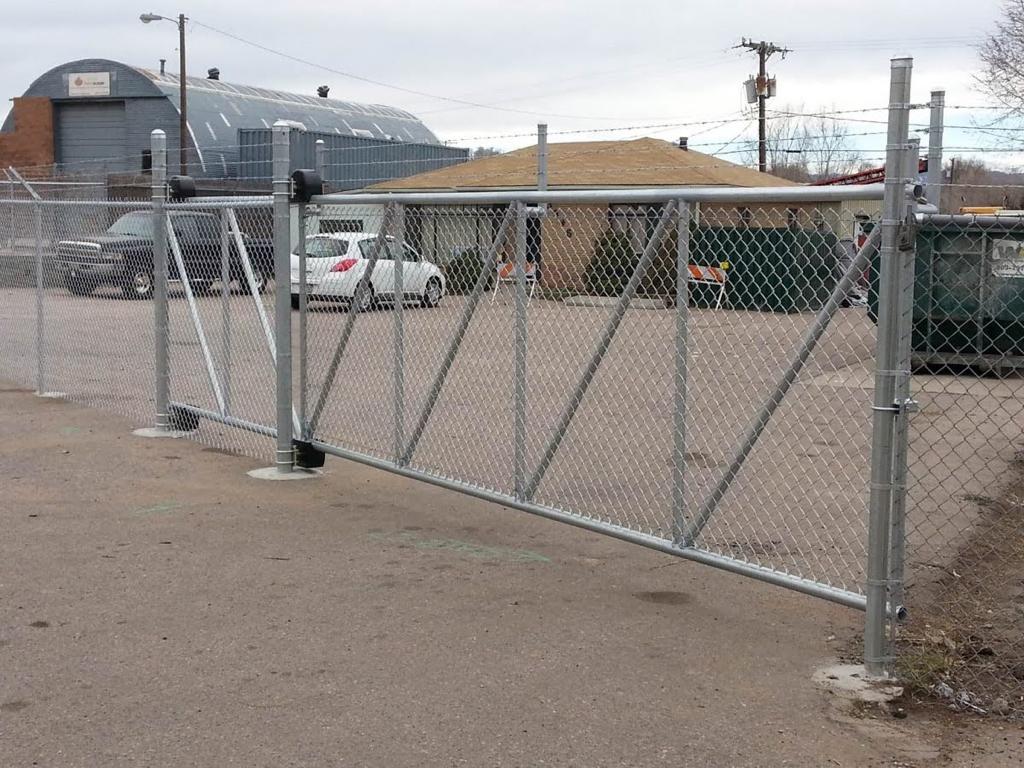
The one real code-driven difference: where the control can go
Because a keypad or call box is fixed to the property, UL 325 (as summarized in DASMA Technical Data Sheet #353 and confirmed in LiftMaster’s own CSL24UL slide and CSW24UL swing operator manuals) sets a minimum 6 ft setback for where that control can be mounted relative to the gate — keeping the person entering a code out of the gate’s own moving path. A handheld remote isn’t fixed to the property at all, so that particular placement rule doesn’t apply to it the same way; the tradeoff shows up elsewhere instead, in managing who has the code (keypad) versus managing lost or dead transmitters (remote).
What doesn’t change: the entrapment-protection requirements below apply to the gate itself, regardless of which control activates it.
Side by side
| Keypad | Remote transmitter | |
|---|---|---|
| Where it lives | Fixed post/column, ≥ 6 ft setback from the gate (UL 325) | Handheld, carried in the vehicle or on a keychain |
| Access code | Shared; needs periodic management/changes | None — nothing to share |
| If one is lost | Change the code | Delete and reprogram that unit at the receiver |
| Range/power | Hardwired or solar at the post | Line-of-sight; handset battery wears out |
| Entrapment protection needed | Same secondary device required (UL 325/ASTM F2200) | Same secondary device required (UL 325/ASTM F2200) |
Sources: UL 325; DASMA Technical Data Sheet #353; LiftMaster CSL24UL / CSW24UL manuals.
Pick the primary control for your gate
Answer two questions about how the gate actually gets used. Either way, the gate still needs a UL 325-listed operator and its own entrapment protection — this only helps pick the activation method.
Based on the tradeoffs above: a keypad’s code is easy to share and change but has to be managed; a remote has no code to share but means reprogramming the receiver when one is lost. Not a substitute for UL 325/ASTM F2200 compliance, which applies regardless of which control is chosen.
What Galveston customers say
5.091 Google reviews · read them all on Google
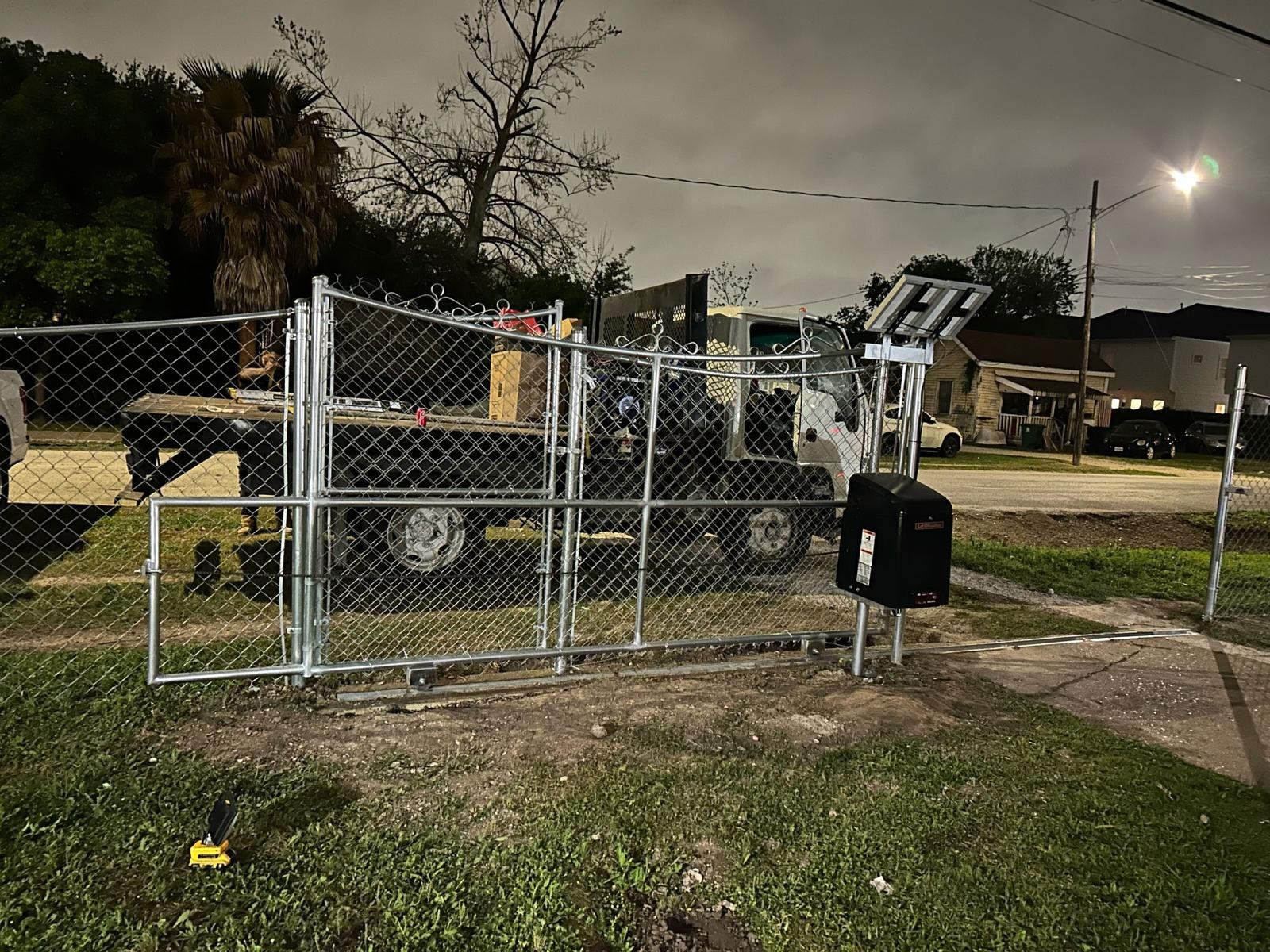
Very professional and friendly. Gotten automatic gates done and they are done to perfection! Thank you
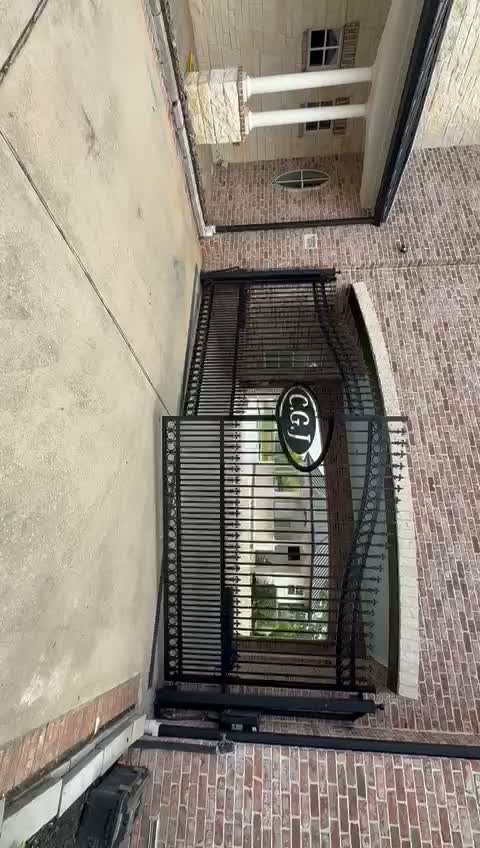
We just installed iron gate and it looks amazing thank you very much mustang fencing .
had an excellent experience with mustang fencing From the initial consultation to the final installation, the team was professional, punctual, and attentive to detail. They helped me choose the perfect fence style to match my property and ensured everything was installed with precision. The quality of materials is top-notch, and the fence has completely transformed the look and security of my home. I highly recommend mustang services to anyone looking for reliable and high-quality fencing services!
Reviews shown word for word from the Mustang Fencing Services Google Business Profile (Galveston), captured 2026-10-12.
Questions we get about this
Can I use both a keypad and a remote on the same gate?
Does a keypad or remote replace the safety sensors my gate needs?
Where does Galveston’s code actually apply to automated gates?
Can a keypad be mounted right next to the gate?
What’s the real tradeoff between a keypad code and a remote?
Sources
Checked October 14, 2026. Rules change, so confirm with the City before you build.
- City of Galveston Ordinance No. 23-012 (2021 IRC adoption, Appendix AO) — AO103.1/AO103.2: automated vehicular gates must comply with ASTM F2200 and use a UL 325-listed operator.
- 2021 IRC Appendix AO, Automatic Vehicular Gates (model-code text) — Scope and definitions for automatic vehicular gates on a one- or two-family lot.
- ASTM F2200-24, Standard Specification for Automated Vehicular Gate Construction — Performance/prescriptive gate-construction requirements; 1.4 requires UL 325 compliance.
- UL 325, Door, Drapery, Gate, Louver, and Window Operators and Systems (7th ed.) — Listing standard for gate operators; entrapment-protection and control-placement requirements summarized on this page from DASMA/LiftMaster documents that reprint its tables.
Deciding how to open your Galveston gate?
We’ll go over whether a keypad, a remote, or both fit how your property is actually used, and make sure the operator and entrapment protection are installed to UL 325/ASTM F2200 either way.