
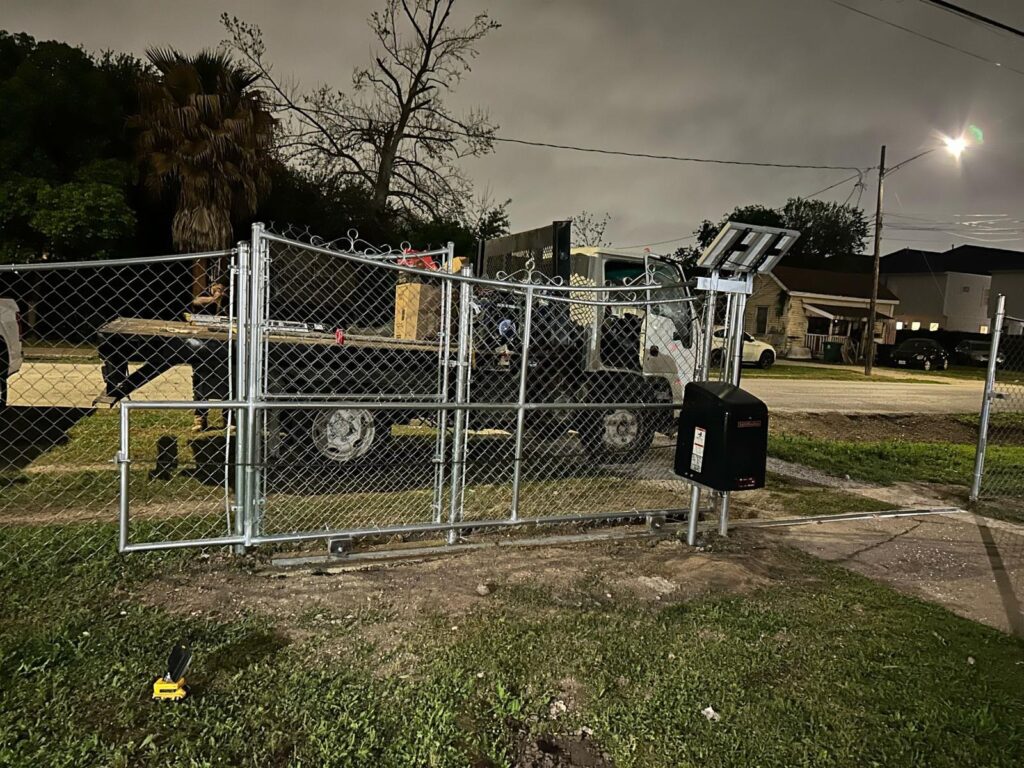
Straight answers from a local fence and gate contractor serving Galveston and Brazoria Counties.
A gate that stops mid-cycle or reverses instead of closing is doing exactly what it’s designed to do when something interrupts a safety sensor — this is a required safety behavior under UL 325 (see our post on electric gate safety sensors), not necessarily a sign the operator itself is broken.
The most common cause: photo-eye sensors
Photo-eye (photoelectric) sensors project a beam across the gate’s path, and if anything breaks that beam while the gate is closing, the operator is designed to stop and reverse the gate rather than continue closing into a potential obstruction. The most frequent reasons this triggers unexpectedly have nothing to do with an actual obstruction: dirt, spider webs, water droplets, or condensation on the sensor lens; misalignment of the two sensor units after they’ve been bumped, jostled, or shifted slightly over time; direct sunlight hitting a sensor at certain times of day and interfering with the beam; and vegetation or landscaping that’s grown into the sensor’s line of sight.
Sensor monitoring can also be the culprit
Current-generation gate operators are required to actively monitor connected safety sensors on every cycle, and if a sensor is disconnected, wired incorrectly, or has failed, the operator is designed to refuse to run rather than operate without functioning entrapment protection. This means a gate that won’t operate at all — not just one that reverses mid-cycle — can also point back to a sensor or its wiring rather than the motor itself.
Other common (non-sensor) causes
Beyond sensors, a few other issues commonly cause stopping or reversing behavior: an obstruction in the gate’s actual path (a rock, debris, or a buildup of dirt on a track for sliding gates); a battery that’s low enough to cause inconsistent operator behavior on systems with backup power; or a genuine mechanical bind — a hinge, roller, or track issue causing physical resistance the operator interprets as an obstruction.
What to check before calling for service
A few things are worth checking first: clean the photo-eye lenses (a soft cloth is usually enough) and confirm the two sensor units are still aimed directly at each other; look for anything — new landscaping growth, a fallen branch, a stray object — that might be sitting in or near the sensor beam or the gate’s actual path; and, for sliding gates, check the track for debris buildup.
When to call a technician
If cleaning the sensors and clearing the path doesn’t resolve it, the issue is likely either a sensor alignment/wiring problem or a genuine mechanical issue, and both are worth having a technician look at rather than disabling or bypassing the safety sensor — which is a real safety risk and not a legitimate fix.
Related Questions
Is it safe to disable a gate’s safety sensor if it keeps false-triggering?
Can dirty sensors really cause a gate to reverse?
Why would my gate refuse to operate at all rather than just reverse?
Ready for a real number for your property? Request a free on-site estimate from Mustang Fencing Services.