
Can My HOA Make Me Remove My Fence?
It can enforce recorded restrictions against a fence, and a court can back it. But Texas law sets the steps first: written notice, a chance to fix a curable problem, and a hearing if you ask. And some fences it can’t touch at all. Here is how it works, and a planner for the letter on your table.
Yes, if the fence breaks your recorded deed restrictions, but not in one step. Before an HOA can fine you or sue (other than to collect assessments), Texas law requires written notice by certified mail, a reasonable time to cure a curable violation, and a board hearing if you request one by the 30th day (Property Code 209.006, 209.007). Cure it in time and no fine may be assessed. If it does go to court, the HOA’s decisions are presumed reasonable, a court can award up to $200 a day (202.004), and the winning HOA gets attorney’s fees (5.006). Some fences are protected: an HOA may not prevent a perimeter fence, and fencing installed before September 1, 2025 may be maintained (202.023).
Sources: Texas Property Code 5.006, 202.004, 202.023, 209.006 and 209.007; text retrieved from the Texas Legislature, September 27, 2026.
Where the HOA’s power to make you change a fence comes from
An HOA’s fence rules live in its dedicatory instruments: the recorded declaration, and rules and guidelines adopted under it (Property Code 202.001). They only have effect once filed in the county real property records (202.006). If your fence breaks one of those recorded rules, or was built without an approval they require, the HOA can enforce it.
Courts give HOAs room. An HOA’s exercise of discretion over a restrictive covenant is “presumed reasonable unless the court determines by a preponderance of the evidence that the exercise of discretionary authority was arbitrary, capricious, or discriminatory” (202.004(a)). A court “may assess civil damages for the violation of a restrictive covenant in an amount not to exceed $200 for each day of the violation” (202.004(c)). And in a suit over a restrictive covenant, the court “shall allow to a prevailing party who asserted the action reasonable attorney’s fees” (5.006). That is why a fence dispute that reaches court gets expensive for the owner quickly.
But the HOA has to take the statutory steps first, and some fences are off limits. Both are below.
The steps before a fine
1. A proper notice. Before an HOA may levy a fine, suspend your use of common areas or sue you (other than to collect assessments), it must send written notice by certified mail that describes the violation and any amount due, and tells you that you may request a hearing on or before the 30th day after it was mailed (209.006(a), (b)). For a curable violation that isn’t a threat to health or safety, it must give you a date to cure it and a reasonable period to do so.
2. The cure period. “If the owner cures the violation before the expiration of the period for cure … a fine may not be assessed for the violation” (209.006(e)). The statute lists examples of curable acts, including “the failure to construct improvements or modifications in accordance with approved plans and specifications” and a maintenance violation (209.006(i)).
3. The hearing. If you request one, the board must hold it within 30 days of receiving your request and give you at least 10 days’ notice. Either side may get one postponement of up to 10 days, and either may record it. At least 10 days before, the HOA must give you a packet of the documents, photos and communications it intends to use; if it doesn’t, you get an automatic 15-day postponement (209.007).
Two limits: if you already had notice and a chance to use these rights on the same violation in the previous six months, the notice step doesn’t repeat (209.006(d)); and these steps don’t apply when the HOA sues for a restraining order or injunction (209.007(d)). Chapter 209 doesn’t cover condominiums (209.003).
The statutory clocks, in days
Texas Property Code 209.006 and 209.007
Fences the HOA can’t make you remove
- A perimeter fence, as such. An HOA “may not adopt or enforce a restrictive covenant that prevents a property owner from building or installing” a perimeter fence (202.023(b)). It may still regulate the type, bar fencing that obstructs a sidewalk, drainage easement or license area, require a driveway gate on a laned road to be set back 10 ft, and, if a covenant provides for it, bar fencing in front of the front-most building line (202.023(c)).
- Older perimeter and front fences. “A property owner may maintain any perimeter fencing or fencing in front of a dwelling’s front-most building line installed or constructed before September 1, 2025” (202.023(d)).
- Mesh pool enclosures. An HOA may not prohibit or restrict a compliant enclosure of transparent mesh or clear panels in metal frames, up to 6 ft and not climbable, and may not ban one in black mesh (202.022).
- Rules that were never recorded. A dedicatory instrument has no effect until it is filed in the county real property records (202.006). Ask for the recorded copy; owners are entitled to association records (209.005).
- Security exceptions. The HOA may not bar perimeter or front fencing if your address is confidential by law, or you give it law-enforcement documentation of a need for enhanced security (202.023(e)).
These don’t make every fence safe. An HOA can still regulate the type of a perimeter fence, so a fence of the wrong material, height or color can still be a violation. What it can’t do is leave you with no perimeter fence at all. For the full list of what HOAs can regulate, see common HOA fence rules; for chain link, does chain link violate HOA rules?
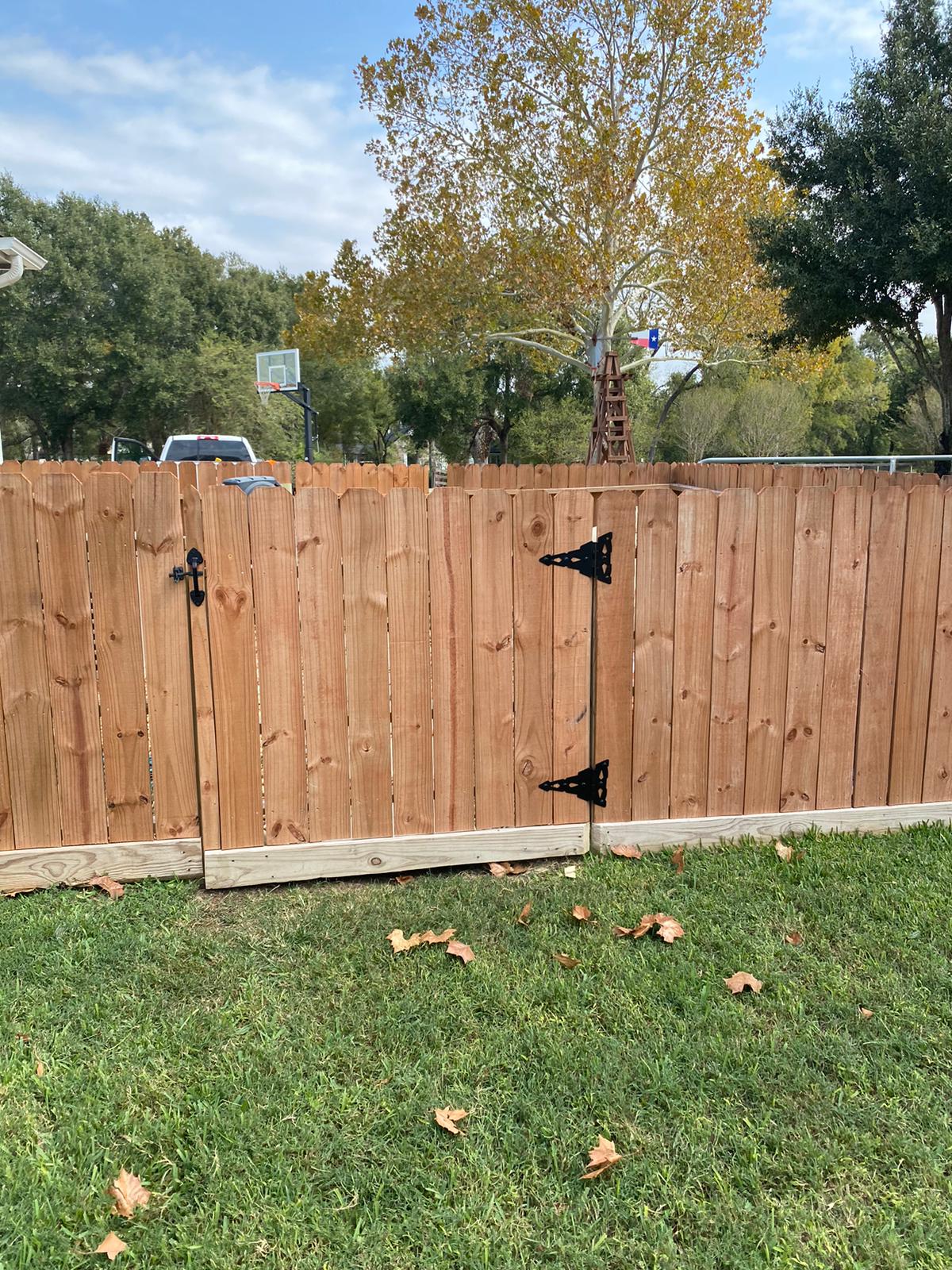
Built differently from the approval
The most avoidable removal fight is a fence that was approved, then built a little differently: a foot taller, a different stain, a gate moved, the good side flipped. Texas law treats that as curable (209.006(i)(3)), so you get notice and a reasonable time to bring it into line, or to ask the committee to approve it as built. It is still a violation. The drawing shows the classic case.
The fix is on paper before anyone digs: put the approved height, material, style, color, gate positions and fence line on your written quote, and build to it. Our HOA approval guide lists what to include in the application.
HOA fence notice planner
Got a letter about your fence? Enter what it says. The planner works out your hearing-request deadline, checks the notice against Section 209.006, and lists the protections that may apply. It is a guide to the statute, not legal advice.
Based on Texas Property Code 202.004, 202.006, 202.022, 202.023, 209.006 and 209.007, text retrieved September 27, 2026. Chapter 209 applies to residential subdivisions with mandatory-membership associations that can levy assessments; it does not apply to condominiums (209.003). The deadline counts calendar days from the mailing date. If you already received a notice about the same thing in the last six months, the notice step may not repeat (209.006(d)). For a live dispute, talk to a Texas real estate attorney.
If you get a letter
- Note the mailing date. Your hearing request is due on or before the 30th day after it. The planner above counts it.
- Check the notice. Certified mail, a description of the violation, a cure date for a curable one, and your right to a hearing (209.006(b)). Ask in writing for anything missing.
- Get the rule. Ask for the recorded declaration and the guideline the HOA relies on. If it isn’t recorded, it has no effect (202.006).
- Compare the fence to your approval. Measure it. Photograph it. If it differs, decide whether to change it or ask the committee to approve it as built.
- Fix it inside the cure period if you can. That ends the fine question (209.006(e)).
- Request a hearing if you disagree. Bring your approval, photos and measurements.
- Talk to a Texas real estate attorney if the HOA sues or the dispute is about the law itself.
If the answer is to change the fence, we can quote a change that matches your guidelines or the original approval, in writing, so the committee can see exactly what will be built. For wood options, see wood fences and privacy fence installation.
What Galveston customers say
5.091 Google reviews · read them all on Google
My new fence looks fantastic and has added both privacy and style to my yard. Highly recommend their services for anyone in need of fencing!
Absolutely loved my fence once i saw the finished product. No hassle, no rude interactions, and no inconveniences everything was just perfect. One of the best fencing companies in Texas
I like their quality, and at this price, it is a great deal to acquire a fence. Overall, I like their competent service. Would book them again if necessary.
Reviews shown word for word from the Mustang Fencing Services Google Business Profile (Galveston), captured 2026-09-27.
Questions we get about this
Can an HOA make you remove a fence in Texas?
Does Texas law limit what HOAs can restrict about fences?
How long do I have to respond to an HOA fence violation letter?
What if my fence doesn’t match what the HOA approved?
Can a new HOA rule force me to remove an existing fence?
Do I need a lawyer for an HOA fence dispute?
Sources
Checked September 27, 2026. Rules change, so confirm with the City before you build.
- Texas Property Code, Chapter 202 — 202.001, 202.004 (discretion presumed reasonable; HOA may litigate; civil damages up to $200 a day), 202.006 (filing), 202.022 (pool enclosures), 202.023 (security measures and perimeter fences; amended by S.B. 711, effective September 1, 2025).
- Texas Property Code, Chapter 209: Texas Residential Property Owners Protection Act — 209.003 (applicability), 209.005 (records), 209.006 (notice, cure period, curable examples, no fine if cured), 209.007 (hearing, packet, postponements).
- Texas Property Code, Section 5.006 — Reasonable attorney’s fees to a prevailing party who asserted an action for breach of a restrictive covenant.
Need a fence your HOA will accept?
Send us the notice and your guidelines. We’ll measure the fence as it stands and quote the change, or a new fence, with the height, material, color and line in writing for the committee. Free on-site estimates across Galveston County.