
My chain link double gate sags in the middle — how do I fix it?
A sagging double drive gate is almost always one (or more) of four things: an undersized gatepost for the leaf width, a post that was never braced and trussed, a footing that’s too shallow or narrow, or hinges carrying more weight than they were set up for — usually with no center support holding the two leaves together. The real industry spec for chain link gates gives real numbers for the first three. Here they are, plus a quick check for your own gate.
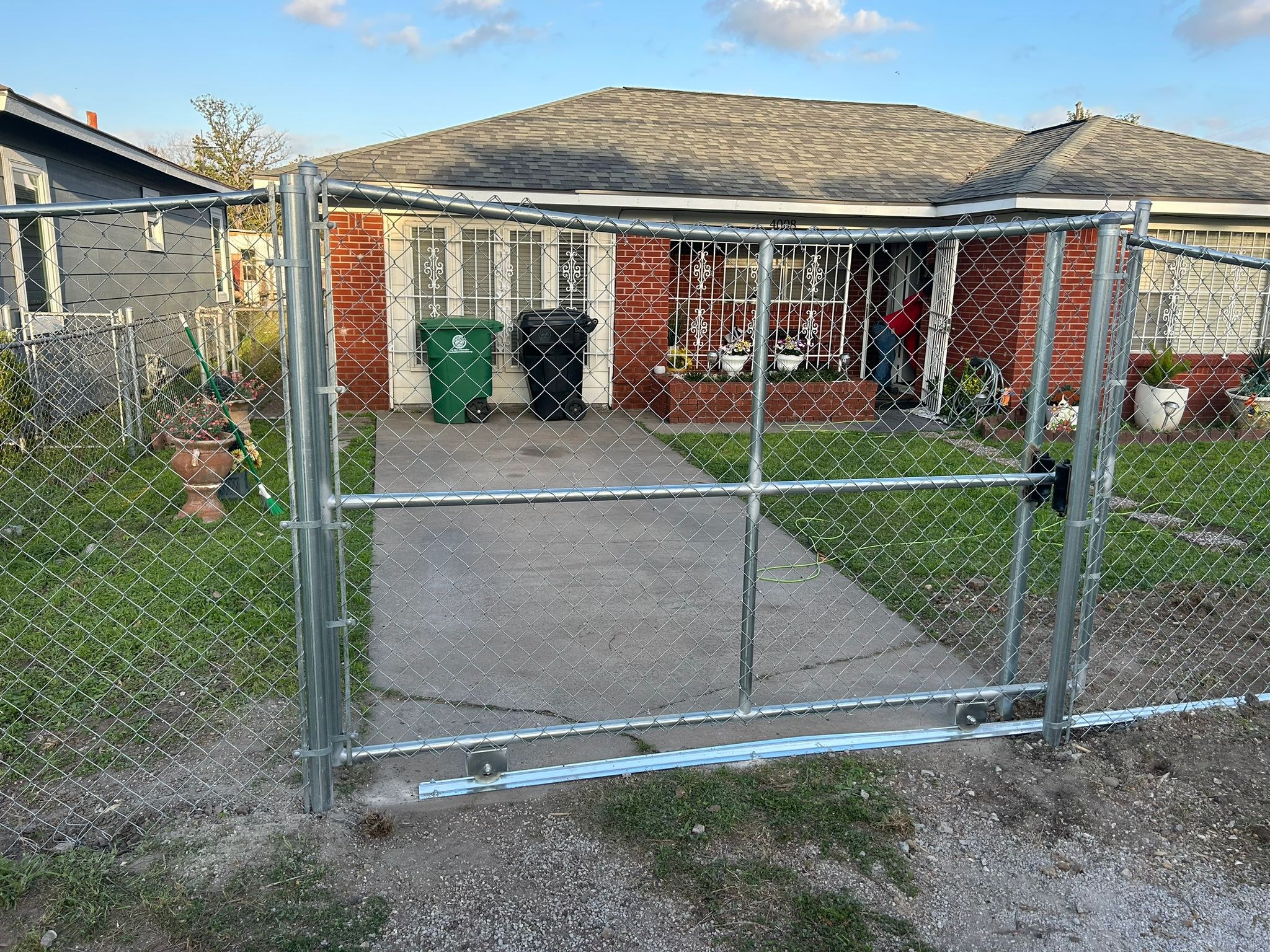
A sagging chain link double gate is a weight-and-support problem, not a mystery. The CLFMI (Chain Link Fence Manufacturers Institute) product manual sizes gate posts by leaf width: a leaf up to 4 ft needs at least a 2.375″ OD post, 4–10 ft needs 2.875″ OD, and 10–18 ft needs 4.000″ OD (for fabric up to 6 ft tall). That same manual requires gate posts to be braced and trussed — a horizontal brace rail plus a diagonal truss rod — on fences 6 ft and higher, and it requires a gate leaf holdback on every double gate, because two independent leaves with nothing tying them together at the center will drift and sag at the latch end over time. Worn or overloaded hinges are the other common cause — a hinge’s published “load rating” is not the same number as the gate weight it’s meant to carry day to day.
Sources: CLFMI Product Manual 32 31 13, §§ 2.9, 3.2, 3.5; D&D Technologies VersaWeld hinge spec (cited the same way on this site’s other gate-hardware pages).
Why double gates sag more than single walk gates
A double drive gate is two separate leaves, each hinged independently and meeting (or not quite meeting) in the middle. Every pound of each leaf’s weight is carried by that leaf’s own hinges and its own gate post — there’s no shared support unless something is added at the center. That’s a fundamentally different load than a single walk gate of the same fabric height, and it’s why CLFMI’s own gate-post sizing table scales up directly with leaf width: a post sized for a narrow leaf is, by the same table, undersized for a wider one.
Over months and years, an undersized or unbraced post doesn’t fail all at once — it leans a little at a time under the constant leverage of the leaf hanging off it, and the gate’s latch-side corner drops as the post tips toward the opening. That slow lean is what actually reads as “the gate is sagging,” even though the gate frame itself is usually fine.
What’s actually failing, by what the gate is doing
| What you see | Likely cause (CLFMI reference) | What usually fixes it |
|---|---|---|
| Gate drags the ground at the latch end, post looks straight | Worn or undersized hinges carrying more than their comfortable share of the leaf’s weight | Re-hang on correctly rated hinges for the gate’s actual weight and size |
| Both leaves lean inward or drift apart at the center over time | No gate leaf holdback — required on every double gate per § 3.5.A, often skipped on older installs | Add a center holdback / drop rod so the leaves meet consistently |
| The whole post leans toward the driveway, gate corner drops | Post undersized for the leaf (Table 2.9B) or not braced/trussed per § 3.2.C | Reset in a correctly sized post with brace rail + truss rod, in a footing sized to ASTM F567 |
| Fabric panel next to the gate sags or bellies | Tension wire not stretched taut and independent of the fabric, per § 3.2.D | Re-stretch the tension wire, then re-secure the fabric to it |
Is your gatepost even sized for your gate?
Based on CLFMI’s own product-manual table for chain link fabric up to 6ft tall. Pick the width of ONE leaf (a double gate has two).
Source: CLFMI Product Manual 32 31 13, Table 2.9B (chain link fabric height up to 6 ft). A post undersized for its leaf width is one of the most common reasons a double gate sags — but it’s not the only one; bracing, footing and hinge condition matter just as much (see below).
Fixing it without rebuilding the whole gate
If the post itself is sound but the frame has racked out of square, a diagonal truss-cable-and-turnbuckle kit — the same mechanism sold for wood-post gate frames — pulls a leaf back square by tightening the turnbuckle, rather than resetting the post. It’s a real, published anti-sag mechanism, just worth knowing it corrects the gate frame, not an undersized or unbraced post underneath it. For double-drive gates specifically, a drop rod kit at the center is the standard fix for leaves that don’t meet consistently — manufacturer installation guidance calls it “highly recommended” for exactly that gate type, with about a 1-inch gap left between the two leaves.

What Galveston customers say
5.091 Google reviews · read them all on Google
Very professional and friendly. Gotten automatic gates done and they are done to perfection! Thank you
Amazing work will go ahead and recommend everyone in friends and family We installed 8ft tall double sided stained cedar wood fence in our backyard, it’s really looks great, installed perfectly nice finishing and cost effective, thanks mustang fencing.
True professionalism is very rare in this day and age, these guys live upto their word and deliver on their service! Our fence was down in the July storm and these guys came and gave a reasonable quote, after confirming I received a time line and they delivered! Will recommend them to everyone I know who needs fencing done.
Reviews shown word for word from the Mustang Fencing Services Google Business Profile (Galveston), captured 2026-11-06.
Questions we get about this
Why does my chain link double gate sag in the middle?
What size post does a chain link gate actually need?
Do chain link gate posts need bracing?
Does a double gate need a center support?
Can I fix a sagging gate without resetting the post?
Is a hinge’s weight rating the same as the gate weight it should carry?
Sources
Checked November 6, 2026. Rules change, so confirm with the City before you build.
- CLFMI Product Manual 32 31 13, Chain Link Fence and Gates — Table 2.9B gate-post OD by leaf width; § 3.2 footing and bracing/trussing requirements for terminal (incl. gate) posts; § 3.5 swing-gate clearances, drop-bar footing, and holdback requirement for double gates.
- Adjust-A-Gate AG72 Adjustable Gate Frame Kit, Installation Manual — Diagonal truss-cable/turnbuckle anti-sag mechanism; double-drive-gate drop-rod recommendation and 1-inch leaf-gap guidance.
Gate sagging and not sure why?
We’ll check the post, footing, bracing and hinges on site and tell you plainly what’s actually causing it before any repair starts. Free on-site estimates across Galveston and Brazoria Counties.