
Solar Driveway Gates on the Gulf Coast: When They Work, and What They Need
A solar gate opener can run a driveway gate in Galveston County — but “works” means something specific here: a Zone 2 sun rating instead of the maker’s “ideal” zone, hardware built for salt air instead of a dry inland yard, and a plan for what the operator does before, during and after a storm. Here is each piece, with the manufacturer’s and the City’s own numbers, and links to the deeper guides behind each one.
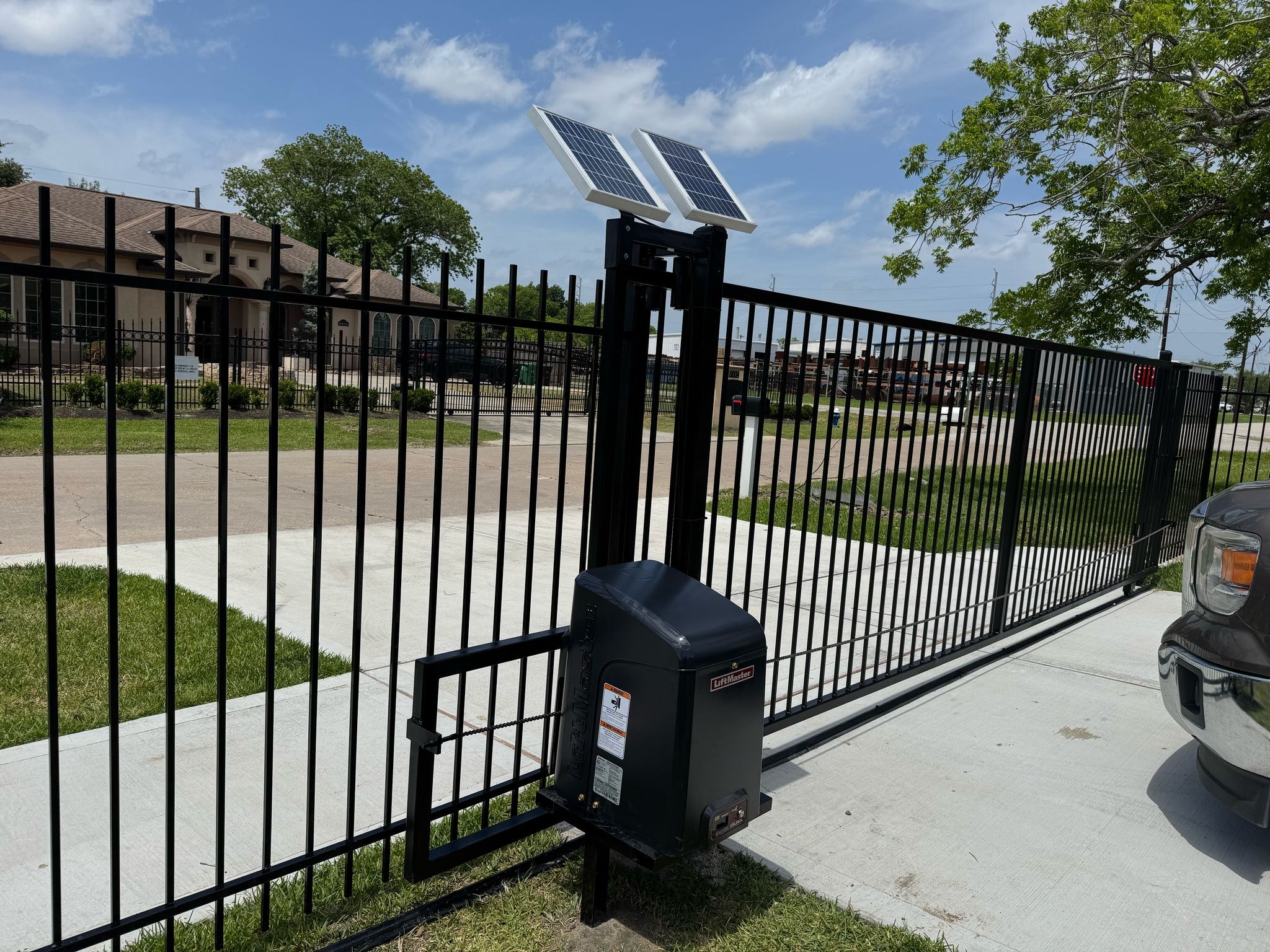
Solar works for a driveway gate in Galveston County, but three things about this coastline change what “works” requires. The manufacturer rates the entire Texas Gulf Coast as Zone 2 for solar gate operators — about 4 usable sun hours a day, one zone down from its 6-hour “ideal” Zone 1 rating — so a solar setup needs sizing margin, not best-case assumptions. The same manual excludes sites with persistent heavy fog or long rain spells outright, worth checking against the specific site. And because this is a coastal county, the panel, battery and control box need hardware rated for salt air, not just rain, plus a plan for what the operator does before, during and after a hurricane. This page covers all three, with a site checker at the bottom and links to the deeper battery-sizing and salt-air-hardware guides behind each one.
Sources: LiftMaster CSW24UL installation manual (Chamberlain Group), solar appendix; NEMA, Enclosure Types (Nov. 2005); City of Galveston Flood Damage Prevention Ordinance Sec. 10-81.
One climate question, three things it changes
“Does solar work here?” has a short answer — yes, Galveston County sits in the manufacturer’s Zone 2 — and a longer one that actually matters for a specific gate: a Zone 2 rating only grades usable sun hours, and it says nothing on its own about how big the battery should be, what the enclosure needs to survive, or what the operator does the next time a named storm crosses the coast. This page walks through the zone rating itself (including the maker’s own exclusions), then the salt-air and hurricane-season pieces that are specific to this coastline, cross-linking to the deep technical guides that cover battery sizing and panel placement in full rather than repeating them here.
The pieces, and where each is covered in depth
| Piece | What it covers | Deep dive |
|---|---|---|
| Solar zone rating | Usable sun hours and the maker’s exclusions — covered on this page | Below |
| Battery sizing | Amp-hour capacity, 23V cutoff, cycles-per-day table | Power outage guide · Daily cycles guide |
| Panel placement & parts | How power flows, where the panel should face, shading | How solar gate openers work |
| Salt-air enclosure hardware | NEMA 4X enclosures, corrosion-resistant anchors | Solar gate guide |
| Flood-zone placement | Elevation and enclosure rules under the City’s ordinance | Flood-zone gate guide |
Each linked page covers its piece in full; this page covers the Zone 2 climate rating itself and the hurricane-season sequence that ties the others together.
Does solar work at this specific site?
For the Texas Gulf Coast broadly, yes — the CSW24UL manual’s own zone map puts the entire coast, Galveston County included, in Zone 2, rated for roughly 4 usable sun hours a day. That is one step down from the 6-hour “ideal” Zone 1 rating the same manual gives far West Texas, which is the practical reason a Gulf Coast solar setup should be sized with margin rather than assumed to perform like a best-case desert install. The same manual is also explicit about where it draws the line: it states the system “is not supported in northern climates” and “not recommended” in areas with “long periods of heavy fog, lake effect snow or rain.” That is a real check worth making against a specific site — a yard that regularly sits under heavy fog or extended rain for reasons particular to its location is a different conversation than a typical Galveston County lot, and it is one a site visit settles, not a zone map alone.
How far that 4 hours/day actually stretches depends heavily on how often the gate cycles — see our solar gate daily-cycles guide for the manufacturer’s full cycles-per-day table by panel size and battery capacity, and how solar gate openers work for where the panel should face and how shade across the seasons changes that.

Battery sizing: budget for Zone 2, not Zone 1
The CSW24UL operator ships with 2 x 7AH batteries standard, upgradable to 33AH with the maker’s Solar Harness Kit and an extra battery tray — more amp-hours buys more stored energy and more cycles between charges, which matters more here than in a Zone 1 install because there is less sun coming in to replace what the gate uses. Either battery size shares the same low-power behavior: below a critically low 23V, the manual’s BATT FAIL logic has the gate latch at a programmed limit rather than keep trying to run, and a separate BACKDRIVE switch decides whether the gate can still be pushed open by hand once both AC and battery power are gone. We cover the full amp-hour comparison and an interactive “what will my gate do right now” tool on our power outage guide, and the maker’s complete cycles-per-day table (which panel and battery combinations support how much daily traffic) on the daily cycles guide — this page only flags that a Gulf Coast install should size toward the larger battery option sooner than a sunnier Zone 1 site would need to.
Salt air needs its own enclosure rating
A rain-rated NEMA Type 3R enclosure is the baseline most installation manuals call for. On a site exposed to salt air — near the bay, the beach or open water — that is not the same test as corrosion resistance, and NEMA’s own enclosure-type definitions list Type 4X as the step up with added protection against corrosion on top of water. FEMA’s guidance on protecting utility systems goes a layer further, recommending stainless steel or hot-dip galvanized anchors and straps specifically to resist salt-spray corrosion on the hardware holding the panel, battery box and operator in place — ordinary zinc-plated hardware is the kind of thing that fails quietly on this coastline years before it would inland. Our solar-powered gate guide covers the full salt-air hardware breakdown and its own sizing tool; this page’s point is narrower: a gate’s distance from open water should decide its enclosure and hardware spec, not just its panel size.
Hurricane season: before, during, after
A solar gate operator installed to code does not need to be torn out before a storm, but three things are worth confirming on a predictable schedule rather than discovering mid-event. Before: know where the manual-release mechanism is (see our manual gate release guide) and confirm the battery is actually holding a charge, and take a look at the panel and enclosure mounting hardware for early corrosion — the salt-air anchors above are the first thing that should fail, if anything does. During a power outage: the operator keeps running on battery exactly as it would for any outage, governed by the same BACKDRIVE and BATT FAIL logic covered on our power outage guide — there is no separate “storm mode.” After: NEMA GD 1-2019’s guidance on water-damaged electrical equipment is specific that batteries and surge-protective devices that actually flood should be replaced, not dried out and reconditioned; a site in a mapped flood zone also falls under the City’s elevation rule (Sec. 10-81(a)(4), at least 18 in above Base Flood Elevation) covered in full on our flood-zone gate guide. One administrative note: per the Texas Department of Insurance, fence and gate repairs don’t require a windstorm inspection certificate, so a post-storm gate repair isn’t held up by that paperwork. For the rest of the property, see our post-hurricane fence inspection checklist and hurricane-ready fencing guide.
Will solar work at this gate, and what should it be built for?
Answer four questions about the site. This points to the right sizing, enclosure and storm-prep answer based on the manufacturer’s solar-zone rules, NEMA/FEMA hardware guidance, and the City’s flood ordinance — it is not a price. A free on-site estimate turns this into an actual plan.
Zone/exclusions and battery basis: LiftMaster CSW24UL installation manual, solar appendix. Enclosure basis: NEMA Enclosure Types; FEMA P-348 anchor/strap guidance. Storm-prep basis: NEMA GD 1-2019; City of Galveston Flood Damage Prevention Ordinance Sec. 10-81. A scope guide, not a quote or an engineered design.
Thinking about a solar gate on the coast?
We’ll look at the site’s sun exposure, distance from salt water, and flood risk, then size the panel, battery and enclosure to fit — on a free on-site estimate across Galveston County.
What Galveston customers say
5.091 Google reviews · read them all on Google
Very professional and friendly. Gotten automatic gates done and they are done to perfection! Thank you
We just installed iron gate and it looks amazing thank you very much mustang fencing .
Excellent work. They came in handy after the hurricane hit our backyard. Friendly people too.
Reviews shown word for word from the Mustang Fencing Services Google Business Profile (Galveston), captured 2026-10-12.
Questions we get about this
Does solar work for a driveway gate in Galveston County?
Are there sites where solar gate openers are not recommended?
What size battery does a solar gate opener need on the coast?
Does a solar gate opener need special hardware near the coast?
Does an automatic gate need to be shut down before a hurricane?
Does a flooded gate battery need to be replaced?
Sources
Checked October 17, 2026. Rules change, so confirm with the City before you build.
- LiftMaster CSW24UL Installation Manual (Chamberlain Group) — Solar zone map (Zones 1-3) and stated exclusions; battery specs (7AH/33AH); BATT FAIL 23V cutoff; BACKDRIVE switch.
- NEMA, Enclosure Types (November 2005) — Type 3R vs Type 4X definitions, used for the salt-air enclosure guidance.
- FEMA P-348, Protecting Building Utility Systems From Flood Damage (2nd ed., 2017) — Recommends stainless steel or hot-dip galvanized anchors and straps to resist salt-spray corrosion.
- NEMA GD 1-2019, Evaluating Water-Damaged Electrical Equipment — Batteries and surge-protective devices listed as components to replace, not recondition, after flooding.
- City of Galveston, Ordinance 25-011 (amending Flood Damage Prevention Ordinance Sec. 10-81), passed 3/27/2025 — Sec. 10-81(a)(4): service equipment elevated >= 18 in above Base Flood Elevation.
- Texas Department of Insurance, Home repairs that don’t require a windstorm inspection — Fence repairs listed among repairs that don’t require a windstorm inspection certificate.
Planning a solar gate for a coastal site?
We’ll check the sun, the salt exposure, and the flood risk, then size the panel, battery and enclosure to fit. Free on-site estimates across Galveston County.