
Does My Pool Gate Need to Be Self-Closing and Self-Latching?
Yes, if it’s a pedestrian gate in the pool barrier — under either rule that can apply to a Galveston pool. The two words have a specific legal meaning: a self-closing device shuts the gate with no push and no motor, and a self-latching device catches and holds it with no hand touching it. Here’s what that hardware actually is, which gates are exempt, and how to test yours. For the full code comparison (heights, gaps, chain link), see our pool barrier guide.
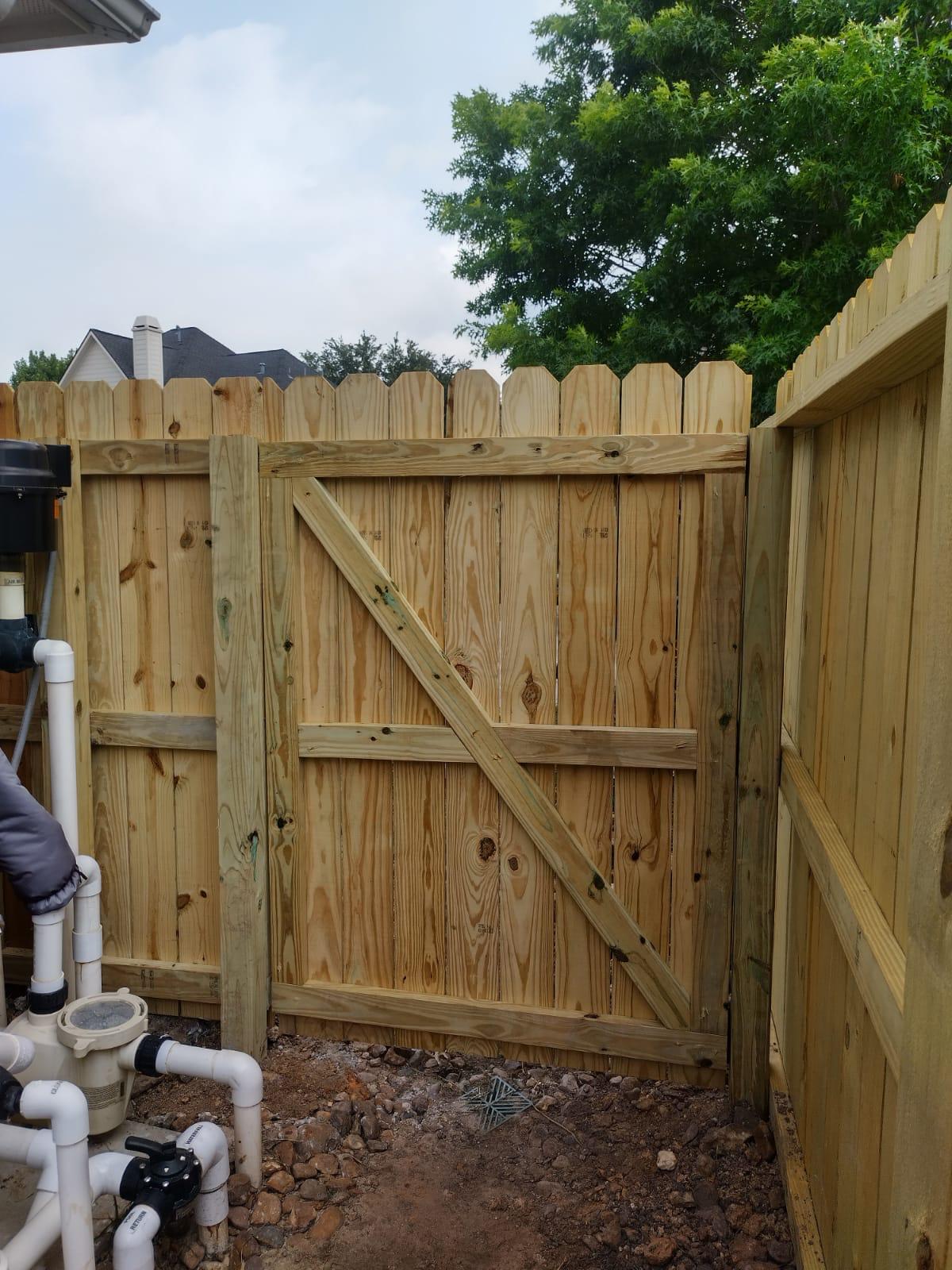
For a pedestrian gate in a pool barrier, yes. Texas defines a “self-closing and self-latching device” (Health and Safety Code 757.001(1)) as one that automatically closes the gate with no human or electrical power after it’s opened, and automatically latches it with no human or electrical power when it closes — in practice, a spring hinge or closer plus a gravity or spring latch, working without anyone touching them. The 2021 ISPSC requires the same two things of a pedestrian pool gate (305.3), plus that it swing outward and take a lock. Two gate types are handled differently: a utility or service gate not meant for pedestrian use just has to stay locked when not in use (305.3.1), and on a double or multi-leaf gate, one leaf can be fixed in place as long as the other has its own self-latching device (305.3.2).
Sources: Texas Health and Safety Code 757.001(1), 757.004(a), 757.009; 2021 ISPSC sections 305.3-305.3.2 (ICC model text).
What “self-closing” and “self-latching” actually mean
These are two different devices doing two different jobs, and the legal definition is specific about how they’re allowed to work. Health and Safety Code 757.001(1) defines a “self-closing and self-latching device” as one that “causes a gate to automatically close without human or electrical power after it has been opened and to automatically latch without human or electrical power when the gate closes.”
Break that into the two halves: self-closing is whatever pulls the open gate shut by itself — typically a spring-tensioned hinge or a mounted gate closer. Self-latching is whatever catches and holds the closed gate by itself — typically a gravity latch (a bar or hook that drops into a keeper under its own weight) or a spring-loaded latch. Neither device can rely on a person pushing the gate shut or flipping a latch, and neither can be electrically powered — that second point is what separates this from an automatic gate opener, which is a different system built to run on electricity. A gate can be self-closing and self-latching without being automatic at all, and most pool gates are exactly that: simple spring hardware, no motor.
Which gates actually need this hardware?
Not every gate in a pool enclosure is held to the same standard. The 2021 ISPSC splits gates into three cases:
- Pedestrian access gates (305.3): people actually walk through these. They must open outward away from the pool, be self-closing, be self-latching, and be able to take a locking device. This is the gate most homeowners mean when they ask this question.
- Utility or service gates (305.3.1): gates “not intended for pedestrian use, such as utility or service doors and gates” — for example, a gate that exists only for equipment access. The code text requires these to “remain locked when not in use,” but does not state a self-closing or self-latching requirement for them specifically. The common misuse is calling a gate people actually walk through a “utility gate” to skip the hardware — if it gets foot traffic, treat it as a pedestrian gate.
- Double or multiple-leaf gates (305.3.2): where a gate has two or more leaves, at least one leaf must be “secured in place” and the adjacent leaf must have its own self-latching device. One fixed leaf doesn’t exempt the other from latching.
The source reviewed for this page (Chapter 757) doesn’t carry 305.3.1’s utility-gate carve-out or 305.3.2’s double-gate language — it states the self-closing/self-latching/lockable/outward-swing requirement for “a gate” generally (757.004(a)). For which rule applies to your pool at all (a private home vs. an apartment, condo or HOA pool), see Texas pool fence code requirements.
The two devices, in hardware terms
| Self-closing device | Self-latching device | |
|---|---|---|
| What it has to do | Close the gate by itself after it’s opened, from any open position | Latch the gate by itself the moment it closes |
| What commonly does the job | A spring-tensioned gate hinge, or a separate mounted gate closer | A gravity latch (drops into a keeper under its own weight) or a spring-loaded latch |
| Power source allowed | None — spring tension or gravity only (757.001(1)) | None — spring tension or gravity only (757.001(1)) |
| How to tell if it’s working | Open the gate partway and let go — it should swing fully shut unassisted | Let the gate close — the latch should engage without anyone touching it |
| Not the same as | An electric gate operator (a different, motorized system) | A manual bolt or slide lock a person has to move by hand |
Sources: Texas Health and Safety Code 757.001(1); 2021 ISPSC 305.3 (ICC model text).
Does your gate actually pass?
This checks the gate hardware itself — not the whole barrier (use the pool barrier checker for height, gaps and material). Based on ISPSC 305.3-305.3.3 and HSC 757.004.
Sources: ISPSC 2021 305.3, 305.3.1, 305.3.2 (ICC model text); Texas Health and Safety Code 757.004(a). Not a substitute for the City’s permit review.
Who has to keep checking it?
For an apartment, condo or HOA pool, this isn’t a one-time install-and-forget item. Health and Safety Code 757.009 puts an ongoing duty on the owner or association: “exercise ordinary and reasonable care to inspect, maintain, repair, and keep in good working order the pool yard enclosures, gates, and self-closing and self-latching devices,” and specifically, “inspect the pool yard enclosures, gates, and self-closing and self-latching devices on gates no less than once every 31 days.” That duty can’t be waived. It applies where Chapter 757 applies — a multiunit rental complex or property owners association pool, not a single-family home (757.002).
For a private home under the ISPSC, the source reviewed for this page doesn’t state a specific inspection interval, but the same hardware wears the same way: spring tension weakens, hinges sag, latch keepers shift. Run the same push test described above periodically, especially after storm winds rack a gate frame — Galveston sees enough of those.
What Galveston customers say
5.091 Google reviews · read them all on Google
We just installed iron gate and it looks amazing thank you very much mustang fencing .
Very professional and friendly. Gotten automatic gates done and they are done to perfection! Thank you
had an excellent experience with mustang fencing From the initial consultation to the final installation, the team was professional, punctual, and attentive to detail. They helped me choose the perfect fence style to match my property and ensured everything was installed with precision. The quality of materials is top-notch, and the fence has completely transformed the look and security of my home. I highly recommend mustang services to anyone looking for reliable and high-quality fencing services!
Reviews shown word for word from the Mustang Fencing Services Google Business Profile (Galveston), captured 2026-10-12.
Questions we get about this
Does my pool gate have to be self-closing and self-latching?
What counts as a self-closing device?
What counts as a self-latching device?
Is an automatic gate the same as a self-closing, self-latching gate?
Does a utility gate next to my pool need to self-close?
Who has to inspect a pool gate’s self-closing and self-latching device?
Sources
Checked October 15, 2026. Rules change, so confirm with the City before you build.
- Texas Health and Safety Code, Chapter 757: Pool Yard Enclosures — 757.001(1) (definition of self-closing and self-latching device), 757.002 (applies only to multiunit rental complex / property owners association pools), 757.004(a) (gate requirements), 757.009 (inspection, repair and maintenance duty, 31-day interval).
- International Swimming Pool and Spa Code 2021, Section 305 Barrier Requirements — 305.3 (pedestrian gates: self-closing, self-latching, outward swing, lockable), 305.3.1 (utility/service gates: locked when not in use), 305.3.2 (double/multi-leaf gates: one leaf fixed, adjacent leaf self-latching), 305.3.3 (latch release height).
Need a gate that actually passes this test?
We’ll fit the gate with spring hinges or a closer and a self-latching device sized to it, set the swing direction and latch height, and walk through the push test with you before we leave.