
A Custom Cedar Gate for Valarie Eissler in Galveston, Texas
Valarie Eissler wanted a 70-foot cedar gate and fence run with a three-rail frame, assembled entirely with screws, for her Galveston property. Here is that job in photos, plus the USDA Forest Products Laboratory facts behind why one cedar board can stay straighter than another cut from the very same log — grain orientation and how close to the tree’s center it was cut.
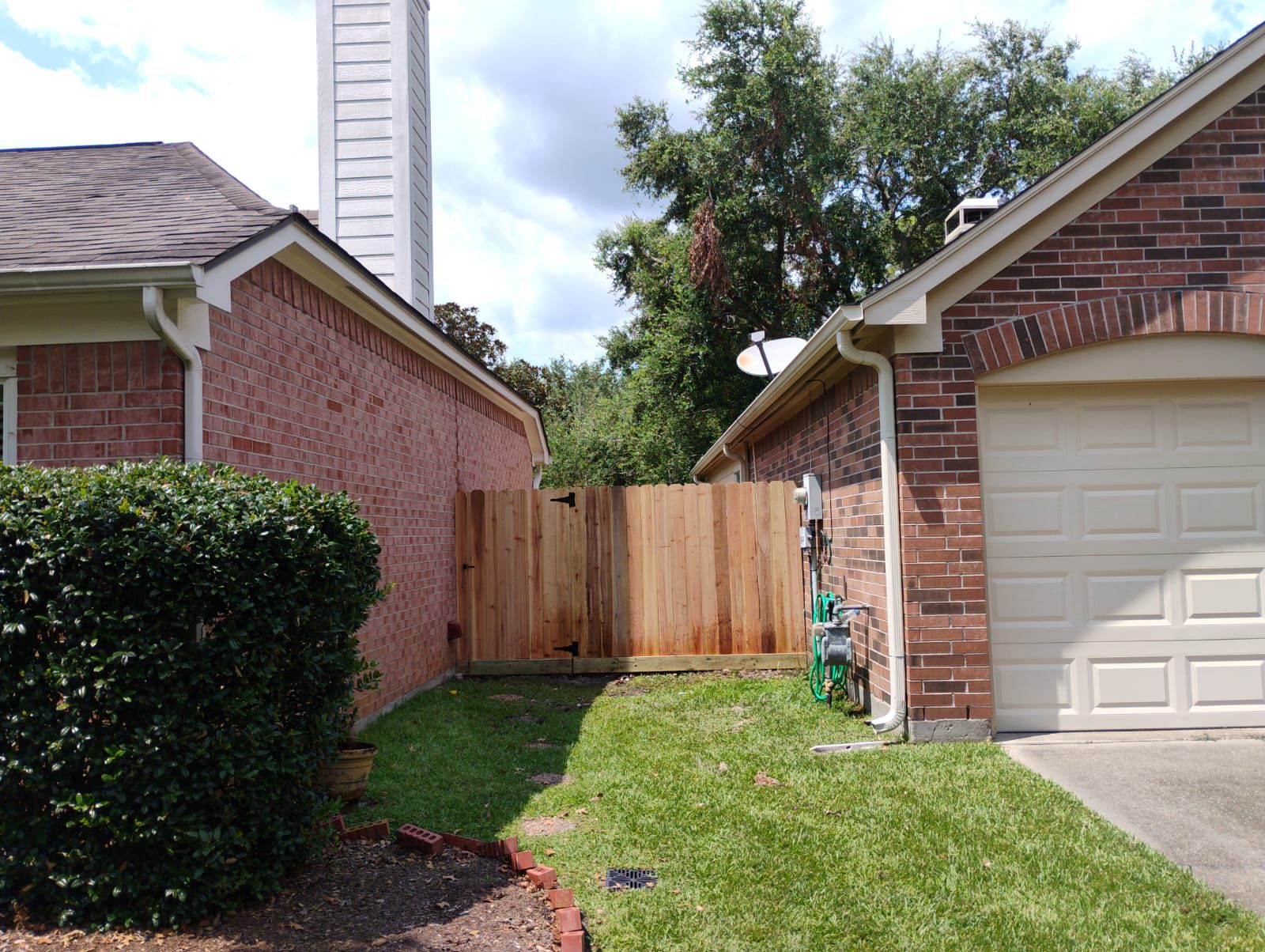
Cedar gave Valarie Eissler a 70-foot gate and fence run built for the long haul, but the USDA Forest Products Laboratory’s Wood Handbook is clear that species alone doesn’t decide whether every board in a run that long stays straight: grain orientation and how close to the tree’s center a board was cut both matter, independent of the fasteners holding it up.
Source: USDA Forest Products Laboratory, Wood Handbook: Wood as an Engineering Material, FPL-GTR-282 (2021).
The job: a 70-foot cedar gate, three rails, all screws
Valarie Eissler wanted a 70-foot cedar gate and fence run for her Galveston property, with a three-rail frame assembled entirely with screws rather than nails. Her goals were straightforward: more security for the property, and a visually appealing, timeless structure that matched the style of her home.
The photos below are from that job.
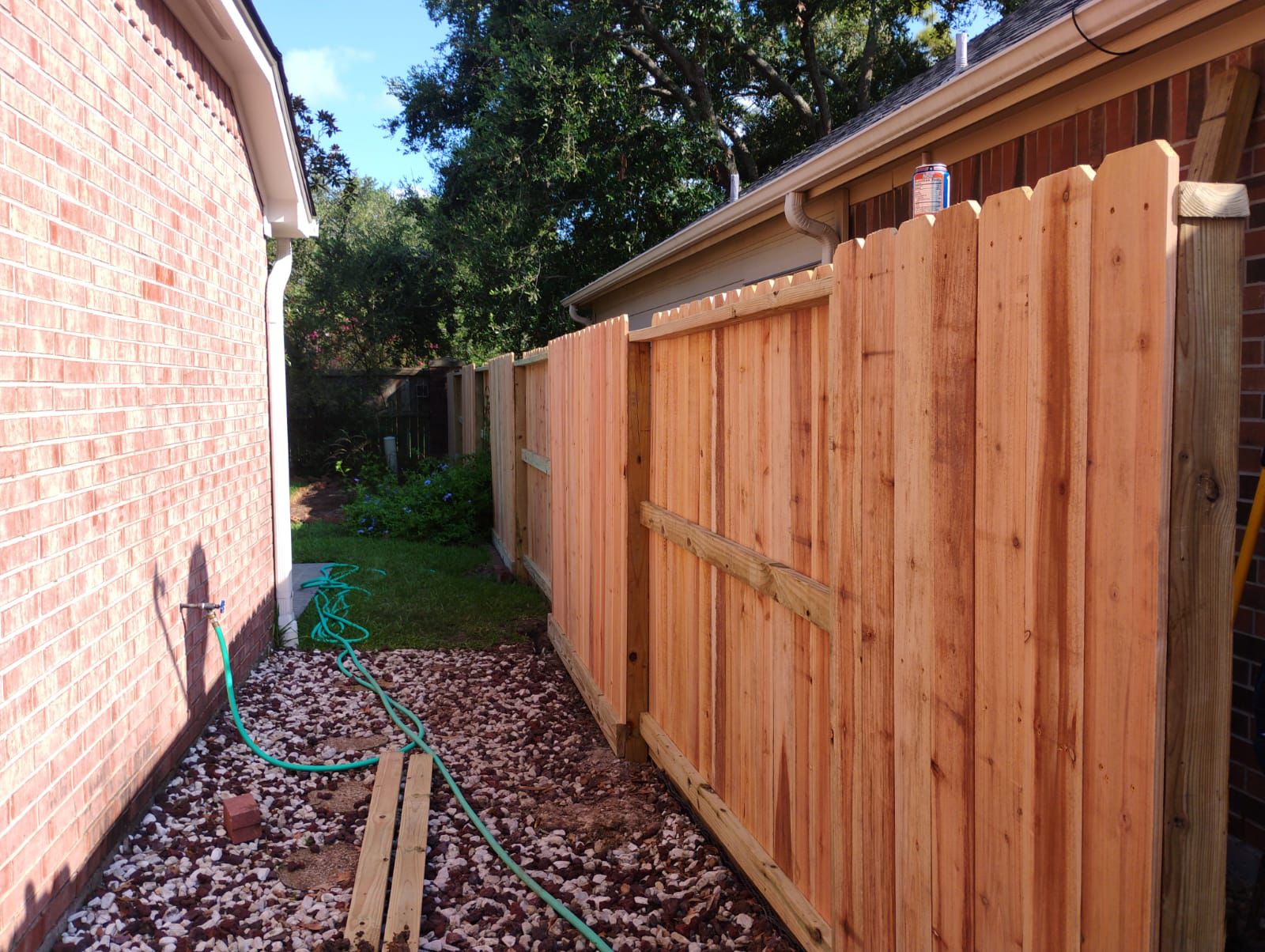
Not every cedar board behaves the same — grain orientation is why
Over a 70-foot run, dozens of individual boards all have to hold a straight, matching line. The species they were cut from is the same, but the USDA Forest Products Laboratory’s Wood Handbook points to a detail that varies board to board regardless of species: how the growth rings run through the board. Vertical-grain lumber has rings running from about 90° (perpendicular to the wide face) down to roughly 45°; past that, a board is considered flat grain, with rings closer to parallel with the face.
That difference shows up over time. The Handbook states plainly: “vertical grain boards and lower density woods typically have less checking, cup, and warp. The tendency to cup increases with width/thickness ratio.” A wide, thin, flat-grain board is the one most likely to cup first on a long fence or gate run.
Juvenile wood near the pith: the other variable
The second detail the Handbook flags is where in the tree a board was cut. Growth from the 2nd to 15th years of a tree’s life is called juvenile wood, and it sits closest to the pith — the tree’s center. The Handbook is specific about how different it behaves: “the very early years of juvenile wood can have extremely high longitudinal dimensional change (2%) compared with normal wood (0.1% to 0.2%).”
Scaled up, that is not a small gap. “The extreme juvenile wood of a 10-ft (3-m) board attempts to shrink 2.4 in. (61 mm), while the mature wood will shrink 10 to 20 times less.” The Handbook adds that “this dimensional instability can lead to severe warping and cross-grain checking in a board with the pith on one side.” That is a property of the wood itself — no fastener changes it.
Longitudinal shrinkage: mature wood vs. extreme juvenile wood
Shrinkage lengthwise along a board, as a percentage, for a 10-ft cedar board.
Cedar board check for a long fence or gate run
Pick what the boards show at the ends and faces. Based on the USDA Forest Products Laboratory’s own notes on grain orientation and juvenile wood. A visual check, not a grading inspection.
Grain: USDA Wood Handbook Ch.16 (vertical-grain and lower-density boards typically check, cup and warp less; cup tendency increases with width/thickness ratio). Juvenile wood: Ch.16 (2nd-15th year growth can shrink lengthwise up to 2%, versus 0.1%-0.2% for mature wood; a 10-ft board of extreme juvenile wood attempts to shrink 2.4 in., 10-20 times more than mature wood).
What Galveston customers say on Google
5.091 Google reviews · read them all on Google
Amazing work will go ahead and recommend everyone in friends and family We installed 8ft tall double sided stained cedar wood fence in our backyard, it’s really looks great, installed perfectly nice finishing and cost effective, thanks mustang fencing.
had an excellent experience with mustang fencing From the initial consultation to the final installation, the team was professional, punctual, and attentive to detail. They helped me choose the perfect fence style to match my property and ensured everything was installed with precision. The quality of materials is top-notch, and the fence has completely transformed the look and security of my home. I highly recommend mustang services to anyone looking for reliable and high-quality fencing services!
I recently hired Mustang Fencing Services for a fence installation, and I couldn’t be happier with the results. The team was professional, punctual, and very knowledgeable. They provided a detailed estimate and completed the job on time and within budget. Overall highly recommended Mustang fencing services
Reviews shown word for word from the Mustang Fencing Services Google Business Profile (Galveston), captured 2026-10-26.
Questions we get about this
What’s the difference between vertical-grain and flat-grain cedar boards?
Does board width affect how much a cedar fence board cups?
Why do some boards on the same cedar fence warp more than others?
Does using screws instead of nails stop a cedar board from warping?
How long was the cedar gate built for Valarie Eissler in Galveston?
Sources
Checked October 28, 2026. Rules change, so confirm with the City before you build.
- USDA Forest Products Laboratory, Wood Handbook: Wood as an Engineering Material, FPL-GTR-282 (2021) — Grain-angle definitions and cup/check/warp tendency by grain type and width/thickness ratio (Ch. 16); juvenile-wood longitudinal shrinkage and the 10-ft board example (Ch. 16); differential shrinkage as a cause of warp (Ch. 4, Ch. 13).
Planning a wood fence or gate?
We’ll walk the property, talk through wood choice, fastening and finishing, and put it on a written quote.