
A Rewarding Wooden Fence Project with Todd Engelder in Galveston, Texas
Todd Engelder wanted a custom wood privacy fence for his Galveston property, finished with a protective stain to handle the coastal climate. Here is that job in photos, plus the USDA Forest Products Laboratory research behind what actually makes a fence stain last — and what shortens it.
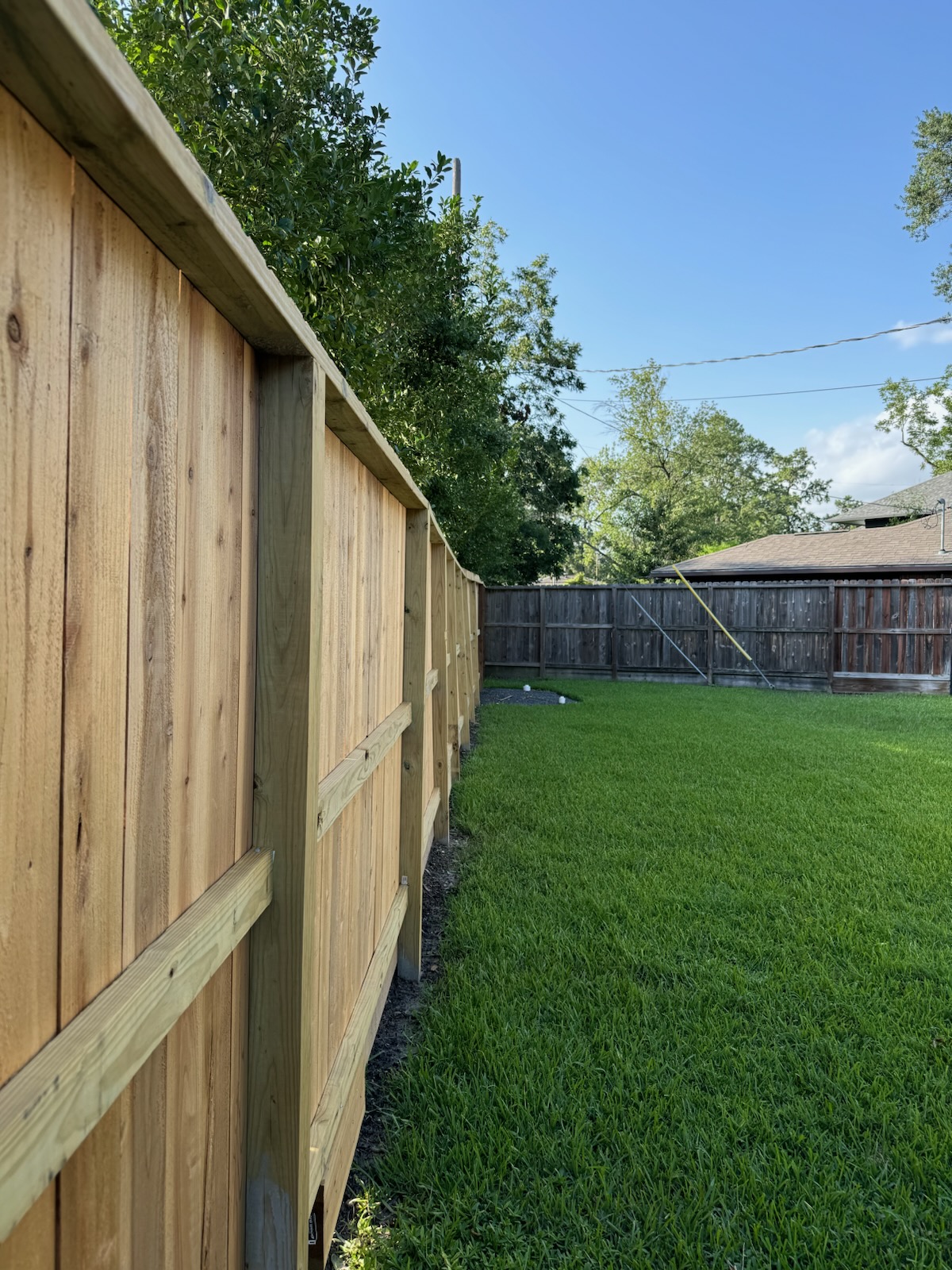
Todd Engelder’s custom wood privacy fence was finished with a protective stain to help it hold up in Galveston’s coastal climate. How long that stain actually lasts comes down to specific, measurable factors — the type of stain, how the boards were surfaced, and which side faces the sun.
Source: USDA Forest Products Laboratory, Wood Handbook: Wood as an Engineering Material, FPL-GTR-282 (2021), Chapter 16 (exterior finishes).
The job: a custom wood privacy fence, finished for the coast
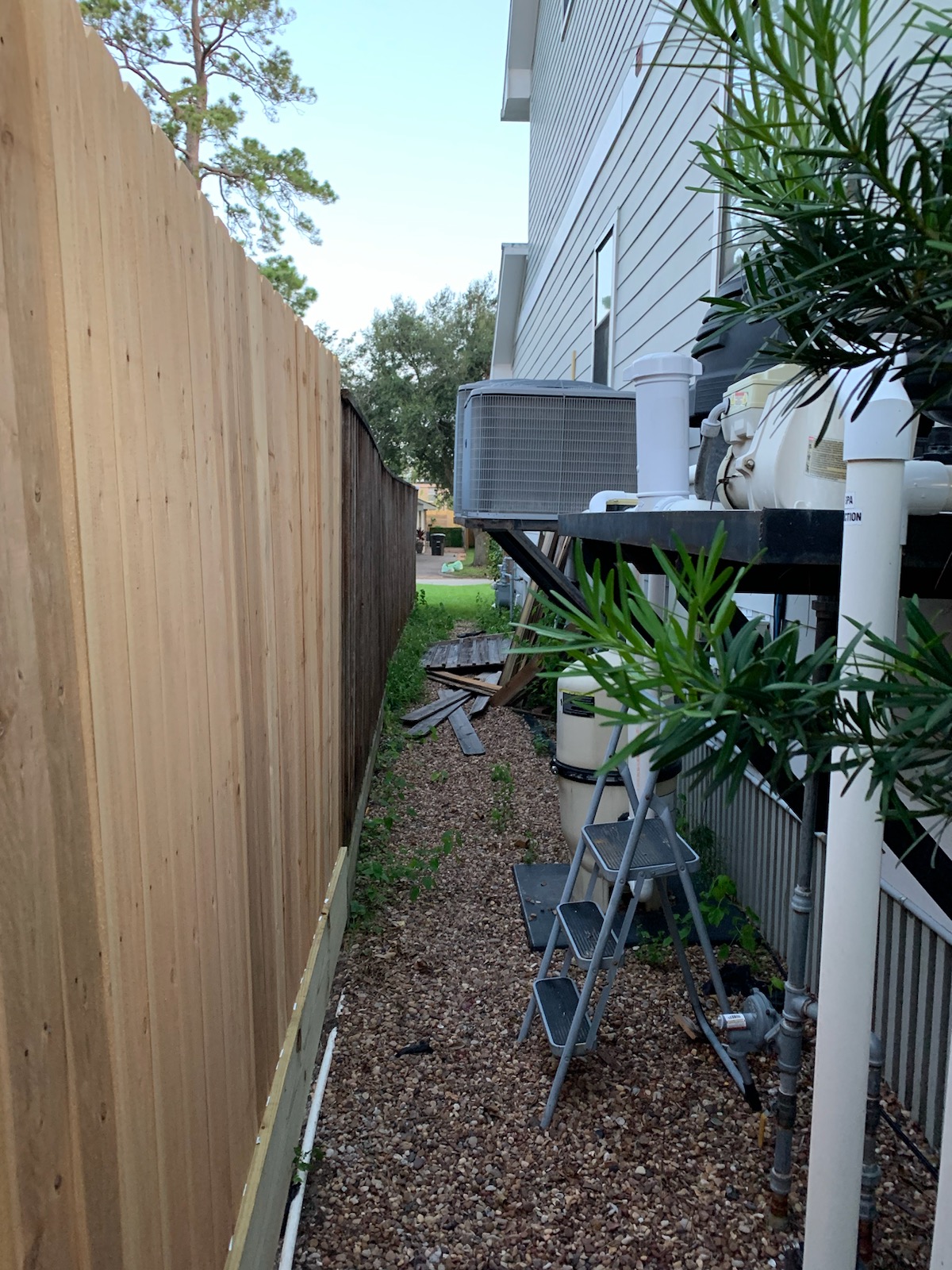
Todd Engelder wanted a custom wood privacy fence for his Galveston property — built with his input on wood, stain color and finish, running along the side yard and around the backyard perimeter. Once the fence was up, the crew applied a protective stain intended to handle Galveston’s coastal humidity and sun while bringing out the wood’s natural tone.
The photos below are from that job.
What “protective stain” actually means: two different finish types
Not all stains work the same way. The USDA Forest Products Laboratory’s Wood Handbook splits exterior wood finishes into two basic types. Penetrating finishes — transparent or lightly colored water-repellent preservatives, oil-based semitransparent stains, and oils — “flow into the pores of wood and do not form a film. Because they do not form a film, they cannot crack or flake.”
Solid-color stains work differently: they’re “opaque finishes…made with a higher concentration of resin and pigment than are semitransparent penetrating stains,” and they “form a film, like paints.” The difference from paint is that they’re built to erode faster on purpose, so the film never gets too thick — which also means “solid color stains need to be reapplied more often than paint.”
Two factors that change how long any stain lasts
Even with the right finish type, two site-specific factors matter just as much. First, board surface: “Semitransparent stains perform well on saw-textured surfaces. If used on smooth wood, expect approximately half the service life compared with saw-textured surfaces.” A rough-sawn board simply holds more finish than a smooth-planed one.
Second, sun exposure: “Paint erodes at different rates, so different sides of a structure do not need to be painted on the same schedule. Paint on the shaded side often lasts twice as long as that on a fully exposed, sunny side.” A fence line that runs along a shaded side yard, like part of Todd’s, will hold its finish longer than a run facing full Gulf Coast sun.
What’s shortening (or extending) your fence stain’s life?
Pick your board surface and sun exposure. Based on the USDA Forest Products Laboratory Wood Handbook, Chapter 16 (exterior finishes). General guidance, not a warranty or a maintenance schedule.
USDA Forest Products Laboratory, Wood Handbook FPL-GTR-282 (2021), Ch. 16: semitransparent stains on smooth wood get “approximately half the service life compared with saw-textured surfaces”; paint “on the shaded side often lasts twice as long as that on a fully exposed, sunny side.”
What Galveston customers say on Google
5.091 Google reviews · read them all on Google
My new fence looks fantastic and has added both privacy and style to my yard. Highly recommend their services for anyone in need of fencing!
had an excellent experience with mustang fencing From the initial consultation to the final installation, the team was professional, punctual, and attentive to detail. They helped me choose the perfect fence style to match my property and ensured everything was installed with precision. The quality of materials is top-notch, and the fence has completely transformed the look and security of my home. I highly recommend mustang services to anyone looking for reliable and high-quality fencing services!
I have hired Mustang fencing services to fix my backyard fencing. Good wood to used. I really like theirs work. Best of luck
Reviews shown word for word from the Mustang Fencing Services Google Business Profile (Galveston), captured 2026-10-26.
Questions we get about this
What’s the difference between a penetrating stain and a solid-color stain?
Does a smooth-planed fence board hold a stain as long as a rough-sawn one?
Does the side of the fence facing the sun need restaining sooner?
How often does a solid-color stain need to be reapplied?
What kind of fence did Todd Engelder build in Galveston, TX?
Sources
Checked October 28, 2026. Rules change, so confirm with the City before you build.
- USDA Forest Products Laboratory, Wood Handbook: Wood as an Engineering Material, FPL-GTR-282 (2021) — Chapter 16 (exterior finishes): penetrating vs. film-forming finish behavior, solid-color stain reapplication, and the smooth-vs-saw-textured and shaded-vs-sun-exposed service-life comparisons.
Planning a wood fence or gate?
We’ll walk the property, talk through wood choice, fastening and finishing, and put it on a written quote.