
A Successful Wooden Fence Installation for Kavin White in Galveston, Texas
Kavin wanted a sturdy, good-looking privacy fence that could take Galveston’s salt air and humidity. Here is the documented scope — a 6-foot vertical pressure-treated pine fence and a reinforced gate, set in concrete — plus the sourced reason the hardware matters as much as the lumber near the coast.
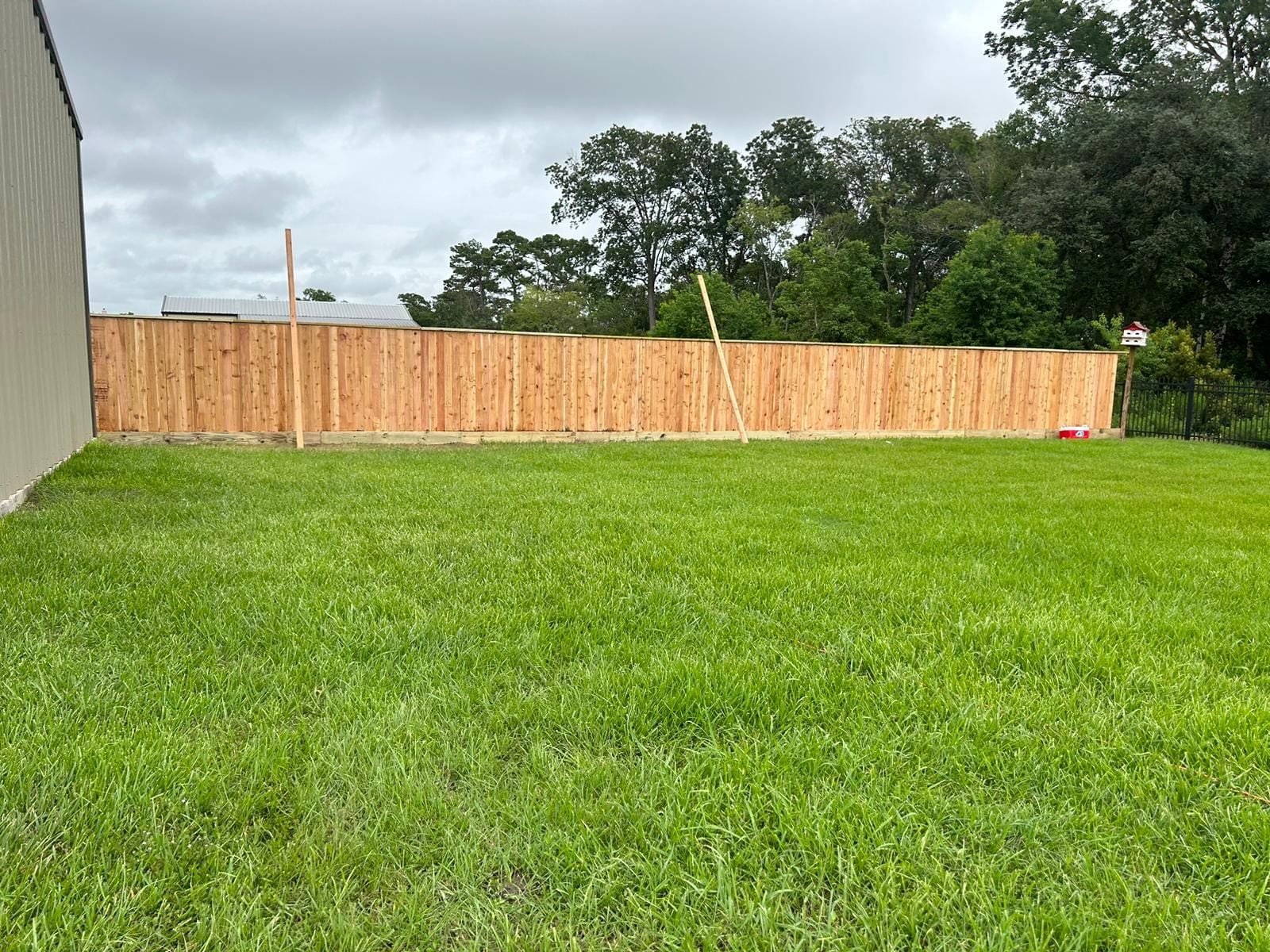
Mustang Fencing built a 6-foot pressure-treated pine privacy fence and a gate with a reinforced metal frame for Kavin White in Galveston, TX. Posts were set in concrete with the depth measured for wind resistance, and the wood was chosen specifically to hold up against salt air and humidity.
Sources: this project’s own documented facts and photos; Southern Forest Products Association, Pressure-Treated Southern Pine (2019). Checked November 4, 2026.
The job: a 6-ft vertical privacy fence and gate for Kavin White
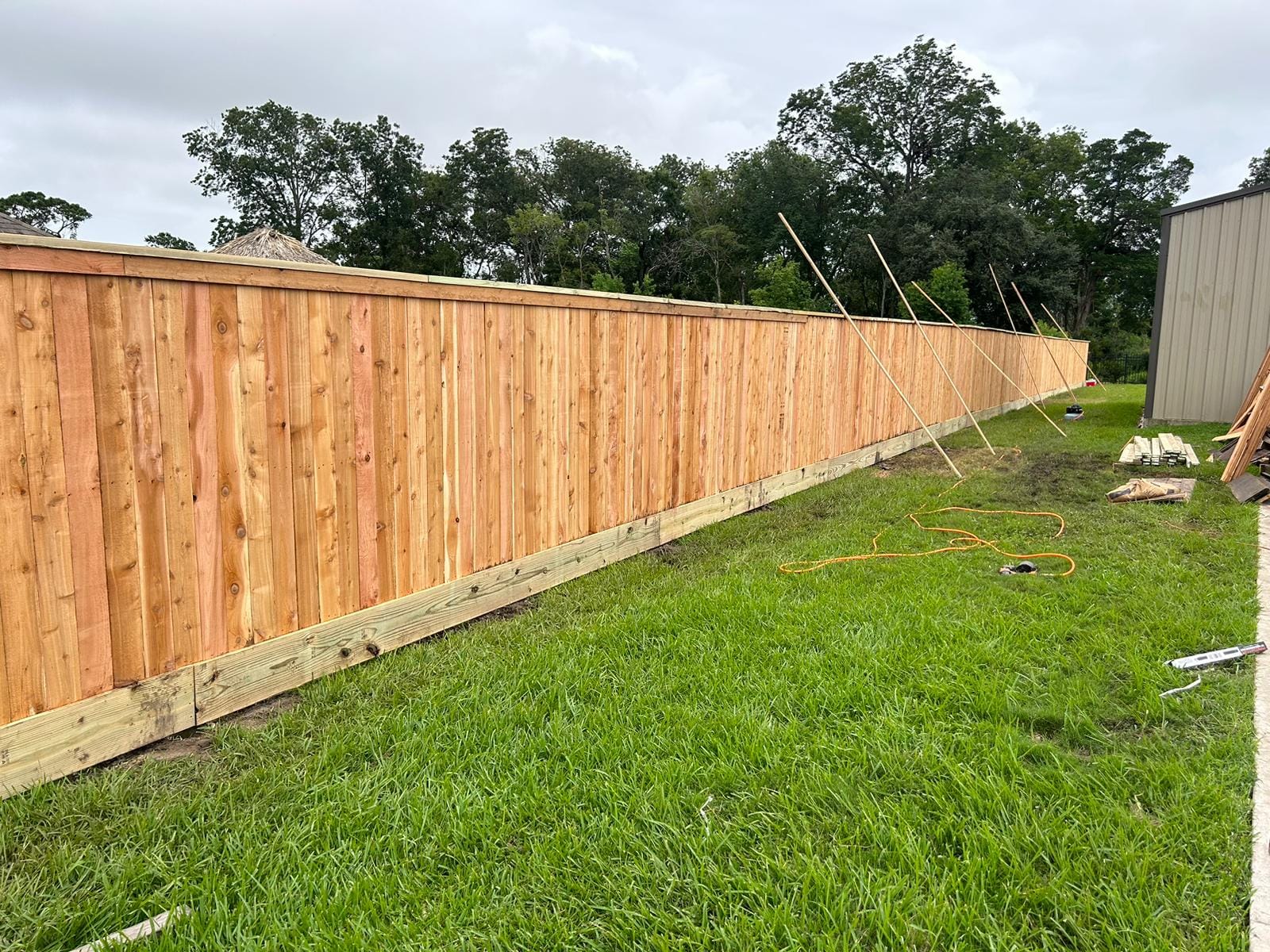
Kavin White came to Mustang Fencing wanting a sturdy, good-looking wooden fence for his Galveston property — one that would hold up to the area’s salt air and humidity while adding privacy and security. After discussing picket, board-on-board and horizontal styles, Mustang recommended a classic vertical privacy fence: pickets set edge-to-edge with no overlap, in pressure-treated pine chosen for its resistance to the coastal climate. The 6-foot panels were set on posts anchored in concrete, with the hole depth measured for wind resistance, and the project included a gate built with a reinforced metal frame for added rigidity. The finish was a rich natural stain that lets the wood grain show through.
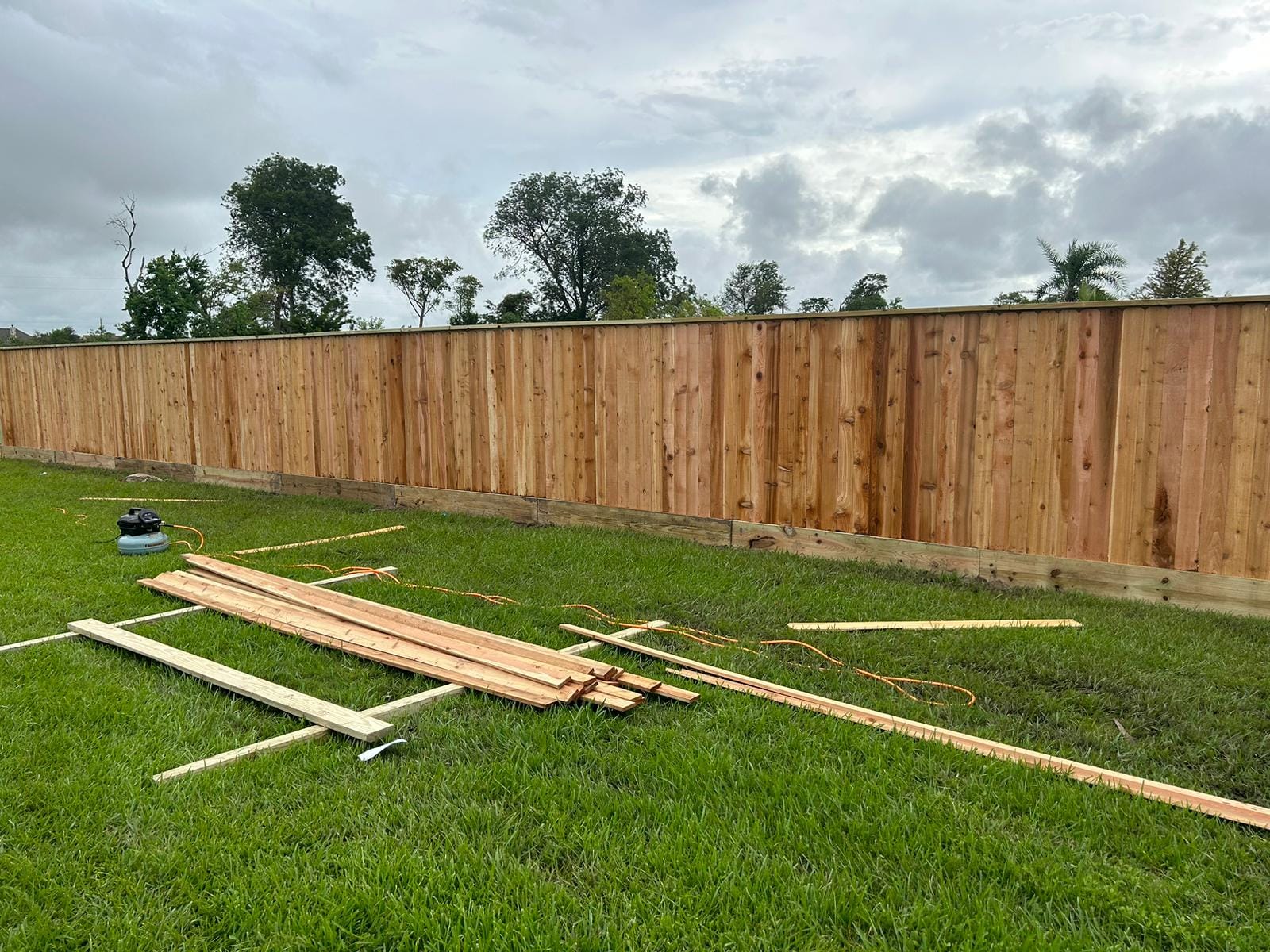
The project’s own photos document the work in progress — a long run braced during installation — through to the finished fence enclosing the open lawn, with a final shot showing offcut lumber on the grass as the last pickets were trimmed to fit.
Why the hardware matters as much as the lumber near the coast
Kavin’s main concern — salt air and humidity breaking down a wood fence over time — is real, but the lumber is only half of it. Fasteners exposed to salt-water environments corrode differently than the wood around them, and model building codes address this directly. Under IBC §2304.10.5.1 and IRC §R317.3, fasteners in severe or salt-water-exposed conditions must be hot-dip, zinc-coated galvanized steel (ASTM B695), Type 304 or 316 stainless steel, or silicon bronze or copper. The codes’ exception for plain carbon-steel fasteners applies only to borate-treated wood kept dry indoors — not an outdoor Galveston fence. Fasteners and connectors used together should also share the same metallic composition, since mixing metals at a joint can cause galvanic corrosion.
Pressure-treated pine finish wait-time guide
How long treated pine should dry before a finish goes on, per Southern Forest Products Association guidance. Not a guarantee — actual drying time also depends on your climate and whether the lumber was dried after treatment. Follow the product label.
Source: Southern Forest Products Association, Pressure-Treated Southern Pine (2019) and southernpine.com finishing guidance, retrieved 2026-09-26. Wood that was not dried after treatment must fully dry first — SFPA gives no fixed day count for that step, since it depends on the product and climate.
What customers say on Google
5.091 Google reviews · read them all on Google
I have hired Mustang fencing services to fix my backyard fencing. Good wood to used. I really like theirs work. Best of luck
had an excellent experience with mustang fencing From the initial consultation to the final installation, the team was professional, punctual, and attentive to detail. They helped me choose the perfect fence style to match my property and ensured everything was installed with precision. The quality of materials is top-notch, and the fence has completely transformed the look and security of my home. I highly recommend mustang services to anyone looking for reliable and high-quality fencing services!
I am so pleased with the fence!! Your solution was exactly the right one and the team did a highly professional job. Frankly, I was amazed at how clean the job site was at the completion of the project. Feel free to list me as a reference and a very happy customer. Thanks again and please let the men know That I appreciate their hard work and quality craftsmanship.
Reviews shown word for word from the Mustang Fencing Services Google Business Profile (Galveston), captured 2026-11-02.
Questions we get about this
What did Mustang Fencing build for Kavin White?
Why pressure-treated pine for a Galveston fence?
Does the type of screw or bolt matter for a coastal wood fence?
How long before a stain or paint can go on treated pine?
Why vertical pickets instead of board-on-board?
Sources
Checked November 4, 2026. Rules change, so confirm with the City before you build.
- Southern Forest Products Association, Pressure-Treated Southern Pine (2019 ed.) — Fastener requirements for severe and salt-water-exposed environments (hot-dip galvanized, 304/316 stainless, silicon bronze/copper), and recommended finish wait times for treated lumber.
- Southern Forest Products Association — Finishing, Maintenance, and Inspection — Wait-time guidance for water-repellent coatings, semi-transparent stains, and solid-color stains/paint on treated lumber.
Want a privacy fence built for Galveston’s coast?
We’ll walk the property, talk through wood, hardware and design, and put the scope on one written estimate before any work starts.