
Automatic Gate Installation Cost Factors in Galveston County
No two automatic gates cost the same to install, and four decisions move that cost more than any other: the operator’s duty class, whether it runs on mains power or solar, how much access control you’re adding, and whether the site sits in a flood zone. Here is how each one changes the scope of the job — without a made-up number attached.
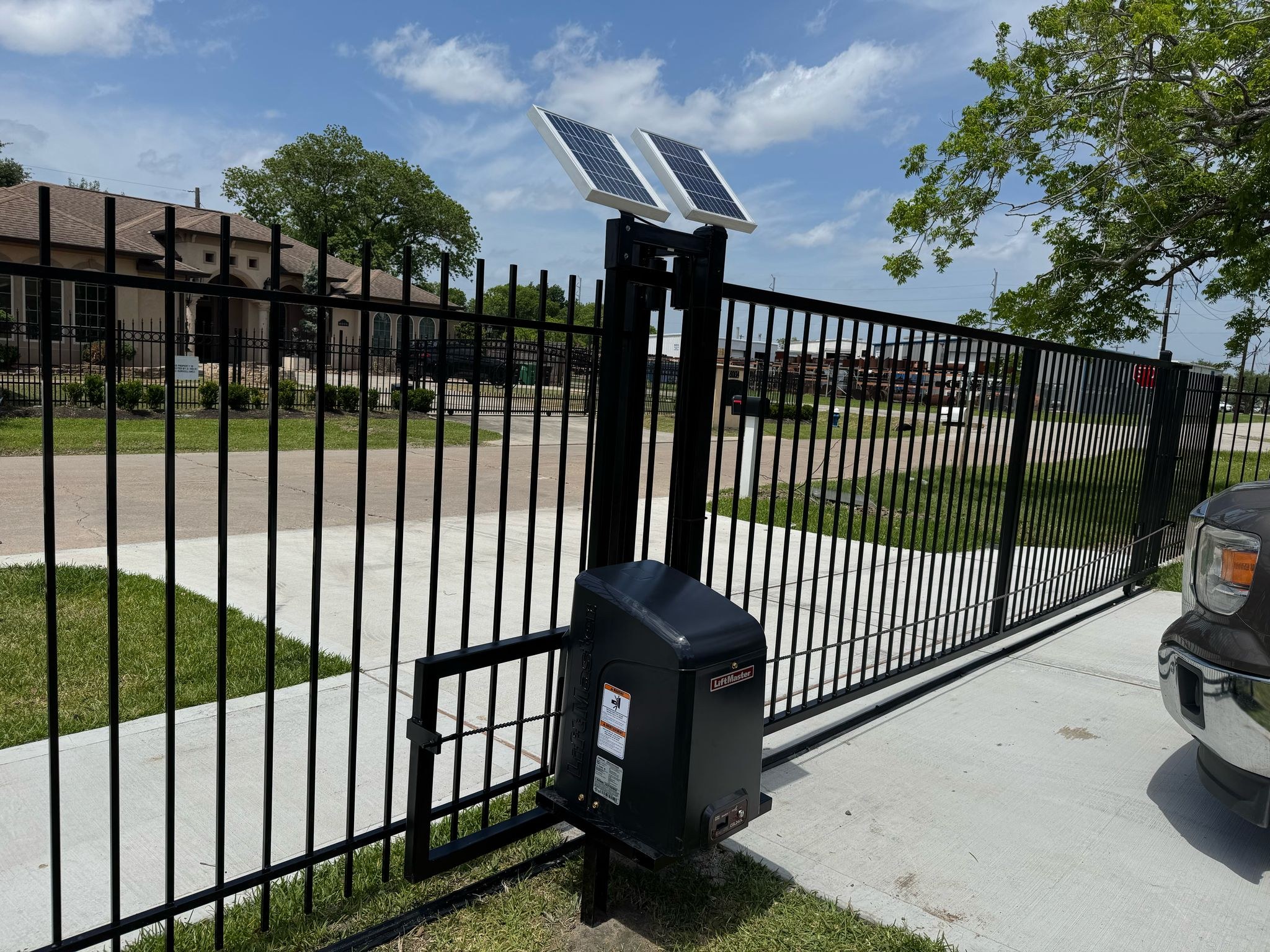
Four factors move an automatic gate’s installation cost more than anything else, and none of them has one honest number. The operator’s UL 325 duty class (set by where the gate sits — a residential driveway, a commercial entrance, an industrial site, or a guarded industrial site) changes how heavy-duty the machine needs to be. Power source changes whether the job includes trenching and conduit, or a solar panel and battery sized to the Gulf Coast’s sun exposure. Access control — a keypad versus telephone entry, a card reader, or a system managing many users — adds its own hardware and wiring on top of the operator. And flood-zone placement can require elevating equipment, a higher corrosion/water enclosure rating, and extra conduit under the City’s flood ordinance. This page walks through what each one adds to the scope of the job, with a checker at the bottom — a free on-site estimate is still how you get an actual price.
Sources: DASMA TDS 353 (rev 1/25), reprinting UL 325 operator Classes I-IV; LiftMaster CSW24UL/CSL24UL installation manuals; City of Galveston Flood Damage Prevention Ordinance Sec. 10-81; NEMA, Enclosure Types (Nov. 2005); NEMA GD 1-2019.
Four decisions, not one price
Ask for “the cost of an automatic gate” and the honest answer is always “it depends” — the same way it does for a custom gate’s material, size and labor, or for a gate’s financed monthly payment. This page isolates four decisions that are specific to an automatic gate in Galveston County and change how much work the installation actually involves: the operator’s duty class, the power source, how much access control rides on top of it, and whether the site’s flood exposure adds scope. None of them produces a number on its own — they change what has to be bought, trenched, elevated or wired, and a site visit turns that into an actual quote.
The four factors, at a glance
| Factor | What it changes | Deep dive |
|---|---|---|
| Operator duty class | How heavy-duty a machine the setting calls for (UL 325 Class I-IV) | UL 325 / ASTM F2200 guide |
| Power vs. solar | Trenching and conduit, or a sized panel/battery pairing and enclosure | Solar gate guide |
| Access control | Entry-method hardware, wiring, and user-list complexity | Access control planner |
| Flood-zone placement | Elevation, enclosure rating and conduit under the City’s flood ordinance | Flood-zone gate guide |
Each deep-dive page covers the full technical requirements; this page covers how each factor changes the scope of the job.
Operator duty class: what the setting asks of the machine
UL 325, as reprinted in DASMA’s own technical data sheet, sorts vehicular gate operators into four classes by where they’re used:
- Class I: “a vehicular gate operator (or system) intended for use in garages or parking areas associated with a residence of one-to four single families.”
- Class II: “a vehicular gate operator (or system) intended for use in a commercial location or building such as a multi-family housing unit (five or more single family units), hotel, garages, retail store, or other buildings accessible by or servicing the general public.”
- Class III: “a vehicular gate operator (or system) intended for use in an industrial location or building such as a factory or loading dock area or other locations not accessible by or intended to service the general public.”
- Class IV: “a vehicular gate operator (or system) intended for use in a guarded industrial location or building … in which unauthorized access is prevented via supervision by security personnel.”
That classification is about the setting and the traffic it sees, not a price list — but it is still a real cost factor, because a Class II, III or IV operator is engineered for heavier, more frequent use than a Class I residential operator, the same way a commercial-grade appliance is typically a bigger purchase than a residential one in the same category. Every class, regardless of size, has to meet UL 325’s entrapment-protection requirements for its gate type (swing, slide, vertical pivot, and the others UL 325 addresses) — that part is the same page every time; see our UL 325 / ASTM F2200 guide for the full entrapment-protection tables by class and gate type. Mechanism choice (swing vs. slide vs. vertical pivot, and cantilever vs. track for a slide gate) is its own decision with its own civil-work implications; see our cantilever vs. V-track guide for that comparison.
Power vs. solar: trenching, or a sized panel and battery
If mains power already reaches the gate, the operator just needs a compatible supply. If it doesn’t, the choice is between running power to the gate — trenching and conduit, which costs more the farther the gate sits from the house or the nearest line — or a self-contained solar operator that charges its own battery from a panel, with no trench or utility hookup at all. The trade is that a solar setup has to be sized correctly: the gate maker’s own solar-zone map rates the Texas Gulf Coast, including Galveston, as Zone 2, about 4 hours of usable sun a day — one zone down from the 6-hour “ideal” Zone 1 rating — so the panel and battery need margin for cloudy stretches, and the enclosure around the panel, battery and control board should be rated for salt air (NEMA Type 4X), not just rain. See our full solar-powered gate guide for the sizing tool and salt-air hardware details.
Either power source carries one more recurring line: LiftMaster’s own swing and slide operator manuals recommend replacing the backup batteries roughly every 3 years — a cost factor that comes back on a schedule rather than once at installation.
Access control: what rides on top of the operator
The operator opens and closes the gate; access control decides who gets to tell it to. A single keypad and a handful of remotes is the simplest layer, and commonly fits in the operator’s own memory. Telephone entry, card readers with their own controller, or a system that has to manage a long list of users and permissions is a bigger step up — more hardware, its own wiring or network connection, and more to configure. Whether that wiring runs wireless (a battery keypad) or has to be trenched to a pedestal or loop detector is itself a factor, as is how many access points and users the system has to track. We cover the entry-method trade-offs in detail, including a planning tool, on our gate automation & access control page — this page only flags it as the third lever that moves scope on top of the operator and power choice above.

Flood-zone placement: elevation, enclosure rating, and drainage
Galveston’s Flood Damage Prevention Ordinance, Sec. 10-81(a)(4), requires that new construction or substantial improvements’ “electrical, heating, ventilation, plumbing, and air conditioning equipment and other service facilities” be “elevated to a minimum of eighteen (18) inches above the base flood elevation and designed so as to prevent water from entering or accumulating within the components during conditions of flooding.” The ordinance doesn’t name gate operators specifically, but a gate’s control board, transformer and battery are exactly that kind of service equipment — so on a site in a mapped flood zone (or simply exposed to storm surge and salt spray even outside the mapped zone), the installation can pick up real added scope versus a standard inland site:
- Elevation. A raised pad or a post-mounted operator (both options named in the LiftMaster manuals) instead of a standard at-grade concrete pad.
- Enclosure rating. Stepping up from a basic rain-rated NEMA Type 3R enclosure to Type 4X (added corrosion protection) or 6/6P (rated for occasional or prolonged temporary submersion), per NEMA’s own enclosure-type definitions.
- Drainage and grounding. FAAC’s 770 operator manual calls for a second conduit specifically to drain rainwater out of the control box, plus a ground rod within 3 ft of the operator and a surge suppressor — all standard practice that matters more on an exposed site.
One more reason this factor is worth planning for rather than discovering after a storm: NEMA GD 1-2019’s guidance on water-damaged electrical equipment lists batteries, surge-protective devices and electronically controlled contactors as components that should be replaced, not dried out and reconditioned, once they’ve actually flooded. The elevation and enclosure choices above are what stand between a gate operator and that outcome. See our full gate operators in a flood zone guide for the complete placement rules and the sources behind them.
Which cost factors apply to your gate?
Answer five questions about the gate and the site. This shows which factors typically ADD scope to an installation, based on UL 325 operator classes, the gate maker’s solar sizing data, and the City’s flood ordinance — it is not a price and gives no dollar figure. A free on-site estimate turns this into an actual quote.
Operator basis: DASMA TDS 353 (rev 1/25), UL 325 operator Classes I-IV. Power basis: LiftMaster CSW24UL/CSL24UL installation manuals, solar appendix. Access-control basis: our gate automation & access control planner. Flood basis: City of Galveston Flood Damage Prevention Ordinance Sec. 10-81; NEMA Enclosure Types; NEMA GD 1-2019. A scope guide, not a quote or an engineered design.
Planning an automatic gate in Galveston County?
We’ll look at the setting, the power situation, how you want to control access, and whether the site is flood-exposed, then scope the job and quote it on site — free.
What Galveston customers say
5.091 Google reviews · read them all on Google
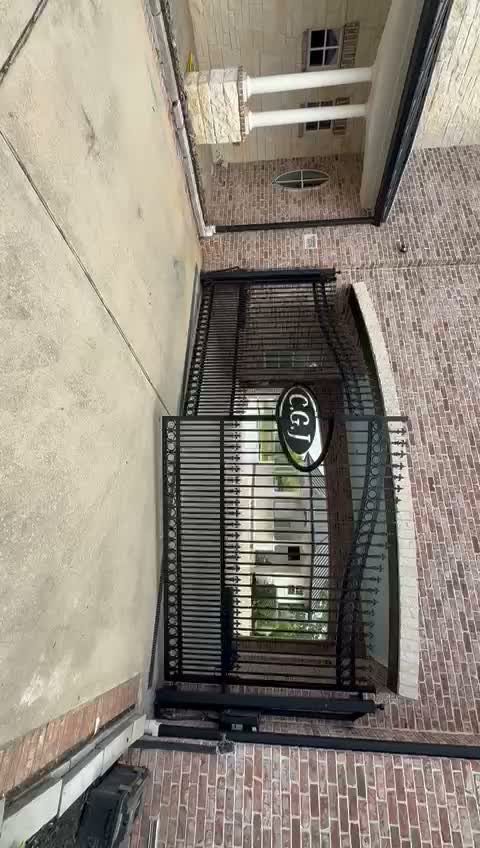
Very professional and friendly. Gotten automatic gates done and they are done to perfection! Thank you
We just installed iron gate and it looks amazing thank you very much mustang fencing .
chainlink fence installation by mustang fencing, looks really great, thanks.
Reviews shown word for word from the Mustang Fencing Services Google Business Profile (Galveston), captured 2026-10-12.
Questions we get about this
What determines the cost of an automatic gate in Galveston County?
Does a commercial automatic gate cost more than a residential one?
Is a solar gate opener cheaper to install than a wired one?
Does access control (keypad, telephone entry, card reader) add to gate installation cost?
Does being in a flood zone add cost to an automatic gate installation?
Can I get an exact price for my automatic gate without a site visit?
Sources
Checked October 16, 2026. Rules change, so confirm with the City before you build.
- DASMA TDS 353, Vehicular Gate Operators and the ANSI/CAN/UL 325 Standard (rev. 1/25) — UL 325 operator Classes I-IV definitions, quoted directly.
- UL 325 7th ed. scope (via cited extracts), gate types addressed — Named gate mechanisms: horizontal slide, horizontal swing, vertical lift, vertical pivot, overhead pivot, horizontal bifold.
- City of Galveston, Ordinance 25-011 (amending Flood Damage Prevention Ordinance Sec. 10-81), passed 3/27/2025 — Current codified Sec. 10-81(a)(4): service equipment elevated >= 18 in above Base Flood Elevation, designed against water entry.
- LiftMaster CSW24UL Installation Manual (Chamberlain Group) — Concrete pad vs. post-mount alternative, ground rod, battery replacement interval (~3 years), solar appendix Zone 2 rating.
- FAAC 770 24VDC Swing Gate Operator Manual (Rev 02, Jun 2012) — Drain conduit for the control box, grounding and surge-suppressor guidance.
- NEMA, Enclosure Types (Nov. 2005) — Type 3R, 4X, 6 and 6P definitions used to frame the flood-zone enclosure upgrade.
- NEMA GD 1-2019, Evaluating Water-Damaged Electrical Equipment — Batteries and surge-protective devices listed as components to replace, not recondition, after flooding.
Ready to scope your automatic gate?
We’ll walk the site, talk through operator class, power, access control and flood exposure, and give you a written price. Free on-site estimates across Galveston County.