
What Are the Best Custom Iron Driveway Gate Design Ideas?
Iron gives a driveway gate more design range than almost any other material — but the right starting point is how your driveway actually works, not a style photo. Here’s how gate type, decorative detail and coastal-grade hardware fit together, plus what Galveston’s adopted code requires if you automate it.
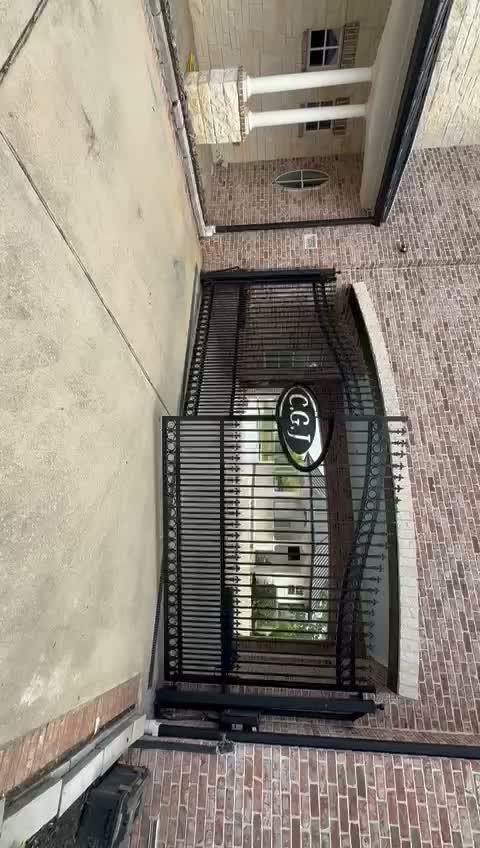
Start with how the driveway works, then choose the decorative details. ASTM F2200 — the specification Galveston’s adopted code points to for automated gates — groups driveway gates into real, defined types: horizontal swing, horizontal slide, vertical lift/pivot, overhead pivot and horizontal bifold. Your opening width, available swing or slide-back room, and grade decide which types fit; iron’s real advantage shows up after that, in scrollwork, laser-cut panels, medallions and matching your home’s architectural style.
Sources: ASTM F2200-24 scope (astm.org); UL 325, 7th ed. (shopulstandards.com); City of Galveston Ordinance No. 23-012 adopting 2021 IRC Appendix AO (galvestontx.gov); NPS Preservation Brief 27; American Galvanizers Association. Retrieved Sept. 24–25, 2026.
Gate style follows the driveway, not the other way around
The right gate style often comes down to the driveway itself before it comes down to aesthetics. A wide, grand entrance with room to swing favors a classic double swing gate, opening outward (or inward) in two matching halves. A narrower driveway or one without a full swing radius often fits a bi-fold, which folds rather than swinging a full arc, or a single swing for a simpler side-yard or secondary access point. Drawing IG-1 lines these up by footprint, using the same gate-type categories ASTM F2200 defines for automation.

Decorative details that actually make a gate custom
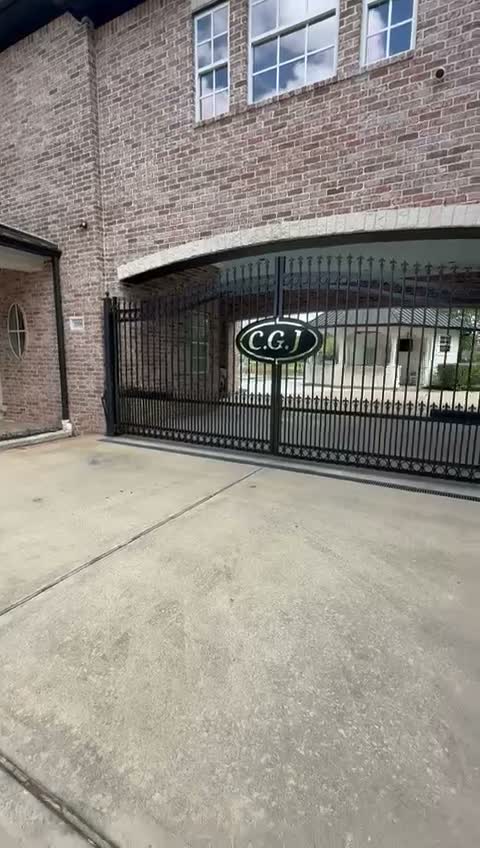
This is where iron separates itself from other materials. Scrollwork and classic ornamental patterns are the traditional look most people picture when they think “iron gate” — curling, decorative ironwork along the top and through the panel. Laser-cut designs cut precise, intricate patterns directly into flat panel sections, from geometric shapes to custom scenes. Medallions and inserts add a decorative casting or insert as a focal point, sometimes custom to a family crest, initial or meaningful image. And a good custom gate should echo the architectural style of the house it’s attached to — modern-farmhouse, Spanish/Mediterranean, French-country, Texas-ranch — rather than being chosen off a catalog page alone.
Cast iron vs. wrought iron vs. mild steel near the coast
The three metals behind “iron” gates don’t perform the same way in salt air. Per NPS Preservation Brief 27, cast iron is more resistant to corrosion than either wrought iron or steel, but it’s hard and brittle and can’t be shaped by forging. Wrought iron is comparatively ductile and traditionally hand-worked into scrollwork. Mild steel is the least corrosion-resistant of the three. Mixing dissimilar metals in the same gate (hinges, hardware, frame) also matters: galvanic corrosion happens when two different metals react in the presence of an electrolyte such as water containing salts — exactly the condition a coastal gate sits in. A maintained powder coat or galvanized finish slows corrosion by forming a protective barrier, per the American Galvanizers Association, but coating condition matters more here than it would inland.
Which gate type fits my driveway?
Answer a few questions about your driveway to see which ASTM F2200 gate category usually fits, and whether automating it brings Galveston’s adopted gate code into play.
Gate-type categories: ASTM F2200 §1.2 (horizontal slide, horizontal swing, vertical lift, vertical pivot, overhead pivot, horizontal bifold gates). Automation requirement: City of Galveston Ordinance No. 23-012 adopting 2021 IRC Appendix AO — AO103.1 (ASTM F2200) and AO103.2 (UL 325-listed openers). General guidance; an installer confirms fit on-site.
Matching gate type to your property
| Driveway situation | Gate type that usually fits | Why |
|---|---|---|
| Wide, grand entrance, room to swing | Double swing | Classic look; needs clear swing-arc room on both sides (or one side for inward-only) |
| Narrow driveway, little swing clearance | Bi-fold or single swing | Folds or swings within a tighter footprint than a full double-swing arc |
| Sloped driveway or no swing room at all | Horizontal slide (cantilever) | Needs level run-back space beside the opening instead of swing room, per ASTM F2200’s slide-gate category |
| Automating any of the above | Any type, opener UL 325-listed | Required by Galveston’s adopted 2021 IRC Appendix AO / ASTM F2200 |
ASTM F2200 gate-type scope; City of Galveston Ordinance No. 23-012.
What customers say
5.091 Google reviews · read them all on Google
We just installed iron gate and it looks amazing thank you very much mustang fencing .
Mustang’s team installed iron fence for me and did an absolutely incredible job! I would recommend this company to anyone I know!
Very professional and friendly. Gotten automatic gates done and they are done to perfection! Thank you
Reviews shown word for word from the Mustang Fencing Services Google Business Profile (Galveston), captured 2026-10-19.
Questions we get about this
What’s the difference between cast iron and wrought iron gates?
Do I need a permit to automate my driveway gate in Galveston?
Which gate style needs the least space?
Is iron more likely to rust near the coast?
What makes a custom iron gate different from a stock one?
Sources
Checked October 21, 2026. Rules change, so confirm with the City before you build.
- ASTM F2200-24, Standard Specification for Automated Vehicular Gate Construction — Defines the gate types the specification covers: horizontal slide, horizontal swing, vertical lift, vertical pivot, overhead pivot, horizontal bifold.
- UL 325, Door, Drapery, Gate, Louver, and Window Operators and Systems — Listing standard for gate operators; referenced by Galveston’s adopted code for automated vehicular gate openers.
- City of Galveston, Ordinance No. 23-012 (2021 IRC adoption, incl. Appendix AO) — Adopts the 2021 IRC appendix governing automatic vehicular gates, including the ASTM F2200 and UL 325 references.
- American Galvanizers Association, “Performance of Galvanized Steel in Different Environments” — Marine-atmosphere corrosion is chloride-driven; galvanizing’s protective patina slows but does not eliminate it.
Have a design in mind for your driveway gate?
We’ll measure your actual swing or slide clearance, talk through scrollwork, laser-cut or medallion details, and confirm what Galveston’s automation code requires if you want it motorized.