
What Actually Drives Commercial Fence Installation Cost Per Foot?
Commercial fence pricing varies more than most property owners expect, because “commercial fence” covers everything from a chain link enclosure to an ornamental steel perimeter fence engineered for wind and security. Rather than quote a generic national range, here’s what actually changes the per-foot price — construction type, height combined with local wind engineering, security rating, coastal corrosion protection, and gates — each sourced to the standard that drives it.
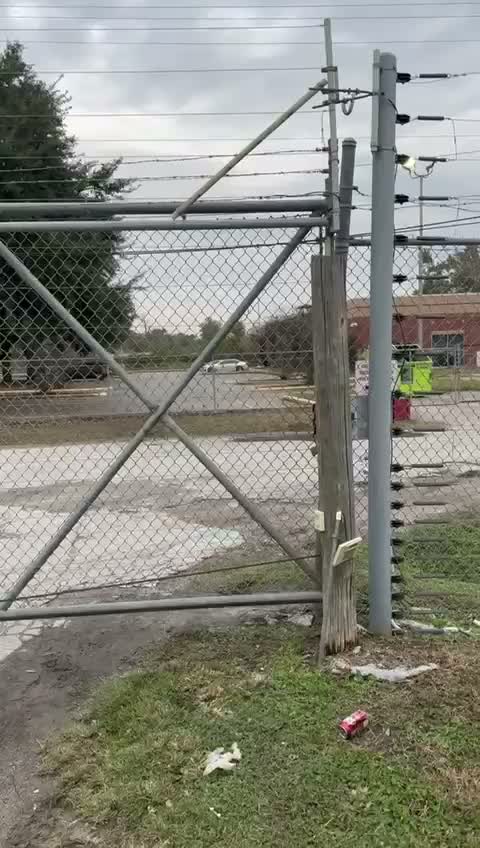
Commercial fence cost per foot depends on independent factors that each change the scope of the job: construction type, height combined with the local wind-engineering requirement, whether the fence needs a security/forced-entry rating, how much corrosion protection the coastal environment calls for, and whether any gates are motorized. We don’t publish a generic $/ft figure here because none found for this specific market are sourced to anything — the real way to budget is a site walk with an itemized written estimate that breaks out material, labor, gates and site prep separately.
Sources: CLFMI Wind Load Guide (WLG-2445, 2018); TDI Galveston County wind zone data; American Galvanizers Association ISO 9223 corrosion categories.
Why there’s no single honest commercial rate
Search “commercial fence cost per foot” and you’ll find national ranges with no source attached, usually sorted loosely by material. The real answer is that several independent factors each change the scope of a job: the construction type (chain link versus ornamental steel versus ornamental aluminum), the height combined with the local wind-engineering requirement, whether the fence needs to meet a security rating, how much corrosion protection the site’s distance from salt water calls for, and whether any gates are motorized. Two properties with identical linear footage can land on very different scopes once those factors are answered differently. Rather than repeat an unsourced national figure, this page breaks down what each factor actually changes and why.
Height and wind zone change the post count, not just the fabric
The Chain Link Fence Manufacturers Institute publishes line-post-spacing tables for eight wind-speed classes, from 105 mph up to 170 mph, because the force a fence panel has to resist scales with its face area — height times post spacing — and with the wind speed the site is engineered for. The recommended post spacing is calculated as a base spacing adjusted by coefficients for fabric gauge/mesh size, wind exposure category and other site factors, and footing embedment depth is calculated up to a maximum of 12 feet below finish grade for the most demanding combinations (CLFMI Wind Load Guide, WLG-2445).
Galveston Island itself has historically been treated as a higher wind-speed zone than areas just inland: under the legacy 2006 IRC/IBC-based rules the Texas Department of Insurance applied from 2008 to before September 2020, the City of Galveston fell in the “Seaward” zone at a 130 mph 3-second-gust design wind speed, versus 110-120 mph for the county’s “Inland” zones. Current code (2018/2024 IRC/IBC) sets wind speed site-specifically from ASCE 7 hazard maps rather than one countywide number, but the underlying principle is unchanged: a taller fence, a higher wind-speed site, or both, needs posts spaced closer together and footings set deeper — pure material and labor, not a markup.
What drives commercial fence cost per foot
| Factor | What changes | Why |
|---|---|---|
| Construction type | Chain link vs. ornamental steel vs. ornamental aluminum use different parts in different quantities | Chain link is fabric + line/terminal posts; ornamental steel is welded picket/rail/post assemblies at specific gauges (ASTM A392; example spec via Ameristar Montage catalog) |
| Height + wind zone | Posts spaced closer together and footings set deeper as height or wind speed rises | Panel wind-load face area scales with height x spacing; Galveston Island has historically sat in a higher wind bracket than inland sites (CLFMI Wind Load Guide; TDI zone data) |
| Security rating | A forced-entry or anti-climb rated fence needs different fabric, framework and anchoring than standard perimeter fencing | ASTM F2611 (chain link security fence design) and F2781 (forced-entry/ballistic test levels) define the engineering scope of a rated system |
| Coastal corrosion protection | Coatings/galvanizing upgraded for the site’s distance from salt water | Sites within about 1 km of the Gulf fall in ISO category C4/C5, several times the corrosion rate of the C3 band most hardware is designed around (AGA/ISO 9223) |
| Gates | A motorized slide or swing gate is its own certified system; a manual gate is not | UL 325 rates gate operators in classes I-IV by where they’re used (DASMA TDS 353) — a commercial installation needs a different class than a residential one |
| Site conditions | Terrain, existing fence removal, corner/end posts and utility easements add labor | Corner and terminal posts carry different loads than line posts; added labor beyond the base install, same as any fence type |
Sources: CLFMI Wind Load Guide (WLG-2445, 2018); ASTM F2611-23, F2781-15(2021); DASMA TDS 353 (UL 325); American Galvanizers Association ISO 9223 categories; Ameristar Montage Commercial catalog.
Check your site conditions
Answer four questions about the fence you’re planning and this lists which of the factors above actually apply to your project, and why each one adds engineering or material scope. It does not output a price.
This checklist reflects the sourced factors on this page; it is not a quote. The only way to get a real number is a site walk.
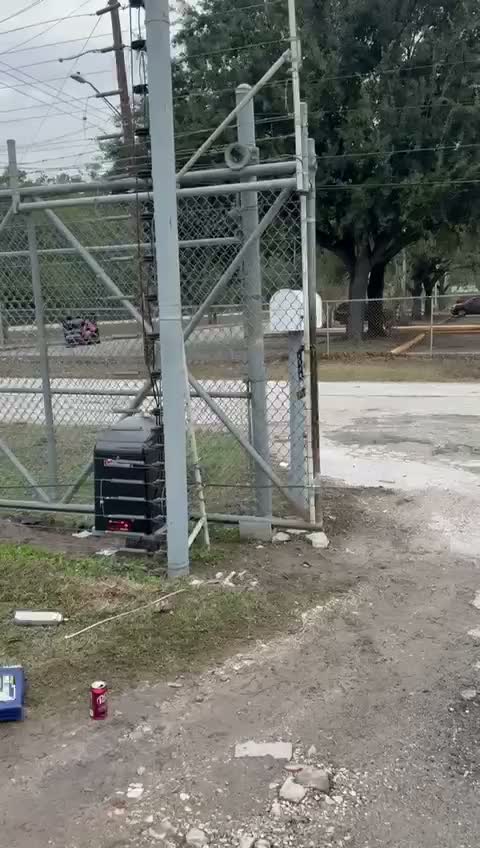
A security rating is an engineering scope, not an upgrade option
ASTM F2611 covers the material selection, system design and installation of chain link fencing meant to substantially increase the difficulty and time required to penetrate a perimeter — fabric, framework, barbed wire or tape, tension wire, fittings, and even gates are all addressed by the guide as part of one engineered system, not a fence with barbed wire added on top. ASTM F2781 goes further and defines how a fence system is tested: three forced-entry threat levels (Low, Medium and Aggressive/High, each defined by the tool inventory assumed available to an attacker), a limited ballistic test against handgun and rifle rounds, and a vehicle-impact test. A fence engineered to pass a specific threat level is a different design exercise — and a different bill of material — than a standard perimeter fence, which is why “security fencing” isn’t simply a pricier version of the same product.
Gates are engineered and certified separately
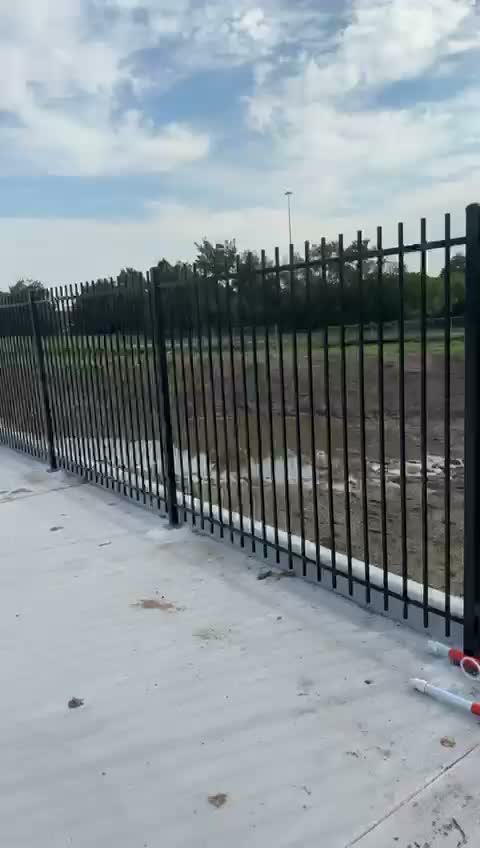
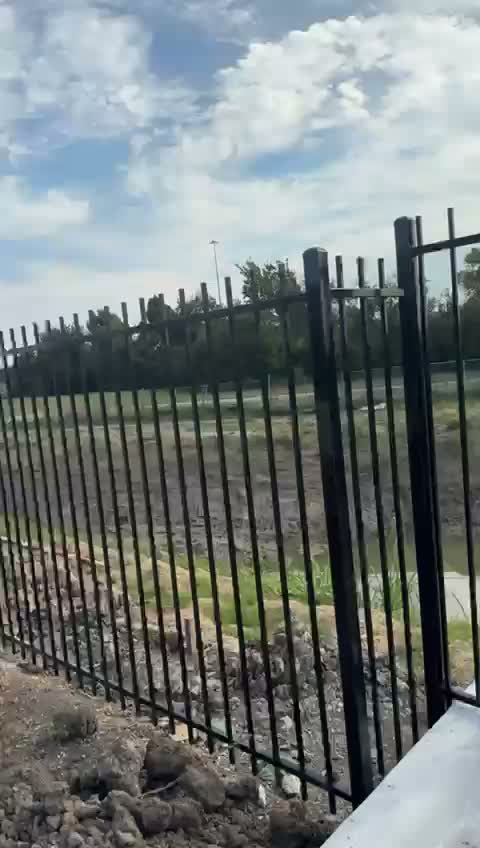
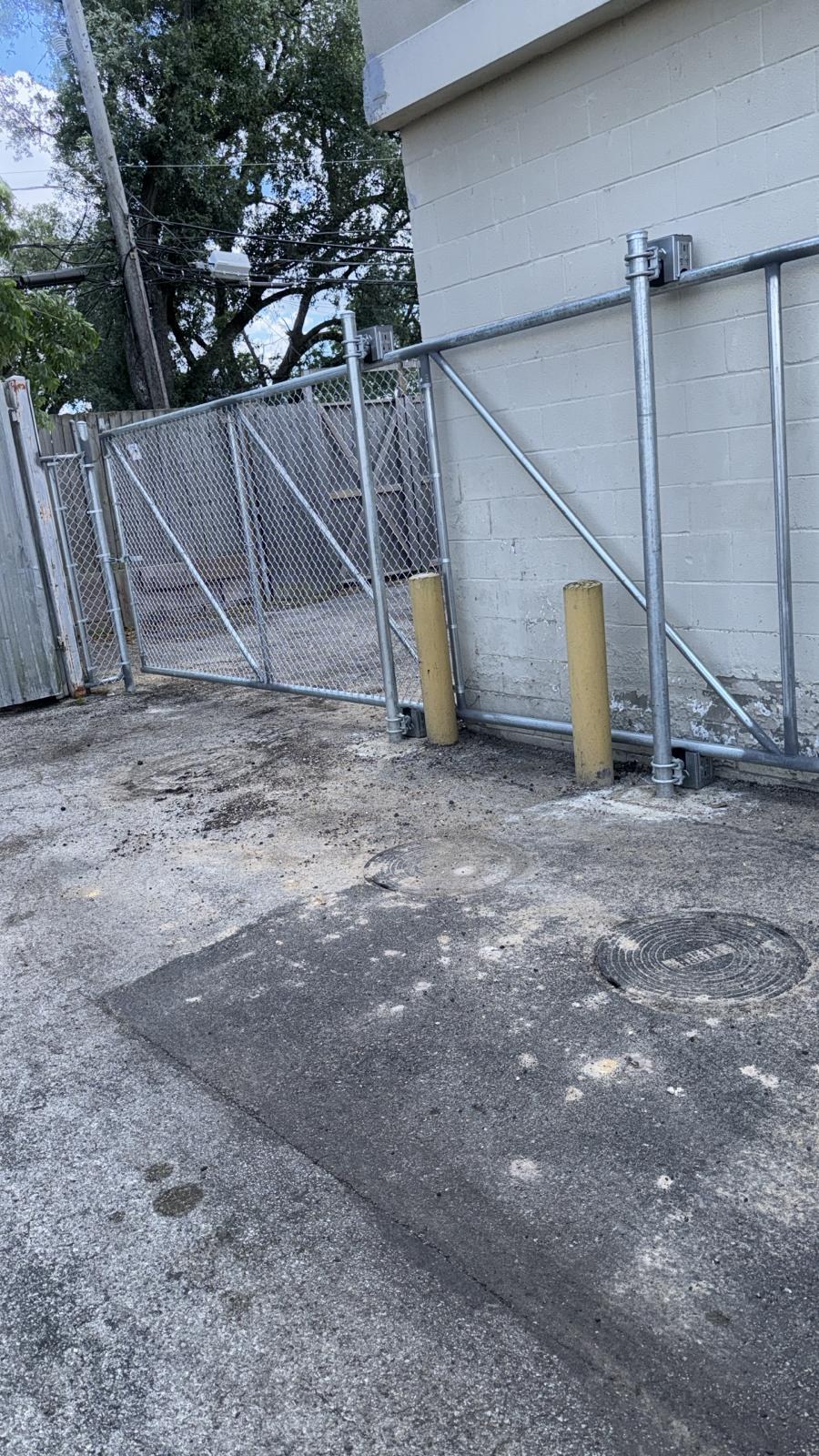
A manual walk or swing gate is a smaller version of the fence next to it: its own frame and hardware, sized to the opening. A motorized slide or swing gate is a different kind of product, covered by its own safety standard. UL 325 classifies vehicular gate operators by where they’re used — Class I for a 1-4 family residential garage or parking area, Class II for a commercial location such as a multi-family building, hotel or retail store, Class III for an industrial location not open to the public, and Class IV for a guarded or restricted industrial/security location (DASMA TDS 353, reprinting UL 325’s own definitions). A commercial property needs at minimum a Class II-rated operator, with required entrapment-protection features (reversal, force limits, monitored safety devices) that a residential-grade operator isn’t certified to provide — which is why gates are priced and itemized separately from the linear-foot fence rate.
What Galveston customers say
5.091 Google reviews · read them all on Google
chainlink fence installation by mustang fencing, looks really great, thanks.
Mustang’s team installed iron fence for me and did an absolutely incredible job! I would recommend this company to anyone I know!
Very professional and friendly. Gotten automatic gates done and they are done to perfection! Thank you
Reviews shown word for word from the Mustang Fencing Services Google Business Profile (Galveston), captured 2026-10-19.
Questions we get about this
How much does a commercial fence cost per linear foot?
Does height change commercial fence cost per foot?
Why would a commercial fence need a security rating?
Are automatic commercial gates more expensive than manual gates?
Does being close to the coast change commercial fence pricing?
Sources
Checked October 25, 2026. Rules change, so confirm with the City before you build.
- Chain Link Fence Manufacturers Institute, Wind Load Guide (WLG-2445, 2018) — Line-post-spacing tables for wind-speed classes 105-170 mph; post-spacing formula; footing embedment depth up to a 12 ft maximum.
- Texas Department of Insurance, Galveston County windstorm zone data — Legacy 2006 IRC/IBC design wind speeds by zone: City of Galveston “Seaward” 130 mph vs. “Inland” 110-120 mph.
- ASTM F2611-23, Standard Guide for Design and Construction of Chain Link Security Fencing — Material selection, system design and installation requirements for intrusion-delay fencing.
- ASTM F2781-15(2021), Standard Practice for Testing Forced Entry, Ballistic and Low Impact Resistance of Security Fence Systems — Three forced-entry threat levels; ballistic and vehicle-impact test methods.
- DASMA TDS 353 (reprinting UL 325 7th ed. definitions) — Vehicular gate operator Class I-IV definitions by use location.
- American Galvanizers Association, “HDG Corrosion Rates for ISO Categories C1-C5/X” (2021) — ISO 9223:2012 corrosivity categories and zinc corrosion rate ranges by distance from the coastline.
Want a real per-foot number for your commercial property?
Tell us the construction type, height, and any security or gate requirements, and we’ll walk the site and quote the real number — no generic national range, no guessing.