
What Does “Custom Fence Fabrication” Actually Mean?
Most fences sold as “custom” are stock panels with a choice of color and top. Real fabrication means the metal is cut, welded and finished to your measurements. Here is how to tell which one you are being quoted, the two tests that decide whether you need it, and the coating question that matters most near salt water.
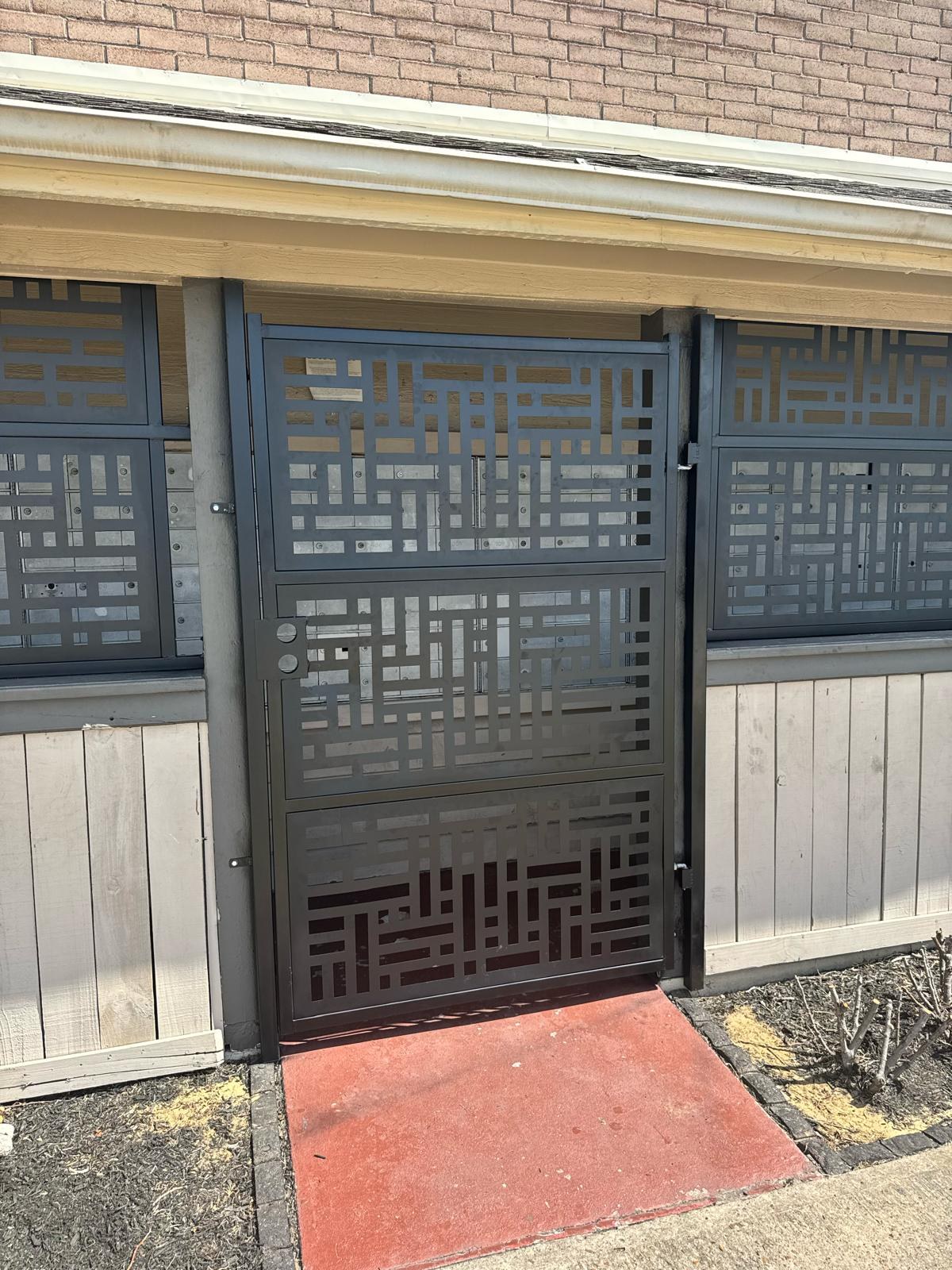
Custom fence fabrication means the fence or gate is cut, welded and finished to your site’s measurements, instead of being assembled from a manufacturer’s stock panels. Many fences sold as “custom” are stock panels with a choice of height, color and top style. That is often the right answer. Rackable aluminum panels can follow a moderate slope, and they come with a factory finish and warranty. You need real fabrication when the site goes past what a stock system can do: a slope steeper than the panel’s rack limit, an opening no stock gate fits, a pattern to match, or a design the catalog doesn’t have. On the Gulf Coast, the trade-off is the coating. A fabricated steel piece is only as protected as the finish put on after the last weld.
Sources: Fortress Building Products, Athens Residential (checked Oct 2, 2026); American Galvanizers Association, handrail venting guidance; City of Galveston Design Standards for Historic Properties; 2021 International Swimming Pool and Spa Code §305.
Three things people call “custom”
The word gets used for three different things. Ask which one you are being quoted, because they differ in how well they fit the site, how they are finished and what the warranty covers.
- Stock panels with options. A manufacturer’s ornamental fence comes in set panel widths and heights, with a choice of picket top, color and accessories. Fortress’s Athens aluminum line, for example, lists 71-inch panels in several heights and styles. Ameristar’s Montage steel panels are 8 feet long (92 inches actual). Choosing among these is customizing. Nothing is built for your site.
- Stock panels modified on site. The installer racks panels to follow the ground, cuts a short panel to finish a run, or adds posts. This is still a stock system, and it is how most stock fences fit real yards. The catch is in the finish and the warranty: a cut through coated steel leaves bare metal (see below).
- Shop-fabricated sections and gates. The metal is cut and welded to the measurements of your site, then finished. It can follow any grade, fill any opening and copy any pattern. It is also the option where the coating depends most on how the work is done.
None of these is “better” in general. A level backyard on a standard layout is usually best served by a stock system with a factory finish. The rest of this page is about how to tell when it isn’t. For the design service itself, see custom fence design in Galveston. For gates, see custom gate design.
Stock, modified or fabricated at a glance
| Stock panels | Stock, modified on site | Shop-fabricated | |
|---|---|---|---|
| Who sets the dimensions | The manufacturer’s catalog | The catalog, adjusted to the site | Your site measurements |
| Sloped ground | Racks up to the maker’s published limit | Racked, or stepped at each post | Built to the measured grade |
| Odd lengths and openings | Stock gate widths and panel lengths | Short panels cut to finish a run | Any opening, including fixed masonry |
| Coating on steel | Applied at the factory over the whole panel | Factory finish, except at every cut | Whatever is applied after the last weld |
| Warranty | The maker’s written warranty | Can depend on how cuts are sealed | Whatever the fabricator and finisher put in writing |
| Best for | Level or gently sloped, standard runs | Most real yards | Steep or irregular ground, odd openings, matching, one-off designs |
Fortress Athens and Ameristar Montage product data; Ultra Aluminum Section 32 31 19 specification; Ameristar Montage Commercial warranty (cutting and sealing terms).
Test 1: Can a stock panel follow your ground?
Ornamental panels handle a slope in one of two ways. A rackable panel lets its rails tilt while the pickets stay plumb, so the fence follows the ground. A panel that can’t rack far enough has to be stepped: it stays level and drops at each post, leaving a triangle of open space under the low end.
The limit is a number the manufacturer publishes. Fortress lists its Athens aluminum panels as “fully rackable” to 12⅜ inches, which it describes as up to 10 degrees of grade change. Across a 71-inch panel, that is a rise of about 17 percent (12⅜ ÷ 71). Ultra’s aluminum specification says racking is done at the factory at no extra charge, and that on a slope, post spacing is measured along the grade, not level. Ameristar sells its Montage steel panels as welded and rackable. Whatever system you are quoted, ask for its rack limit in writing.
Most of Galveston Island is close to flat, so slope rarely forces the issue on a typical island lot. It comes up on graded pads, berms, drainage swales and driveway aprons, and where a fence climbs to an elevated house. Step past the rack limit and you have three choices:
- step the panels and accept the gaps underneath,
- regrade so the panels can rack, or
- build sections to the slope.
If the fence is a pool barrier, stepping is usually ruled out by the gap rule (see the pool section below).
How much one 71-inch panel has to rack
Rise across a single 71 in panel at different slopes, in inches. The Athens aluminum panel cited above racks up to 12⅜ in.
Stock panels or custom fabrication?
Answer six questions about the run. The checker applies the manufacturer limits, the pool code and the City of Galveston historic-district approval rules cited on this page. It sorts the fence and the gate separately, because many jobs end up as a stock fence with a gate built to the opening. No prices.
Rack limit: Fortress Athens aluminum, 12⅜ in across a 71 in panel (about 10°); rise per panel = your rise × 71 ÷ 72. Steel makers publish their own limits. Coating: ASTM F2408 / F2589 scopes, AGA design guidance, Ameristar Montage warranty. Pool: 2021 ISPSC §305, which the City of Galveston pool permit requires. Historic: City of Galveston Design Standards for Historic Properties, administrative approval of fences. A planning aid, not an engineered design or a permit decision.
Test 2: Does the opening fit a stock gate?
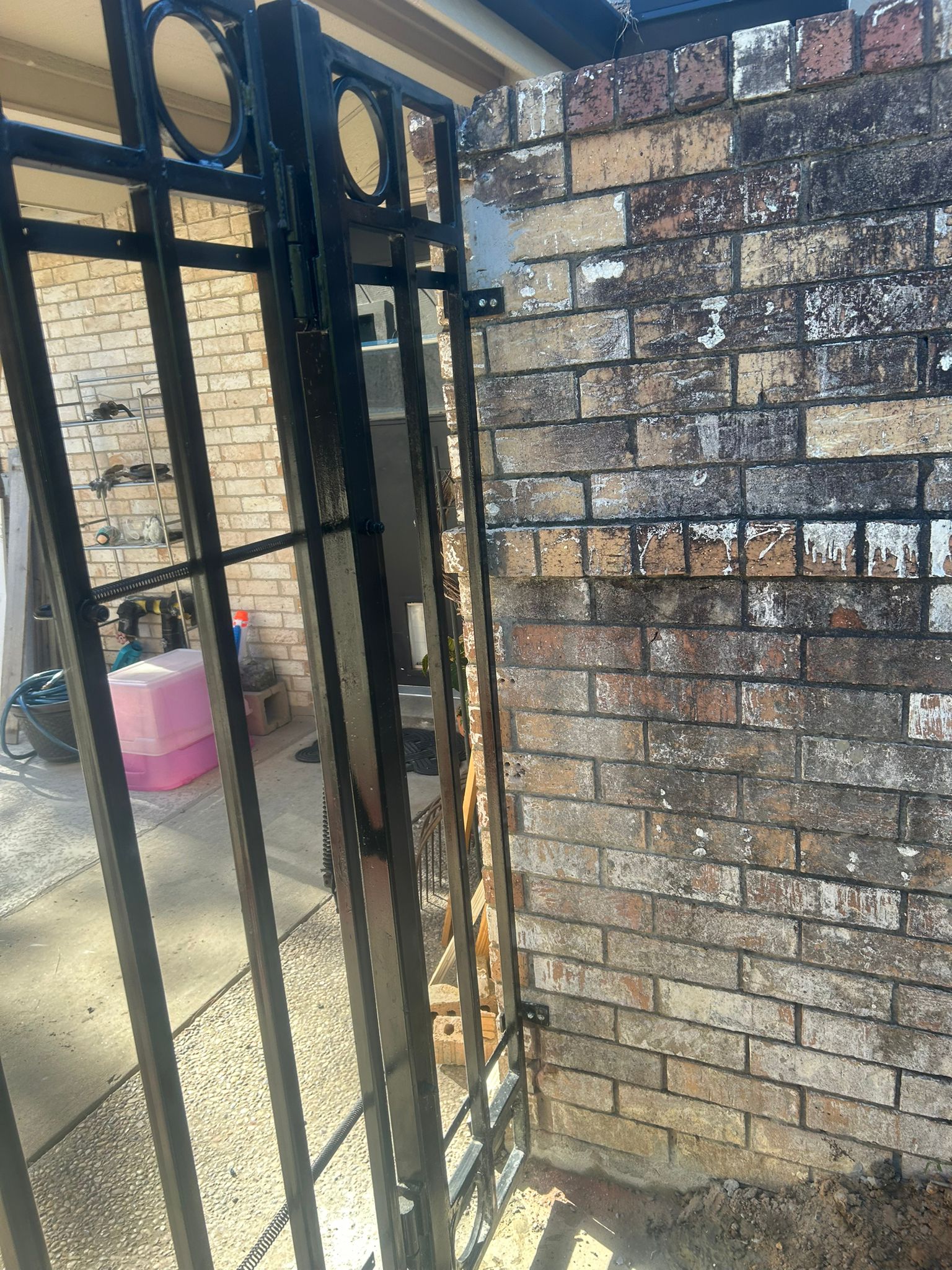
Gates are where most “custom” work actually happens. Stock gate lines come in set widths and heights. An opening between two existing brick columns, a walkway set by the house, or a driveway that is a few inches off a standard width doesn’t change to suit the catalog. The gate has to be built to the opening, or the opening has to be rebuilt.
That’s why many jobs end up as a stock fence with a gate built to the opening. If the gate will be automated, settle that before it is built. The frame, the hinge side and the operator mounting all depend on it (see custom gate design). Ultra’s specification, for one, calls for welded swing gate frames that hold a 300 lb vertical load on the latch side, and self-closing, self-latching walk gates. Ask for the same kind of written numbers on any gate built for you.
Near salt water, the coating decides whether custom is worth it
Steel rusts where it is bare. On a stock ornamental steel panel, the protection is put on at the factory over the whole welded panel. On a custom piece, it is only as good as what is done after the last cut and weld. That is the question to ask any fabricator, and the standards make it easy to ask precisely:
- Galvanized tube (ASTM F2408). The steel is hot-dip galvanized before or after it is formed, then powder coated or painted. This is what most stock ornamental steel is.
- Black steel tube (ASTM F2589). The same kind of fence made from steel that is not galvanized. It relies on its paint or powder coat alone. Neither standard covers solid-bar or wrought iron.
- Galvanized after fabrication (ASTM A123). The finished, welded piece is dipped whole in molten zinc. The American Galvanizers Association describes A123 as the specification for steel that is fabricated and then galvanized. It coats the welds and, if the piece is vented, the inside of the tube.
Galvanizing after fabrication has design rules of its own. The AGA says fabrications need vent and drain holes. Without them, trapped cleaning solution flashes to steam at pressures up to 3,600 psi, which can rupture the piece or leave bare spots. For welded pipe assemblies such as handrail, which is the closest AGA example to a gate frame, it calls for external vent holes as close to the weld as possible and not less than 3/8 inch, ½-inch vents in end sections, and open tube ends. Hinges should be galvanized separately, be of the loose-pin type and be fitted afterwards. Moving parts need at least 1/16 inch of radial clearance for the added zinc. A fabricator who galvanizes after welding will know these details. If one doesn’t, that tells you something.
Field cuts count too. Ameristar’s Montage warranty is voided by “any on-site cutting or welding” by the owner. Any cut must be sealed in three steps: remove the shavings, apply zinc-rich primer, then two coats of matching paint. Its warranty also says normal use “does not include … heavy salt spray exposure”. On a beachfront lot, read the salt clause in any warranty before you rely on it. The AGA notes that field repair of galvanizing (ASTM A780) works, but field fabrication that removes the coating “should be minimized”. Our steel fence page covers coatings in more depth.
Custom fence features worth asking for
These are the features people usually mean by custom fencing. Each one changes something on the quote, so it helps to know what.
- Following the grade. Racking within the maker’s limit is routine; Ultra’s spec does it at the factory at no additional charge. Going past the limit means stepping, regrading or fabrication.
- A gate sized to the opening. The most common fabricated item. Settle automation, the swing or slide direction and the hardware before the gate is built.
- Matching an existing fence. Picket spacing, rail heights, tops and finials copied from what is there. See matching an existing fence.
- Pool-ready infill. Under the 2021 ISPSC, which City of Galveston pool permits require, no opening may pass a 4-inch sphere. Where the horizontal rails are less than 45 inches apart, they go on the pool side and the vertical gaps shrink to 1¾ inches. Decorative cutouts are held to 1¾ inches as well.
- Decorative work. Arched tops, medallions, scrolls and cut panels like the one at the top of this page. They are one-off by nature, so they are fabricated.
- Mixed materials. A steel frame with wood or composite infill, for example. In a Galveston historic district, note that the design standards say not to mix wood and metal fence styles.
- Hardware built in. Drop rods, latch boxes, operator mounts and house numbers are easier to weld into a frame than to add later.
What custom does not mean is “more ornate”. A plain fence built to an awkward slope is as much a fabrication job as a scrolled estate gate. The defining thing is fit, not decoration. For how these choices move the price, see custom vs standard fence cost.
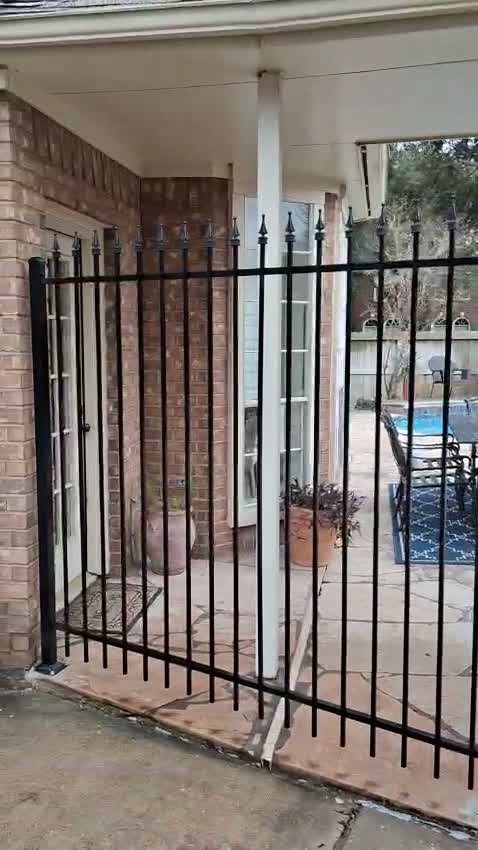
Custom pool fences: the code doesn’t care who built it
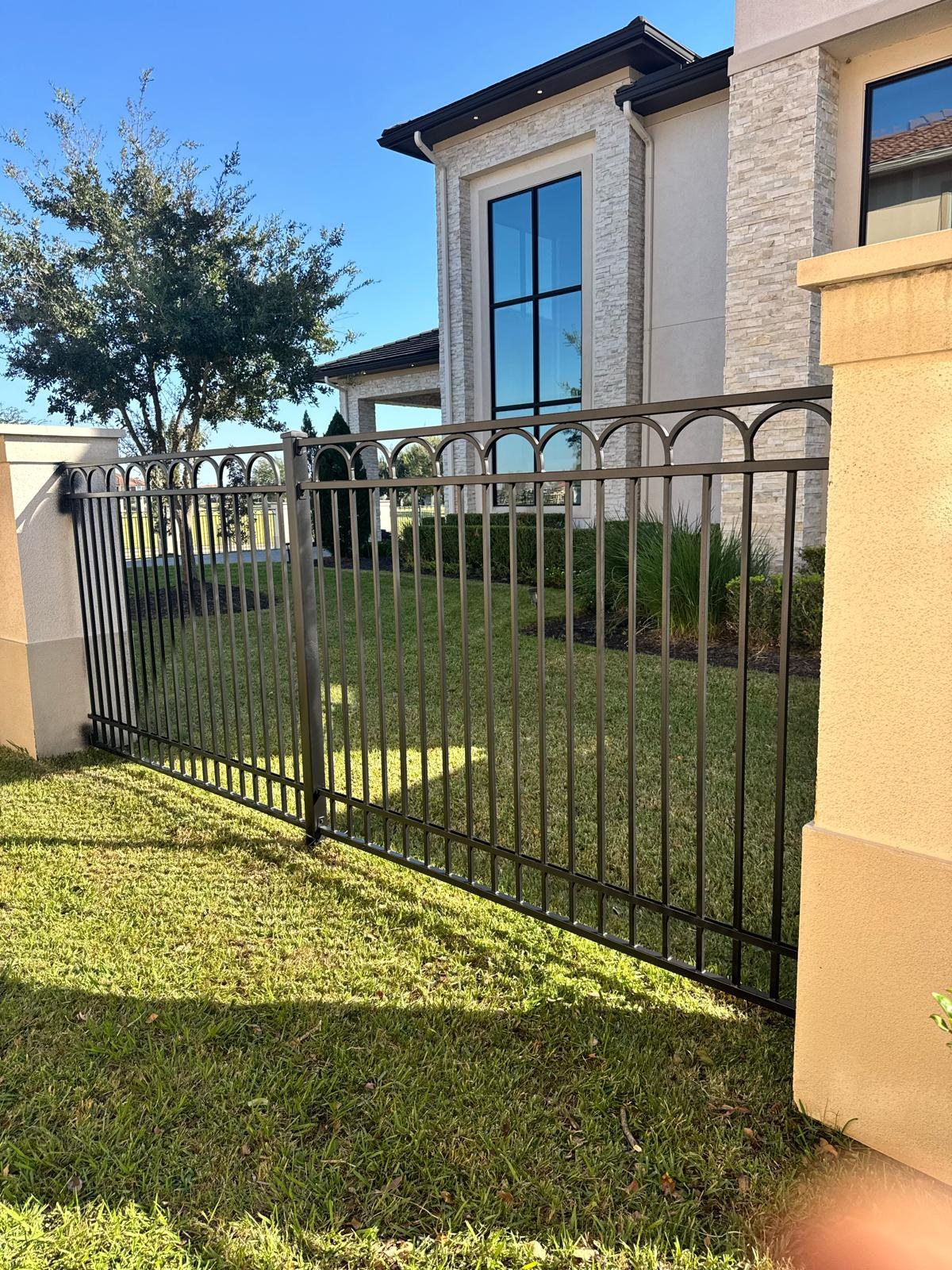
City of Galveston pool permits require compliance with the 2021 International Swimming Pool and Spa Code, and new fencing needs its own fence permit. Under ISPSC §305, a barrier must be at least 48 inches tall. It may leave no more than 2 inches under it on grass or gravel, or 4 inches over concrete, and no opening may pass a 4-inch sphere. Gates must open outward, away from the pool, and must self-close and self-latch. On a residential pool, an outside latch release that isn’t self-locking goes at least 54 inches up.
Two of these rules shape custom work. A stepped fence on a slope fails the gap rule at the low end of every panel, so a pool fence on sloped ground is usually racked within its limit or built to the grade. And decorative infill, such as scrolls, cut panels or wide picket spacing, has to be drawn to pass the sphere and cutout limits before it is made, not checked after.
When custom fabrication is worth it, and when it isn’t
Worth it: ground steeper than the rack limit; an opening no stock gate fits; a pattern to match or a historic design to reproduce; a pool barrier on uneven ground; or a design the catalogs don’t make. In these cases a stock system either can’t do the job or does it with gaps and compromises.
Usually not worth it: a level or gently sloped run of standard height, where a stock aluminum or galvanized steel system racks to the ground, arrives with a factory finish over every surface and carries a written warranty. Near salt water, that factory finish is a real advantage. Spend the custom budget on the gate instead.
Either way, the questions are the same: what is the rack limit, what fits the opening, and for any steel, how is it protected after the last weld? Those are the questions to settle at the on-site estimate. Fence and gate work on Galveston Island is covered on our Galveston Island page. For a Galveston job that paired a 93-foot fence with a 9.5-foot gate, see the project write-up.
What Galveston customers say
5.091 Google reviews · read them all on Google
We just installed iron gate and it looks amazing thank you very much mustang fencing .
had an excellent experience with mustang fencing From the initial consultation to the final installation, the team was professional, punctual, and attentive to detail. They helped me choose the perfect fence style to match my property and ensured everything was installed with precision. The quality of materials is top-notch, and the fence has completely transformed the look and security of my home. I highly recommend mustang services to anyone looking for reliable and high-quality fencing services!
I am so pleased with the fence!! Your solution was exactly the right one and the team did a highly professional job. Frankly, I was amazed at how clean the job site was at the completion of the project. Feel free to list me as a reference and a very happy customer. Thanks again and please let the men know That I appreciate their hard work and quality craftsmanship.
Reviews shown word for word from the Mustang Fencing Services Google Business Profile (Galveston), captured 2026-10-02.
Questions we get about this
What is custom fence fabrication?
What custom fence features can I choose?
Can a stock aluminum fence follow a slope?
Is a custom steel fence galvanized?
Do I need approval for a custom metal fence in a Galveston historic district?
Does a custom pool fence have to meet the pool code?
Sources
Checked October 2, 2026. Rules change, so confirm with the City before you build.
- Fortress Building Products, Athens Residential aluminum fencing (product data, checked October 2, 2026) — “Fully rackable panels match up to 10 degrees of grade change”; rackability 12-3/8 in; 71 in panels.
- Ultra Aluminum, Section 32 31 19 Decorative Metal Fences and Gates (guide specification) — Pickets screwed, welding to rails not permitted; racking at no additional charge; post spacing measured along the grade; welded swing gate frames, 300 lb latch-side load; self-closing, self-latching walk gates.
- Ameristar, Montage Commercial catalog, guide specification and warranty — Welded and rackable panels, 8 ft (92 in actual); warranty void for owner on-site cutting or welding; 3-step sealing of cuts; normal use excludes heavy salt spray exposure.
- ASTM F2408, Ornamental Fences Employing Galvanized Steel Tubular Pickets (scope) — Galvanized before or after forming; powder or two-coat liquid finish.
- ASTM F2589, Ornamental Fences Employing Steel Tubular Pickets (scope) — Black (not galvanized) steel; does not apply to solid bar or wrought iron.
- American Galvanizers Association, ASTM A123 and G90 specifications — A123 covers products fabricated and then hot-dip galvanized (batch process).
- American Galvanizers Association, Venting and Drainage: Handrail (and the Venting and Drainage overview) — Vent holes as close to the weld as possible, not less than 3/8 in; 1/2 in in end sections; open ends; why venting matters (steam pressure up to 3,600 psi).
- American Galvanizers Association, Moving Parts — At least 1/16 in radial clearance; hinges galvanized separately, loose-pin type, assembled after galvanizing.
- American Galvanizers Association, Repairing HDG Steel — Field repair per ASTM A780; field fabrication that removes the coating should be minimized.
- City of Galveston, Design Standards for Historic Properties (Chapter 3: fences; administrative approval) — Administrative approval criteria (48 in; pool 5 ft; corner 4 ft; side or rear cast or wrought iron up to 8 ft); Landmark Commission otherwise; no chain link; don’t mix wood and metal styles.
- City of Galveston, Fence Permit Application — Historic district or landmark question: attach photos of existing fences and the proposed design.
- International Code Council, 2021 ISPSC Section 305 Barrier Requirements — Height 48 in; 2 in / 4 in under the barrier; 4 in sphere; 45 in horizontal-member rule; gates outward, self-closing, self-latching; latch release height.
- City of Galveston, Swimming Pool Permit Application — New pools must comply with the 2021 ISPSC; a separate fence permit is required for new fencing.
Not sure if your fence needs to be custom?
We’ll measure the run, the slope and the openings, and tell you which parts a stock system handles and which need to be built to fit, all on a written quote. Free on-site estimates across Galveston County.