
Crafting a Quality 6’ Privacy Fence for Carlos Lemus in Danbury, Texas
Carlos wanted a 6-foot privacy fence that could stand up to Texas wind and still look good from both sides. Here is the documented scope Mustang completed — a board-on-board pressure-treated pine fence run and a matching gate, set in concrete — plus the sourced reason pressure-treated pine resists rot in ground contact.

Mustang Fencing built a 6-foot pressure-treated pine privacy fence and a matching gate for Carlos Lemus in Danbury, TX, using a board-on-board design so both sides look finished with no sightline gaps. Posts were set in concrete with the depth measured for wind resistance.
Sources: this project’s own documented facts and photos; American Wood Protection Association, Use Category System (UC4A). Checked November 4, 2026.
The job: a 6-ft board-on-board fence and gate for Carlos Lemus
Carlos Lemus approached Mustang Fencing wanting a 6-foot privacy fence for his Danbury property. His stated concerns were durability against Texas wind and humidity, an appearance that complemented the home, and full privacy with no gaps for neighboring sightlines. Mustang recommended pressure-treated pine in a board-on-board design — alternating overlapping boards that leave both the front and back of the fence looking finished. Posts were set in concrete, with the hole depth measured specifically to hold up against wind.
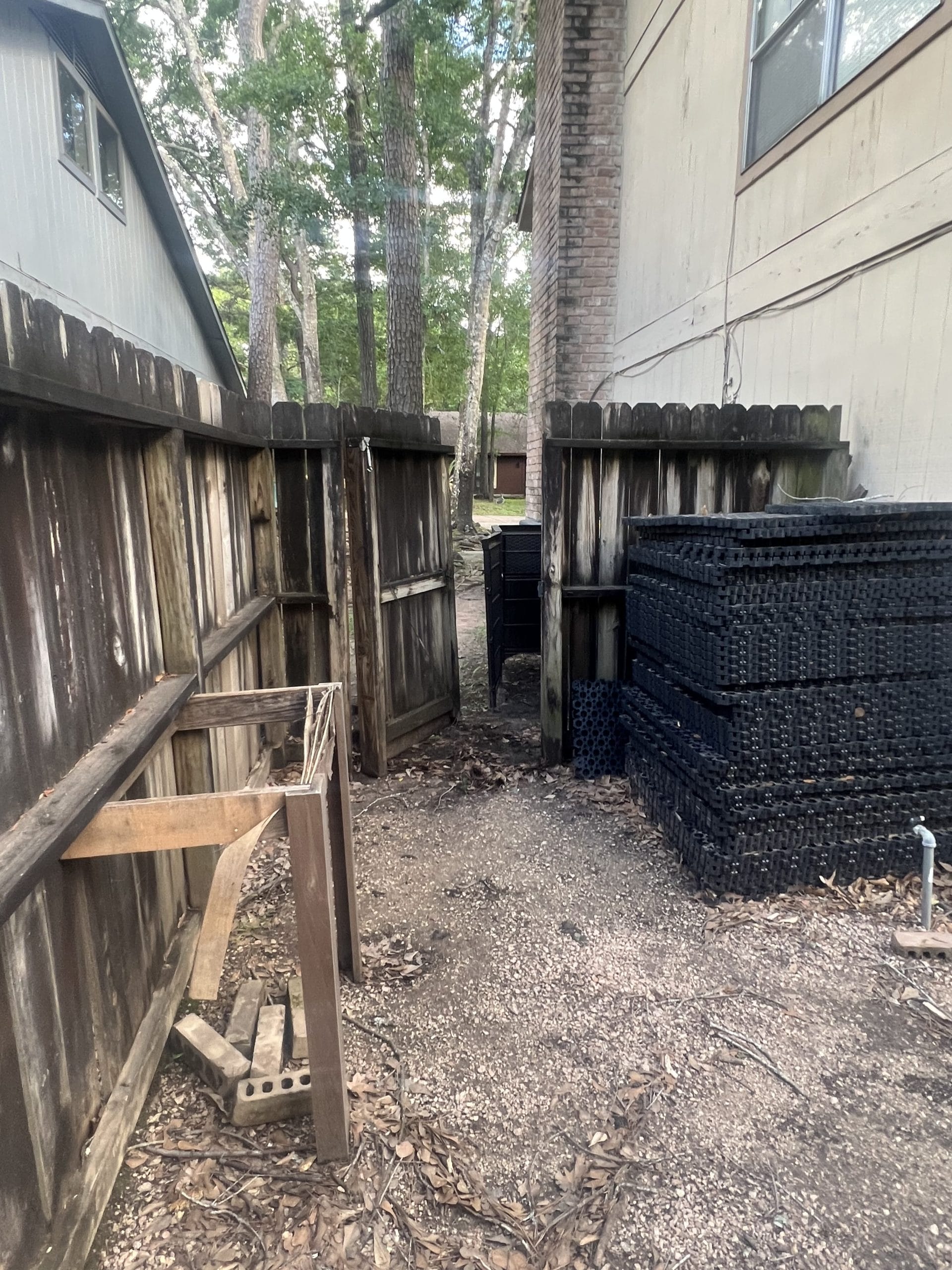
The project’s own photos show a new 6-ft run completed across the cleared rear yard and a matching board-on-board gate built as part of the same job. One section of the property — a narrow side yard — had an older, weathered fence before this work; that section is documented here as the “before” condition, distinct from the new run shown finished.
Why pressure-treated pine resists rot in the ground
Pressure-treated pine was chosen partly because it resists rot, decay and insect damage — the reason is a national material standard, not a marketing claim. The American Wood Protection Association’s Use Category System rates ground-contact lumber as UC4A — “Ground Contact, General Use” — the category fence posts fall under. UC4A sets minimum preservative retention levels depending on the chemical used: for Southern Pine, that ranges from 0.15 lb/ft³ for CA-C/MCA up to 0.40 lb/ft³ for ACQ-D. Those retention levels are calibrated so the preservative reaches deep enough into the wood to resist decay fungi and wood-boring insects for the post’s service life in soil contact.

Fence post concrete footing estimator
Cylindrical-hole arithmetic for how much ready-mix concrete one post footing needs, based on hole diameter and depth. Not a quote — actual footing size depends on the post, soil and local wind requirements. Defaults are a common starting point; change any field.
Arithmetic: hole volume (cu ft) = π × (diameter ÷ 24)² × depth. Bags = ceiling(volume ÷ 0.45 cu ft, the published yield of a 60 lb ready-mix bag). Does not subtract the post’s own volume.
What customers say on Google
5.091 Google reviews · read them all on Google
I chose Mustang Fencing for my backyard due to their reputation for quality and security. Their wood fencing exceeded my expectations, durable and visually appealing. The customer service was top-notch, and the installation was quick and efficient.
Mustang Fencing Services provides great quality and craftsmanship. Their workforce is competent and efficient, guaranteeing that every project meets the greatest requirements. The materials utilized are strong, and the attention to detail is excellent. Highly suggest to anyone in need of dependable fencing solutions!
Mustang Fencing exceeded my expectations! Durable and attractive fencing options available. Excellent customer service. Highly recommended for quality fencing solutions.
Reviews shown word for word from the Mustang Fencing Services Google Business Profile (Galveston), captured 2026-11-02.
Questions we get about this
What did Mustang Fencing build for Carlos Lemus?
Why board-on-board for a privacy fence?
Why pressure-treated pine?
How does the post installation affect wind resistance?
Does a board-on-board pine fence need much maintenance?
Sources
Checked November 4, 2026. Rules change, so confirm with the City before you build.
- American Wood Protection Association (AWPA), Use Category System — technical information for homeowners — Defines UC4A (“Ground Contact, General Use”) and lists minimum preservative retention levels (e.g. 0.40 lb/ft³ for ACQ-treated Southern Pine) that let ground-contact pine resist decay fungi and wood-boring insects.
Want a privacy fence built to last?
We’ll walk the property, talk through materials and design, and put the scope on one written estimate before any work starts.