
Crafting a Stunning 31-Foot Cedar Fence for Malorie Barbee in Kemah, Texas
Malorie Barbee wanted a cedar privacy fence for her Kemah property that kept the wood’s natural look. Here is that 31-foot fence in photos, plus what her clear-sealant finish choice means for upkeep.
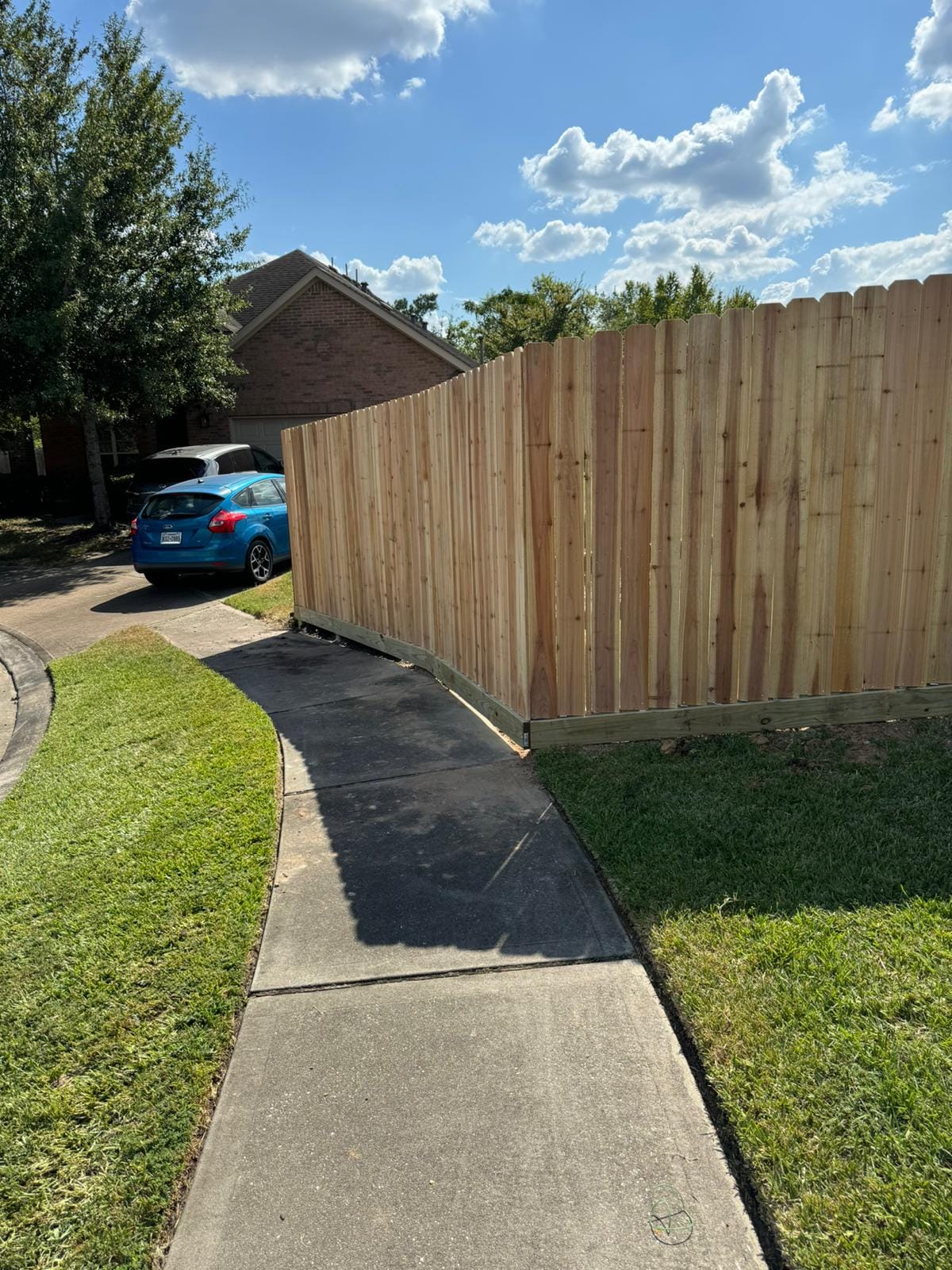
Malorie Barbee’s cedar fence in Kemah is 31 feet long, built with vertical 2×6 boards, and finished with a clear sealant. That sealant was chosen to keep the cedar’s natural color rather than tint it — but per the USDA Forest Products Laboratory’s Wood Handbook, clear and lightly tinted finishes also sit at the low-pigment end of its finish table, which the Handbook ties directly to a shorter expected service life before refinishing.
Source: USDA Forest Products Laboratory, Wood Handbook FPL-GTR-282 (2021), Ch.16, Table 16-2.
The job: a 31-foot vertical cedar fence with a clear sealant finish
Malorie Barbee wanted a cedar privacy fence for her Kemah property that provided privacy and security while keeping the wood’s natural character. The team built a vertical board design using 2×6 cedar boards, running 31 feet along the property line.
For the finish, Malorie chose a clear sealant over a tinted stain, specifically to enhance the wood grain without changing cedar’s natural color. During installation, the crew ran into rockier-than-expected soil in Kemah, which made digging the post holes more difficult; posts were anchored with specialized tools to keep the fence stable.

Why a clear finish is a real tradeoff, not just a look
A clear sealant does one thing very well: it lets the cedar’s own grain and color show through, instead of hiding it under a tint or an opaque coat. But the Wood Handbook’s own guidance on exterior finishes ties how long a finish lasts to how much pigment it carries. Its Table 16-2 footnote is direct about it: “The higher the pigment concentration, the longer the service life.” A clear or lightly tinted finish, by definition, sits at the low end of that scale.
What the pigment in a finish is actually blocking
Pigment is not just color. In a finish, it is also the layer that intercepts sunlight before it reaches the wood fibers underneath. The Wood Handbook describes penetrating, lightly pigmented finishes as ones that “fade, and if pigmented, the pigments erode” as they weather. A clear sealant has little or no pigment to erode in the first place, so the wood beneath is more directly exposed to UV, and the sealant’s own protection fades faster than a heavily pigmented coat would.
Anatomy of Malorie Barbee’s cedar fence
Put together, the fence built for Malorie runs vertical 2×6 cedar boards for the full 31-foot length, set on posts anchored through Kemah’s rockier soil, finished in a clear sealant that keeps the cedar’s natural tone on display.

Finish refinish-interval estimator
Pick a finish type and a surface texture to see the Wood Handbook’s published service-life range for smooth cedar/redwood siding. A fence is not in the table; treat this as the closest published reference, not a spec for your job.
USDA Forest Products Laboratory, Wood Handbook FPL-GTR-282 (2021), Ch.16, Table 16-2 (smooth cedar/redwood siding figures) and footnote b: pigment concentration drives service life.
What Galveston-area customers say on Google
5.091 Google reviews · read them all on Google
Amazing work will go ahead and recommend everyone in friends and family We installed 8ft tall double sided stained cedar wood fence in our backyard, it’s really looks great, installed perfectly nice finishing and cost effective, thanks mustang fencing.
had an excellent experience with mustang fencing From the initial consultation to the final installation, the team was professional, punctual, and attentive to detail. They helped me choose the perfect fence style to match my property and ensured everything was installed with precision. The quality of materials is top-notch, and the fence has completely transformed the look and security of my home. I highly recommend mustang services to anyone looking for reliable and high-quality fencing services!
True professionalism is very rare in this day and age, these guys live upto their word and deliver on their service! Our fence was down in the July storm and these guys came and gave a reasonable quote, after confirming I received a time line and they delivered! Will recommend them to everyone I know who needs fencing done.
Reviews shown word for word from the Mustang Fencing Services Google Business Profile (Galveston), captured 2026-10-26.
Questions we get about this
Why does a clear sealant need refinishing sooner than a stain or paint?
Does that mean a clear sealant is a bad choice?
How big is the board used on this fence?
What made installation harder on this job?
How often should a clear-sealed cedar fence be refinished?
Sources
Checked October 29, 2026. Rules change, so confirm with the City before you build.
- USDA Forest Products Laboratory, Wood Handbook FPL-GTR-282 (2021), Chapter 16: Finishing of Wood, Table 16-2 (p.406) — Suitability and expected service life of finishes for exterior wood surfaces, by pigment concentration — the basis for comparing Malorie’s clear-sealant finish to tinted stains and paint.
Planning a cedar fence or choosing a finish?
We’ll walk the property, talk through board size, finish options and the upkeep tradeoffs, and put it on a written quote.