Project case study · Galveston, Texas

Crafting a Stunning 6’ Cedar Privacy Fence with Top Cap for Paul Mordente in Galveston, TX

Paul Mordente wanted a 6-foot cedar privacy fence finished with a top cap and a double-coated orange peel stain. Here is that job in photos, plus what a cap rail and a second coat of stain are actually doing for a fence on the Texas coast.
  • Reviewed Oct 29, 2026
  • Source: USDA Wood Handbook Ch.16
  • 2 job photos
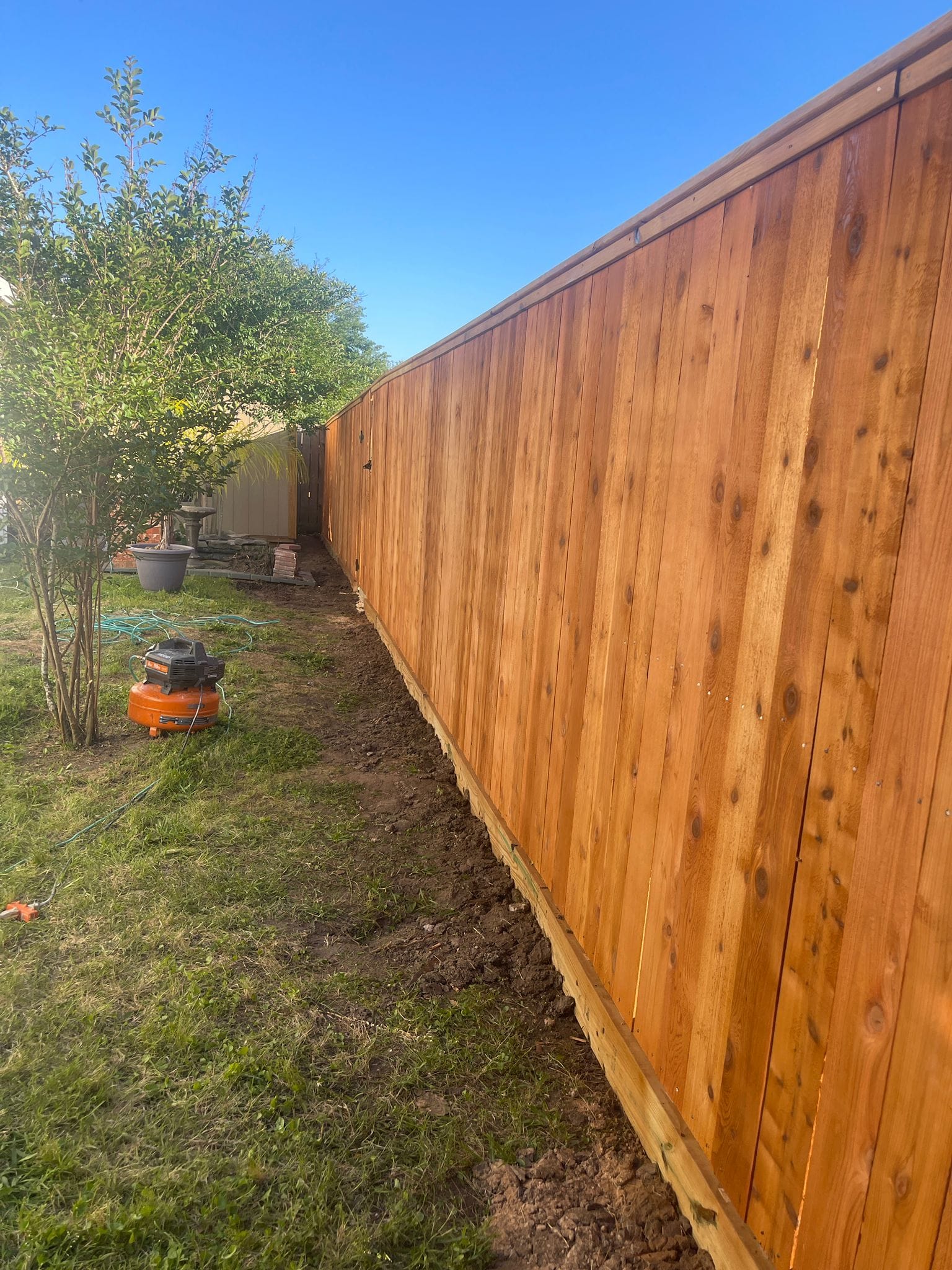
Red-stained cedar privacy fence with cap rail running along a lawn
The finished 6-foot cedar privacy fence with cap rail and double-coated orange peel stain, Galveston, Texas.
The short answer

Paul Mordente’s 6-foot cedar privacy fence was finished with a top cap and a double-coated orange peel stain. Both choices line up with how USDA Forest Products Laboratory guidance says a wood fence should be protected: seal the end grain, and apply enough finish to reach a real film-thickness target.

6 ftHeight of Paul Mordente’s cedar privacy fence, Galveston, TX
2 coatsTopcoats of orange peel stain applied, inside the Wood Handbook’s 0.10-0.13mm (4-5 mil) best-service-life range for smooth-planed wood
1 capTop cap rail, which seals the exposed end grain at the top of every picket
Concrete-setPosts set in concrete for stability against Galveston’s occasional high winds

Source: USDA Forest Products Laboratory, Wood Handbook FPL-GTR-282 (2021), Ch.16.

The job: a 6-foot cedar privacy fence with a top cap and a double-coated stain

Paul Mordente wanted a 6-foot cedar privacy fence for his Galveston property, finished with a top cap and a double-coated orange peel stain. Cedar was chosen for its natural resistance to decay and insects, and each post was set in concrete for stability in Galveston’s occasional high winds.

The photos below are from that job.
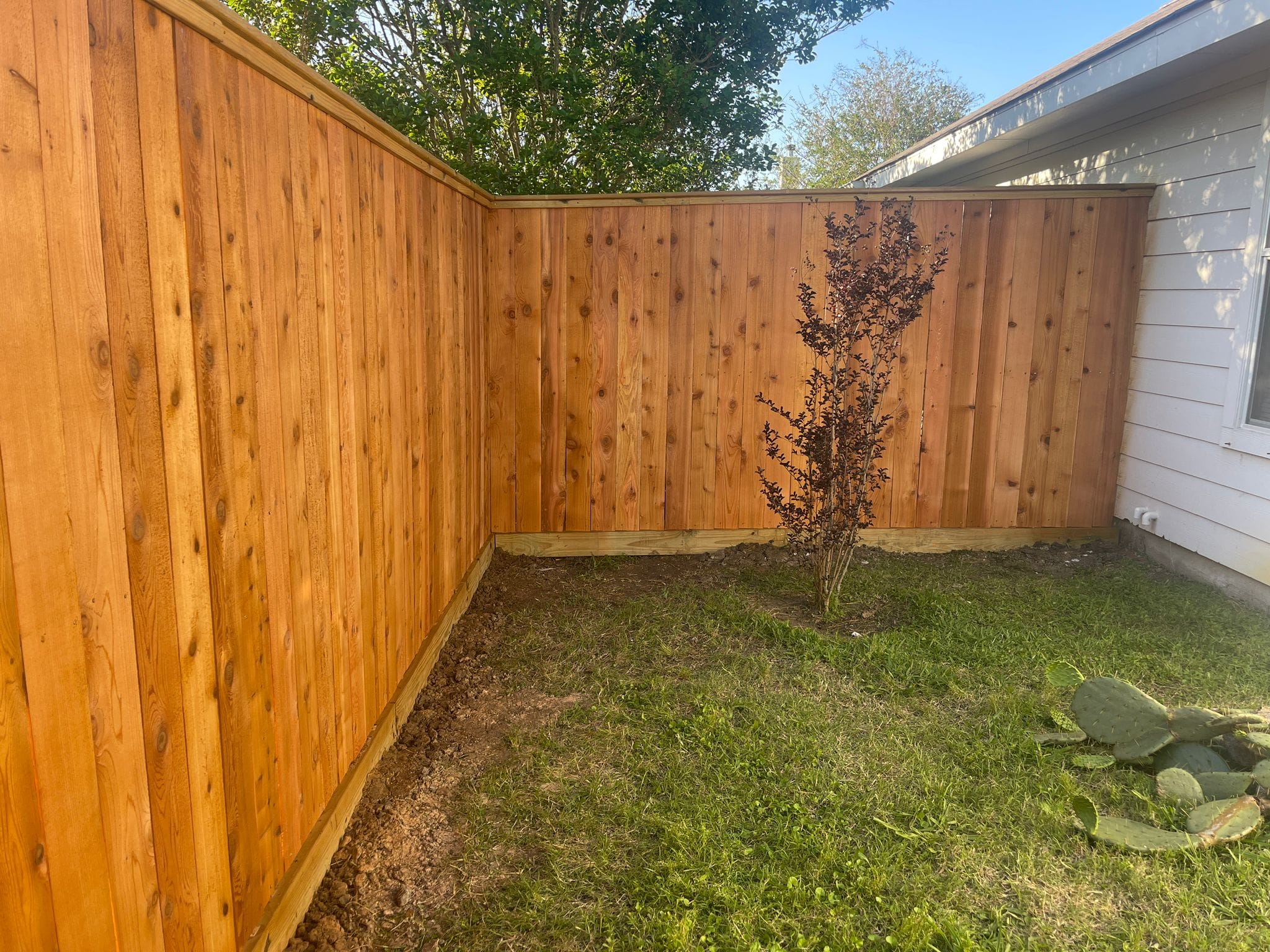
Wood privacy fence forming a corner around a lawn with a young tree
The cedar privacy fence turning the corner of the lawn, Galveston, Texas.

What the top cap is actually doing

A fence’s top cap is more than a finished look. USDA Forest Products Laboratory’s Wood Handbook instructs, on finishing exterior wood: “always seal all end grain.” End grain — the cut top edge of a picket — is the most exposed part of any board on a privacy fence, sitting directly under sun and rain with no coating protecting it unless something covers it. A cap rail running the top of the fence line is one straightforward way a wood privacy fence seals that edge, instead of leaving every picket top bare.

Two groups of fence pickets side by side. The left group has bare tops labeled no cap, end grain exposed at the top of each board. The right group has a horizontal cap rail across the top labeled with cap, cap rail seals the end grain, sheds water off the top. NO CAPend grain exposed at the top of each board WITH CAPcap rail seals the end grain, sheds water off the top What a cap rail is actually doing Wood Handbook Ch.16 instructs: “always seal all end grain.” A cap rail is one way a privacy fence does that at the most exposed edge — the picket tops.
S-2
DrawingCap rail vs. bare picket tops
BasisUSDA Forest Products Laboratory, Wood Handbook FPL-GTR-282 (2021), Ch.16 (“always seal all end grain”)
ScaleNot to scale
Without a cap, every picket top is exposed end grain. The cap rail on Paul’s fence seals that edge.

Why the stain went on in two coats, not one

The Wood Handbook also gives a concrete target for a film-forming finish like a solid-color or heavily pigmented stain: “On smooth-planed wood, the best service life comes from a primer and two topcoats to achieve a 0.10- to 0.13-mm (4 to 5-mil) dry film thickness.” A single coat typically falls short of that range. Paul’s double-coated orange peel stain puts the finish in the thickness band the Handbook ties to the longest service life, rather than relying on one thin coat.

A bar chart with a shaded target band between 0.10 and 0.13 millimeters. A shorter bar labeled 1 coat, below target, sits under the band. A taller bar labeled 2 coats, inside target band, reaches into it. TARGET: 0.10-0.13mm (4-5 mil) dry film 1 COAT~0.06mm — below target 2 COATS~0.115mm — inside target band Dry film thickness: one coat vs. two coats of a film-forming finish Illustrative midpoints, not lab measurements. The Wood Handbook ties the 0.10-0.13mm target to the best service life on smooth-planed wood.
S-1
DrawingDry film thickness: 1 coat vs. 2 coats
BasisUSDA Forest Products Laboratory, Wood Handbook FPL-GTR-282 (2021), Ch.16 (0.10-0.13mm / 4-5 mil target, best service life on smooth-planed wood)
ScaleNot to scale
One coat typically lands below the Handbook’s target film-thickness band; two coats reaches into it.

When two coats everywhere isn’t practical

Coating an entire fence line twice takes time, and the Handbook accounts for that: “If applying two topcoats to the entire structure is not practical, consider two topcoats for fully exposed areas on the south and west sides and a single topcoat on other areas.” On the Gulf Coast, that means the sides of a fence catching the most direct afternoon sun are the ones where a second coat matters most.

A plan-view square with four sides labeled. The south and west sides are marked 2 coats; the north and east sides are marked 1 coat OK. SOUTH — full sun, 2 coats NORTH — shaded, 1 coat OK WEST EAST If 2 coats everywhere isn’t practical: prioritize the exposed sides Wood Handbook Ch.16: when coating the whole structure twice isn’t practical, put the second coat on the fully-exposed south and west sides first; a single topcoat is acceptable elsewhere.
S-3
DrawingPriority sides for a second coat
BasisUSDA Forest Products Laboratory, Wood Handbook FPL-GTR-282 (2021), Ch.16 (south/west sides prioritized when 2 coats everywhere is impractical)
ScaleNot to scale
When time or budget limits a second coat to part of the fence, the Handbook points to the south- and west-facing sides first.

Cedar fence finish-coat check

Pick a finish type and how many topcoats are planned. Based on USDA Forest Products Laboratory Wood Handbook Ch.16. General guidance, not a spec for your project — confirm with your installer.

Film thickness
End grain

USDA Forest Products Laboratory, Wood Handbook FPL-GTR-282 (2021), Ch.16: a primer plus two topcoats reaching 0.10-0.13mm (4-5 mil) dry film gives the best service life on smooth-planed wood for film-forming finishes; always seal all end grain.

★★★★★
White PVC fence. Beautifully done! Thanks Mustang it’s really looks perfect.
Diana Martinez · Google review · a year ago
★★★★★
Fenomenal job, really nice guy. Contacted them after hurricane knocked down my fence facing the street and got it done really quickly.
Patricia Rios · Google review · a year ago
★★★★★
Mustang’s team installed iron fence for me and did an absolutely incredible job! I would recommend this company to anyone I know!
Theodore Howitt · Google review · a year ago

Reviews shown word for word from the Mustang Fencing Services Google Business Profile (Galveston), captured 2026-10-26.

Questions we get about this

Why does Paul Mordente’s fence have a top cap?
A cap rail seals the exposed end grain at the top of every picket. USDA Forest Products Laboratory’s Wood Handbook Ch.16 instructs that exterior wood finishing should always seal all end grain, since it is the most exposed, least protected part of a board.
Why was the stain applied in two coats instead of one?
The Wood Handbook ties the best service life for a film-forming finish on smooth-planed wood to a primer plus two topcoats reaching a 0.10- to 0.13-mm (4-5-mil) dry film thickness. A single coat typically falls short of that range.
Does the whole fence need two coats of stain?
Not necessarily. The Handbook notes that if coating the entire structure twice is not practical, the south- and west-facing sides (the most sun-exposed) should get priority for the second coat, with a single topcoat acceptable elsewhere.
What is an orange peel stain finish?
It is a double-coated, heavily pigmented exterior stain finish, named for its textured surface. It forms a protective film over the wood rather than soaking in like a thin semitransparent stain.
What fence did Paul Mordente build in Galveston, TX?
A 6-foot cedar privacy fence finished with a top cap and a double-coated orange peel stain, with posts set in concrete.

Sources

Checked October 29, 2026. Rules change, so confirm with the City before you build.

  1. USDA Forest Products Laboratory, Wood Handbook FPL-GTR-282 (2021), Chapter 16: Finishing of Wood — End-grain sealing instruction and the two-topcoat / 0.10-0.13mm film-thickness guidance for film-forming finishes, plus the south/west priority-coating note.
Free on-site estimate

Planning a wood fence or gate?

We’ll walk the property, talk through wood choice, caps, fastening and finishing, and put it on a written quote.

Page reviewed October 29, 2026 by Mustang Fencing Services, Galveston. Next review due April 2027.