
Creating a Beautiful Wooden Fence for Lisa Korstanje in Galveston, Texas
Lisa Korstanje’s cedar fence project in Galveston includes a double gate with wood infill set into a black metal frame — and why that wood-to-metal joint calls for a different fastener than a wood-to-wood fence.
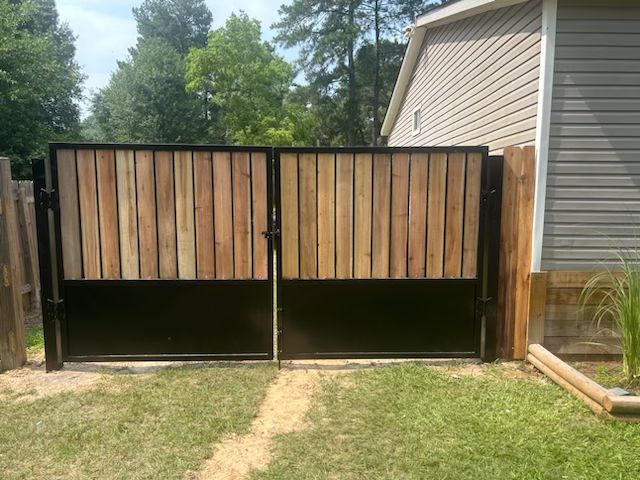
Lisa Korstanje’s cedar fence project in Galveston is a 6-foot privacy fence with a flat-top design, plus a double gate with wood infill boards set into a black metal frame. That gate’s wood-to-metal construction is fastened differently than a typical wood-to-wood picket fence: the USDA Forest Products Laboratory’s Wood Handbook (Ch.8) found that nails driven into wood which then goes through wetting-and-drying cycles can retain as little as 25% of their original holding power — which is why fastener choice matters more where wood meets a frame that does not move with it.
Source: USDA Forest Products Laboratory, Wood Handbook FPL-GTR-282 (2021), Ch.8 (Fasteners, p.207-208).
The job: a 6-foot cedar privacy fence with a wood-and-metal double gate
Lisa Korstanje, a homeowner in Galveston, Texas, wanted a cedar fence that would add privacy for her property while standing up to the area’s salty, coastal air. The project came together as a 6-foot cedar privacy fence with a flat-top design, one of the more common choices for homeowners in the area.
The project also includes a double gate built with wood infill boards set into a black metal frame, rather than a wood frame. Pairing a metal gate frame with wood privacy boards is a common way to get a rigid, square-holding gate opening while keeping the wood look of the fence it sits in.
Why a gate’s frame material changes how the wood gets fastened
On most of a wood privacy fence, pickets are nailed to wood rails — and wood rails swell and shrink with humidity right along with the pickets they’re holding. A metal gate frame does not. It does not absorb moisture, and its dimensions stay essentially fixed through Galveston’s humid, rainy swings. That means on Lisa’s gate, the wood infill boards are doing all of the seasonal moving, and they are doing it at a fixed set of fastener points driven into metal.
What happens to a nail when the wood around it dries and wets again
The USDA Forest Products Laboratory’s Wood Handbook (Ch.8) describes what happens to a nail’s grip when the wood around it changes moisture content after the nail is driven: “if common smooth-shank nails are driven into … seasoned wood that is subjected to cycles of wetting and drying before the nails are pulled, they lose a major part of their initial withdrawal resistance. The withdrawal resistance … may be as low as 25% of the values for nails tested soon after driving.” The same chapter notes that “annularly and helically threaded nails” hold “about four times greater” withdrawal resistance than a smooth nail of the same diameter.
Fastener choice checker
For wood fastened into a rigid frame (like a metal gate frame) rather than another piece of wood. Based on the USDA Forest Products Laboratory Wood Handbook, Ch.8. General guidance, not a spec for your project.
USDA Forest Products Laboratory, Wood Handbook FPL-GTR-282 (2021), Ch.8, p.207-208: smooth nails can retain as little as 25% of their original withdrawal resistance after the wood is subjected to wetting-and-drying cycles; annularly/helically threaded fasteners hold about four times more than a smooth nail of the same diameter.
What Galveston customers say on Google
5.091 Google reviews · read them all on Google
Amazing work will go ahead and recommend everyone in friends and family We installed 8ft tall double sided stained cedar wood fence in our backyard, it’s really looks great, installed perfectly nice finishing and cost effective, thanks mustang fencing.
I am so pleased with the fence!! Your solution was exactly the right one and the team did a highly professional job. Frankly, I was amazed at how clean the job site was at the completion of the project. Feel free to list me as a reference and a very happy customer. Thanks again and please let the men know That I appreciate their hard work and quality craftsmanship.
Absolutely loved my fence once i saw the finished product. No hassle, no rude interactions, and no inconveniences everything was just perfect. One of the best fencing companies in Texas
Reviews shown word for word from the Mustang Fencing Services Google Business Profile (Galveston), captured 2026-10-26.
Questions we get about this
How tall is Lisa Korstanje’s fence, and what’s the design?
Does the project include a gate?
Why does a wood-infill gate in a metal frame need a different fastener than a wood fence?
What’s the difference between a smooth nail and a threaded nail here?
Why was cedar chosen for this Galveston fence?
Sources
Checked October 29, 2026. Rules change, so confirm with the City before you build.
- USDA Forest Products Laboratory, Wood Handbook FPL-GTR-282 (2021), Chapter 8: Fasteners (Effect of Seasoning, p.207-208) — Finds that nails driven into wood which then undergoes wetting-and-drying cycles can retain as little as 25% of their original withdrawal resistance, and that annularly/helically threaded nails hold about four times more than a smooth nail of the same diameter under those conditions — the basis for why a wood-infill gate fastened into a rigid metal frame calls for a different fastener choice than a wood-to-wood fence.
Planning a wood fence or gate?
We’ll walk the property, talk through frame material, gate style and fastener choice, and put it on a written quote.