
Farmhouse Driveway Gates in Galveston: Sloped-Top, Flat-Top and Hog-Wire Styles Explained
A farmhouse gate is defined less by any one material and more by three things: a sloped or flat top, an exposed diagonal brace, and — increasingly — a wood frame built around a hog-wire mesh panel instead of solid boards. Here is how each piece is actually framed, and what keeps one of these gates from sagging.
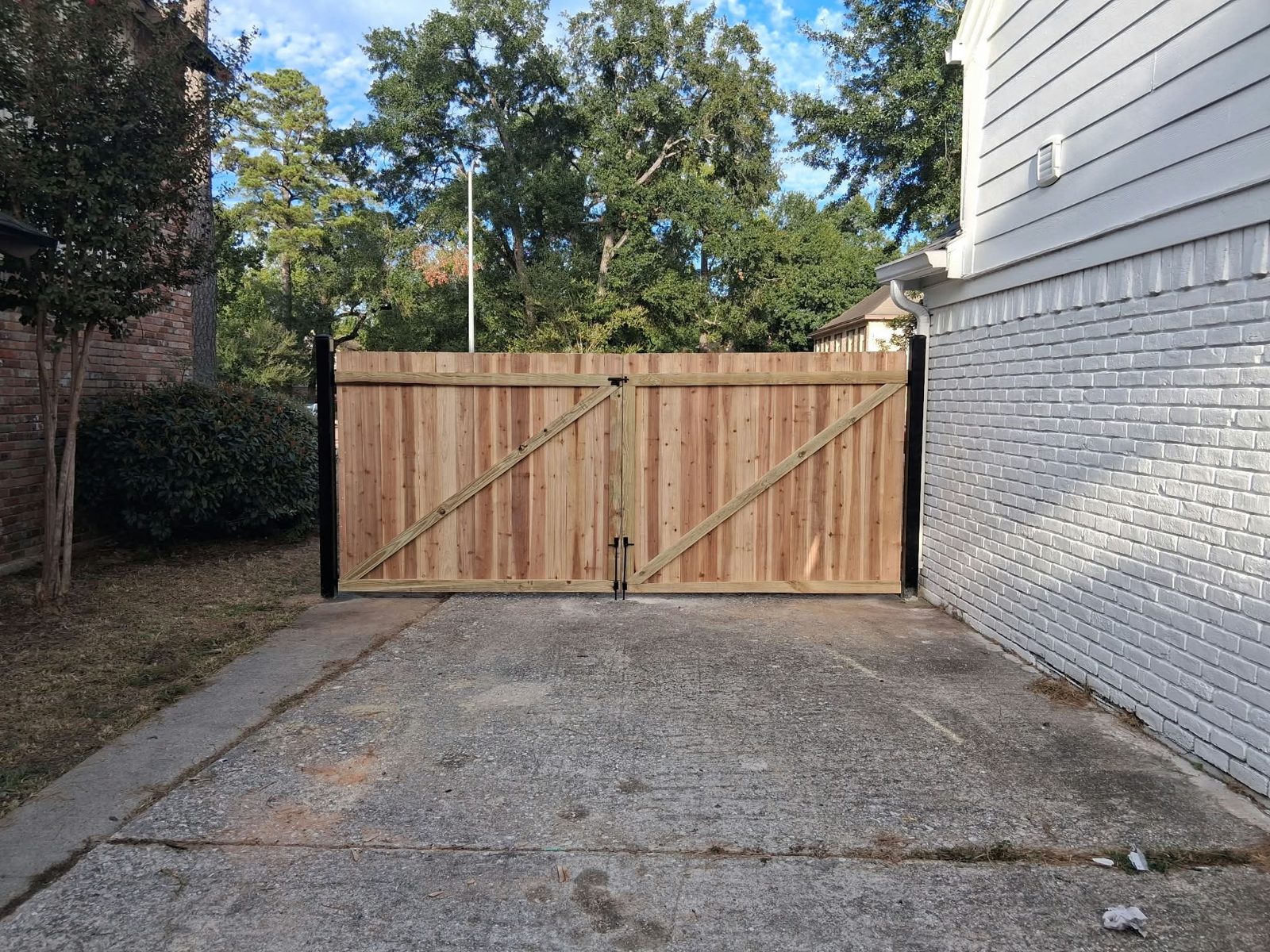
A farmhouse driveway gate is a wood-framed gate with a sloped or flat top and a visible diagonal brace, built as a single swing (up to about 6 ft), a double swing (roughly 10-14 ft), or a wide double swing (16 ft+) that needs an A-frame brace on each leaf. The infill panel can be solid boards for full privacy or a hog-wire mesh panel for a more open, ranch-style look. None of that replaces the separate brace post that building-spec guidance calls for on both sides of the gate opening itself.
Sources: USDA NRCS Fence Specification TX-382-1 (Texas, Rev. 2015); Behlen Country hog panel spec; Jacksons Fencing gate-bracing guidance.
What actually makes a gate “farmhouse style”
There is no single material that makes a gate “farmhouse.” The style is really three choices stacked together: a top shape (sloped, which sheds rain off the high side, or flat, which is a slightly simpler build), a visible diagonal brace running across the frame instead of a hidden one, and an infill of either solid wood boards for privacy or a wire-mesh panel for a more open, see-through look. That combination is also why it pairs so naturally with the farm and ranch fencing most of these gates sit next to, and with a wood fence line on either side.
It is a different thing from a working ranch gate built to move livestock — cattle guards, pipe gates, and panel gates for an actual pasture entrance are covered in our farm-style gate guide. A farmhouse driveway gate is doing a different job: it is the entrance to a house, built to look a certain way, not rated for herding cattle.
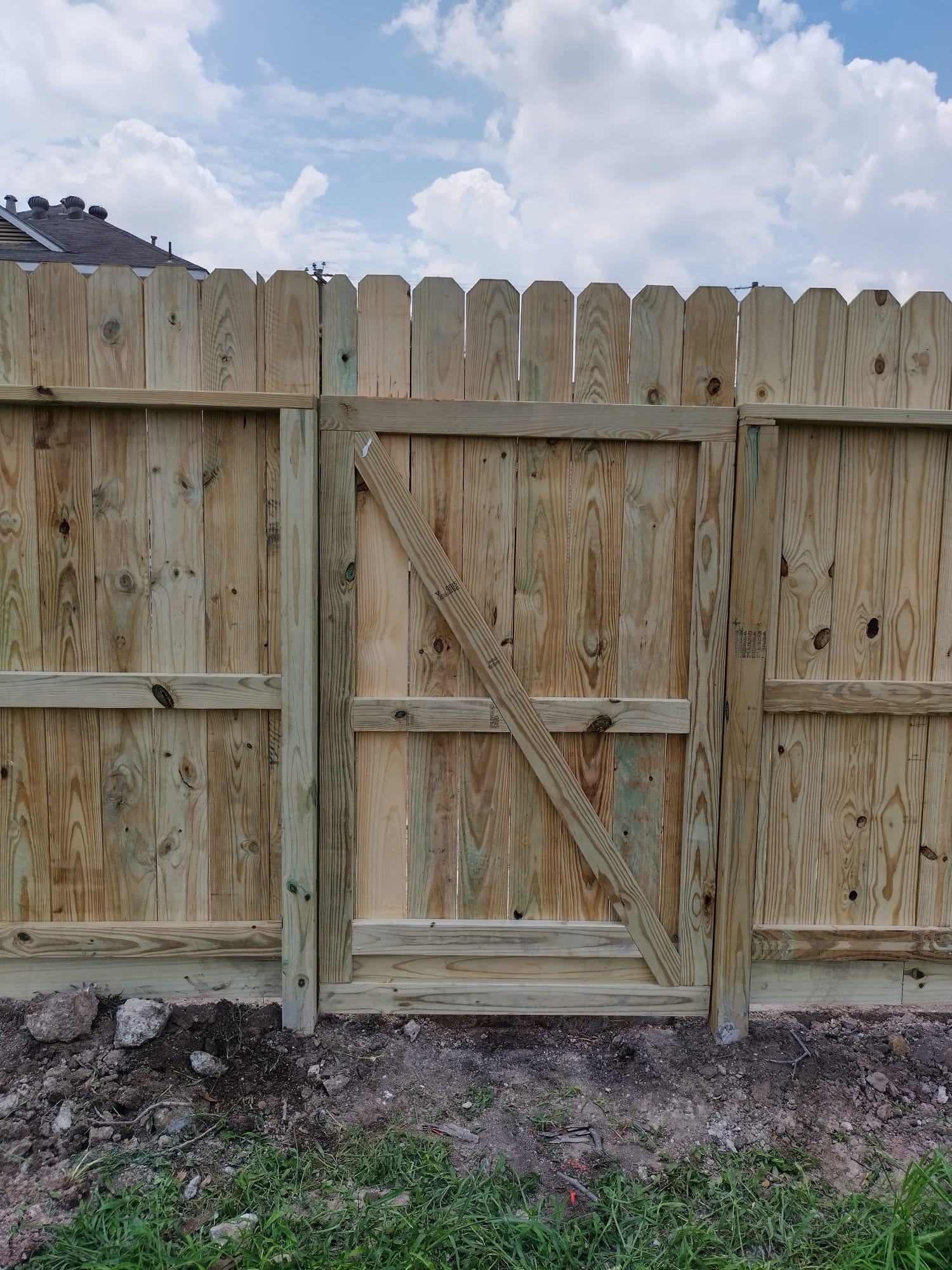
Three farmhouse gate styles, compared
| Infill | Typical opening | Best for | |
|---|---|---|---|
| Sloped-top solid wood | Full boards, full privacy | Single (up to ~6 ft) or double (10-14 ft) | Classic farmhouse look; sheds rain off the high side |
| Flat-top solid wood | Full boards, full privacy | Single or double | Same bracing, simpler top cut |
| Hog-wire infill (sloped or flat top) | Galvanized wire mesh panel in a wood frame | Single or double | A more open, ranch look that still screens the opening |
| Wide double-swing | Solid or hog-wire | 16 ft or more | Wide drives — needs an A-frame brace on each leaf |
Styles as commonly built; infill-wire example from Behlen Country’s hog panel line.
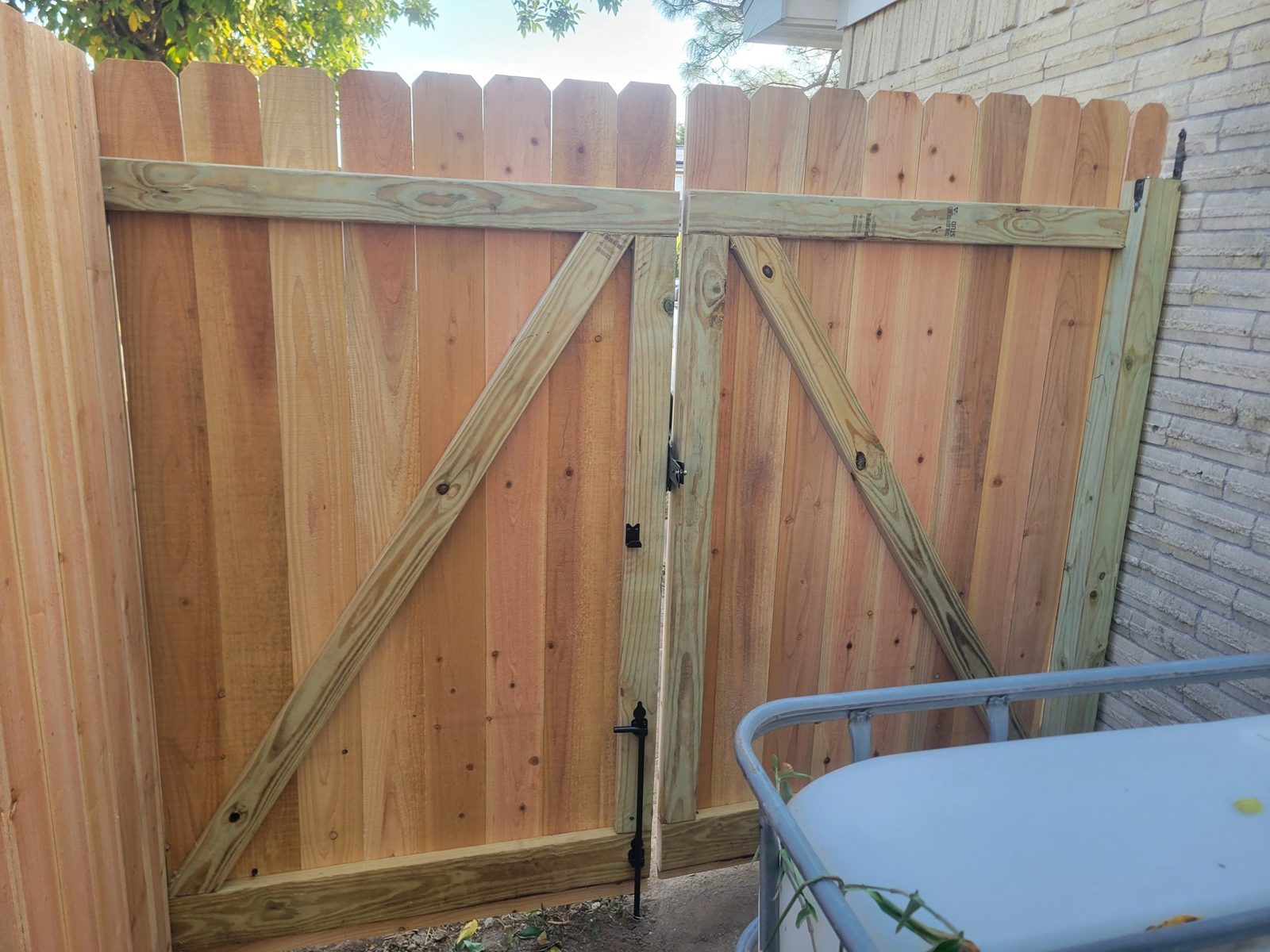
Hog-wire infill: how it changes the gate, not just the look
Swapping solid boards for a hog-wire panel does not change how the gate is framed or braced — it changes what sits inside that frame. Behlen Country’s 34in x 16ft hog panel is a useful reference point for the wire itself: 5-gauge wire, 11 line wires, fully welded, and hot-dip galvanized rather than plain steel. That galvanizing matters more here than it does inland — Galveston’s salt air is harder on bare or lightly coated steel, so the wire mesh, the hinges, and the fasteners on a hog-wire gate are all worth confirming as galvanized (or stainless) hardware, not just the posts.
The trade-off is privacy. A hog-wire panel opens up the view through the gate the way solid boards never will, which is exactly why it is popular on ranch-style properties that want the farmhouse look without a fully closed-off entrance. It still needs the same diagonal brace as a solid-board version — the wire panel does not add any structural strength to the frame itself.
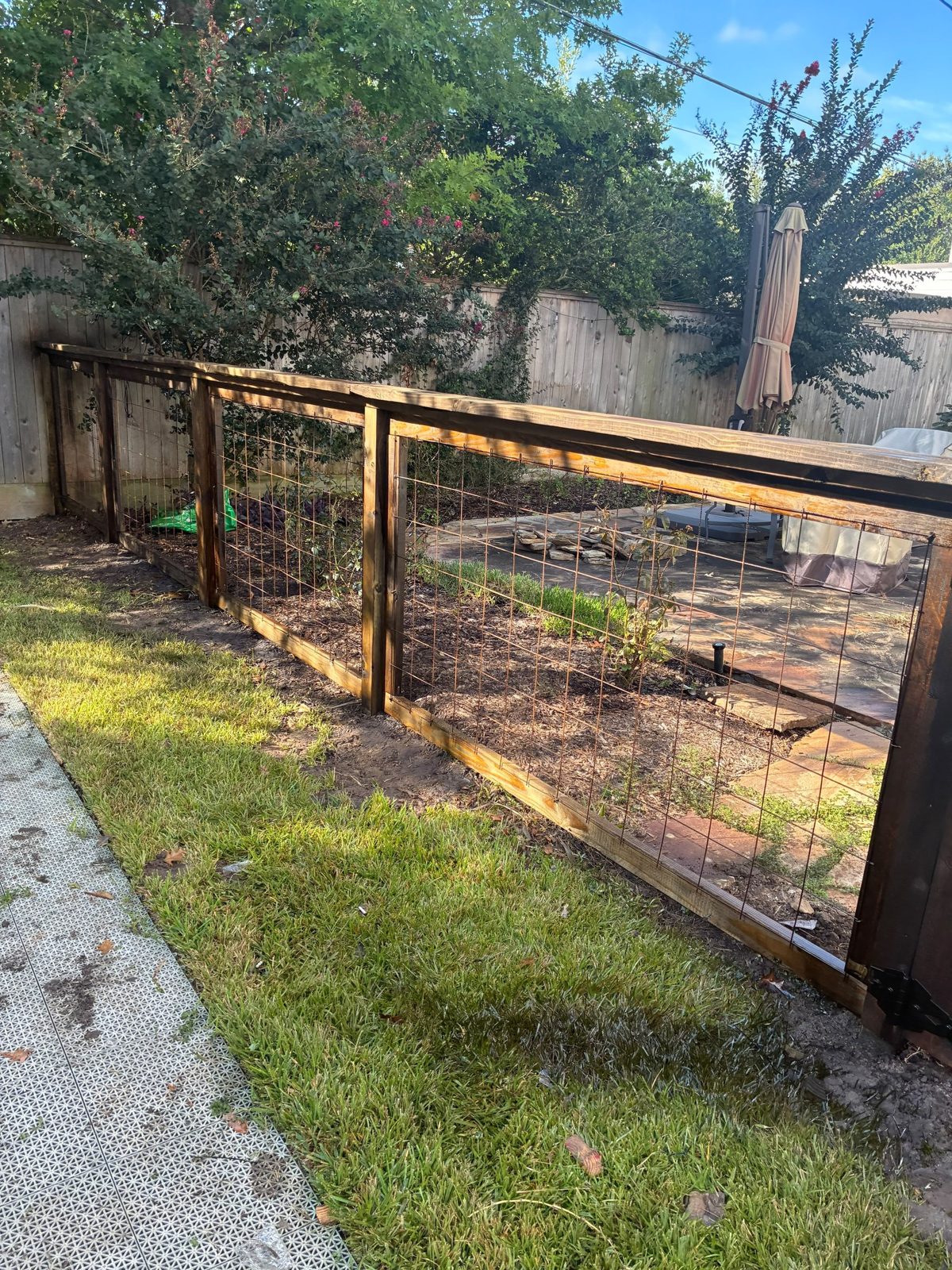
Which farmhouse gate style fits your driveway?
Answer three questions about the opening. This is a planning aid, not a quote — an installer still needs to see the actual driveway and posts.
Planning aid only. Bracing guidance from Jacksons Fencing’s gate-bracing explainer; hog-wire infill spec from Behlen Country’s 34in hog panel (5-gauge wire, hot-dip galvanized). It does not price hardware or installation — get bids from at least two installers.
What Galveston customers say
5.091 Google reviews · read them all on Google
We just installed iron gate and it looks amazing thank you very much mustang fencing .
Amazing work will go ahead and recommend everyone in friends and family We installed 8ft tall double sided stained cedar wood fence in our backyard, it’s really looks great, installed perfectly nice finishing and cost effective, thanks mustang fencing.
had an excellent experience with mustang fencing From the initial consultation to the final installation, the team was professional, punctual, and attentive to detail. They helped me choose the perfect fence style to match my property and ensured everything was installed with precision. The quality of materials is top-notch, and the fence has completely transformed the look and security of my home. I highly recommend mustang services to anyone looking for reliable and high-quality fencing services!
Reviews shown word for word from the Mustang Fencing Services Google Business Profile (Galveston), captured 2026-11-06.
Sources
Checked November 6, 2026. Rules change, so confirm with the City before you build.
- USDA NRCS, Fence Specification TX-382-1 (Texas, Revised October 2015) — gate and brace-assembly requirements: gates attach directly to a brace assembly post; an End/Gate brace assembly is required on both sides of a gate opening; wood brace post and horizontal-brace dimensions and depth.
- Behlen Country, fence panel product line (34in hog panel) — wire gauge (5-gauge), line-wire count (11), and hot-dip galvanized finish used here as the reference spec for a hog-wire infill panel.
- Jacksons Fencing, “Which way should a garden gate be braced” — Z-brace direction (bottom hinge corner to top latch corner, brace in compression) and the A-frame adaptation for wider gates.
Planning a farmhouse-style gate in Galveston?
We’ll look at your opening width, how much privacy you actually want, and whether solid boards or a hog-wire panel fits the property better. Free on-site estimates across Galveston Island and Galveston County.
Questions we get about this
What makes a gate "farmhouse style" rather than just a wood gate?
The combination of a sloped or flat top, a visible diagonal brace across the frame, and an infill of either solid boards or a hog-wire mesh panel. Any one of those on its own is just a wood gate detail; together they’re what people mean by “farmhouse gate.”
Which way should the diagonal brace run?
From the bottom corner on the hinge side up to the top corner on the latch side, so the brace works in compression. Braced the opposite way, it provides no real support and the latch corner will eventually sag (Jacksons Fencing gate-bracing guidance).
Can a farmhouse gate use a see-through panel instead of solid boards?
Yes — a hog-wire mesh panel set into the same wood frame is a common option. It uses the same diagonal brace as a solid-board gate; the wire doesn’t add structural strength, it just changes how much of the opening you can see through (reference spec: Behlen Country’s 34in hog panel, 5-gauge wire, hot-dip galvanized).
Does a wide double-swing gate need anything different?
Past roughly 16 ft of total opening, a single diagonal brace per leaf stops being enough on its own. The frame is typically built as an A-frame (or X-brace) instead, which keeps an effective brace angle above 45 degrees on each leaf (Jacksons Fencing).
Is the gate’s own brace the same thing as the brace posts flanking the opening?
No — they’re two different things. The diagonal brace inside the gate frame keeps the gate panel itself from sagging. Separately, USDA NRCS’s Texas fence specification (TX-382-1) calls for a brace-post assembly on both sides of the gate opening in the fence line, sized by the post and brace diameter, independent of how the gate itself is framed.