
What Is a “Good Neighbor” Fence, and Should I Build One?
A standard privacy fence gives one side a smooth board face and the other side bare rails and posts. A good neighbor fence is built so both sides see the same finished look — here’s how the two real ways to build one compare, and when the extra material is worth it.

A good neighbor fence is any fence built to look the same from both sides of the property line, solving the classic problem where one household gets the smooth board face and the other stares at exposed rails and posts. There are two real ways to build one: alternating boards, which attach to alternating sides of the rails so both faces see a mix of board and narrow gap (close to a shadowbox pattern), or double-sided construction, which fastens a full board layer to each face for a gap-free look on both sides at roughly double the board material. Galveston’s height rules (LDR 2.501) apply the same way regardless of which style you build. There is no Texas law requiring a neighbor to split the cost — put any cost-sharing or ownership agreement in writing.
Sources: City of Galveston LDR Sec. 2.501(B); Texas Agriculture Code Ch. 143 (rural/livestock fences only — no residential cost-sharing provision); USDA Wood Handbook Table 15-6.
Why a standard fence creates a “good side” and a “bad side”
A standard wood privacy fence attaches boards to only one side of the horizontal rails. That’s not a defect — it’s just how a single-sided fence is built — but on a shared property line it means one household gets the finished board face by default, while the other looks at the bare rails and posts from their own yard.
A good neighbor fence changes what gets fastened to the frame, not the frame itself. The posts and rails run the same way in a standard fence, an alternating-board fence, or a fully double-sided fence — only the board layout on top of that frame differs.
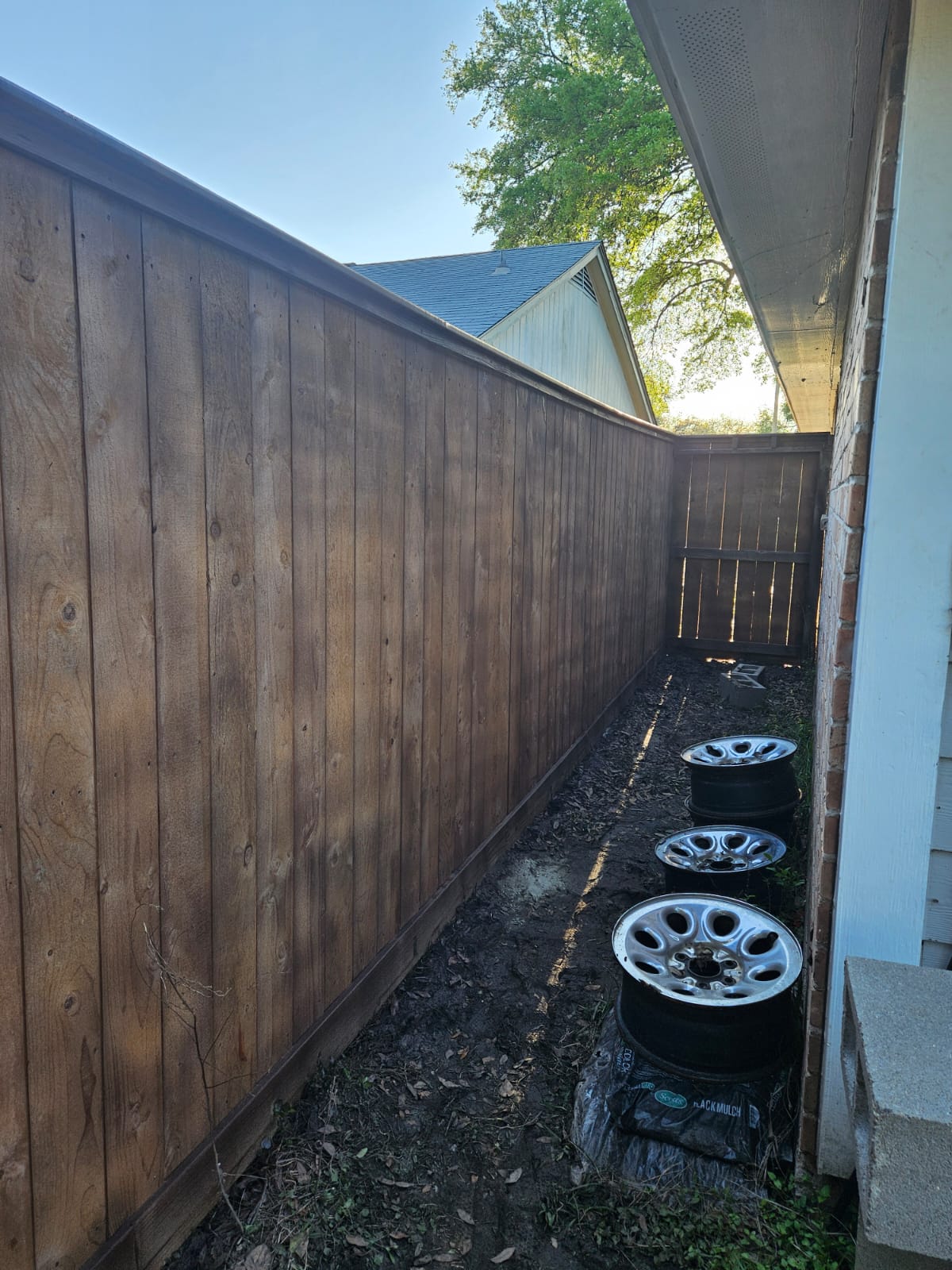
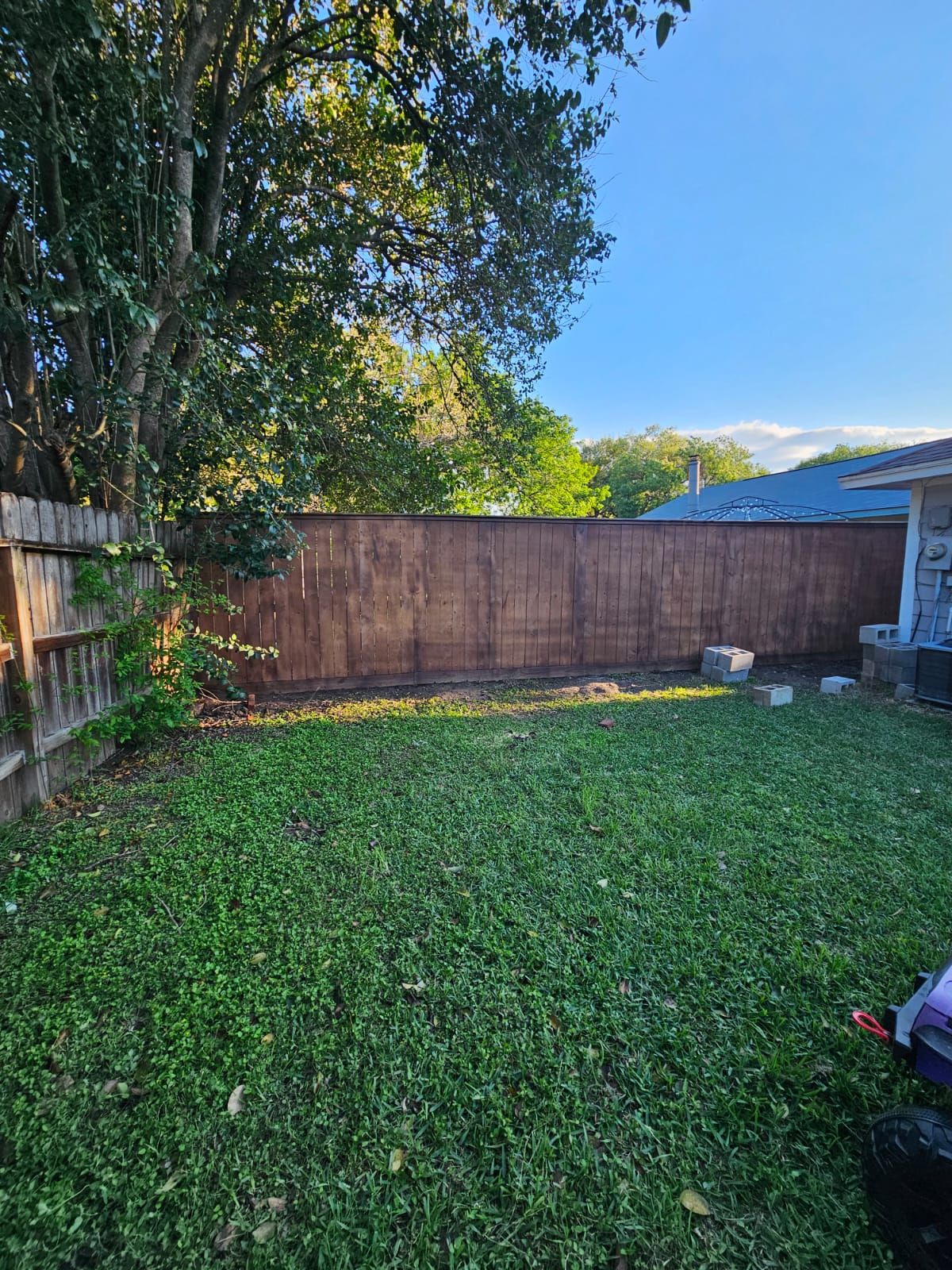
Alternating boards vs. double-sided: which to choose
Alternating-board design attaches boards to alternating sides of the rails in a repeating pattern, close in construction to a shadowbox fence, just built with good-neighbor symmetry in mind. Both sides see a mix of board faces and narrow gaps rather than one side getting a smooth wall and the other getting framework. It adds only the extra overlap needed to close those gaps, so the material cost is close to a standard fence.
Double-sided (true two-face) construction fastens boards to both sides of the framing, so each side gets a fully finished, gap-free appearance — effectively two fence faces sharing one frame. Per the USDA Wood Handbook’s use-category table, that’s roughly double the UC3B board/rail material of a standard fence (the UC4A post treatment requirement doesn’t change, since there are still the same number of posts). It costs and weighs more, but it delivers full privacy and a finished look on both sides with no compromise — see a real example we built, a 6-foot double-sided cedar fence with a camel stain finish in Galveston.
Is a good neighbor fence a fit for your fence line?
A few questions about the fence line, not a quote.
Reads the same construction trade-offs covered on this page. It doesn’t estimate cost or decide ownership — put cost-sharing and ownership in writing with your neighbor; see who’s responsible for a shared fence in Texas.
What Galveston customers say
5.091 Google reviews · read them all on Google
Amazing work will go ahead and recommend everyone in friends and family We installed 8ft tall double sided stained cedar wood fence in our backyard, it’s really looks great, installed perfectly nice finishing and cost effective, thanks mustang fencing.
I have hired Mustang fencing services to fix my backyard fencing. Good wood to used. I really like theirs work. Best of luck
Excellent work. They came in handy after the hurricane hit our backyard. Friendly people too.
Reviews shown word for word from the Mustang Fencing Services Google Business Profile (Galveston), captured 2026-10-12.
Questions we get about this
Is a good neighbor fence the same as a shadowbox fence?
Does a good neighbor fence provide as much privacy as a solid privacy fence?
How much more does a good neighbor fence cost?
Does my neighbor have to pay for half of it?
Who owns a good neighbor fence built on the property line?
Sources
Checked October 16, 2026. Rules change, so confirm with the City before you build.
- City of Galveston Land Development Regulations, Sec. 2.501(B) — Side/rear yard 8 ft cap; front yard 4 ft solid / 5 ft if at least 60% transparent — applies regardless of face pattern.
- Texas Agriculture Code, Chapter 143: Fences; Range Restrictions — Division/partition fences for cultivated land and livestock at large; no residential cost-sharing provision, confirmed against this program’s prior research on the shared-fence-responsibility page.
- USDA Forest Products Laboratory, Wood Handbook: Wood as an Engineering Material (FPL-GTR-282, 2021) — Table 15-6, AWPA use categories UC3B (boards/rails) and UC4A (posts), used here to illustrate the material step-up for double-sided construction.
Thinking about a good neighbor fence?
We’ll walk the property line, talk through alternating-board vs. double-sided construction, and give you a written price for either. Free on-site estimates across Galveston County.