Project case study · Galveston, Texas

Transforming Joseph Dupre’s Property with a Stunning Wooden Fence in Galveston, Texas

Joseph wanted a taller treated-wood privacy fence that could take Galveston’s coastal weather. Here’s that fence, plus how often a stained or sealed wood fence actually needs attention — and when the right move is just a wash.
  • Reviewed Nov 1, 2026
  • Source: USDA Wood Handbook
  • 1 job photo
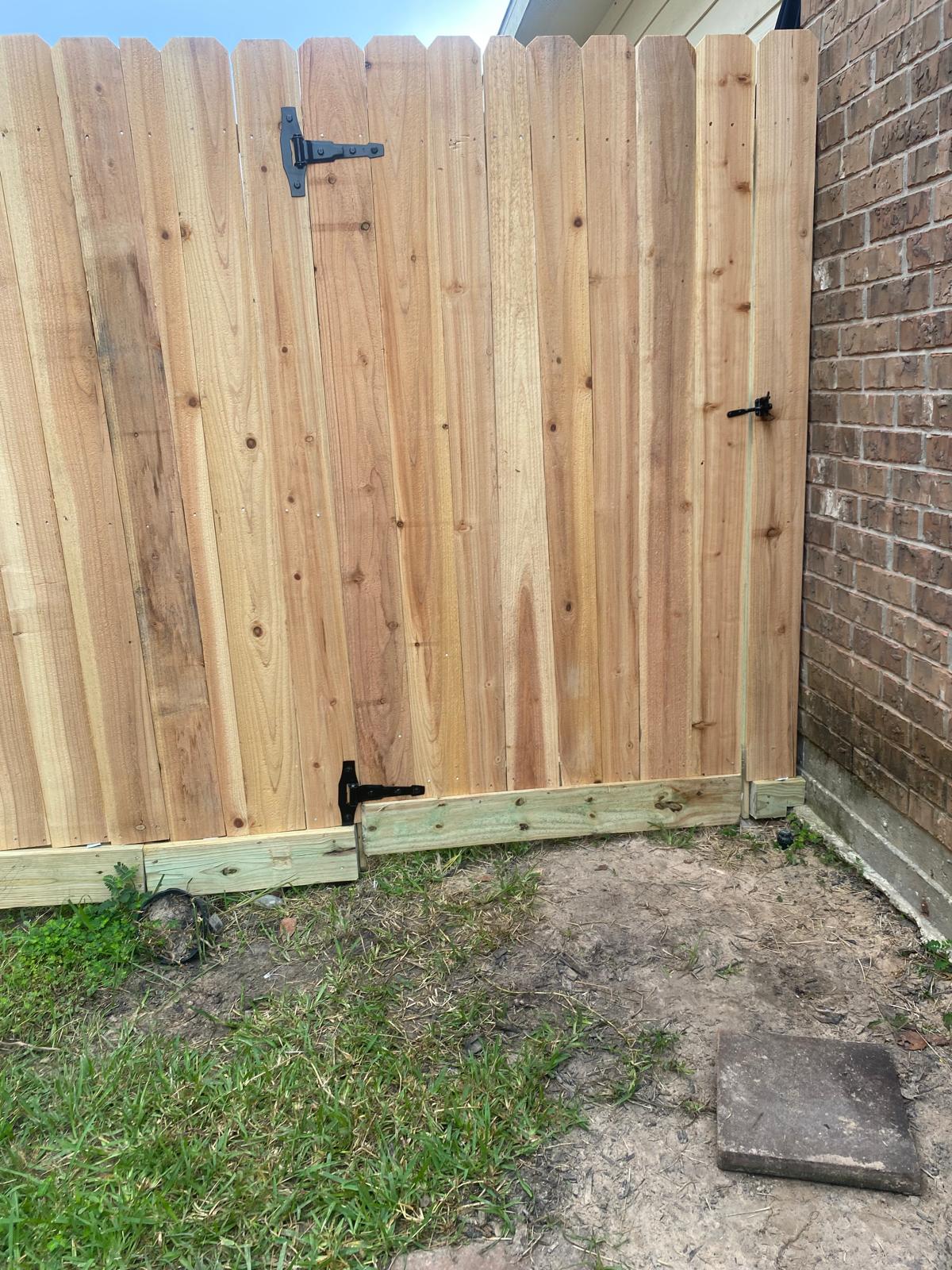
Vertical dog-eared wood privacy fence and gate at the corner of a brick house
The fence and gate from Joseph’s Galveston job, at the corner of the house — dog-eared boards, strap hinges and latch, and a treated kickboard at grade.
The short answer

Joseph’s Galveston fence is treated wood, built taller for privacy, with weather-resistant fasteners and hardware, set to follow the natural slope of his yard. Staining and sealing came up to help it handle the salty coastal air — and once that finish is on, how often it needs to be redone depends on which side of the fence you’re looking at, and whether it’s actually failing or just needs a wash.

Treated woodResistant to rot and insects, for a coastal climate
Taller, privacy styleJoseph’s choice for privacy
Weather-resistant hardwareFasteners and hinges selected for the climate
Follows the yard’s slopeBuilt to the property’s natural contours

Source: USDA Forest Products Laboratory, Wood Handbook (2021).

The job: a taller, treated wood privacy fence

Joseph wanted a wooden fence for his Galveston property that would hold up to the coastal climate while adding privacy. The crew recommended treated wood, chosen for its resistance to rot and insects, and built it taller than a standard boundary fence for the privacy Joseph was after.

The crew used weather-resistant fasteners and hardware and built the fence to follow the natural slope of the yard rather than stepping it. The job photo on file shows the finished run at the corner of the house: vertical, dog-eared boards, a gate hung on black strap hinges with a latch, and a pressure-treated kickboard running along the bottom at grade.

Staining and sealing came up during the project as a way to protect the wood from Galveston’s salty air. That’s a real maintenance commitment, not a one-time task — which raises the question below: once a finish is on, how often does it actually need to be redone?

Why stains don’t last as long as paint, by design

If Joseph’s fence gets a solid-color stain instead of paint, it will likely need attention sooner — and that’s intentional, not a flaw. Per the USDA Forest Products Laboratory’s Wood Handbook: solid-color stains “are different from paint in that they are designed to erode more quickly so that even after applying many coats, the film does not get too thick.” The tradeoff: “because they erode, solid color stains need to be reapplied more often than paint.”

A bar comparison: solid-color stain is formulated to erode faster and needs recoating sooner, while paint forms a slower-eroding film and needs recoating less often. Solid-color stain (erodes by design) Recoat sooner Paint (forms a slow-eroding film) Recoat less often Both protect the wood — stains are simply formulated to wear away faster so coats never build up too thick Why a stained fence is recoated more often than a painted one “Solid color stains … are designed to erode more quickly … Because they erode, solid color stains need to be reapplied more often than paint.” USDA Forest Products Laboratory, Wood Handbook (2021), Ch. 16.
S-1
DrawingWhy a stained fence is recoated more often than a painted one
BasisUSDA Forest Products Laboratory, Wood Handbook (2021), Ch. 16
ScaleNot to scale
Stains are built to wear away on purpose so coats never get too thick — that means more frequent recoats than paint.

The same fence, two different recoat schedules

Which side of the fence gets direct sun matters as much as the finish type. The Wood Handbook notes: “paint erodes at different rates, so different sides of a structure do not need to be painted on the same schedule. Paint on the shaded side often lasts twice as long as that on a fully exposed, sunny side.” A south- or west-facing run of Joseph’s fence will likely need a fresh coat well before a shaded stretch does.

A full-sun side of the fence needs recoating at roughly a 1x interval, while a shaded side lasts roughly twice as long before it needs recoating. Full sun (south/west side) ~1x interval recoat sooner Mostly shaded side ~2x interval lasts roughly twice as long The same fence can need two different recoat schedules “Paint on the shaded side often lasts twice as long as that on a fully exposed, sunny side.” USDA Forest Products Laboratory, Wood Handbook (2021), Ch. 16.
S-2
DrawingThe same fence can need two different recoat schedules
BasisUSDA Forest Products Laboratory, Wood Handbook (2021), Ch. 16
ScaleNot to scale
A fully sun-exposed run (south/west) typically needs recoating about twice as often as a mostly shaded run.

Wash it, or recoat it? How to tell

Not every dull-looking fence needs a new coat. Per the Wood Handbook: “do not paint too often. If paint is sound, but discolored with mildew, wash it. It does not need repainting.” Recoating a finish that’s still sound just adds unnecessary coats — and “too many coats of latex paint can eventually lead to adhesion failure of the primer.” The signal that it’s actually time to recoat: “when the topcoats begin to wear thin, exposing the primer, reapply one or two new topcoats.”

A decision diagram: a sound but dirty or mildewed finish should be washed, not recoated; a finish with the topcoat thinning and primer showing should get one or two new topcoats; recoating too often risks adhesion failure. Inspect the finish Sound, just dirty or mildewed? Wash it does not need repainting Topcoat thinning, primer showing? Reapply 1-2 topcoats Caution: recoating too often adds up Too many coats of latex paint can lead to primer adhesion failure “Do not paint too often … if sound, but discolored with mildew, wash it. It does not need repainting.” USDA Forest Products Laboratory, Wood Handbook (2021), Ch. 16.
S-3
DrawingWash-only vs. recoat: how to read a weathered finish
BasisUSDA Forest Products Laboratory, Wood Handbook (2021), Ch. 16
ScaleNot to scale
Sound-but-dirty gets washed, not recoated; only a thinning topcoat with primer showing calls for 1-2 new coats.
A simple timeline: fence is stained and sealed, then the sun-exposed side is checked first since it wears faster, then the shaded side, then wash or recoat is decided per the prior diagram. Fence stained/ sealed Check the sun-exposed side first (wears faster) Check the shaded side (roughly 2x longer) Wash or recoat per S-3 A seasonal check accounts for exposure, not just time elapsed Based on the recoat-interval and wash-vs-recoat facts above (USDA Wood Handbook, 2021, Ch. 16).
S-4
DrawingA seasonal check that accounts for exposure, not just time
BasisUSDA Forest Products Laboratory, Wood Handbook (2021), Ch. 16
ScaleNot to scale
Checking the sun-exposed side first, then the shaded side, keeps the recoat schedule matched to how each side actually weathers.

Does this fence section need a wash, or a recoat?

Pick what you’re seeing to get a general read based on how stains and paints age on wood. General information only — not a substitute for your installer’s in-person look at your fence.

What to do
Roughly how often this side needs it

USDA Forest Products Laboratory, Wood Handbook (2021), Ch. 16: a sound, mildewed finish needs washing, not repainting; too many recoats can cause adhesion failure; a fully sun-exposed side wears roughly twice as fast as a shaded side; once the topcoat is thin enough to show primer, reapply one or two topcoats.

★★★★★
Amazing work will go ahead and recommend everyone in friends and family We installed 8ft tall double sided stained cedar wood fence in our backyard, it’s really looks great, installed perfectly nice finishing and cost effective, thanks mustang fencing.
Muqeet Mohammed Abdul · Google review · a year ago
★★★★★
Installed Stained cedar wood fence yesterday by mustang fencing, thanks for the beautiful work.
Shahrukh Abdul · Google review · a year ago
★★★★★
I have hired Mustang fencing services to fix my backyard fencing. Good wood to used. I really like theirs work. Best of luck
Zaidbin Saif · Google review · a year ago

Reviews shown word for word from the Mustang Fencing Services Google Business Profile (Galveston), captured 2026-10-26.

Questions we get about this

What kind of fence did Joseph get?
A treated wood privacy fence, built taller than a standard boundary fence, with weather-resistant fasteners and hardware, following the natural slope of his yard. The job photo on file shows vertical, dog-eared boards with a gate on strap hinges and a treated kickboard at grade.
How often does a stained wood fence need to be redone?
It depends on the finish type and sun exposure. Solid-color stains are formulated to erode faster than paint, so they need more frequent recoats. A fully sun-exposed side (south/west) typically needs recoating roughly twice as often as a mostly shaded side, per the USDA Wood Handbook.
Should I recoat as soon as the fence looks dull?
Not necessarily. If the finish is sound but just dirty or mildewed, washing it is enough — it does not need repainting. Recoat when the topcoat is visibly thinning and primer or bare wood is showing. Recoating too often can eventually cause the primer to fail to adhere.
Does this page say Joseph’s fence had horizontal rails?
No. An earlier version of this page repeated that claim, but the job photo on file shows a vertical, dog-eared board fence, not horizontal rails. This page describes the fence as the photo actually shows it.
Does this page give the exact wood species or board spacing used on Joseph’s property?
No — those specifics were not published on the original post and are not invented here. This page covers the maintenance facts that were documented, plus the general Wood Handbook guidance behind them.

Sources

Checked November 1, 2026. Rules change, so confirm with the City before you build.

  1. USDA Forest Products Laboratory, Wood Handbook FPL-GTR-282 (2021), Ch. 16 — Covers exterior wood finishing: why solid-color stains erode faster and need more frequent recoats than paint; how sun exposure changes recoat intervals (shaded sides last roughly twice as long); when to wash versus recoat; and the adhesion-failure risk from recoating too often.
Free on-site estimate

Planning a treated wood privacy fence?

We’ll walk the property, talk through wood and finish choices, and put it on a written quote.

Page reviewed November 1, 2026 by Mustang Fencing Services, Galveston. Next review due May 2027.