
Will my white vinyl fence turn yellow, and how do I clean it if it does?
Sometimes. A “yellow” vinyl fence is really one of two different things: a slow change in the PVC material’s own color, or a surface film — hard-water residue, mildew, airborne dirt — sitting on top of it. They look similar from the sidewalk and need completely different responses. Here is what the material standard and manufacturers actually publish, and a spot test that tells you which one you’re dealing with in about ten minutes.
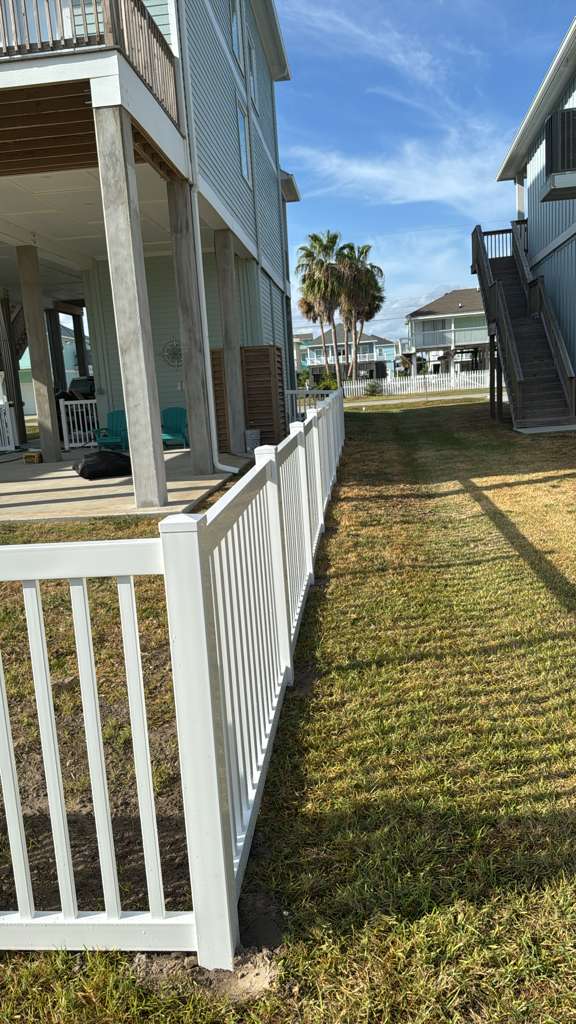
A “yellow” vinyl fence is one of two different problems, and they need different fixes. Rigid PVC fence profiles (defined by ASTM F964) are manufactured with impact modifiers, UV stabilizers and a weathering package built into the material — either in a single homogeneous extrusion or in a co-extrusion with a separate outer capstock layer carrying extra UV/impact additive over a structural core (F964 § 1.2). A thinner or lower-grade additive package in either construction is what shows up, over years, as visible color change in the vinyl itself. Separately — and far more commonly — what looks like yellowing is a surface film: hard-water deposits, mildew, or airborne dirt sitting on top of the vinyl, which a non-abrasive, car-wash-type soap and a soft cloth (the manufacturer’s own cleaning guidance) will usually lift right off. F964 does not publish a numeric color-retention or yellowing timeline for either scenario, so no honest page can quote you one — the manufacturer’s own written warranty is the real source for that.
Sources: ASTM F964-13 § 1.2 (astm.org); Illusions Vinyl Fence install/QC guide and FAQ (illusionsfence.com); Bufftech install/warranty guide.
What can actually change the color of a vinyl fence
PVC — polyvinyl chloride — is the resin. To make it into fencing, manufacturers extrude it with impact modifiers, UV stabilizers and a weathering package, either as one solid compound or as a co-extrusion with a separate capstock layer carrying extra UV/impact additive over a structural core. ASTM F964 requires that finished profile to be tested for weatherability as a condition of meeting the standard, but the standard itself does not publish a number for how many years of Gulf Coast sun it takes before a visible change shows up. That figure, if it exists in writing anywhere, lives in the specific manufacturer’s own warranty — ask for it before you compare price on a quote.
What F964 does confirm is that the additive package is a real, measured manufacturing variable, not a marketing claim: Illusions Vinyl Fence’s own production QC tests color-match against standard samples and capstock thickness at least every two hours of a production run. A thinner additive package or inconsistent capstock is what tends to age faster in direct sun — which is why two fences that look identical on install day can age differently years apart.
What to clean it with — and what not to assume
Illusions Vinyl Fence’s entire published cleaning guidance is a non-abrasive cleaner — something like a car-wash soap — used with a soft cloth or brush, with a direct warning that the wrong cleaner or washer can damage the vinyl. Bufftech’s install/warranty guide adds a next step for stubborn stains: a mild detergent and a plastic scouring pad first, then a cleanser such as Soft Scrub® or whatever cleaning solution is listed on that specific warranty. Neither manufacturer names a pressure-washer PSI limit or a solvent/bleach list, so don’t extrapolate beyond what’s actually written down — when in doubt, test on a small spot first.
One real but separate issue worth knowing about: Bufftech’s own warranty carries a specific exclusion for heat distortion, not yellowing — intense sunlight reflected off nearby glass (a window, a pool, a car) can concentrate enough heat to warp or melt vinyl, and that damage is explicitly not covered. It is a different mechanism from gradual color change and is worth ruling out separately if you see localized warping rather than a color shift.
Is it the vinyl itself, or something sitting on top of it?
A quick, honest checklist — not a lab test. It follows the same logic as the diagram above: material color change is gradual and even; a surface film is patchy and wipes off.
Cleaning step follows Illusions Vinyl Fence’s own FAQ guidance: a non-abrasive, car-wash-type soap with a soft cloth or brush, since the manufacturer warns the wrong cleaner or washer can damage the surface.
What Galveston customers say
5.091 Google reviews · read them all on Google
had an excellent experience with mustang fencing From the initial consultation to the final installation, the team was professional, punctual, and attentive to detail. They helped me choose the perfect fence style to match my property and ensured everything was installed with precision. The quality of materials is top-notch, and the fence has completely transformed the look and security of my home. I highly recommend mustang services to anyone looking for reliable and high-quality fencing services!
I recently hired Mustang Fencing Services for a fence installation, and I couldn’t be happier with the results. The team was professional, punctual, and very knowledgeable. They provided a detailed estimate and completed the job on time and within budget. Overall highly recommended Mustang fencing services
I chose Mustang Fencing for my backyard due to their reputation for quality and security. Their wood fencing exceeded my expectations, durable and visually appealing. The customer service was top-notch, and the installation was quick and efficient.
Reviews shown word for word from the Mustang Fencing Services Google Business Profile (Galveston), captured 2026-11-06.
Questions we get about this
Does white vinyl fencing always turn yellow eventually?
How do I tell true yellowing apart from dirt or mildew?
What should I clean a vinyl fence with?
What is a "capstock" layer on vinyl fencing?
Is warped or melted vinyl the same problem as yellowing?
Can I pressure-wash a vinyl fence to remove yellowing?
Sources
Checked November 6, 2026. Rules change, so confirm with the City before you build.
- ASTM F964-13, Standard Specification for Rigid Poly(Vinyl Chloride) (PVC) Exterior Profiles Used for Fencing and Railing — Defines PVC fence profiles; § 1.2 permits single or co-extruded (capstock) construction; requires weatherability testing as a material property; publishes no numeric color-retention figure; Note 2 excludes windload.
- Illusions Vinyl Fence, FAQ: “How do I clean my Illusions vinyl fence?” — Manufacturer cleaning guidance (non-abrasive, car-wash-type soap, soft cloth/brush) and production QC note (color-match and capstock-thickness testing every 2 hours).
- Bufftech Vinyl Fence Installation & Warranty Guide — Cleaning steps for stubborn stains (mild detergent + plastic scouring pad, then a Soft Scrub®-type cleanser); separate warranty exclusion for heat distortion from reflected sunlight.
Not sure what you’re looking at on your own fence?
Send us a photo or let us take a look in person — we’ll tell you plainly whether it’s a cleaning job or a material question, before you spend anything. Free on-site estimates across Galveston and Brazoria Counties.