
How Long Does a Vinyl Fence Actually Last?
Vinyl fencing is sold as a long-lasting, low-maintenance material, and manufacturer engineering specs back that up — if the installation actually meets them. A privacy fence’s real-world lifespan on the Gulf Coast depends less on the material itself than on three documented things below: the compound’s tested durability, whether the posts and footing were specified for wind, and how it’s cleaned. No single “years” figure is published by any of the standards or manufacturer guides below, so none is guessed at here.
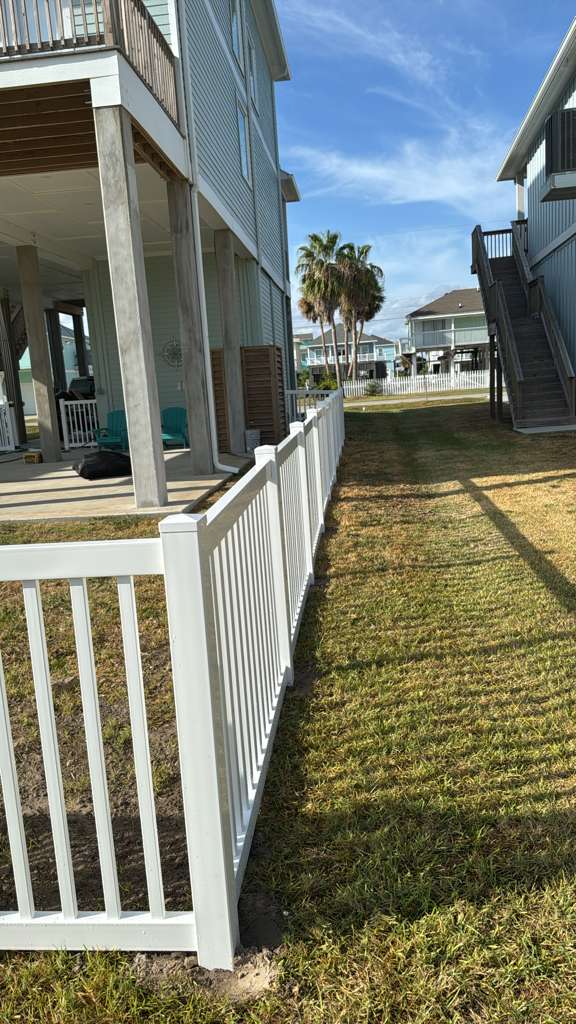
How long a vinyl fence lasts comes down to three documented things, not a single advertised number. The PVC compound itself has to meet material-and-physical-property standards like ASTM F964, and a real manufacturer compliance spec shows a compound tested to hold a minimum impact resistance even after weathering in a hot, humid climate. Separately, a fence’s wind performance is only as good as its posts: a privacy or picket fence can be independently certified to a specific wind rating, but only with the manufacturer’s matching heavy-duty posts and footing — not a standard post of the same size. On the Gulf Coast, that installation gap is usually where the real-world difference in lifespan shows up, more than the vinyl itself. Mustang Fencing Services installs vinyl fencing across Galveston and the surrounding coastal communities, specified to the wind and footing requirements below.
Sources: Illusions Vinyl Fence install/compliance documentation and 75 MPH Wind Kit instructions; Bufftech (CertainTeed) install guideline.
What actually determines how long it lasts
Rigid PVC fencing is covered by ASTM F964, a material-and-physical-property specification for the extruded profiles used in fencing and railing — it sets requirements for things like dimensional tolerance, extrusion quality and weatherability, and notably says up front that it does not address load-bearing characteristics like wind load. That distinction matters: the standard governs the material, not how a finished fence performs against wind, which is a separate, manufacturer-specific certification (see below).
One manufacturer’s own compliance documentation goes further than the base ASTM scope, stating its compound is tested to a minimum impact resistance of 0.6 in-lb/mil after weathering six months to a year — including in a hot, humid climate such as Miami, FL, not just a mild one. That’s a closer proxy for Gulf Coast conditions than a generic “vinyl lasts a long time” claim, though it’s one manufacturer’s own published figure, not a universal guarantee across every PVC fence sold.
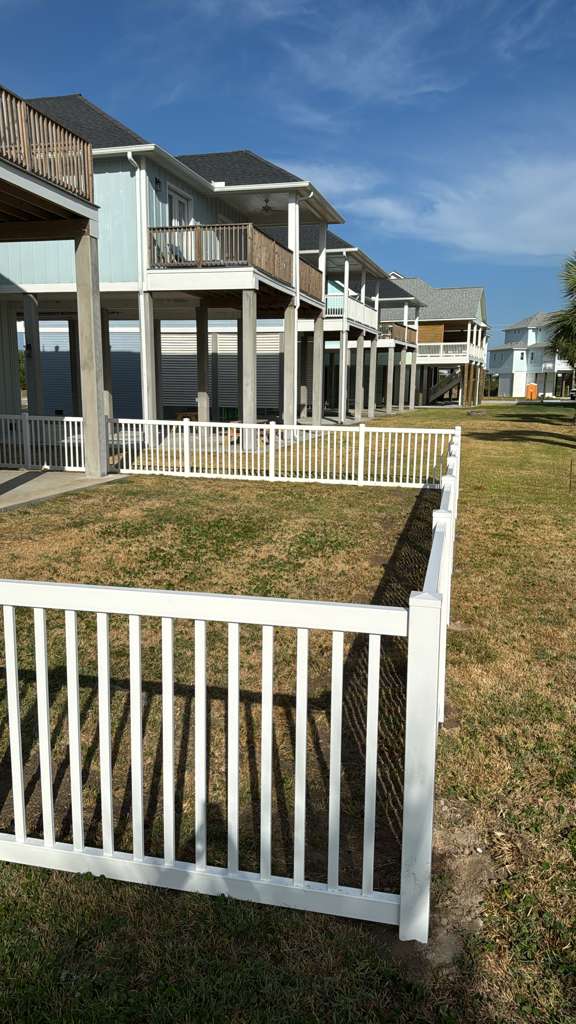
Coastal exposure: humidity, UV and salt air
Salt-laden air and intense, near-constant summer UV exposure are harder on an exterior material than a milder inland climate. The weathering test cited above — a hot, humid climate “such as Miami, FL” — is the closest documented analog to Galveston’s own exposure among the manufacturer specs reviewed for this page; it isn’t a Texas-specific or Galveston-specific test, but it’s a more relevant proxy than a dry or northern-climate figure would be.
Routine care matters too, and manufacturers are specific about what not to use: one publishes only that a non-abrasive, car-wash-type soap with a soft cloth or brush is the right approach, and warns generically that “the wrong cleaners or washers” can damage the vinyl, without naming specific products to avoid. A different manufacturer’s own install guide permits a cleanser like Soft Scrub for stubborn stains, or “the cleaning solution listed on warranty” — in other words, the approved method varies by manufacturer, so the specific one that applies to your fence is worth confirming rather than assuming.
What a material-defect warranty usually covers — and a real exclusion you might not expect
| Typically covered | Typically NOT covered | Source |
|---|---|---|
| Premature cracking, splitting or unusual fading of the PVC material under normal use | Impact damage — a fallen limb, a vehicle, storm debris | Common manufacturer warranty language |
| Manufacturing defects in the extruded profile itself | Post cracking from certain installation methods in a freeze-thaw climate (footnoted on every style page of one guide) | Bufftech install guideline |
| — | Heat buildup and distortion from sunlight reflected off nearby glass or metal — explicitly named as not covered under the limited warranty | Bufftech install guideline |
Coverage terms, duration and transferability to a new owner vary by manufacturer — get them in writing at the time of purchase, not after a problem shows up.
Gulf Coast wind & footing self-check
Check what’s already true about a vinyl fence installation against the manufacturer specs above. A starting checklist, not a certification — only the manufacturer or installer of record can certify a wind rating.
Checklist items are drawn from the Illusions 75 MPH Wind Kit instructions, the Bufftech install guideline, and the Bufftech warranty’s named heat-reflection exclusion (see below). Does not inspect any property or certify a wind rating — it only tallies what you tell it.
What Galveston customers say
5.091 Google reviews · read them all on Google
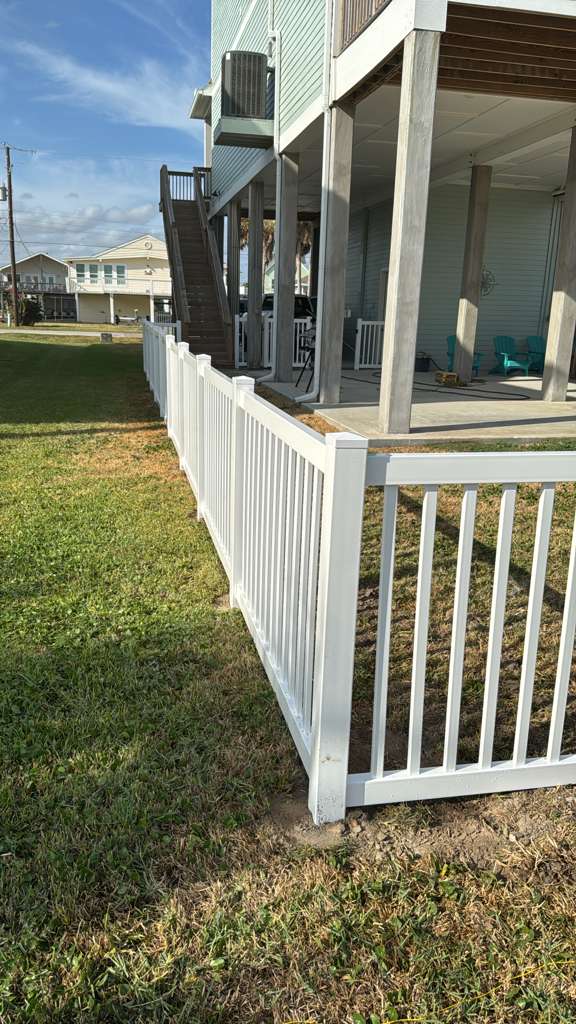
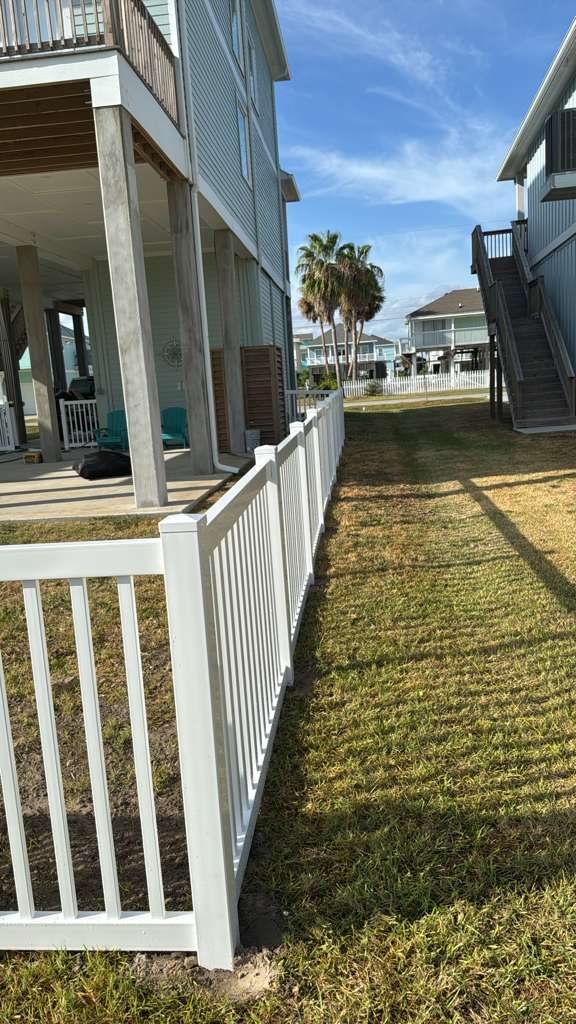
White PVC fence. Beautifully done! Thanks Mustang it’s really looks perfect.
True professionalism is very rare in this day and age, these guys live upto their word and deliver on their service! Our fence was down in the July storm and these guys came and gave a reasonable quote, after confirming I received a time line and they delivered! Will recommend them to everyone I know who needs fencing done.
Fenomenal job, really nice guy. Contacted them after hurricane knocked down my fence facing the street and got it done really quickly.
Reviews shown word for word from the Mustang Fencing Services Google Business Profile (Galveston), captured 2026-10-12.
Questions we get about this
Is a vinyl fence warranty transferable if I sell my home?
Does hurricane or impact damage get covered under a standard vinyl fence warranty?
Can reflected sunlight off windows or metal actually damage a vinyl fence?
What’s the difference between a standard vinyl fence post and a wind-rated one?
How often should a vinyl fence be cleaned?
Sources
Checked October 14, 2026. Rules change, so confirm with the City before you build.
- ASTM F964-13, Standard Specification for Rigid PVC Exterior Profiles Used for Fencing and Railing — Material-and-physical-property specification; explicitly excludes load-bearing/wind-load performance from its scope.
- Illusions Vinyl Fence, Installation & Compliance Instructions — ASTM D4216 compound class and the 0.6 in-lb/mil post-weathering impact-resistance figure, tested in climates including Miami, FL.
- Illusions Vinyl Fence, “75 MPH Wind Kit” Installation Instructions — Wind certification scope and conditions, heavy-duty post specs, footing depth/diameter by post size.
- Illusions Vinyl Fence FAQ — Manufacturer cleaning guidance (non-abrasive, car-wash-type soap).
- Bufftech (CertainTeed), Molded and Extruded Fence Installation Guideline — Footing depth/diameter and concrete-strength specs by post size and fence height; the named reflected-heat warranty exclusion.
Specifying a vinyl fence for a Galveston property?
We’ll spec the post, footing and wind-rated hardware to the manufacturer’s own documentation above — in writing, before any work starts. Free on-site estimates across Galveston and the surrounding coastal communities.