
Our Project with Hope Courser in Galveston, Texas
Hope’s Galveston property got a neighbor-friendly pine privacy fence — smooth side facing out — after the crew worked through rocky ground in that part of the island. Here is that fence, and what tougher digging actually means for a footing.
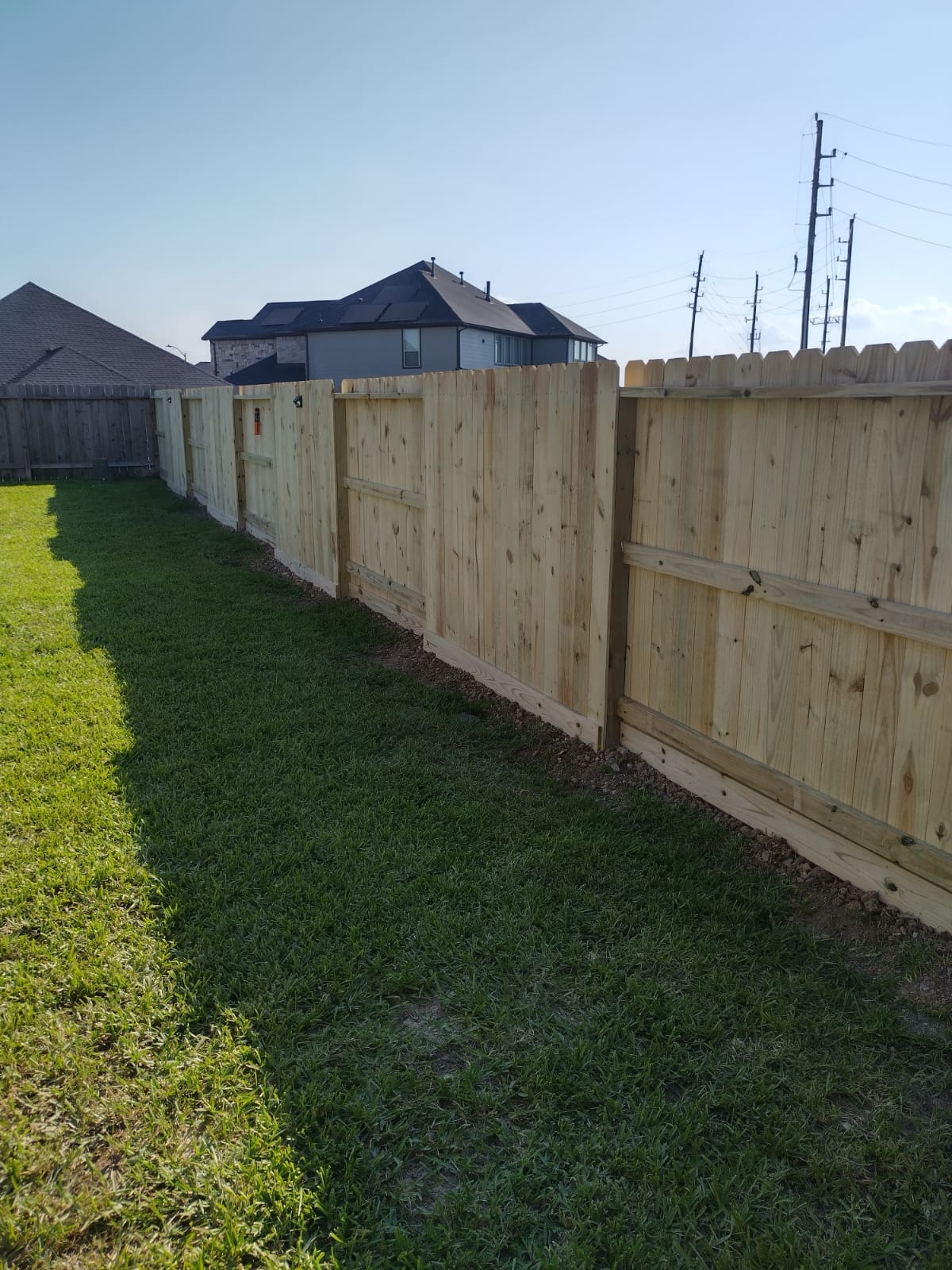
Hope’s Galveston property got a neighbor-friendly pine privacy fence, built with the smooth side facing outward so neighbors see a finished face rather than the rails. Digging hit rocky soil in that part of Galveston, which the crew worked through with specialized tools — rockier ground is generally tougher to dig, not a weaker base to build on.
Source: 2009 IBC Table 1806.2, as reprinted in CLFMI Wind Load Guide WLG 2445-2018.
The job: a neighbor-friendly pine privacy fence
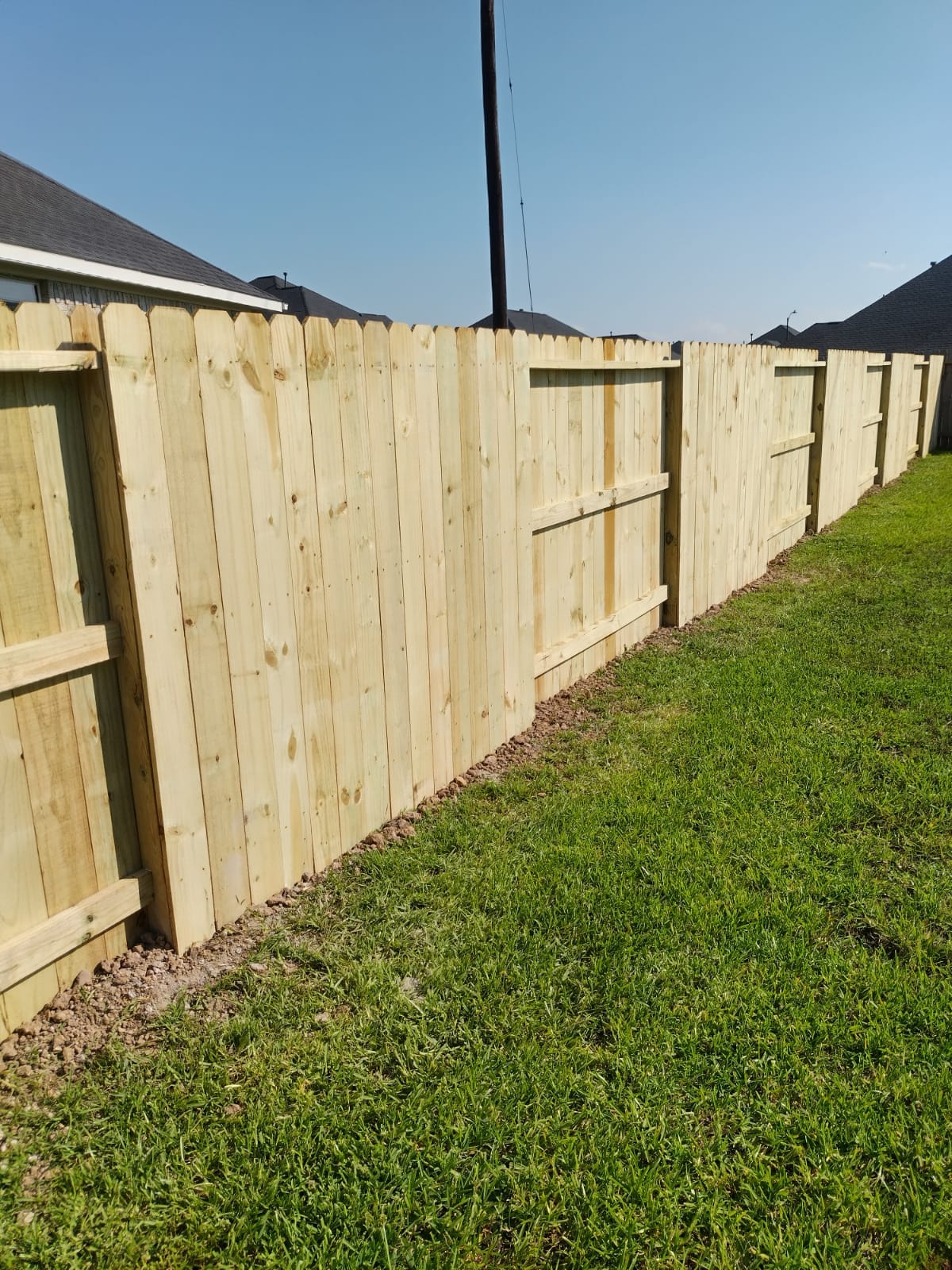
Hope’s Galveston property got a pine privacy fence built as a neighbor-friendly design — the smooth, finished side faces outward, so the view from the street or the neighboring yard is the flat face of the boards rather than the rails and posts. Hope’s own side of the fence shows the rail side, which is what both existing job photos capture.
Digging for this job hit rocky soil, which the original job account describes as “not uncommon in certain areas of Galveston.” The crew adapted with specialized tools to get through it rather than treating it as a problem with the plan.
Does rocky ground mean a weaker fence?
Not on its own. The 2009 International Building Code’s Table 1806.2 (reprinted in the Chain Link Fence Manufacturers Institute’s Wind Load Guide) rates how much sideways load different soil classes can resist per foot of footing depth, in pounds per square foot (psf/ft). Sandy gravel and gravel sit at 200 psf/ft — higher than sand and silty sand at 150 psf/ft, and higher again than clay at 100 psf/ft.
In other words, ground that is harder to dig through because it is rocky or gravelly generally has a higher allowable bearing pressure than loose sand, not a lower one. Tougher digging is a statement about effort, not about how firmly a post will stand once it is set.
That said, most residential fence posts aren’t set using this engineered table at all. The Guide also cites ASTM F567’s prescriptive depth schedule: 24 inches minimum, plus 3 inches for every foot of fence height over 4 feet. That schedule is keyed to height alone and applies the same way whether the hole went in easily or took a digging bar to break through. The engineered, soil-dependent method in Table 1806.2 comes into play for taller fences or higher wind-load sites, not as the default. No soil classification is being claimed for Hope’s own yard here — the original job account doesn’t document one, and this page isn’t a substitute for a site-specific geotechnical read.
Does tougher digging mean a weaker fence?
General guidance from the 2009 IBC’s soil-bearing table, reprinted in the CLFMI Wind Load Guide. Not a soil report for any specific yard.
2009 IBC Table 1806.2, Presumptive Load-Bearing Values, as reprinted in CLFMI Wind Load Guide WLG 2445-2018, p.392 (bearing pressure) and p.168 (ASTM F567 depth schedule).
What customers say on Google
5.091 Google reviews · read them all on Google
Amazing work will go ahead and recommend everyone in friends and family We installed 8ft tall double sided stained cedar wood fence in our backyard, it’s really looks great, installed perfectly nice finishing and cost effective, thanks mustang fencing.
I have hired Mustang fencing services to fix my backyard fencing. Good wood to used. I really like theirs work. Best of luck
I am so pleased with the fence!! Your solution was exactly the right one and the team did a highly professional job. Frankly, I was amazed at how clean the job site was at the completion of the project. Feel free to list me as a reference and a very happy customer. Thanks again and please let the men know That I appreciate their hard work and quality craftsmanship.
Reviews shown word for word from the Mustang Fencing Services Google Business Profile (Galveston), captured 2026-11-02.
Questions we get about this
What kind of fence did Hope get?
Does rocky soil make a fence post weaker?
How deep does a fence post footing need to be?
Does this page know Hope’s yard’s exact soil classification?
Sources
Checked November 2, 2026. Rules change, so confirm with the City before you build.
- Chain Link Fence Manufacturers Institute, Wind Load Guide for the Selection of Line Post Spacing and Size (WLG 2445, 2018) — p.392, 2009 IBC Table 1806.2 (Presumptive Load-Bearing Values, lateral bearing pressure by soil class); p.168, ASTM F567 prescriptive minimum footing depth by fence height.
Planning a neighbor-friendly privacy fence?
We’ll walk the property, talk through the ground conditions and footing depth, and put it on a written quote.