
Transforming Gabriel Vazquez’s Property with a Beautiful Wooden Fence in Galveston, Texas
Gabriel’s Galveston property got a 6-foot cedar privacy fence with a cap board and a rot board near the ground — built despite a rain shower mid-installation. Here is what these photos show, and what Gulf Coast humidity actually changes about installing wood fencing.
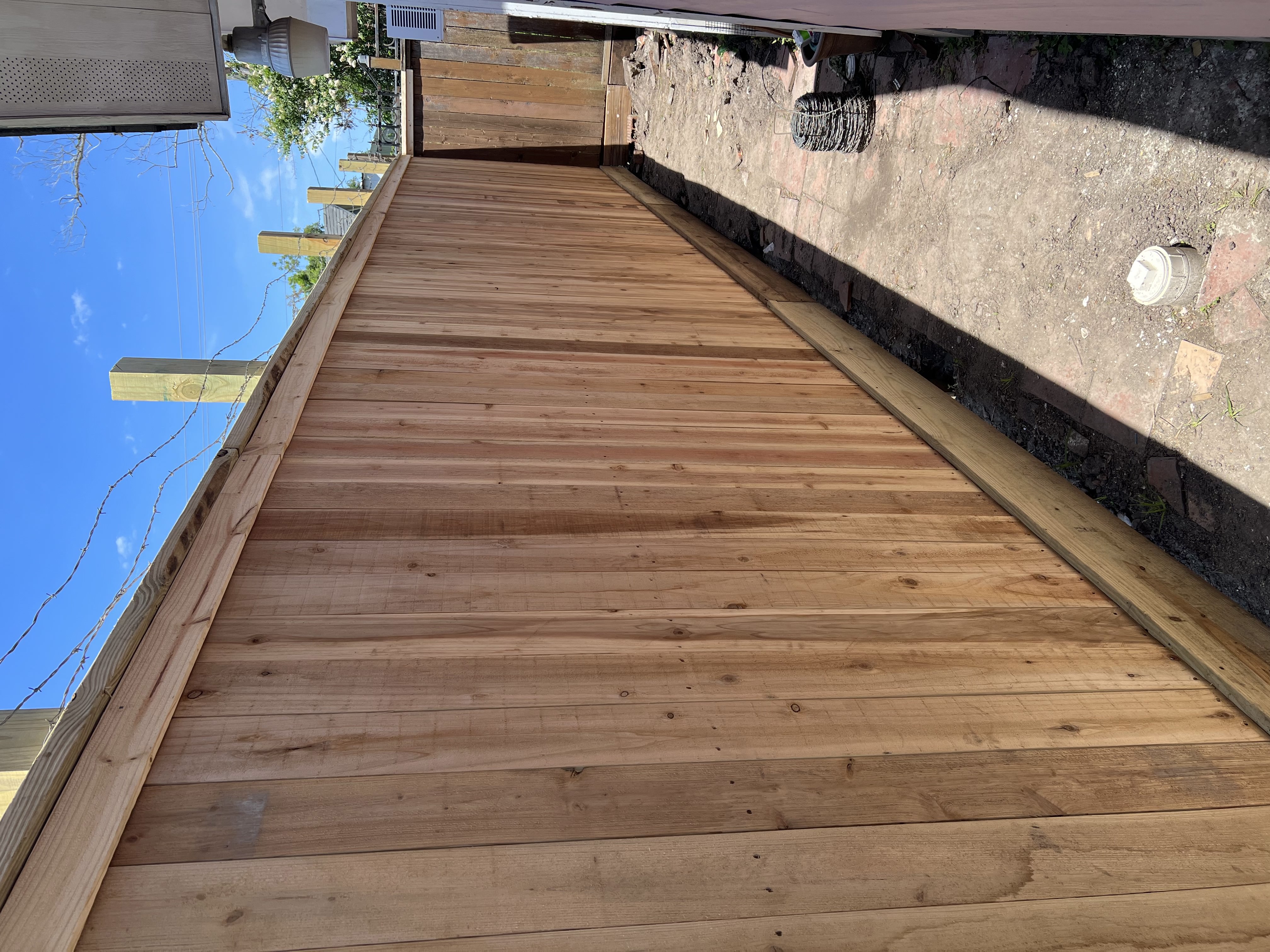
Gabriel Vazquez’s Galveston property got a 6-foot cedar privacy fence with a cap board on top and a rot board near the ground. Installation ran through a sudden rain shower, which the crew worked around with waterproof materials to stay on schedule. For exterior fence lumber, the recommended moisture content at installation is the same range whether the area is dry or a damp, warm coastline like Galveston — so the coastal humidity itself is not what a rain delay is about.
Source: USDA Forest Products Laboratory, Wood Handbook (FPL-GTR-282, 2021), Tables 13-2 and 13-5.
The job: a cedar privacy fence, built through a rain delay
Gabriel’s property got a 6-foot cedar privacy fence, documented in two photos: a close-up showing the top cap beside an evergreen shrub, and a wider shot along a side-yard walkway showing both the cap board and a rot board near the ground. A rot board is the lowest board on a privacy fence, set closest to grade — it is meant to take ground-moisture wear first, so it can be replaced later without rebuilding the rest of the fence.
A sudden rain shower rolled in during installation. Rather than stopping the job, the crew used waterproof materials to keep working and stayed on schedule.
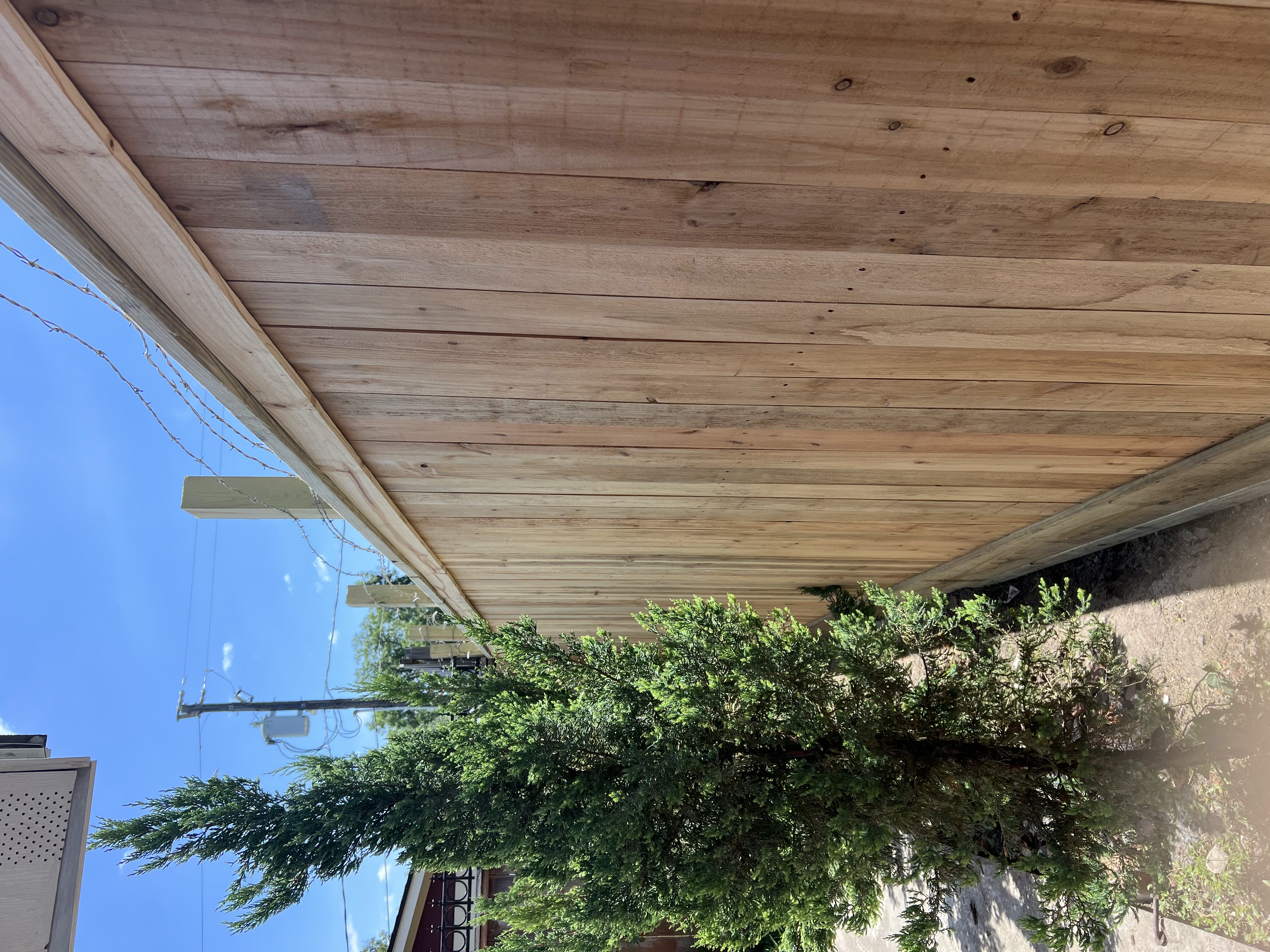
Cap, pickets, rot board: what’s visible in these photos
The walkway photo shows three parts of a standard privacy-fence elevation: a cap board running along the top, vertical pickets below it, and a rot board at the bottom, closest to grade. The rot board is a sacrificial piece — it is the part of the fence most exposed to splashback, mowing debris and ground moisture, so it is built to be the first thing replaced if it wears out, rather than the whole fence.
Does Galveston’s humidity change how a wood fence should be installed?
Less than it might seem. The USDA Forest Products Laboratory’s Wood Handbook gives a recommended moisture-content range for exterior wood (siding, trim, fencing) at the time of installation: about 12% on average, within a 9%-14% range. That recommendation is the same number for “most areas of the United States” and for a “damp, warm coastal area” like Galveston — the climate zone does not change the target for exterior-grade lumber.
What a rain shower during installation changes is timing, not the target: boards that pick up extra surface moisture need to be given a chance to settle back toward that range rather than being installed and fastened tight while noticeably wetter than normal. Lumber is only graded “dry” below 19% moisture content, under the American Softwood Lumber Standard.
Why small gaps can open up between cedar boards
Enter a board width and how much its moisture content might drop after installation (for example, if it went in slightly wetter than normal after a rain) to see the estimated width change. This is general wood-movement arithmetic, not a measurement of Gabriel’s fence.
Shrinkage (in) = board width × tangential dimensional-change coefficient (0.00162 for Eastern redcedar, per 1% MC change) × MC drop. USDA Forest Products Laboratory, Wood Handbook (FPL-GTR-282, 2021), Table 13-5. Valid within the 6%-14% MC range the table specifies; not a measurement of any specific fence.
What customers say on Google
5.091 Google reviews · read them all on Google
Amazing work will go ahead and recommend everyone in friends and family We installed 8ft tall double sided stained cedar wood fence in our backyard, it’s really looks great, installed perfectly nice finishing and cost effective, thanks mustang fencing.
I am so pleased with the fence!! Your solution was exactly the right one and the team did a highly professional job. Frankly, I was amazed at how clean the job site was at the completion of the project. Feel free to list me as a reference and a very happy customer. Thanks again and please let the men know That I appreciate their hard work and quality craftsmanship.
Seems to have helped out a after hurricane beryl we all appreciate it thank you!
Reviews shown word for word from the Mustang Fencing Services Google Business Profile (Galveston), captured 2026-11-02.
Questions we get about this
What kind of fence did Gabriel get?
What is a rot board?
Did the rain shower during installation weaken the fence?
Does Galveston’s humidity require a different fence board?
Sources
Checked November 2, 2026. Rules change, so confirm with the City before you build.
- USDA Forest Products Laboratory, Wood Handbook: Wood as an Engineering Material (FPL-GTR-282, 2021) — Table 13-2, recommended moisture content at installation by US region; Table 13-5, tangential dimensional-change coefficient for Eastern redcedar (0.00162 per 1% MC change).
Planning a cedar privacy fence?
We’ll walk the property, talk through the cap and rot-board details, and put it on a written estimate before any order.