
Should I Install a Cattle Guard or a Farm Gate?
A cattle guard lets vehicles in without stopping and keeps cattle from walking out. A gate closes, locks and works for every animal. Here is how each one is built, why extension guides say cattle guards don’t work for horses, what Texas law says about guards on county roads, and why many entrances end up with both.
Install a cattle guard if the entrance sees frequent vehicle traffic, the animals behind it are cattle, and nobody needs to close it against people. Install a gate if you keep horses, need to lock the entrance, or move animals through it. Extension guidance says cattle guards don’t work well for horses, which often try to jump across or walk through and injure their legs. Many entrances use both: the USDA plan for a cattle guard suggests a wide gate beside it for extra-wide equipment and livestock.
Sources: MSU Extension publication 6051 (USDA 1968 cattle guard plan); UGA Cooperative Extension, Elevated Equine, Fall 2022; Texas Transportation Code §251.009.
What each one actually does
A cattle guard is a grid of pipes or rails laid over a shallow pit where a drive crosses a fence line. Vehicles roll across it. Cattle won’t walk onto it, because the gaps and the drop under them give no safe footing. On each side, wings connect the fence to the guard, so animals can’t walk around the end. That’s the “cattle guard fence” people search for: the fence and the guard work as one line.
A gate is a moving part of the fence. It closes completely, it can be locked, and it works for every animal, not just cattle. The trade-off is that someone has to open and close it, or it needs an operator to do that automatically.
So the choice is really about three things:
- Vehicle convenience. A guard never has to be opened. A hand gate has to be opened and closed on every trip.
- Which animals. A guard is built around cattle. Horses are the big exception (see below).
- Control over people. A guard is always open to any vehicle or anyone on foot. Only a gate can close the entrance.
On the mainland side of Galveston County, around Santa Fe and Hitchcock, and across Brazoria County, most small acreages have one drive-through entrance and several working gates behind it. The working gates are covered in farm gate vs ranch gate. This page is about the entrance.
Cattle guard vs farm gate at a glance
| Cattle guard | Gate | |
|---|---|---|
| Vehicles | Drive straight over; nobody gets out | Stop, open, drive through, stop, close (or an automatic operator) |
| Cattle | Built to stop them | Stops them when closed |
| Horses | Not recommended: they may try to jump it or walk through and injure their legs (UGA) | Recommended |
| People and security | Always open to vehicles and people on foot | Can be closed and locked |
| Moving livestock or extra-wide equipment | Can’t pass; the USDA plan adds a wide gate beside the guard | Pass through the opening |
| Site work | A pit, supports and drainage; wings tied to the fence | Braced posts on both sides of the opening |
| On a Texas county road | Needs commissioners court authorization and the county’s standard design (§251.009) | County rules for gates on roads are separate |
MSU Extension publication 6051 (USDA 1968 plan); UGA Cooperative Extension, Elevated Equine, Fencing for Horses (2022); Texas Transportation Code §251.009; NRCS Texas Practice Specification 382 (2021) for gate bracing.
How a cattle guard is built
The clearest public drawings of a farm cattle guard are the USDA and Mississippi State University Extension plans (publication 6051, drawn in 1968 and still published). They are a reference design, not a code, but they show every part a buyer should ask about:
- The deck. Fourteen pieces of 2-inch galvanized steel pipe, 7 inches on center, each 10 feet long, running across the road. With pipe that size, the clear gap between pipes works out to about 4.6 inches (7 in minus the 2⅜ in outside diameter).
- The pit. An excavated pit 18 inches deep under the pipes, with concrete curbs at each end and a support under the middle of the pipes.
- Drainage. A 4-inch drain tile “where possible.” A pit is a hole in the road, and water will find it.
- Size. A 10-foot opening across the road, 9 feet along the direction of travel, and 16 feet 8 inches between the fence posts at the tips of the wings.
- Wings. Sloped panels of 1×6 slats spaced 3 inches apart that close the gap between the fence and the guard.
The same publication has a wood version: 2×4s on edge, 8 inches on center, over a pit 2 feet 8 inches to 3 feet deep overall. Most guards sold today are prefabricated steel, so treat the plan as a checklist. Whoever builds yours should be able to tell you, in writing, the spacing, pit depth, drainage and load rating. The NRCS Texas fence specification also expects the location of “gates and cattle guards” to be part of a fence design, so plan the guard and the fence together.
Cattle guard, gate or both?
Answer six questions about the entrance. The checker applies the extension plan, the horse guidance and the Texas county-road rules cited on this page, and counts how often someone gets out of the truck at a hand-opened gate. No prices.
Horses: UGA Cooperative Extension, Elevated Equine, Fencing for Horses (2022). Guard layout, drain tile and the gate beside the guard: MSU Extension / USDA 1968 cattle guard plan, pub. 6051. County roads: Texas Transportation Code §251.009 and Agriculture Code §143.003. Get-outs = trips per day × 2 (out to open, out to close) × 365. A way to think the decision through, not an engineered design.
Do cattle guards work for horses?
No. The University of Georgia Cooperative Extension puts it plainly: “Cattle guards don’t work well either because horses will often try to jump across or walk through, again tangling and injuring legs.” A horse that tries to cross can put a leg between the pipes.
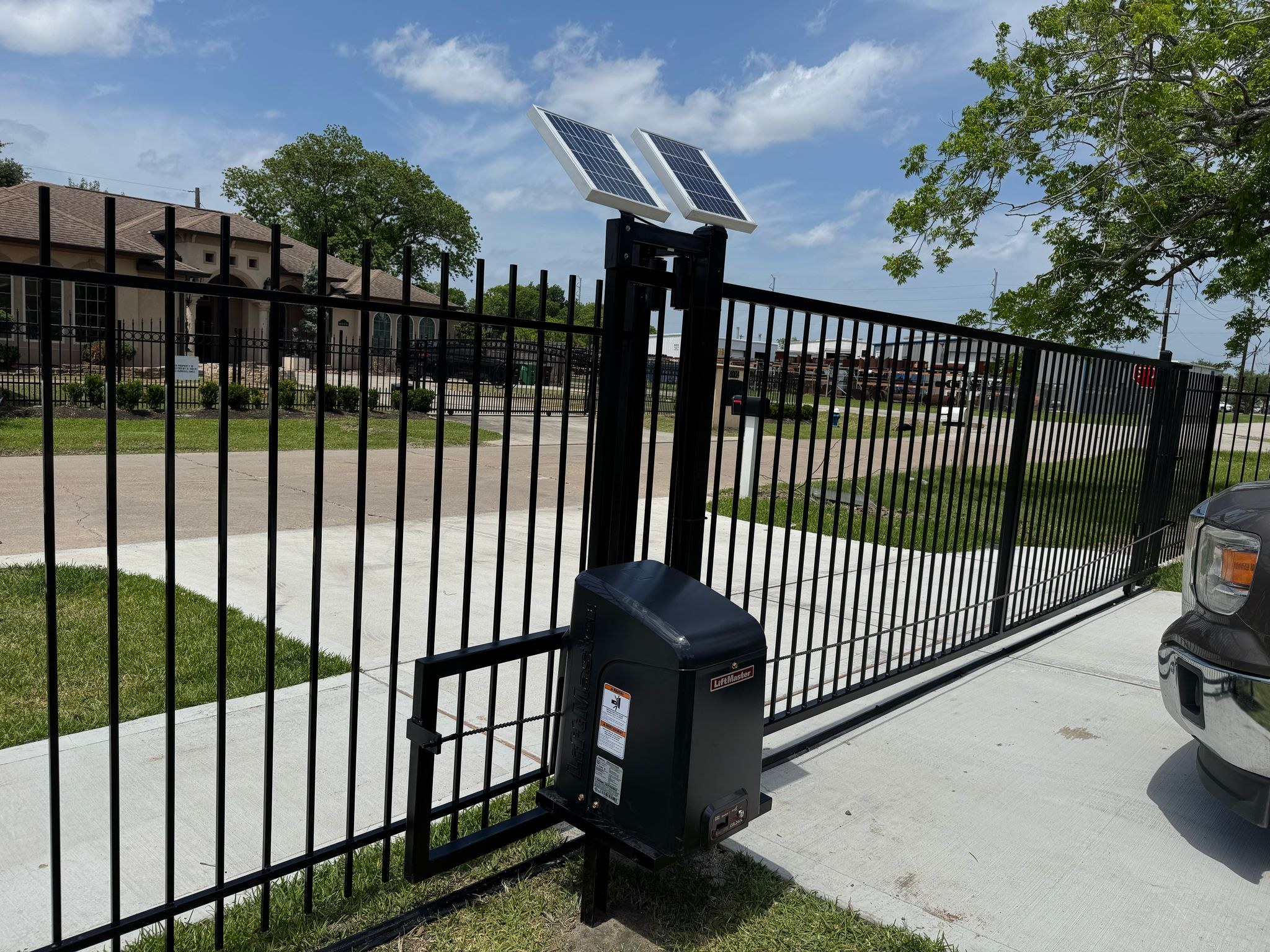
If horses live behind the entrance, use a gate. The same UGA article suggests 12 to 16 feet as a handy width for main gates so equipment can get through, and says the gate should be as tall as the fence so horses don’t lean over it or try to jump it. If the entrance gets a lot of traffic, an automatic gate gives you the no-stopping convenience of a guard without the leg risk. See how solar gate openers work, which is how most rural entrances far from grid power are automated.
Goats, sheep and pigs are a different question. The extension plans cited on this page were designed around cattle. If you keep smaller livestock, ask the guard maker to state in writing whether its design stops your animals. If it won’t, use a gate.
How often someone gets out at a hand-opened gate
Times per year, if you get out once to open and once to close on every trip.

Coastal ground and the pit
A cattle guard is the only entrance option that puts a hole in the drive. On flat, low ground that holds water after heavy rain, the pit is the part to plan carefully. The USDA plan handles it two ways:
- It calls for a 4-inch drain tile out of the pit “where possible.” Ask where yours will drain to. A pit with nowhere to drain holds water and silt.
- It shows two ways to set the guard: with the floor level with grade, or raised above grade with earth ramps up to it. The raised version needs less digging below the road surface.
A gate has no pit. It needs a brace assembly on both sides of the opening, and the NRCS Texas fence specification notes that sandy and consistently wet soils need posts set deeper than its standard 3 feet. Either way, the ground at your entrance shapes the job, which is why it’s worth looking at on site before choosing.
The common answer: a guard and a gate
The USDA plan itself draws a “gate for passage of cattle and wide equipment” next to the guard, and its note says a wide gate beside the guard “is suggested for passage of extra wide equipment and livestock.” That is the setup many working entrances end up with:
- The guard takes the everyday traffic, so nobody gets out of the truck.
- The gate beside it handles cattle drives, hay equipment wider than the guard, and anything that has to be closed at night or locked while you’re away.
Size the gate for the widest load. UGA’s horse fencing bulletin puts pasture gates for equipment at 14 to 16 feet. Hang it on braced posts, as described in farm gate vs ranch gate. If you want drive-through convenience without a pit, a bump gate or an automatic gate are the other options.
What Galveston customers say
5.091 Google reviews · read them all on Google
Very professional and friendly. Gotten automatic gates done and they are done to perfection! Thank you
had an excellent experience with mustang fencing From the initial consultation to the final installation, the team was professional, punctual, and attentive to detail. They helped me choose the perfect fence style to match my property and ensured everything was installed with precision. The quality of materials is top-notch, and the fence has completely transformed the look and security of my home. I highly recommend mustang services to anyone looking for reliable and high-quality fencing services!
Absolutely loved my fence once i saw the finished product. No hassle, no rude interactions, and no inconveniences everything was just perfect. One of the best fencing companies in Texas
Reviews shown word for word from the Mustang Fencing Services Google Business Profile (Galveston), captured 2026-09-28.
Questions we get about this
Is a cattle guard better than a gate?
Do cattle guards work for horses?
How far apart are the pipes on a cattle guard?
How deep is a cattle guard pit?
Can I put a cattle guard on a county road in Texas?
Do I still need a gate if I have a cattle guard?
Sources
Checked September 27, 2026. Rules change, so confirm with the City before you build.
- Mississippi State University Extension, publication 6051, Cattle Guards (USDA 1968 plan, sheets 1–2) — Pipe size and spacing, pit depth, curbs, drain tile, wings, dimensions, wood version, level and raised floors, and the note suggesting a wide gate beside the guard.
- University of Georgia Cooperative Extension, Elevated Equine, Fencing for Horses (Fall 2022) — Cattle guards don’t work well for horses; main gates 12–16 ft; gates as tall as the fence.
- Texas Transportation Code §251.009, Construction of Cattle Guards on County Roads; Offense — Commissioners court authorization, standard plans and specifications, misdemeanor for a nonconforming guard.
- Texas Agriculture Code, Chapter 143, Fences; Range Restrictions — §143.003: cattle on a county road with an authorized cattle guard between two tracts under common ownership or lease.
- USDA NRCS Texas, Practice Specification Fence (Code 382), March 2021 — Fence design includes the location of gates and cattle guards; brace assemblies on both sides of gate openings; deeper posts in sandy or wet soils.
- University of Georgia Cooperative Extension Bulletin 1192, Fences for Horses — Pasture gates for equipment at least 14 to 16 ft wide.
Planning a farm or ranch entrance?
We’ll look at the entrance, what needs to get through it and the ground it sits on, and put the gate, posts and bracing on a written quote. Free on-site estimates across Galveston County.