
How Solar-Powered Gate Openers Work
A solar gate opener is a normal 24-volt gate operator whose batteries are charged by a small solar panel instead of a power line. The panel charges the batteries; the batteries run the gate, day and night. Here is how the parts connect, how many cycles a day the maker’s own table gives on the Texas coast, where the panel has to go, and what happens when the batteries run low.
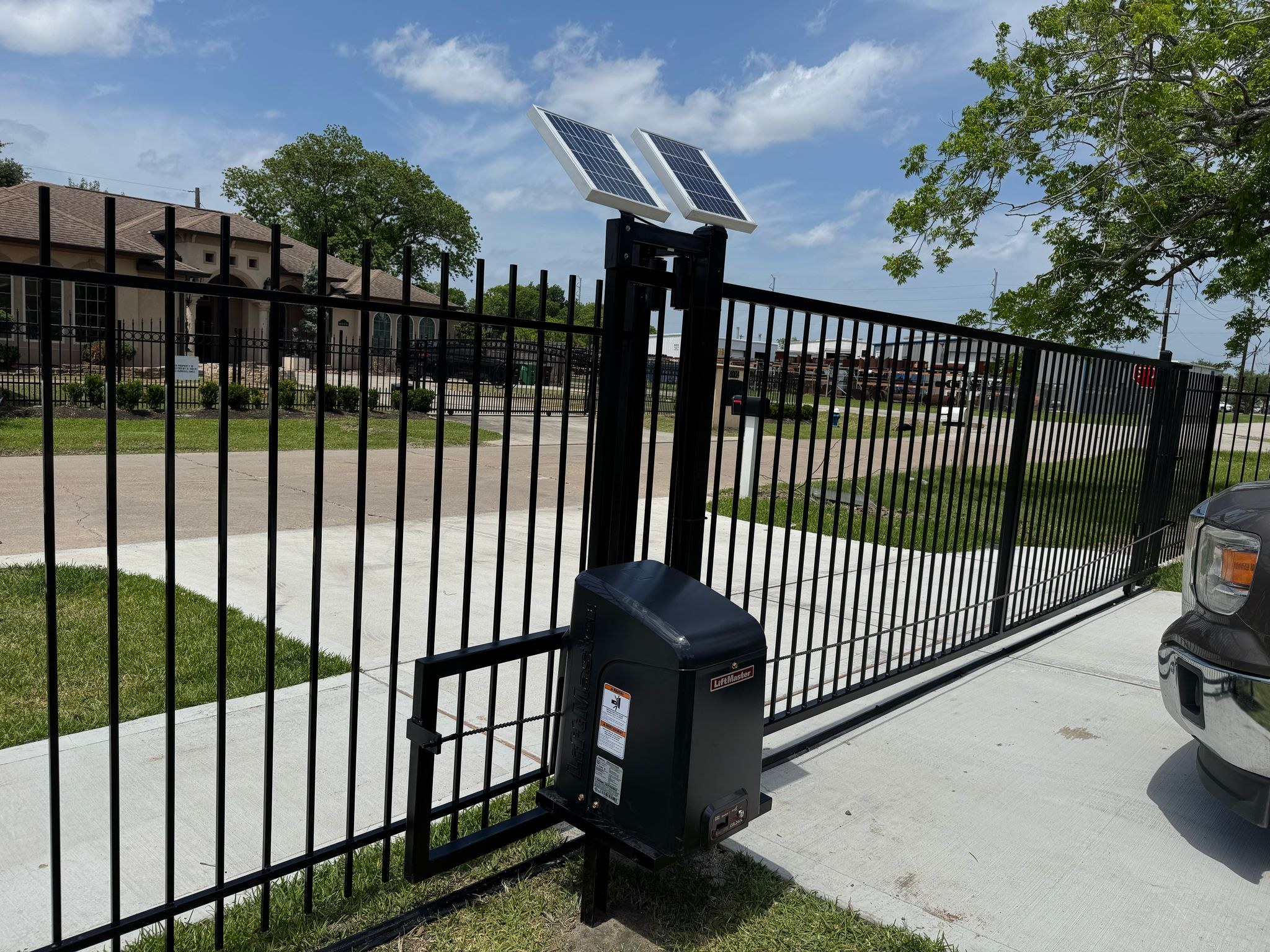
The solar panel doesn’t run the gate. It charges the batteries, and the batteries run the gate. Panels make DC power in daylight; a harness feeds it to two 12-volt batteries wired in series for 24 volts; the operator draws on them whenever the gate moves, and all night. In the LiftMaster CSW24UL manual, a solar setup needs at least two 10 W panels in series (up to six, 60 W), a solar harness kit, and panels facing due south with no shade. On the maker’s map the Texas Gulf coast is Zone 2, about 4 hours of sun a day. How many cycles you get depends on panel watts, battery size and the always-on draw of accessories: in the maker’s Zone 2 table, from about 11 to 146 cycles a day. Mustang Fencing Services installs and sizes solar automatic gate installation in Galveston County, matching the panel and battery bank to your gate and cycle count.
Source: LiftMaster CSW24UL installation manual, solar appendix, pp. 47–49, and battery wiring section.
The parts, and how the power flows
“Photovoltaic materials and devices convert sunlight into electrical energy,” in the US Department of Energy’s words, and the modules produce direct current (DC). A gate operator built for solar is a DC operator, so the panel’s output can charge its batteries directly through the maker’s harness. Using the LiftMaster CSW24UL swing gate operator’s manual as the worked example, the chain is:
- Solar panels. Not included with the operator; they’re accessories. The manual requires a minimum of two 10 W panels in series and allows a maximum of six, which matches its “solar power max” of 60 watts.
- Solar harness kit. The maker’s harness connects the panels and the larger batteries to the control board.
- Batteries. Two 12 V batteries wired in series make the 24 V system. The operator ships with two 7 Ah batteries; for solar, two 33 Ah batteries in an extra battery tray store more.
- Control board and motor. The board takes the battery power, runs the motor when the gate is told to move, and powers the accessories.
- Accessories. Remotes, a myQ device, an expansion board and loop detectors all draw a small current around the clock, whether the gate moves or not. On solar, that standby draw matters as much as the gate’s movement.
At night and on cloudy days nothing changes for the gate: it runs on the batteries, and the panel tops them up again when the sun is out. Everything else about an automatic gate stays the same, including the safety rules in UL 325 and ASTM F2200.
How many cycles a day? The standby draw decides
The manual’s solar table is the most useful thing a buyer can look at, because it shows what really limits a solar gate. It lists cycles per day for each panel size, battery size and sun zone, at different levels of standby current: the draw of the control board and accessories while the gate sits still.
The manual’s standby figures, at 24 V:
- Control board with no radios programmed: 2.7 mA
- One or more remote controls programmed: +1 mA
- A myQ device or wireless dual gate: +2.4 mA
- Expansion board: +11.1 mA
- Each loop detector (up to three, plugged into the expansion board): +3.8 mA
Those look tiny, but they run 24 hours a day, and the table shows the effect. In Zone 2 with 33 Ah batteries, a 40 W panel is rated about 92 cycles a day at 5 mA of standby draw, but 44 at 100 mA. A 20 W panel is rated 40 at 5 mA and 20 at 50 mA, and the table gives no rating at 100 mA. The manual also says the heaters sold for photo-eyes are not recommended on solar, and the operator’s own heater can’t be used at all.
The maker calls these numbers approximations that “vary based on gate construction, installation, and temperature.” A flat figure like “about 10 cycles a day” doesn’t match the maker’s table; what you get depends on the parts you choose. For more on sizing to your traffic, see solar gate cycle limits.
Cycles per day by panel size, Zone 2
Two 33 Ah batteries, 20 mA standby draw (for example, remotes plus a few always-on accessories).
How many cycles a day will a solar gate give you?
Pick the panel, batteries and accessories. The checker adds up the always-on standby draw and reads the gate maker’s own cycles-per-day table for your sun zone. Galveston is in Zone 2 on the maker’s map. One cycle = one open and one close. No prices.
Standby draw per item and the cycles-per-day table: LiftMaster CSW24UL installation manual, solar appendix (pp. 47–48), for that swing-gate operator. The checker rounds your draw up to the next row the table lists, and treats a blank cell as “not available.” The maker calls the ratings approximations that vary with gate construction, installation and temperature. Other operators have their own tables.
Where the panel goes
“The location of the panel(s) is critical to the success of the installation,” the manual says. Its rules:
- Face due south. The manual: “Solar panel(s) MUST be installed facing south. Use a compass to determine direction.”
- No shade. Keep the area around the panel clear of shadows for a 180° arc from east to west. “If the panel(s) is not casting a shadow, the battery is not being charged.”
- Think about winter. Trees or buildings that don’t shade the panel in summer can shade it in winter, when the sun sits lower. The manual suggests tilting the panel up to 15° steeper to favor winter.
- Mind the wire run. If the best sunny spot is away from the gate, the wire from panel to operator has a maximum length that depends on its gauge and the panel watts (table below).
On a lot with big live oaks, the gate post is often not the sunny spot. A separate post for the panel, with the wire run sized to the table, is the usual answer.
Maximum wire length from panel to operator (feet)
| Wire gauge (AWG) | 20 W of panels | 40 W of panels | 60 W of panels |
|---|---|---|---|
| 16 | 235 | 115 | 80 |
| 14 | 375 | 190 | 125 |
| 12 | 600 | 300 | 200 |
| 10 | 940 | 475 | 315 |
LiftMaster CSW24UL installation manual, p.49. The chart assumes copper wire, 65 °C, 5% voltage drop, 30 V nominal.
Connecting solar, or adding it to an opener you already have
People search for “how to connect a solar panel to a gate opener” as if it were a single wire. In the CSW24UL manual it is a set of parts from the operator’s maker:
- Replace the two 7 Ah batteries with two 33 Ah batteries, in the additional battery tray.
- Install the Solar Harness Kit, with its white jumper between the two batteries so they’re in series, and its red and black leads between the batteries and the board’s battery plug.
- Mount two to six panels in series, facing south, and run wire of the right gauge for the distance.
- Give up the operator heater: the manual says a heater can’t be used with solar, and two 33 Ah batteries won’t fit in the enclosure with one.
So adding solar is possible when the operator’s maker supports it and lists the parts. If your opener’s manual has no solar section, don’t improvise one. The wiring errors the manual lists include putting a 12 V battery on a 24 V system and the reverse. Ask for the maker’s solar parts, or an operator that has them. See gate automation and access control for the options.
When the batteries run low
A solar gate’s weak moment is a long cloudy stretch, when the batteries drain faster than the panel refills them. The CSW24UL manual lets you decide in advance what the gate does then:
- When there’s no AC power and the battery is critically low (under 23 V), the gate latches at a limit until the battery recovers.
- An option switch sets which limit: set to OPEN, the gate opens and stays open; set to CLOSE, it stays closed.
- Before that, the operator beeps three times with a command when the battery is low.
Which setting is right depends on the property. A gate that keeps livestock in usually needs to fail closed; an entrance that emergency vehicles must reach may need to fail open. The manual also notes that batteries degrade over time with temperature and use, so a solar gate that was fine for years can start to fall short. Batteries are a maintenance item. For an entrance with no power at all and simple needs, a bump gate is the no-battery alternative.
What Galveston customers say
5.091 Google reviews · read them all on Google
Very professional and friendly. Gotten automatic gates done and they are done to perfection! Thank you
We just installed iron gate and it looks amazing thank you very much mustang fencing .
had an excellent experience with mustang fencing From the initial consultation to the final installation, the team was professional, punctual, and attentive to detail. They helped me choose the perfect fence style to match my property and ensured everything was installed with precision. The quality of materials is top-notch, and the fence has completely transformed the look and security of my home. I highly recommend mustang services to anyone looking for reliable and high-quality fencing services!
Reviews shown word for word from the Mustang Fencing Services Google Business Profile (Galveston), captured 2026-10-05.
Questions we get about this
How does a solar gate opener work?
Does a solar gate opener work at night?
How many times a day can a solar gate open?
Can I add solar to my existing gate opener?
Which way should a gate opener solar panel face?
How far can the solar panel be from the gate opener?
Sources
Checked September 28, 2026. Rules change, so confirm with the City before you build.
- LiftMaster CSW24UL Installation Manual (Chamberlain Group) — Solar requirements, zones and map (p.47); standby current and cycles-per-day tables (p.48); panel position, winter tilt and wire length (p.49); battery wiring and Solar Harness Kit; low-battery option switch; heater limits.
- US Department of Energy, Solar Photovoltaic Technology Basics — PV devices convert sunlight into electrical energy; modules produce direct current.
Thinking about a solar gate?
We’ll look at the gate, where the sun actually falls on your lot through the year, and how often the gate opens, and put the operator, panels and batteries on a written quote. Free on-site estimates across Galveston County.