
What Is a Bump Gate, and Would One Work on My Property?
A bump gate is a farm gate you open by nudging it with the front of your truck. It swings away, stays open long enough to drive through, then closes and latches by itself, with no power at all. Here is how it works, what the posts and hardware have to be, which vehicles it suits, and when an automatic gate or a cattle guard is the better call.
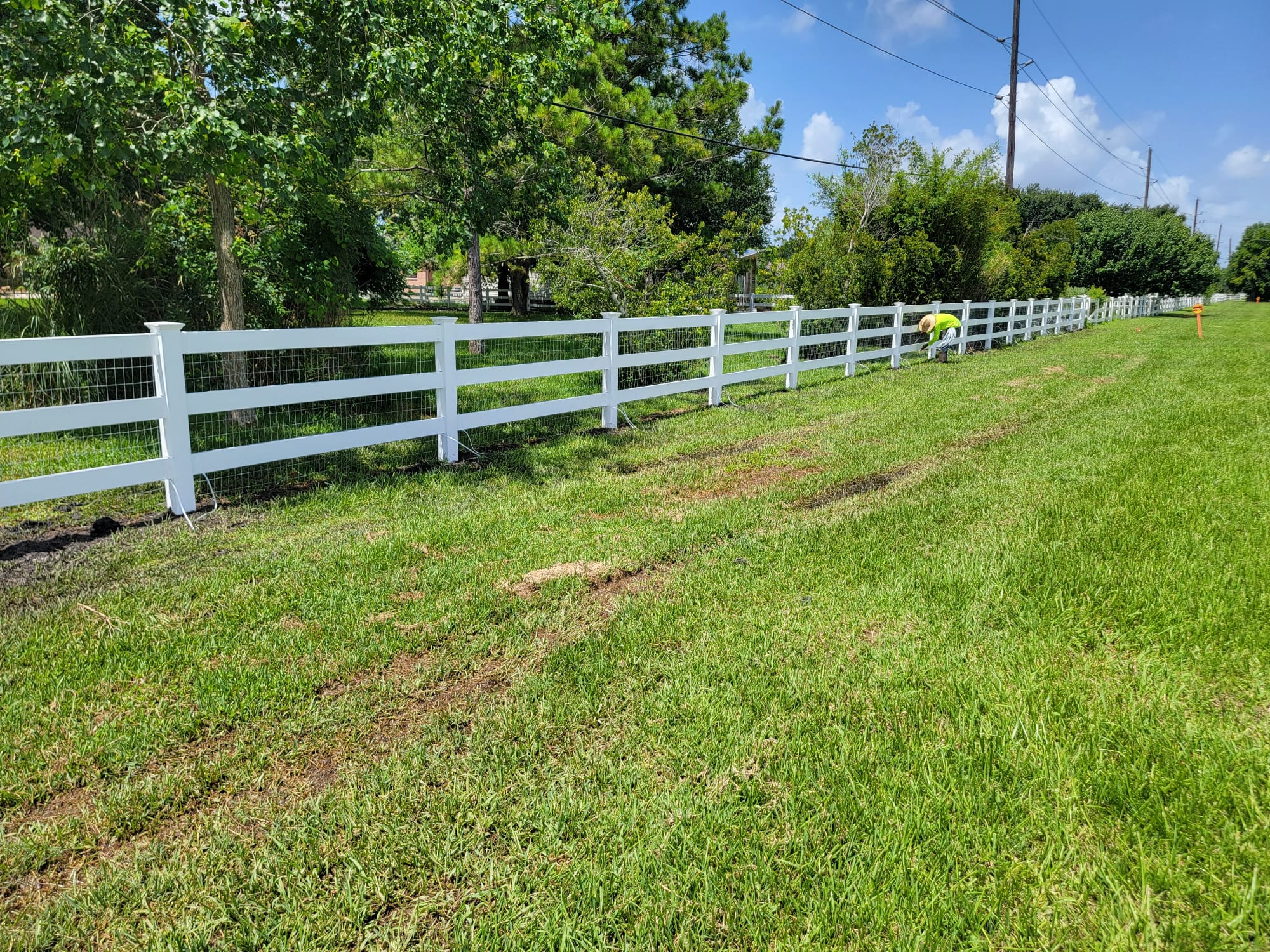
A bump gate is a swinging farm gate that a slowly moving vehicle pushes open. The hinge lifts the gate slightly as it swings, so when you’re through, gravity brings it back to closed and it latches. A damper or holding latch keeps it open long enough to pass; one kit maker lets you set that up to 45 seconds. It needs no electricity, and it opens from either side. It suits cattle and working traffic from drivers who know how to use it. It is not access control: any vehicle can push it open unless it’s locked. Mustang Fencing Services builds and hangs bump gates as part of full farm and ranch gate installation across Galveston County.
Sources: US Patents 2,629,191 (1953), 2,693,043 (1954) and 2,693,653 (1954); Bump N’ Drive gate opener kit instructions (checked Sept 2026).
How a bump gate works
You drive up to the gate slowly until your bumper meets a padded bump arm on the gate. You keep rolling. The push releases the latch, and the gate swings away from you. It stays open while you pass, then swings back and latches behind you. From the other side, the same thing happens in the other direction. Nobody gets out of the truck, and nothing is plugged in.
The idea is old. Three US patents from the early 1950s describe it, and they explain the parts better than any sales page:
- The latch lets go when pushed. A 1953 patent describes a gate “actuated by a vehicle through a bump imparted by the vehicle to the gate to unlatch the gate and swing the gate to an open position,” so the vehicle passes “without necessitating the occupant of the vehicle getting out.” A 1954 patent opens its gate “by horizontal pressure … as by a slowly moving motor vehicle.”
- The hinge lifts the gate as it swings. In the 1953 design, the gate hangs on a chain fixed to the post off-center, so swinging it either way makes it “rise vertically somewhat.” In the 1954 design, a roller rides on a curved cam track with its low point in line with the posts. Either way, the closed position is the lowest point.
- Gravity closes it. Because closed is the low point, the gate falls back to it on its own, “without the use of springs and without the use of a counterbalancing weight.”
- Something slows the return. A third patent, filed by a San Antonio inventor in 1951, starts from the problem every bump gate owner meets: if the gate starts closing as soon as the push stops, it hits the vehicle, and that is “more severe in the case of long vehicles or combinations of vehicles such as trucks, tractors and trailers, farming equipment.” His answer was a dash pot that gives “a definite time lag in closing,” adjustable “for different types of vehicles.”
What a modern bump gate kit includes
Today most bump gates are an ordinary pipe farm gate fitted with a hardware kit. The published parts list for one kit, Bump N’ Drive, shows what that means in practice:
- Special hinges (upper and lower, post side and gate side) that replace the standard ones. The maker says cylinders in them “raise the gate slightly, no matter the direction of opening.”
- Left and right bumper arms with foam padding and rubber caps, on a spring, cable and turnbuckle.
- Catch-and-release latches and two heavy-duty pneumatic pistons, which hold the gate open and let it close slowly.
- A two-way lock and a spring-loaded lock pin, so you can lock it shut.
- A gate wheel, recommended for gates 12 feet and longer.
The maker says the kit is “most suited for pipe rail gates, but also fits on many other kinds of gates,” and that where the latch goes depends on the rail spacing of your gate. That is why the gate itself matters: a straight, square pipe gate on solid posts is the easy case. See farm gate vs ranch gate for the difference between the two common gate types.
Will a bump gate work at your entrance?
Six questions. The checker applies the kit maker’s post, wheel, bumper and hold-open guidance and the patents’ timing problem, and works out how long the gate has to stay open for your longest rig. No prices.
Posts, gate wheel, latch gap, bumpers and the 45-second maximum hold: Bump N’ Drive kit instructions. Closing on long rigs and the adjustable delay: US Pat. 2,693,653. Locking insert: US Pat. 2,693,043. Bracing: NRCS Texas Practice Specification 382. Seconds to clear = (rig length + gate length) ÷ (mph × 1.4667 ft/s), a conservative allowance. A way to think it through, not an engineered design.
Posts and bracing: the part that has to be built right
A bump gate gets pushed by a truck every time it opens. The 1954 patent already worried about gates “securely anchored in the ground and so designed as to resist damage under repeated impacts.” The kit maker’s instructions are specific:
- Hinge post: for a farm or ranch gate up to 20 feet, an 8-inch wooden post, “securely concreted or pounded into the ground.”
- Latch post: a 6-inch post, installed after the gate is hung, so the gap between the swing end and the post comes out at 2½ to 3 inches.
- Metal posts: square steel is recommended. Round steel posts must go in cement with an anchor.
The USDA NRCS fence specification for Texas adds the bracing rule: brace assemblies are required on both sides of gate openings, and gates attach directly to a brace assembly post. It sets brace posts at least 3 feet deep and says sandy and consistently wet soils need more. On low coastal ground in Galveston and Brazoria counties, that is the part to talk through on site.
Seconds a rig needs to clear a 16 ft bump gate
At 2 mph, a slow roll. Dashed line: the longest hold-open the kit maker lists.
Which vehicles and drivers it suits
The kit maker lists RVs, semitrucks, farm vehicles and pickups with trailers. The conditions are about the front of the vehicle and the way it’s driven:
- A true bumper. The kit “was primarily designed for use by vehicles with a true bumper.” You need an even bumper surface to push the arms.
- Nothing hanging off the front. “Any attachments on the front end of your vehicle may trap the bumper arms and cause damage.”
- Care with low cars. Some modern cars have thin plastic skirting close to the ground. Check that no part of it can touch the kit’s bottom plate.
- A slow push, then keep going. Push the arm “at a slow-rolling speed,” and “follow through without stopping” until the gate is fully open.
That last point is why a bump gate works best where the same people drive through every day. A visitor who taps the arm and stops, or a delivery driver in a low car, is the usual trouble. If the entrance gets a lot of unfamiliar traffic, an automatic gate on a solar opener also needs no grid power, and opens for a code or remote instead of a bumper.
Bump gate, hand gate, automatic gate or cattle guard
| Bump gate | Hand-opened gate | Automatic gate | Cattle guard | |
|---|---|---|---|---|
| Get out of the truck? | No | Yes, to open and to close | No | No |
| Power | None | None | Grid or solar | None |
| Keeps people out | Only when locked | When locked | Yes: code, remote or card | No |
| Works from both sides | Yes | Yes | Yes | Yes |
| Horses | It is a gate | It is a gate | It is a gate | Not recommended (UGA Extension) |
| Safety standard | Kit maker’s instructions | — | UL 325 and ASTM F2200 | County design on county roads (Tex. Transp. Code §251.009) |
| Main site work | 8 in hinge post, braced; clear swing area | Braced posts | Braced posts, operator pad, power | Pit, drainage, wings |
Bump N’ Drive kit instructions; US Pat. 2,693,043 (locking insert); NRCS Texas Practice Specification 382; UGA Cooperative Extension, Elevated Equine (2022); UL 325 / ASTM F2200; Texas Transportation Code §251.009.
Bump gate, automatic gate or cattle guard?
- Choose a bump gate when the traffic is regular (you, family, hands, feed deliveries in trucks), the job is keeping livestock in, and there is no power at the gate. It closes the whole opening, which a cattle guard never does.
- Choose an automatic gate when the entrance has to keep people out, when guests and delivery drivers use it, or when low cars come through. Automatic gates are built to UL 325 and ASTM F2200, which cover entrapment protection and gate construction. See gate automation and access control.
- Choose a cattle guard for heavy all-day traffic where only cattle need stopping and nothing needs to close. Not for horses, and not on a county road without the county’s approval.
On the mainland side of Galveston County, around Santa Fe and Hitchcock, and across Brazoria County, small acreages face exactly this choice at the front drive. Where the ground is low or slow to drain, look first at the posts and the swing area, then at who drives through.

What Galveston customers say
5.091 Google reviews · read them all on Google
We just installed iron gate and it looks amazing thank you very much mustang fencing .
Very professional and friendly. Gotten automatic gates done and they are done to perfection! Thank you
I am so pleased with the fence!! Your solution was exactly the right one and the team did a highly professional job. Frankly, I was amazed at how clean the job site was at the completion of the project. Feel free to list me as a reference and a very happy customer. Thanks again and please let the men know That I appreciate their hard work and quality craftsmanship.
Reviews shown word for word from the Mustang Fencing Services Google Business Profile (Galveston), captured 2026-10-05.
Questions we get about this
What is a bump gate?
How long does a bump gate stay open?
Does a bump gate need electricity?
What size posts does a bump gate need?
Will a bump gate damage my car?
Is a bump gate secure?
Sources
Checked September 28, 2026. Rules change, so confirm with the City before you build.
- US Patent 2,629,191, Gravity Return Bump Gate (W. H. Koch and E. Strom, 1953) — Vehicle bump unlatches and swings the gate; off-center chain lifts the gate as it swings either way; returns by gravity without springs or counterweight.
- US Patent 2,693,043, Automatic Bump Gate and Latch (A. G. Leake, 1954) — Opened by horizontal pressure from a slowly moving vehicle; cam track and roller with the low point in line with the posts; opens in either direction; removable locking insert.
- US Patent 2,693,653, Vehicle Operated Bump Gate (A. Dean Jr., San Antonio, 1954) — Gates closing on long vehicles, trucks, trailers and farm equipment; dash pot delay adjustable by vehicle type; posts anchored against repeated impacts.
- Bump N’ Drive, Gate Opener Kit (manufacturer instructions) — Hold-open up to 45 s; slow-rolling push; gate wheel for 12 ft+; 8 in wood hinge post up to 20 ft; 6 in latch post; 2½–3 in gap; metal post guidance; bumper and front-end cautions.
- Bump N’ Drive, Parts and Installation Manual (parts list) — Hinges, bumper arms, catch-and-release latches, two heavy-duty pneumatic pistons, two-way lock, spring-loaded lock pin.
- University of Georgia Cooperative Extension, Elevated Equine, Fencing for Horses (Fall 2022) — Cattle guards don’t work well for horses (comparison table).
- USDA NRCS Texas, Practice Specification Fence (Code 382), March 2021 — Brace assemblies on both sides of gate openings; gates attached to a brace assembly post; brace posts at least 3 ft deep; more depth in sandy or wet soils.
Thinking about a bump gate at your entrance?
We’ll look at the entrance, the vehicles that use it and the ground the posts go into, and put the gate, posts and bracing on a written quote. Free on-site estimates across Galveston County.