
Dog-Proofing a Chain Link Fence: What Actually Stops Escapes
Two failure modes account for most chain link escapes: squeezing through a loose bottom edge, and digging under it. Both are addressed in the chain-link industry’s own installation spec — not folk fixes.
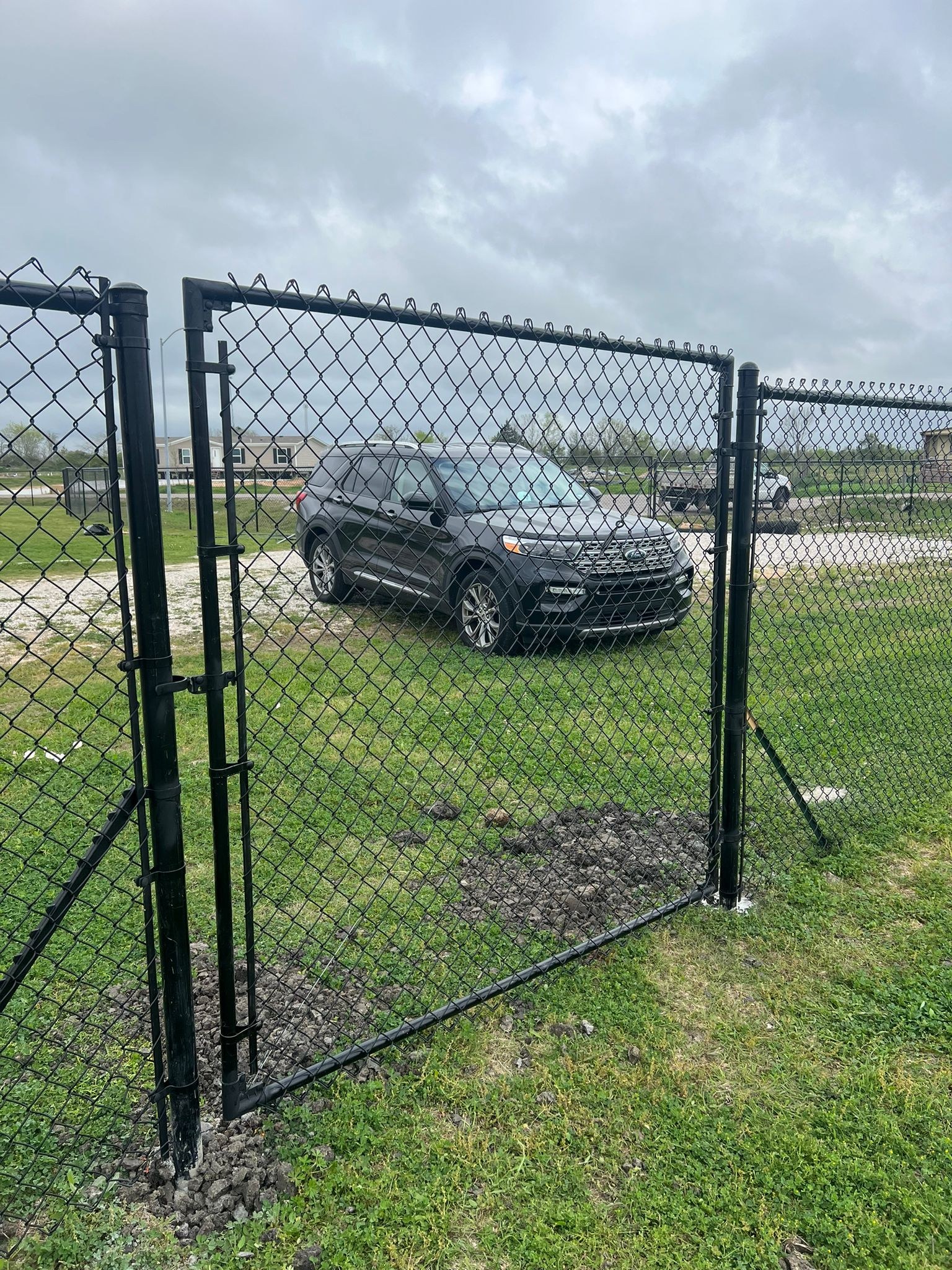
Most chain link escapes come from the bottom edge, not the mesh itself. CLFMI’s own installation spec calls for a tension wire set 4 in. up from the bottom of the fabric (stretched taut and hog-ringed to the fabric every 18 in.), and limits installed fabric to no more than 2 in. of ground clearance. Together those two details close off both squeezing under a loose bottom edge and digging under a gapped one. If a specific dog can still fit through the standard 2 in. diamond mesh itself, the same CLFMI manual lists smaller mesh — down to 3/8 in. — as an available option, with its own reinforced bar attachment.
Source: Chain Link Fence Manufacturers Institute (CLFMI), Guide for Specifying Commercial/Industrial and Security Chain Link Fence and Gates, Section 32 31 13.
Where dogs actually get out
Two mechanisms cover most of it: pushing or squeezing through the fabric where it’s loosest (usually the unsupported bottom edge, if there’s no bottom rail or tension wire holding it taut), and digging under the gap between the fabric and the ground. CLFMI’s installation manual — written for commercial, industrial and security chain link, and used here as the professional-install reference since no dog-specific chain-link standard exists — addresses both with the same two install details: where the tension wire sits, and how close the fabric hangs to grade.
| Spec detail | What CLFMI’s manual specifies | Why it matters for a dog |
|---|---|---|
| Ground clearance | Installed fabric: no more than 2 in. clearance to grade | Closes the digging-under gap without adding a buried footer |
| Tension wire | 4 in. up from the fabric bottom (or 4 in. down from the top with no top rail); stretched taut, hog-ringed to fabric every 18 in. | Stops the bottom edge from flexing outward or inward under a leaning or pushing dog |
| Standard mesh & selvage | 2 in. diamond mesh, knuckle-top/twist-bottom (K&T) selvage at 72 in.+ height | Adequate for most dogs if the bottom edge is properly tensioned and clearance is tight |
| K&K selvage | Knuckled on both top and bottom, specified for fabric under 72 in. tall or wherever called out for safety (CLFMI’s own example: playfields/parks) | No twisted wire ends at nose height — the same safety detail CLFMI specifies for people, applied to a dog’s face |
| Smaller mesh option | 1 in. and smaller mesh available, down to 3/8 in., with its own reinforced bar attachment | A tighter diamond for a small dog or puppy that can fit through standard 2 in. mesh |
Chain Link Fence Manufacturers Institute, Guide for Specifying Commercial/Industrial and Security Chain Link Fence and Gates (32 31 13).

Is standard mesh tight enough?
Enter the narrowest gap (in inches) your dog has pushed a nose or paw through, or clearly could. This checks it against CLFMI’s standard 2 in. diamond mesh and its smaller-mesh options — it doesn’t know your dog’s size, so use your own observation, not a guess.
CLFMI Guide for Specifying Commercial/Industrial and Security Chain Link Fence and Gates (32 31 13): standard mesh is 2 in.; smaller mesh is available down to 3/8 in., with its own reinforced bar attachment. This is a mesh-size reference only — ground clearance and tension-wire placement (see drawing above) matter just as much as mesh size.
What Galveston customers say
5.091 Google reviews · read them all on Google
Mustang Fencing Services provides great quality and craftsmanship. Their workforce is competent and efficient, guaranteeing that every project meets the greatest requirements. The materials utilized are strong, and the attention to detail is excellent. Highly suggest to anyone in need of dependable fencing solutions!
Excellent work and great customer service. They were very professional and did an amazing job.
We took the services to replace our decade-old rotten fence with a modern one. The Services were Professional, completed the job on time, and the fence looked great, giving a new look to our house and they left the yard spotless. Highly recommend!
Reviews shown word for word from the Mustang Fencing Services Google Business Profile (Galveston), captured 2026-10-19.
Questions we get about this
What actually stops a dog from digging under a chain link fence?
How is a chain link fence kept from flexing at the bottom?
Is standard chain link mesh too loose for a small dog?
Does the twisted wire edge at the bottom of chain link hurt pets?
If the fence itself is solid, what else lets a dog out?
Sources
Checked October 25, 2026. Rules change, so confirm with the City before you build.
- Chain Link Fence Manufacturers Institute, Guide for Specifying Commercial/Industrial and Security Chain Link Fence and Gates (32 31 13) — Tension wire height and hog-ring spacing; maximum ground clearance; mesh size range and selvage (K&T vs. K&K) specifications.
- ASTM International, A392-11a(2022), Standard Specification for Zinc-Coated Steel Chain-Link Fence Fabric — Material standard governing mesh size, wire size, fabric height, selvage and zinc coating class for the fabric itself.
Want your fence checked for the gaps that actually matter?
We’ll check tension-wire placement, ground clearance, mesh size and your gate hardware against the spec above. Free estimates across Galveston County.