
Do Double Drive Gates Need a Drop Rod and Center Stop?
A double drive gate has nothing fixed in the middle, so one leaf has to be pinned to the ground before the other can latch to it. Here is what a drop rod and center stop do, what the industry spec requires for them, how automatic gates replace them, and what to check on a quote.
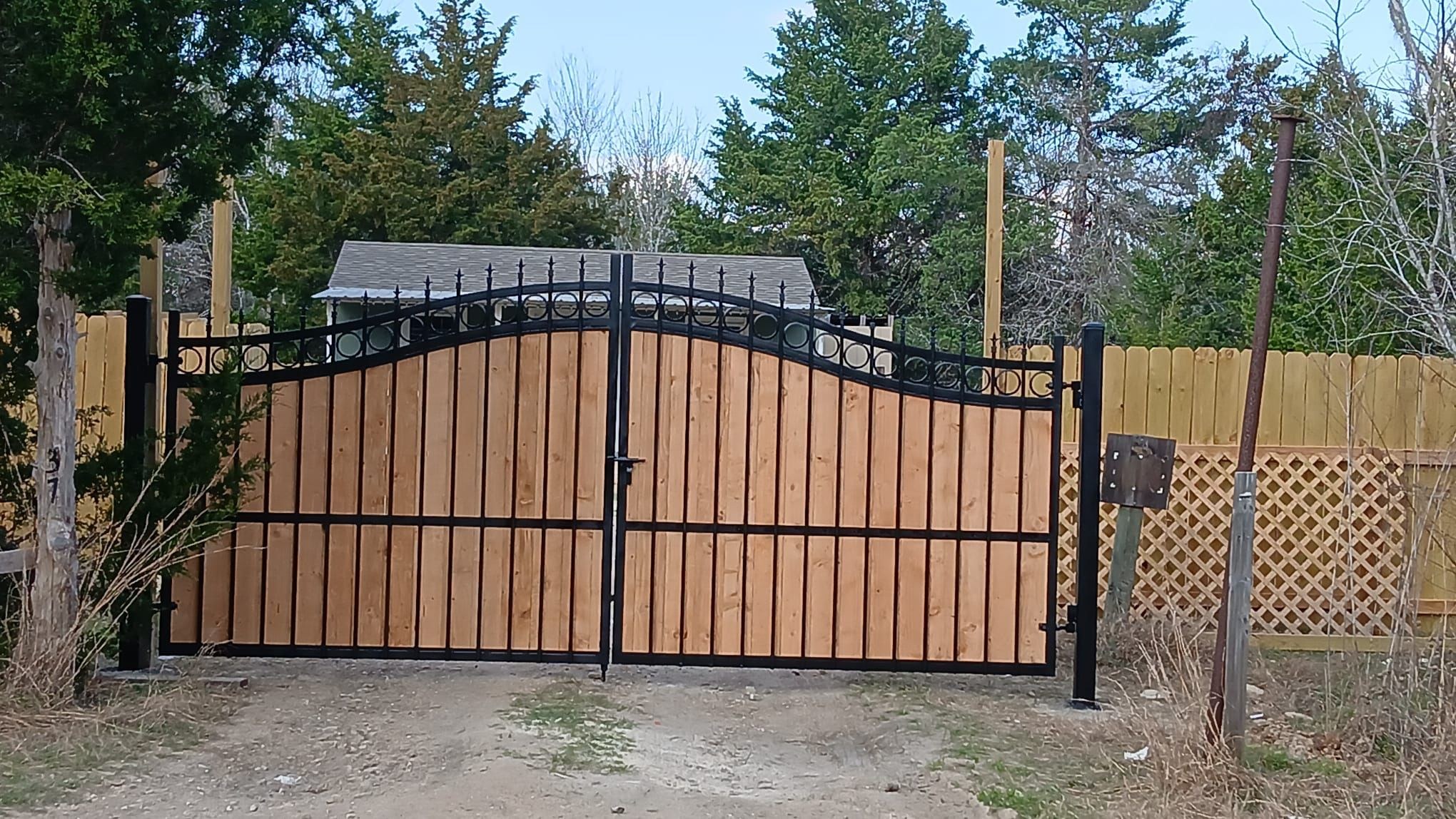
Yes, if the gate is opened by hand. With two leaves meeting in the middle, one leaf (the passive leaf) needs a drop rod that drops into a center stop in the drive. The other leaf then latches to it. The chain link industry’s spec sets that receiver in a concrete footing at least 6 inches across and 24 inches deep, and requires hold-backs to keep both leaves open. On an automatic double gate, the two operators hold the leaves instead, and any manual drop rod has to be up before the gate runs.
Sources: Chain Link Fence Manufacturers Institute, Guide for Specifying Commercial/Industrial Chain Link Fence, Section 32 31 13, §3.5; Jewett-Cameron Adjust-A-Gate installation instructions.
Why a double gate needs something in the middle
A single gate is simple: it hinges on one post and latches to another. Nothing moves on the latch side. A double drive gate has two leaves hung from two hinge posts, and they meet over the middle of the drive, where there is no post. If you latch the leaves only to each other, both can still swing together, and the gate isn’t really shut.
So one leaf gets pinned to the ground. That’s the job of two parts that work as a pair:
- The drop rod is a vertical steel rod mounted in guides on the leaf that stays closed most of the time (the passive leaf). You lift it to open that leaf and drop it to lock it. It’s also sold as a cane bolt, and spec writers call it a drop bar or plunger bar.
- The center stop is what the rod drops into: a receiver set in the drive where the two leaves meet. Without it, the rod has nothing to seat in and the leaf can still move.
Once the passive leaf is pinned, it acts like a post. The active leaf, the one you open every day, latches to it. Open both leaves only when you need the full width, for a trailer, a boat or a delivery truck. For choosing between one wide leaf and two, see single vs double swing gates. For the gate styles themselves, see our double drive gate page.
What the industry spec actually says
The most specific public document on this is the Chain Link Fence Manufacturers Institute’s Guide for Specifying Commercial/Industrial Chain Link Fence (Section 32 31 13). Architects copy it into project specs. For swing gates it says:
- “Double gate drop bar receivers shall be set in a concrete footing minimum 6 in. (152 mm) diameter 24 in. (609.6 mm) deep.” A receiver pushed into loose fill is not what the spec means.
- “Gate leaf holdbacks shall be installed for all double gates.” The spec treats holding the leaves open as part of the job.
- Gates hang plumb when closed, with 3 inches of bottom clearance, grade permitting. The gap from the gate frame to the post at the hinge and latch is no more than 3 inches when closed.
- Latches are positive locking, made of 5/16-inch by 1¾-inch pressed steel, galvanized after fabrication. On vinyl-coated systems, “moveable parts such as hinges, latches and drop rods” may be field coated to match.
- For slide gates, the same guide says “galvanized steel drop bars to be provided with double gates.” Double gates get a drop bar whichever way they move.
That guide is written for chain link. Wood and ornamental gates don’t have an equivalent industry spec, but the physics is the same, and the kit makers agree. Jewett-Cameron’s Adjust-A-Gate instructions, a common frame kit for wood gates, say a double drive gate is two kits hung in reverse. They suggest about 1 inch of space between the leaves and say “drop rod kits are highly recommended” for double drive gates. See wood gates and chain link gates for material choices.
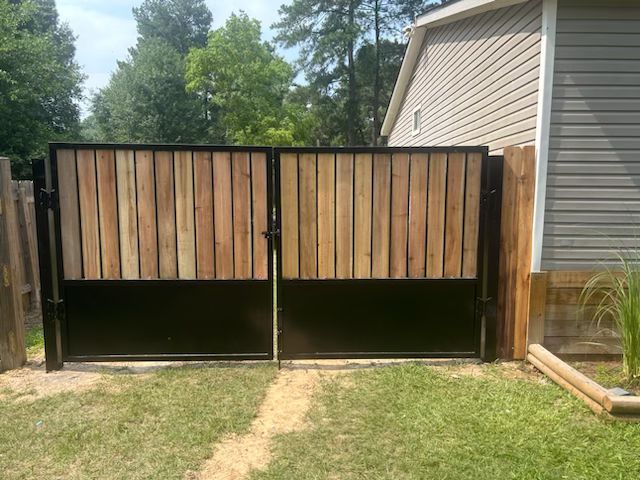
Double drive gate hardware checklist
| Part | What it does | What to look for on the quote |
|---|---|---|
| Drop rod (cane bolt) | Pins the passive leaf to the ground | Named on the quote, and on the passive leaf |
| Center stop (receiver) | Takes the rod when the gate is shut | Set in concrete: CLFMI says a footing at least 6 in across and 24 in deep |
| Center latch | Holds the active leaf to the passive leaf | A positive locking latch (CLFMI); padlockable if you need it |
| Hold-backs | Keep each open leaf from swinging | One per leaf. CLFMI requires them on all double gates |
| Hinges and hinge posts | Carry each leaf’s weight | Post size and footing depth in writing; CLFMI sizes chain link gateposts by leaf width |
| Clearances | Let the leaves swing and meet | Plumb when closed; 3 in bottom clearance, grade permitting; hinge and latch gaps no more than 3 in |
CLFMI Section 32 31 13, §2.9, table 2.9 B and §3.5; Adjust-A-Gate installation instructions.
Setting the center stop in concrete, asphalt, shell or sand
The center stop is where most double gates go wrong over time. The rod only works if the receiver stays exactly where the rod lands. Galveston County drives are a mix of concrete, asphalt, shell, gravel and sand, and each one changes the job:
- New concrete drive. Plan the receiver before the pour, with the gate position and swing marked out. Adding it later means cutting or coring the slab.
- Existing concrete or asphalt. Ask how the receiver will be set and how deep. CLFMI’s spec puts it in its own concrete footing, at least 6 inches across and 24 inches deep. That’s far more than a hole drilled into the surface.
- Shell, gravel and crushed rock. The surface shifts under tires and washes in heavy rain. The concrete footing is what keeps the hole in the same place.
- Sand and dirt. These move and settle more than anything else. The footing matters most here. Also check the 3-inch bottom clearance across the whole swing, not just along the closed line, because a leaf that drags on high ground won’t reach its hold-back.
Whatever the surface, the leaves have to hang true. If a hinge post leans or a leaf sags, the rod stops lining up with the receiver. That’s often the first sign a gate needs attention, and it’s covered in why gates sag and fixing a sagging chain link double gate.
Adding or fixing a double drive gate?
We’ll check the drive surface, the footing and the hold-backs, and put the drop rod, center stop and hardware on a written quote. Free on-site estimates across Galveston County.
Plan the hardware for a double drive gate
Enter the opening and how the gate will be used. The planner works out each leaf’s width and lists the hardware the industry spec and manufacturers call for, so you can check it against a quote. It does not price anything.
Leaf width = (opening − 1 in) ÷ 2, using the 1 in gap suggested in the Adjust-A-Gate instructions; your gate maker may use a different gap. Hardware: CLFMI Guide for Specifying Commercial/Industrial Chain Link Fence, Section 32 31 13 (§2.9, table 2.9 B, §3.5); LiftMaster CSW24UL installation manual; UFC 4-022-03 (U.S. Department of Defense, 2013) for security gates; 2021 IFC §501.3 as adopted by the City of Galveston. The CLFMI post table is written for chain link gates. This is a checklist, not a design.
Hold-backs and posts: the parts people forget
Hold-backs are the other half of the drop rod story. A drop rod holds a leaf shut, and a hold-back holds it open. On the coast that matters. An open gate leaf is a large flat panel on hinges, and a gust can swing it into a car, a person or the other leaf. CLFMI’s spec requires hold-backs on all double gates. If a quote for a double gate doesn’t list them, ask. For planning a fence line around storm season, see hurricane-ready fencing.
Hinge posts carry each leaf’s whole weight at the end of a lever, so they are sized by leaf width, not just fence height. CLFMI’s table for chain link swing gates, shown below, steps the minimum post size up as leaves get wider and taller. Two leaves of 6 feet put far less load on each post than one leaf of 12 feet, which is one reason wide openings are split into double gates. For hardware loads, see how much weight gate hinges can hold.
Minimum chain link swing gatepost size by leaf width
Outside diameter in inches (CLFMI table 2.9 B). The first three bars are gates up to 6 ft high, the rest gates over 6 ft.
Automatic double gates: what replaces the drop rod
On an automatic double swing gate, each leaf gets its own operator, and the operators hold the leaves shut. A drop rod that pins one leaf would stop that leaf’s operator, so it isn’t part of normal automatic operation. The LiftMaster CSW24UL manual, for a common residential swing operator, spells out what a dual gate needs instead:
- Power to both operators. “For dual gate applications, power will have to be connected to each operator.” The two operators talk over a wired or a wireless link, not both at once.
- Electric locks, if you want one. A mag lock or solenoid lock at the center, or a decorative overlay where one leaf laps the other, means one leaf has to close first. The operator’s bipart delay setting handles that.
- Manual release on both sides. In an outage, “the handle must be released on both operators” before the leaves can be moved by hand. If you keep a manual drop rod as a backup for that situation, lift it before the gate runs under power again.
- Swing direction. The same manual says “swinging gates shall not open into public access areas.” An automatic double gate at the street line swings in.
An automatic gate also has to meet UL 325 (the operator) and ASTM F2200 (the gate itself), as CLFMI’s spec notes. What those require is covered in UL 325 and ASTM F2200 explained. For operators and entry systems, see electric gates and gate automation and access control.
When you don’t need a drop rod
A drop rod is only needed where a leaf has nothing fixed to latch to. You can skip it in three cases:
- A single gate, even a wide one, that latches to its own post. Wide single leaves often get a support wheel at the latch end to carry the weight.
- A walk gate that latches to a post or a fixed fence section.
- A slide gate, which closes against a post. A double slide gate is different: CLFMI calls for drop bars there too.
For a manual double gate, plan for at least one drop rod. A second rod on the active leaf lets either leaf be pinned on its own. That is an option to ask about, not a requirement in the documents cited here. For a walk-through opening next to a drive gate, see walk gate widths.
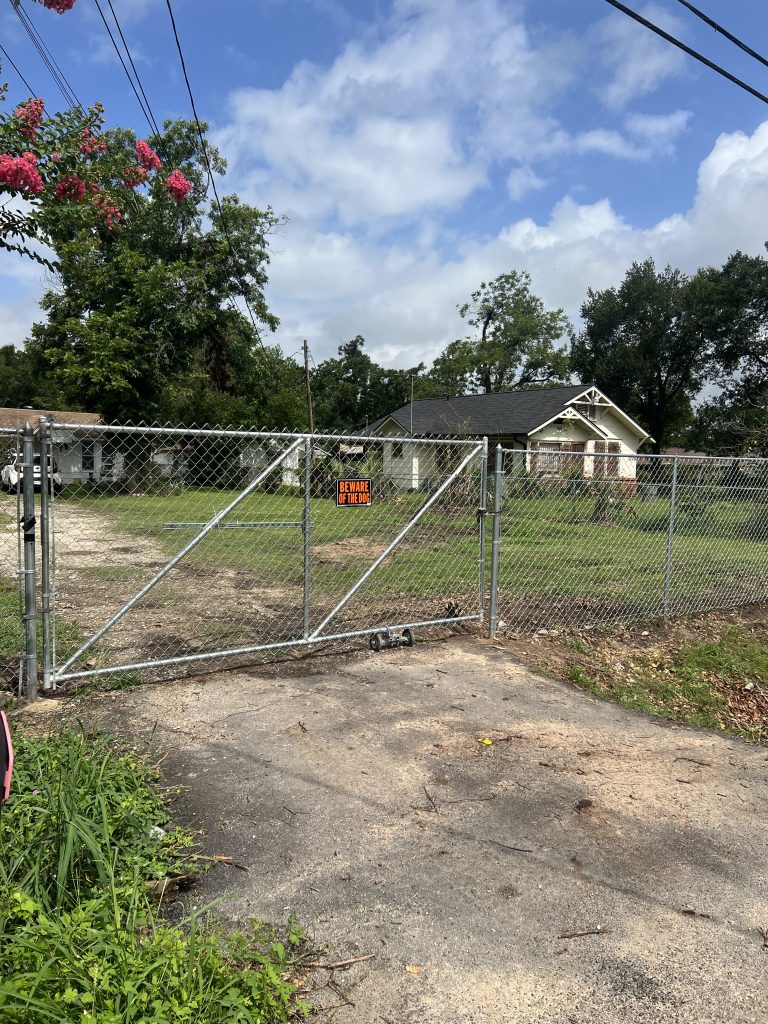
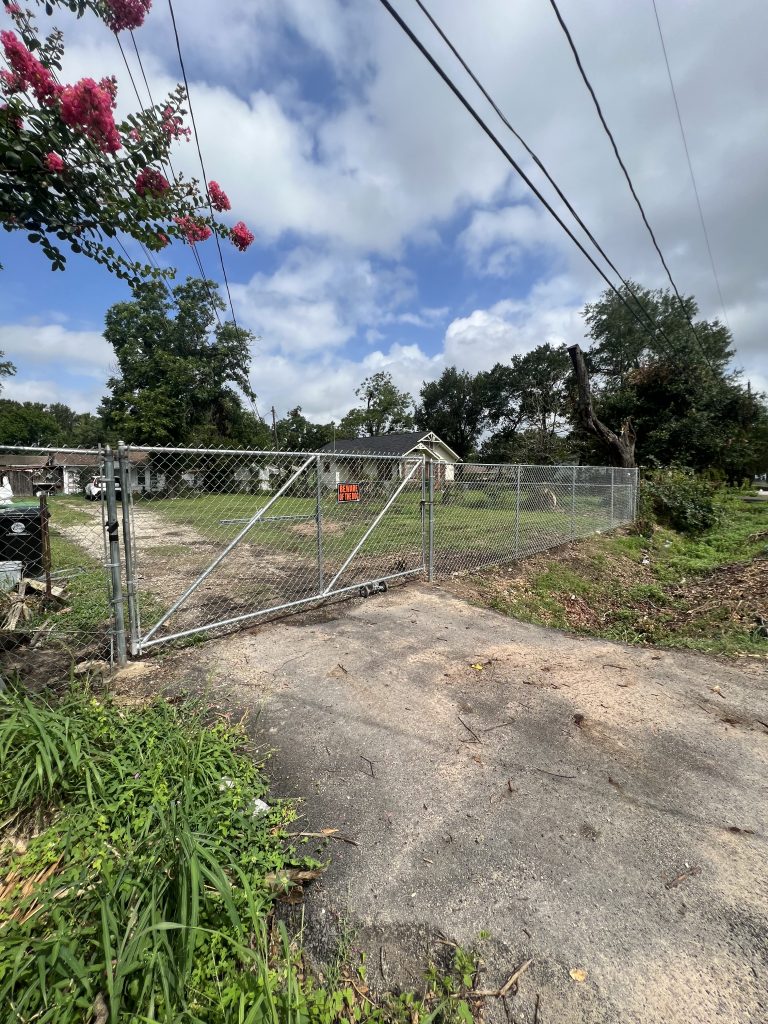
Adding a drop rod to an existing double gate
If a double gate has only a center latch, it can usually be fixed without replacing it. Before adding a drop rod, check three things:
- The leaves hang true. Close the gate and look at the meeting edges. If one leaf sits lower or the edges aren’t parallel, fix the sag first, or the rod won’t line up with its receiver for long.
- There is room for a receiver footing. Where the rod lands, there needs to be room for a concrete footing (CLFMI: at least 6 inches across and 24 inches deep). Check for a drain, a utility line or a slab joint at that spot.
- The rod suits the gate. A light wood gate and a heavy steel gate need different rod sizes and guides. On a vinyl-coated chain link gate, the hardware should be coated to match.
Also check the hold-backs. If the gate never had them, add them at the same time. They are required for double gates in the same spec that sets out the receiver footing.
What Galveston customers say
5.091 Google reviews · read them all on Google
Very professional and friendly. Gotten automatic gates done and they are done to perfection! Thank you
Absolutely loved my fence once i saw the finished product. No hassle, no rude interactions, and no inconveniences everything was just perfect. One of the best fencing companies in Texas
We just installed iron gate and it looks amazing thank you very much mustang fencing .
Reviews shown word for word from the Mustang Fencing Services Google Business Profile (Galveston), captured 2026-10-05.
Questions we get about this
Do double drive gates need a drop rod?
What is a center stop on a double gate?
How deep should a drop rod receiver be set?
Do automatic double gates need a drop rod?
How much gap should there be between double gates?
Can I add a drop rod to my existing double gate?
Should double drive gates swing in or out?
Sources
Checked September 27, 2026. Rules change, so confirm with the City before you build.
- Chain Link Fence Manufacturers Institute, Guide for Specifying Commercial/Industrial Chain Link Fence, Section 32 31 13 — §3.5 gate installation (drop bar receivers in a concrete footing at least 6 in diameter and 24 in deep; hold-backs on all double gates; plumb; 3 in bottom clearance; 3 in hinge and latch gaps); §2.9 swing gates and table 2.9 B gatepost sizes; §2.10 drop bars with double slide gates; UL 325 and ASTM F2200 for electric gates.
- Jewett-Cameron, Adjust-A-Gate installation instructions (AG36/AG60) — Double drive gates use two kits in reverse; suggested 1 inch between leaves; drop rod kits highly recommended for double drive gates; frame designed to open inward.
- LiftMaster CSW24UL swing gate operator, installation manual — Dual gate power to each operator; wired or wireless dual gate link; bipart delay for mag locks, solenoid locks and overlays; manual release on both operators; swinging gates shall not open into public access areas.
- UFC 4-022-03, Security Fences and Gates (U.S. Department of Defense, 2013 edition) — Double swing vehicular gates swing inward with a 2 in maximum bottom gap; swing gate posts on concrete foundations at least 3 ft deep. Written for military sites; shown for scale.
- 2021 International Fire Code, Chapter 5, §501.3 — Security gates across fire apparatus access roads need fire department review and approval before construction.
- City of Galveston City Council minutes, January 26, 2023 — Adoption of the 2021 International Fire Code (Ord. 23-013).
Planning a double drive gate?
We’ll measure the opening, look at the drive surface and the swing, and put the drop rod, center stop, hold-backs and posts on a written quote. Free on-site estimates across Galveston County.