
Do Driveway Gates Need to Be Wind-Rated on Galveston Island?
A driveway gate panel is a lot like a sail bolted to a post. Here’s how much wind force a typical gate panel actually carries at Galveston’s own design wind speed, using the chain-link industry’s own wind-load guide and Texas Dept. of Insurance windstorm zone data — plus a free force estimator for your gate’s size.
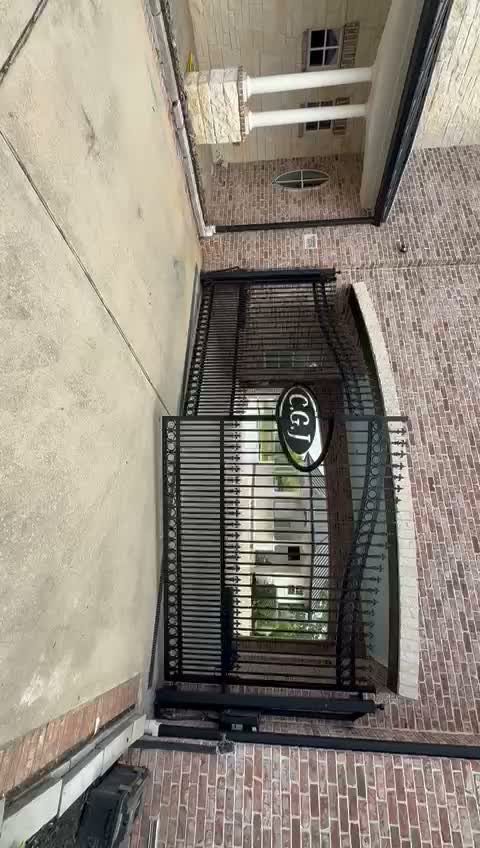
Yes — a driveway gate panel carries real, calculable wind force, and Galveston’s own design wind speed is the highest in the service area. Using the chain-link industry’s own wind-load guide and its Table 13 design wind pressure, a typical 16-foot double gate (two 8×6 ft leaves) carries roughly 2,223 lbs of total wind force at Galveston’s 130 mph design speed, versus about 1,895 lbs at 120 mph (most of the surrounding towns) and 1,592 lbs at 110 mph (Friendswood). Panel style changes that number a lot — an open mesh-style panel carries far less load than a solid one. Numbers below, sourced to the guide’s own tables, not marketing copy.
Sources: CLFMI Wind Load Guide WLG 2445 (Jan. 2018), spsfence.com; TDI windstorm zone pages, tdi.texas.gov. Both checked again Oct. 22, 2026.
How much wind force a driveway gate panel actually carries
A driveway gate panel is, structurally, a large flat surface bolted to a hinge post on one side and latched to a post (or a drop rod) on the other. The chain-link industry’s own wind-load engineering guide (CLFMI WLG 2445) gives a formula for exactly this kind of load: Applied Force = Net Area × Design Wind Pressure ÷ Cf1, where Cf1 is 1.0 for a solid panel and higher for an open mesh pattern. Plug in a common double driveway gate — two 8-foot leaves, 6 feet tall, 48 square feet each — and Galveston’s own 130 mph design wind pressure (23.16 psf at 0-15 ft, Exposure B, from the guide’s Table 13), and each leaf alone carries about 1,112 lbs of wind force. Both leaves together, the whole 16-foot opening carries roughly 2,223 lbs.
Galveston itself carries the highest design wind speed in the service area
Wind force scales with the square of wind speed, so the zone matters. TDI’s windstorm program maps Galveston itself in the Seaward zone at 130 mph; League City, Texas City, Kemah, Dickinson, Santa Fe, Hitchcock, La Marque, Bacliff, San Leon, Bayou Vista and Clear Lake Shores sit one zone lower in Inland I at 120 mph; and Friendswood is Inland II at 110 mph. These are legacy TDI windstorm-zone figures (2006 IBC/IRC with Texas Revisions) — the City of Galveston’s own adopted building-code text doesn’t publish a standalone design wind speed figure, so this is the available sourced number, not a direct city building-code citation.
Wind force on a 16 ft double gate, by TDI zone
Both leaves combined (96 sf), solid infill, using CLFMI’s own Table 13 design wind pressures.

Panel style changes the wind load a lot
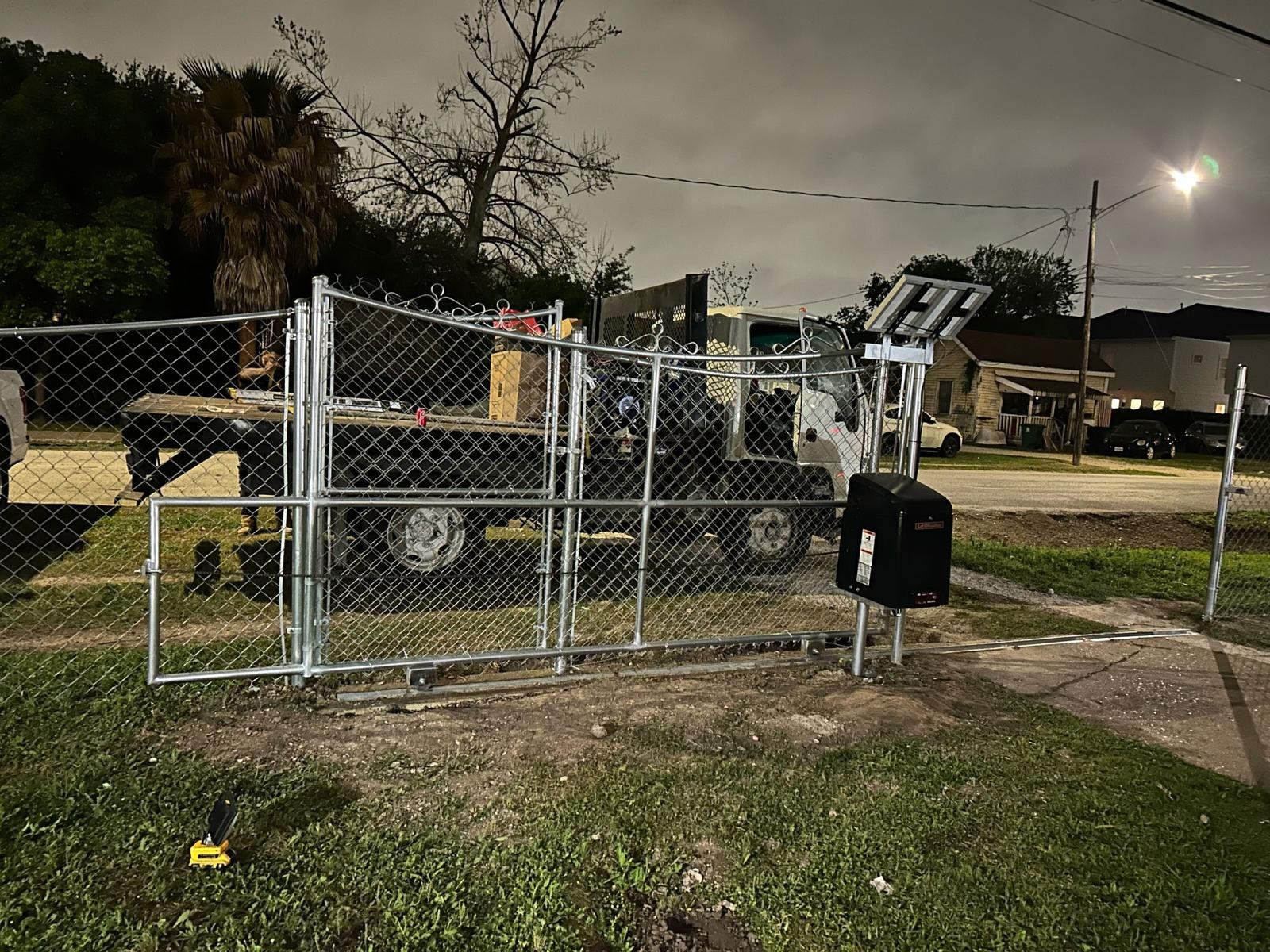
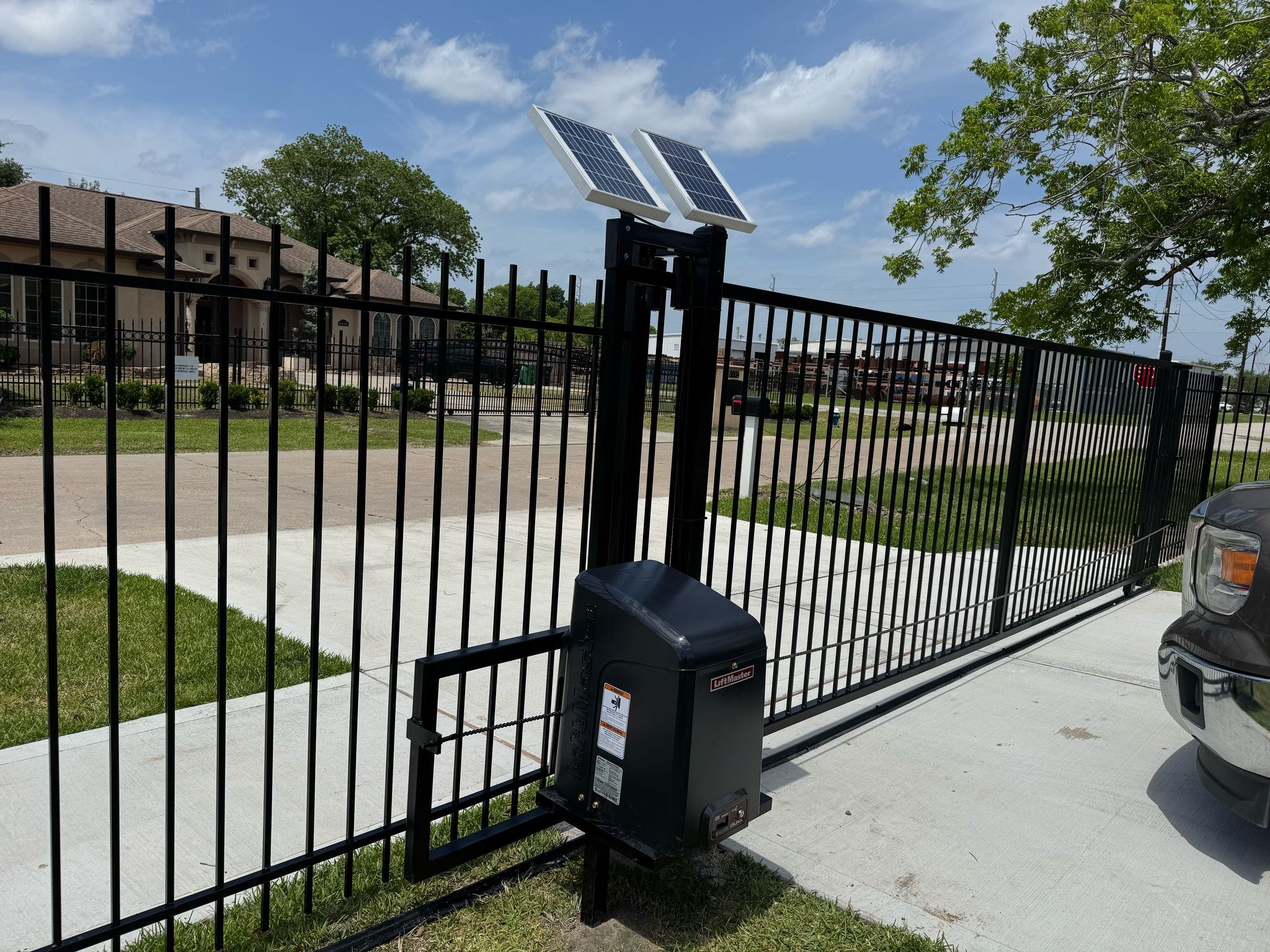
CLFMI’s own Table 9 gives a “Cf1” coefficient for different fabric and panel styles, and the spread is dramatic: a solid panel is the baseline (Cf1 = 1.0, the full load), an 11-gauge, ½-inch mesh chain-link-style pattern carries about 2.2 times less load (Cf1 = 2.2), and a #9-gauge, 1¾-inch mesh very-open pattern carries about 6.4 times less (Cf1 = 6.4). Applied to the same 16-foot, two-leaf gate at Galveston’s 130 mph design speed:
Wind force on the same 16 ft gate, by panel style (Galveston, 130 mph)
| Panel style | CLFMI’s Cf1 | Force, whole gate (96 sf) | Force, one leaf (48 sf) |
|---|---|---|---|
| Solid infill | 1.0 | 2,223 lbs | 1,112 lbs |
| 11-ga, ½″ mesh (chain-link style) | 2.2 | 1,011 lbs | 506 lbs |
| #9-ga, 1¾″ mesh (very open style) | 6.4 | 347 lbs | 174 lbs |
CLFMI WLG 2445 Table 9 (Cf1) and Table 13 (design wind pressure), Applied Force formula. Illustrative figures for a 16 ft, 6 ft tall double gate at Galveston’s 130 mph design speed — not a substitute for a site-specific engineered calc.
What this means for hardware, posts and the footing
A bigger number at the hinge changes what the gate needs, not just how it looks. Heavier hinges, a stiffer frame and — per CLFMI’s own footing math above — a deeper post footing all follow from a higher applied force; the same logic the guide uses for a fence line post applies to a gate post carrying a similar load. Automation adds another variable: an operator sized for a calm day can stall or strain against a gust that a larger motor and a properly tensioned chain or arm would handle without issue. Ask whatever installer you use for the post size, footing depth and hardware rating they’re specifying for your gate’s size and wind exposure, not just for the panel style. See our cantilever vs. slide gate and automatic gate installation pages for more.
Driveway gate wind-force estimator
Enter a gate leaf’s size and pick a wind zone and panel style to see roughly how much force it carries. This isn’t an engineered spec — a real design needs your site’s exposure and a professional’s review.
Force = leaf width × leaf height × design wind pressure (CLFMI WLG 2445 Table 13, Exposure B, 0-15 ft) ÷ Cf1 (Table 9). General guidance only — ask your installer for a site-specific check.
Planning a driveway gate in Galveston County?
We’ll measure your opening, talk through panel style and hardware for your site’s wind exposure, and quote on site — free.
What Galveston customers say
5.091 Google reviews · read them all on Google
True professionalism is very rare in this day and age, these guys live upto their word and deliver on their service! Our fence was down in the July storm and these guys came and gave a reasonable quote, after confirming I received a time line and they delivered! Will recommend them to everyone I know who needs fencing done.
Excellent work. They came in handy after the hurricane hit our backyard. Friendly people too.
Very professional and friendly. Gotten automatic gates done and they are done to perfection! Thank you
Reviews shown word for word from the Mustang Fencing Services Google Business Profile (Galveston), captured 2026-10-19.
Questions we get about this
How much wind force does a driveway gate actually carry in Galveston?
Does a solid gate panel really carry more wind load than an open one?
How deep does a driveway gate post footing need to be?
Do cantilever slide gates handle wind better than swing gates?
Is Galveston’s design wind speed the same as nearby towns?
Should I do anything with my driveway gate before a hurricane?
Sources
Checked October 22, 2026. Rules change, so confirm with the City before you build.
- CLFMI Wind Load Guide (WLG 2445), Jan. 2018 — Table 13 design wind pressures, Table 9 Cf1 mesh/fabric coefficients, the Applied Force formula, and the ASTM F567 footing-depth rule quoted in the guide’s own text.
- Texas Department of Insurance, Galveston County windstorm zone map — Legacy 2006 IBC/IRC-with-Texas-Revisions design wind speeds by zone and named community.
Want a gate built for the wind it will actually face?
We’ll look at your opening size, exposure and panel-style preference, and recommend hardware and a footing that match the load — no invented numbers, just a real on-site estimate.