
What Fencing Requirements Apply to an Apartment Complex Perimeter?
An apartment complex’s fence answers to more than one rule at once: the City’s zoning height limit for a multifamily property, a separate material rule for shared and service areas, and — if there’s a pool — a Texas state law written specifically for a ‘multiunit rental complex.’ Below: what each one actually requires, where they overlap, and a self-check for the pool fence.
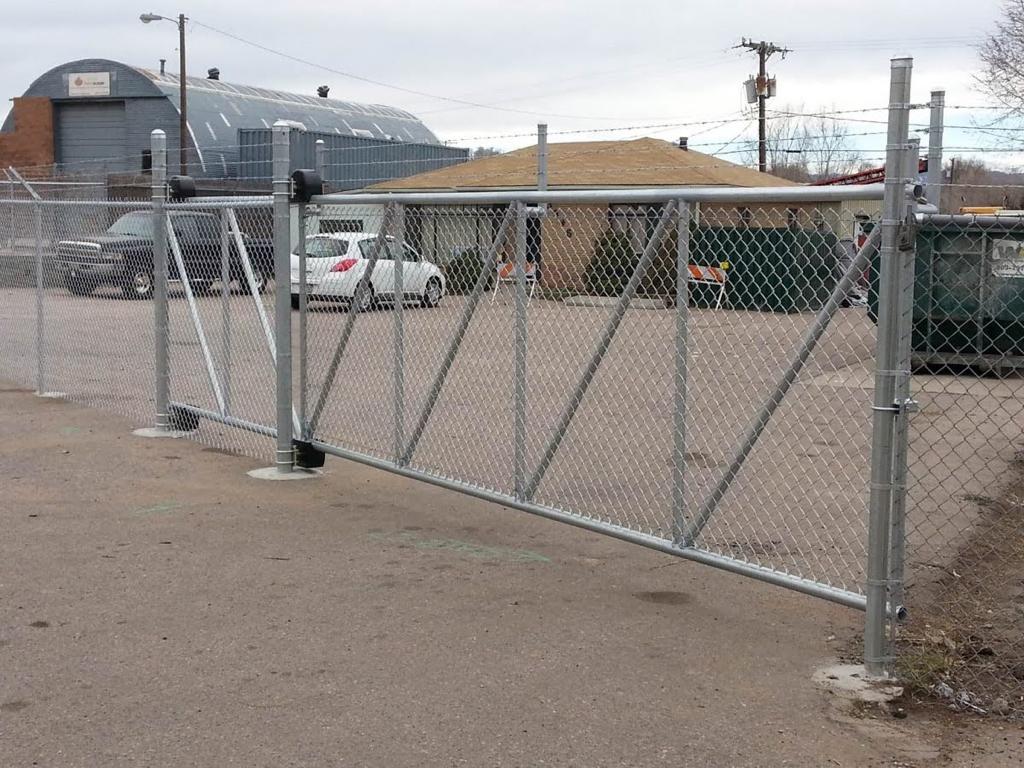
An apartment complex’s fence is governed by more rules at once than a single-family house’s is. The City of Galveston’s Land Development Regulations give “multifamily” its own category inside the residential fence rules (§2.501) — a different front-yard transparency allowance than a house gets — and treat shared or service areas like a clubhouse, leasing office, or dumpster corral as a separate “nonresidential use” with its own material rules (§2.601). If the property has a pool, Texas law adds a third layer: Chapter 757 of the Health and Safety Code sets a pool yard enclosure standard that applies specifically to a “multiunit rental complex” — the statute’s own term for an apartment community — separate from and in addition to the City’s zoning height rule and its own pool-permit requirements. A design that nails the perimeter height can still fail the pool-fence rule, or the reverse. Mustang Fencing Services installs chain link perimeter fencing for commercial and multifamily properties across Galveston County, specified to the use each part of the property actually has.
Sources: City of Galveston Land Development Regulations §2.501(B) and §2.601; Texas Health and Safety Code §757.003 and §757.009.
Why an apartment complex isn’t coded like a house
Galveston’s Land Development Regulations split fence rules into two divisions, and an apartment complex usually has fence on both sides of the line. Division 2.500, §2.501 covers residential uses — including multifamily — and sets:
- 8 feet for any residential use, including multifamily, on side and rear lot lines, unless a narrower front-yard rule applies.
- 4 feet solid, or 5 feet if at least 60% transparent, in the front yard of an ordinary residential use.
- 4 feet solid, or 6 feet if at least 60% transparent, in the front yard of a single-family-attached dwelling or multifamily use specifically — one foot more transparent-fence allowance than a house gets.
- 12 feet for a tennis court fence.
Division 2.600, §2.601 covers nonresidential and mixed-use fences — which, on an apartment property, means the clubhouse, leasing office, dumpster corral, or parking-lot screening, even though the rest of the property is residential. That section caps height at 8 feet and requires “durable, high-quality materials used for commercial application,” while banning several materials outright when the fence is visible from a public street: scrap lumber, plywood, sheet metal, plastic or fiberglass sheets, barbed or razor wire, welded wire or chicken wire, and glass, spikes, nails or other sharp points on top. Barbed or razor wire is allowed only on fences enclosing public utility buildings, protective care facilities, correctional facilities, industrial properties, or agricultural uses — categories a typical apartment community doesn’t fall into.
The pool fence law written specifically for an apartment complex
If the property has a pool, a third rule layer applies on top of the City’s zoning height limit: Texas Health and Safety Code Chapter 757, Pool Yard Enclosures. The statute defines a “multiunit rental complex” as two or more dwelling units in one or more buildings, under common ownership or management, on the same or adjacent lots — in plain terms, an apartment or condo community. Chapter 757 applies to any pool owned, controlled, or maintained by that owner, and to the doors and windows of rental dwellings that open into the pool yard.
The enclosure must completely surround the pool yard, be at least 48 inches tall measured on the side away from the pool, and have no gap that lets a 4-inch sphere pass under or through it (tightening to 1¾ inches if the fence has horizontal rails spaced less than 45 inches apart). Chain link fencing is prohibited entirely for a new pool yard enclosure built after January 1, 1994 — a real constraint for a property type where chain link is otherwise a common, code-compliant perimeter material under §2.601. Every gate must have a self-closing, self-latching device, open outward away from the pool, and have hardware that can be locked; the latch is generally set at least 60 inches high, with a lower allowance only under specific conditions. None of this is a one-time design question: the owner must inspect the enclosure, every gate, and every self-latching device no less than once every 31 days, and that duty cannot be waived by a lease or any other agreement.
The City of Galveston’s own swimming pool permit adds a fourth and fifth layer on top of the state law: it requires new pools to comply with the 2021 International Swimming Pool and Spa Code (ISPSC), and it states plainly that “a separate fence permit is required for new fencing” — the pool fence doesn’t ride along on the main perimeter fence permit.
Three rule sets, three different things they cover
| What it covers | Who sets it | Key number | Source |
|---|---|---|---|
| Perimeter / property-line fence | City of Galveston zoning | 8 ft general cap; 4 ft solid or 6 ft @ 60%+ open in the front yard for multifamily | LDR §2.501(B) |
| Shared & service-area fencing (clubhouse, dumpster corral, parking) | City of Galveston zoning | 8 ft max; commercial-grade materials; barbed/razor wire banned (narrow exceptions) | LDR §2.601 |
| Pool yard enclosure (if there is a pool) | Texas state law + City permit | 48 in min height; no new chain link; self-closing/self-latching gate; 31-day inspections | TX HSC Ch.757; 2021 ISPSC §305 |
| Dumpster/trash enclosure screening | City of Galveston | Must be screened; not visible from a public right-of-way | LDR Art.10 Service Elements; City Code Ch.15 §15-4 |
Meeting one rule set does not satisfy the others — each is enforced separately. Confirm current requirements with the City of Galveston Development Services Department before finalizing a design. See our dedicated breakdown of the dumpster-enclosure rule, linked below.
Pool yard enclosure self-check (Texas HSC Ch. 757 baseline)
Check what’s already true about an on-site pool enclosure. This tallies it against the Texas state-law baseline for a multiunit rental complex pool — a starting checklist, not a substitute for the City’s permit review or a licensed contractor’s inspection.
Checklist items are drawn from Texas Health & Safety Code §757.003 and §757.004, the state baseline for a pool owned or controlled by a multiunit rental complex owner. Does not inspect any property — it only tallies what you tell it. The §757.009 31-day inspection duty is an ongoing routine, not a one-time design question this checklist can answer.

What Galveston customers say
5.091 Google reviews · read them all on Google
chainlink fence installation by mustang fencing, looks really great, thanks.
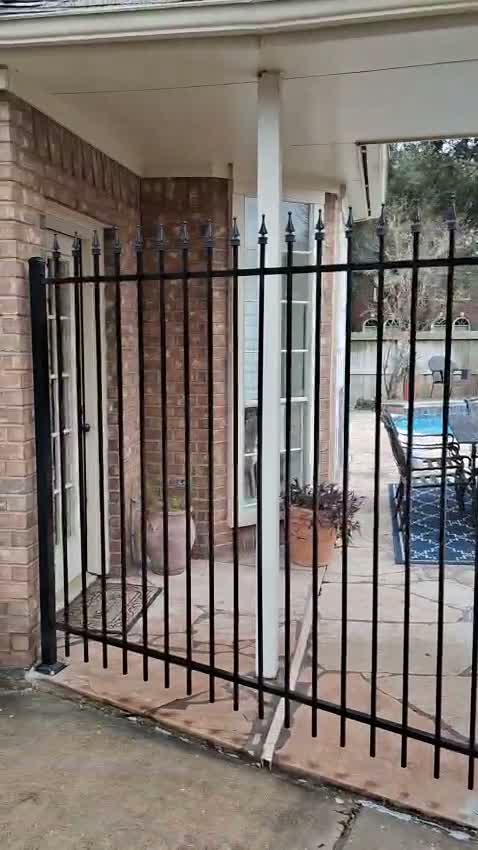
We just installed iron gate and it looks amazing thank you very much mustang fencing .
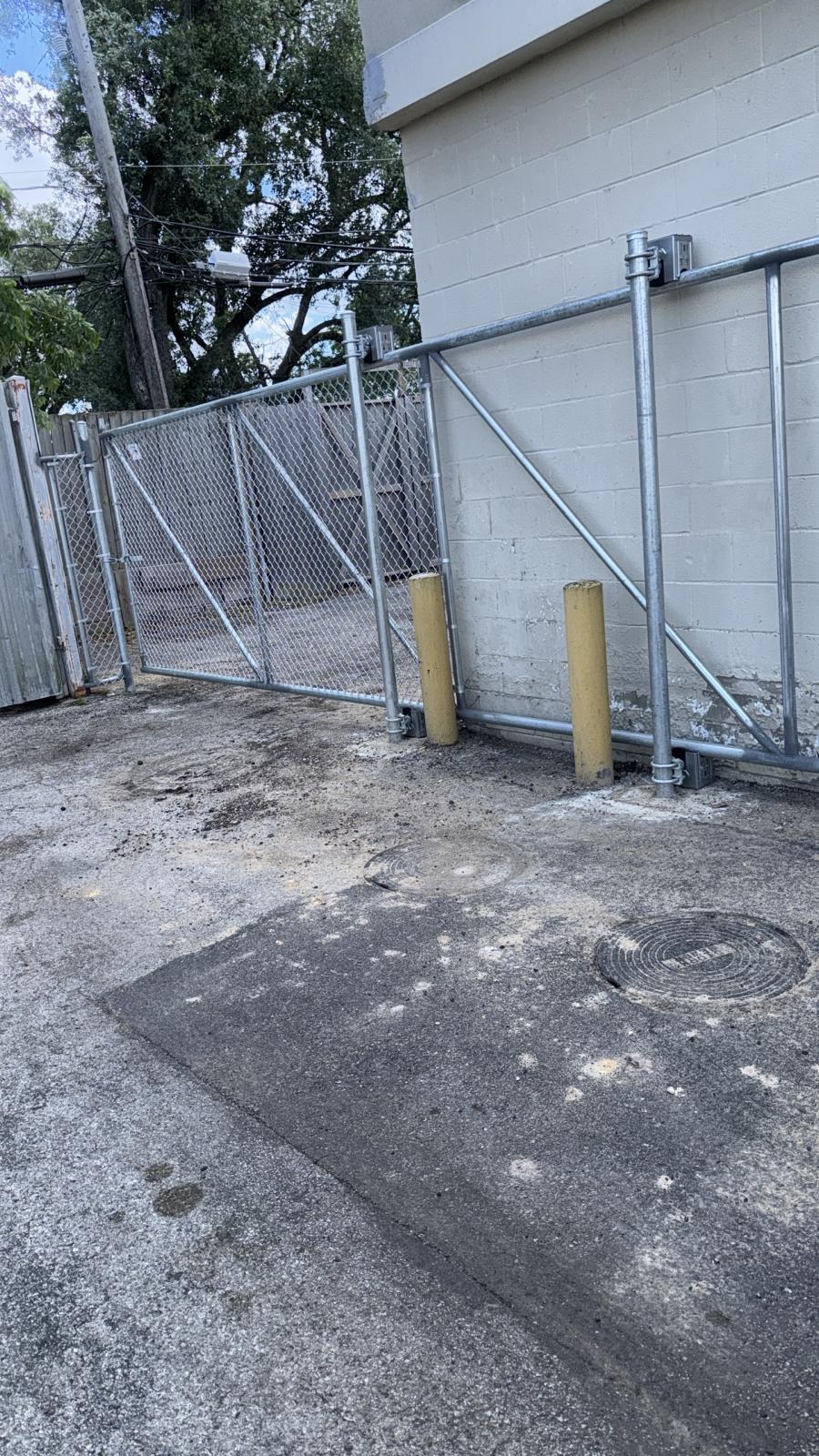
Very professional and friendly. Gotten automatic gates done and they are done to perfection! Thank you
Reviews shown word for word from the Mustang Fencing Services Google Business Profile (Galveston), captured 2026-10-12.
Questions we get about this
Is an apartment complex’s perimeter fence held to the same height limit as a house’s?
Can an apartment complex’s perimeter fence be chain link?
Does a pool at the complex need its own separate fence?
Can that pool fence be chain link?
How often must the owner inspect the pool fence and gates?
Does the dumpster or trash enclosure need to be screened too?
Sources
Checked October 14, 2026. Rules change, so confirm with the City before you build.
- City of Galveston Land Development Regulations (2015, as amended) — Sec. 2.501 (residential, incl. multifamily, fence heights) and Sec. 2.601 (nonresidential/mixed-use fence heights and materials); Art.10 Service Elements and refuse-screening provisions.
- City of Galveston Fence Permit Application (Rev. 03/2023) — Residential vs. commercial distinction (survey required for commercial), barbed/razor-wire disclosure question, historic-district and coastal triggers.
- City of Galveston Swimming Pool Permit Application (Rev. 04/2024) — New pools must comply with the 2021 ISPSC; a separate fence permit is required for new pool fencing.
- Texas Health and Safety Code, Chapter 757 — Pool Yard Enclosures — Defines “multiunit rental complex”; sets the pool yard enclosure, gate, and 31-day inspection requirements that apply to that property type.
- 2021 International Swimming Pool and Spa Code, Section 305 (ICC) — Model-code barrier height, clearance, opening and gate detail that the City’s own pool permit adopts.
Planning or replacing perimeter fencing at an apartment or condo property?
We’ll walk the property, separate the perimeter, shared-area, and pool-fence requirements above, and spec materials and gates that pass each one — in writing, before any work starts. Free on-site estimates across Galveston County.