
How Much Gap Should Be Under a Gate?
It depends on what the gate is for. An ordinary yard gate just has to clear the ground everywhere it swings. A pool gate and a security gate have hard maximums, and an automatic gate adds sensor rules. Here are the actual numbers from the codes, standards and makers’ instructions, and where to measure them.
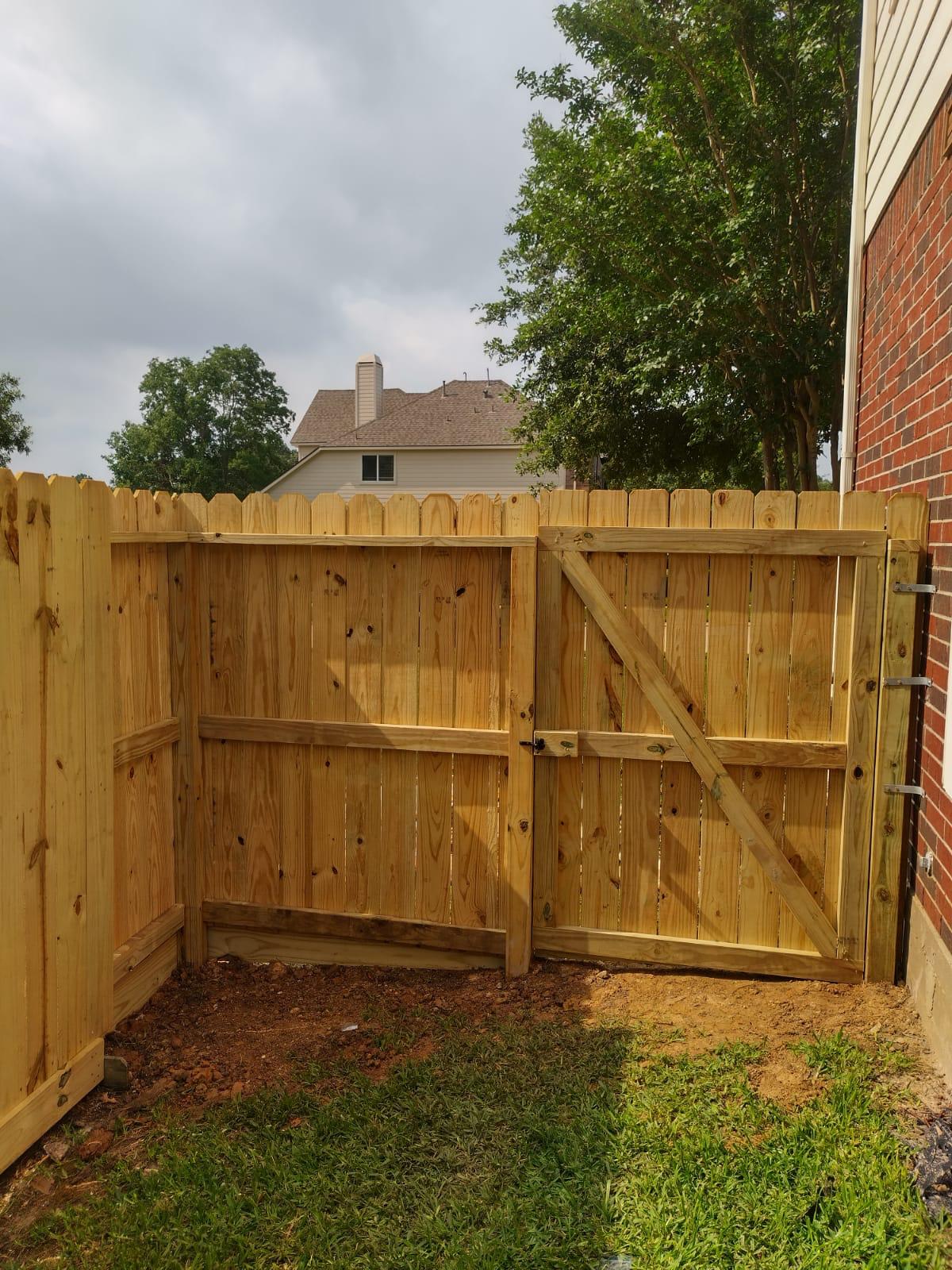
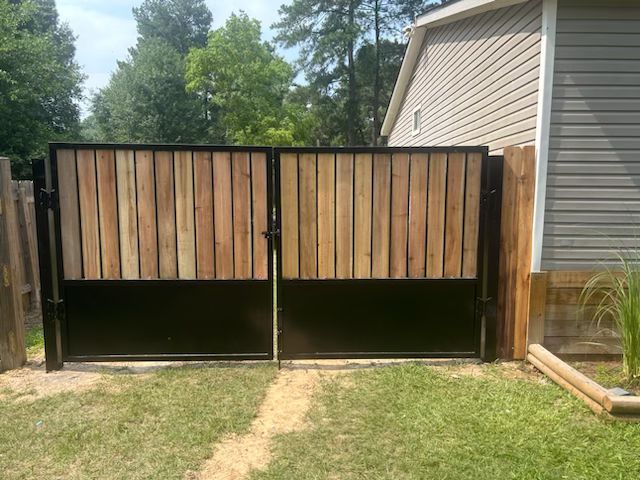
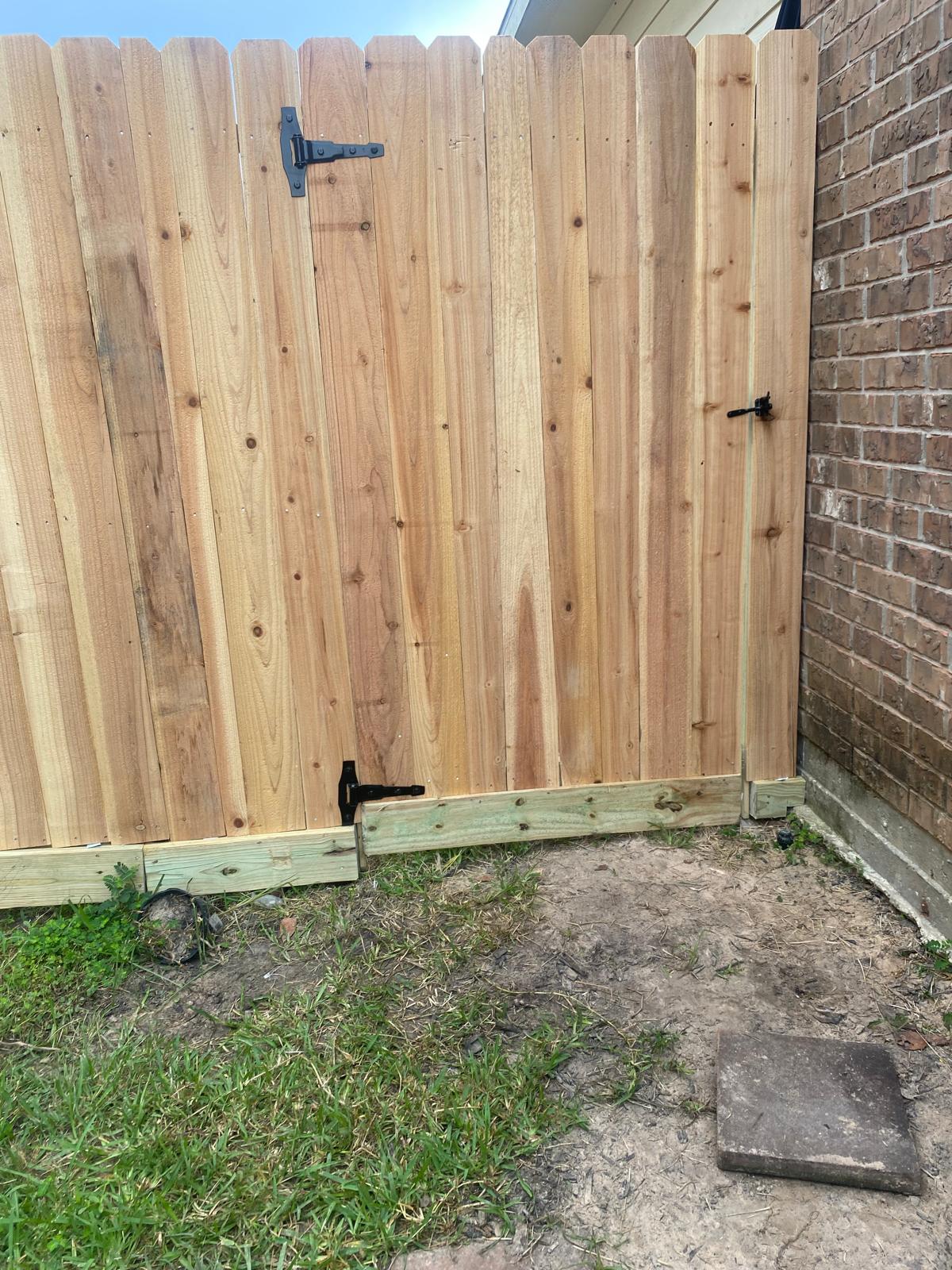
For most gates the target is about 2 to 3 inches, measured at the highest ground the gate passes over. The chain link industry’s guide specification calls for 3 in under swing and slide gates, “grade permitting”, and one gate-kit maker cuts gate boards 2 in shorter than the fence boards for clearance. Two kinds of gate have hard caps. A pool barrier gate in Galveston must leave no more than 2 in over grass or gravel and 4 in over concrete, measured on the outside (2021 ISPSC, which the City’s pool permit requires). A security vehicle gate built to Defense Department criteria leaves no more than 2 in to the road. On an automatic swing gate, a bottom gap of more than 4 in and less than 16 in anywhere in its swing means it needs a bottom-edge sensor.
Sources: Chain Link Fence Manufacturers Institute guide specification 32 31 13; 2021 International Swimming Pool and Spa Code Section 305 and the City of Galveston pool permit application; Texas Health and Safety Code 757.003; UFC 4-022-03; LiftMaster CSW24UL and CSL24UL manuals. Read September 27, 2026.
Why there isn’t one number
The gap under a gate does two jobs that pull in opposite directions. It has to be big enough for the gate to swing or slide without touching the ground anywhere in its travel. It also has to be small enough for the gate to do its job: keep a child out of a pool yard, keep a dog in, or stop someone sliding under a security gate.
For an ordinary yard gate, no code sets the number, so the installer works to the makers’ guidance and the ground. For a pool barrier the code sets a maximum. For an automatic gate the operator’s safety standard adds rules about dragging and sensors. The table below puts the numbers side by side; the sections after it explain each one.
Two things apply to all of them:
- Measure at the highest ground the gate passes over, not just under the closed gate. A crown, a step in the slab or a lump of soil in the swing is where a gate drags. On a rising drive that can take many inches; see swing gates on sloped driveways.
- The ground under a gate changes. New soil settles, mulch and shell get topped up, a slab gets poured. The gap set on install day is the gap on flat, finished ground, so finish the surface under the gate first, or plan for it.
Gap numbers by gate type
| Gate | Bottom gap | Side gaps | Source |
|---|---|---|---|
| Chain link swing or slide gate | 3 in, grade permitting | Hinge and latch offset 3 in max. | CLFMI 32 31 13 §3.5 |
| Wood gate from a kit frame | Boards cut 2 in shorter than the fence boards | — | Adjust-A-Gate instructions |
| Vinyl gate | Set on blocks while the post concrete cures (72 hours) | About 1½ in at the gate post; about 1 in at the end post or between leaves | Bufftech install guide |
| Composite gate (Trex Seclusions) | — | At least 1 in between gate panel and gate post | Trex gate guide |
| Pool barrier gate | 2 in max over grass or gravel; 4 in max over concrete, measured outside | No opening that passes a 4 in sphere | 2021 ISPSC 305.2 (City of Galveston pool permit) |
| Apartment or HOA pool enclosure | No opening under it that passes a 4 in sphere | Same sphere rules for openings | Tex. HSC 757.003 |
| Security vehicle gate (double swing) | 2 in max to the road surface, closed | As tight as the fence | UFC 4-022-03 |
| Automatic swing gate | Must not drag; bottom-edge sensor if 4–16 in anywhere in its arc | Covered objects 4 in max; others 16 in away | LiftMaster CSW24UL (UL 325, ASTM F2200) |
| Automatic slide gate | Clears its whole run; smooth bottom, protrusions ½ in max | 2¼ in max to the nearest fixed object | LiftMaster CSL24UL (ASTM F2200); DuraGates |
Ordinary yard and side gates
For a wood, vinyl or metal gate that isn’t part of a pool barrier, no code sets a bottom gap. The numbers come from the makers and the chain link specification:
- Chain link: the Chain Link Fence Manufacturers Institute’s guide specification has swing gates hung “plumb in the closed position having a bottom clearance of 3 in. (76 mm) grade permitting”, and the same 3 in for slide gates. It caps the hinge and latch offset, the space between the gate frame and the post, at 3 in. The fence fabric beside the gate sits no more than 2 in off the ground.
- Wood from a kit frame: Jewett-Cameron’s Adjust-A-Gate instructions recommend cutting the gate boards 2 in shorter than the fence boards, so the top of the gate lines up with the fence and there is clearance under the gate.
- Vinyl: Bufftech’s installation guide says “All gates require about a 1-1/2” gap between the gate and the gate post, and about a 1” gap between the gate and the end post or between the two gates when using double gates”, and to leave the gate on blocks for 72 hours while the post concrete sets. The blocks hold the gap until the posts can.
- Composite: the Trex Seclusions gate guide has the hinges adjusted for “a minimum of 1” clearance between the gate panel and gate post”.
Beyond that, choose the gap by what the gate has to hold. If the yard has to keep a small dog in, keep the bottom tight and make the ground under the swing level, so the gate can hang low without dragging; the level ground is what lets the gap stay small. For gate choices by material, see wood gates, vinyl gates and chain link gates, or our driveway gate page if this gate also serves the drive.
Pool gates: the gap is a code limit
In the City of Galveston a new pool needs a permit, and the City’s swimming pool permit application says the work “must comply with the 2021 International Swimming Pool and Spa Code (ISPSC)”, listing the fence location and height and self-closing gates among what it wants to see. Section 305 of that code sets the barrier rules, and a gate is part of the barrier:
- Over grass, soil or gravel: “The vertical clearance between grade and the bottom of the barrier shall not exceed 2 inches (51 mm) for grade surfaces that are not solid, such as grass or gravel”.
- Over concrete or another solid surface: no more than 4 in.
- Where to measure: both are measured “on the side of the barrier that faces away from the pool or spa”. If the ground slopes down away from the pool, the outside is the side with the bigger gap.
- Openings: openings in the barrier must not pass a 4 in sphere (305.2.2), which includes the gaps beside the gate.
- The gate itself: pedestrian gates open outward, away from the pool, and are self-closing and self-latching (305.3). A gate that rubs the ground may not swing shut and latch on its own, and closing on its own is the point of the rule.
At apartment complexes and property owners’ association pools, Texas law adds its own rule: “Openings under the pool yard enclosure may not allow a sphere four inches in diameter to pass under the pool yard enclosure” (Health and Safety Code 757.003). More in Texas pool fence code requirements and pool fence installation.
Bottom-gap numbers in the sources, in inches
Maximums and reference clearances as written; see the table for what each applies to
Automatic gates: no dragging, and sensors for big gaps
Gate operators are listed to UL 325, and the gates they move should meet ASTM F2200. The operator manuals print the rules that decide the gap:
- Swing gates. The LiftMaster CSW24UL manual: “Gate MUST NOT hit or drag across ground”, the gate must be level and “supported entirely by its hinges”, and any wheels come off the bottom of the gate. And “if the bottom edge of a swing gate is greater than 4 inches (10.1 cm) but less than 16 inches (406 mm) above the ground at any point in its arc of travel, one or more contact sensors shall be located on the bottom edge”, in addition to the leading-edge sensors.
- Slide gates. The ASTM F2200 provisions in the LiftMaster CSL24UL manual call for smooth bottom edges, with any vertical bottom protrusion no more than 0.50 in, and cap the gap between the gate frame and the nearest fixed object by the roadway, such as the support post, at 2¼ in open or closed.
- Cantilever vs V-track. A cantilever gate hangs from rollers beside the opening, so it just has to be set high enough to clear the highest ground in its path. A V-track gate rides on a ground track, and as one hardware maker puts it, the “ground track can be obstructed by objects laying over it”. On sand, shell and gravel drives that matters every day. See cantilever vs V-track slide gates.
So on an automatic swing gate, pick the gap on purpose. Up to about 4 in keeps the sensor requirement to the leading edges. Over a rising drive, where the gap has to be bigger, plan for the bottom-edge sensor, or split the opening into a double gate. More in UL 325 and ASTM F2200 explained, electric gate installation or our automatic gate installation page.
Setting up a gate in Galveston County?
We measure, check your HOA and city rules, and quote on site — free.
Gap checker: is the gap under your gate right for its job?
Pick what the gate is for and what is under it, then enter two measurements: the smallest gap anywhere the gate travels (swing it through its whole arc, or slide it all the way, and measure at the tightest point) and the largest gap under the closed gate. The checker compares them with the numbers in the sources on this page. It doesn’t replace the permit review for a pool barrier.
Numbers from the CLFMI guide specification 32 31 13, the 2021 ISPSC Section 305 (required by the City of Galveston pool permit), Texas Health and Safety Code 757.003, UFC 4-022-03, the LiftMaster CSW24UL and CSL24UL manuals (UL 325 and ASTM F2200), and the Bufftech, Trex and Adjust-A-Gate installation guides. Read September 27, 2026.
Security gates: the bottom is the weak spot
Security fencing has its own reference. The Defense Department’s Unified Facilities Criteria for security fences and gates, UFC 4-022-03, says gates “are known to be the weakest point in the perimeter security fence”. For double swing vehicle gates it requires that “a 2 inch (51 mm) maximum clearance must be maintained between the bottom of fence and the road surface when gate is in closed position”. It also runs chain link fabric “to within 2 inches (51 mm) of firm ground”.
These are criteria for military sites, not a code for homes or businesses. They are still a useful benchmark when a gate is there for security: a 2 in gap needs a flat, hard surface across the whole swing, which usually means a concrete apron. See security gate installation.
Sand, shell, slabs and slopes
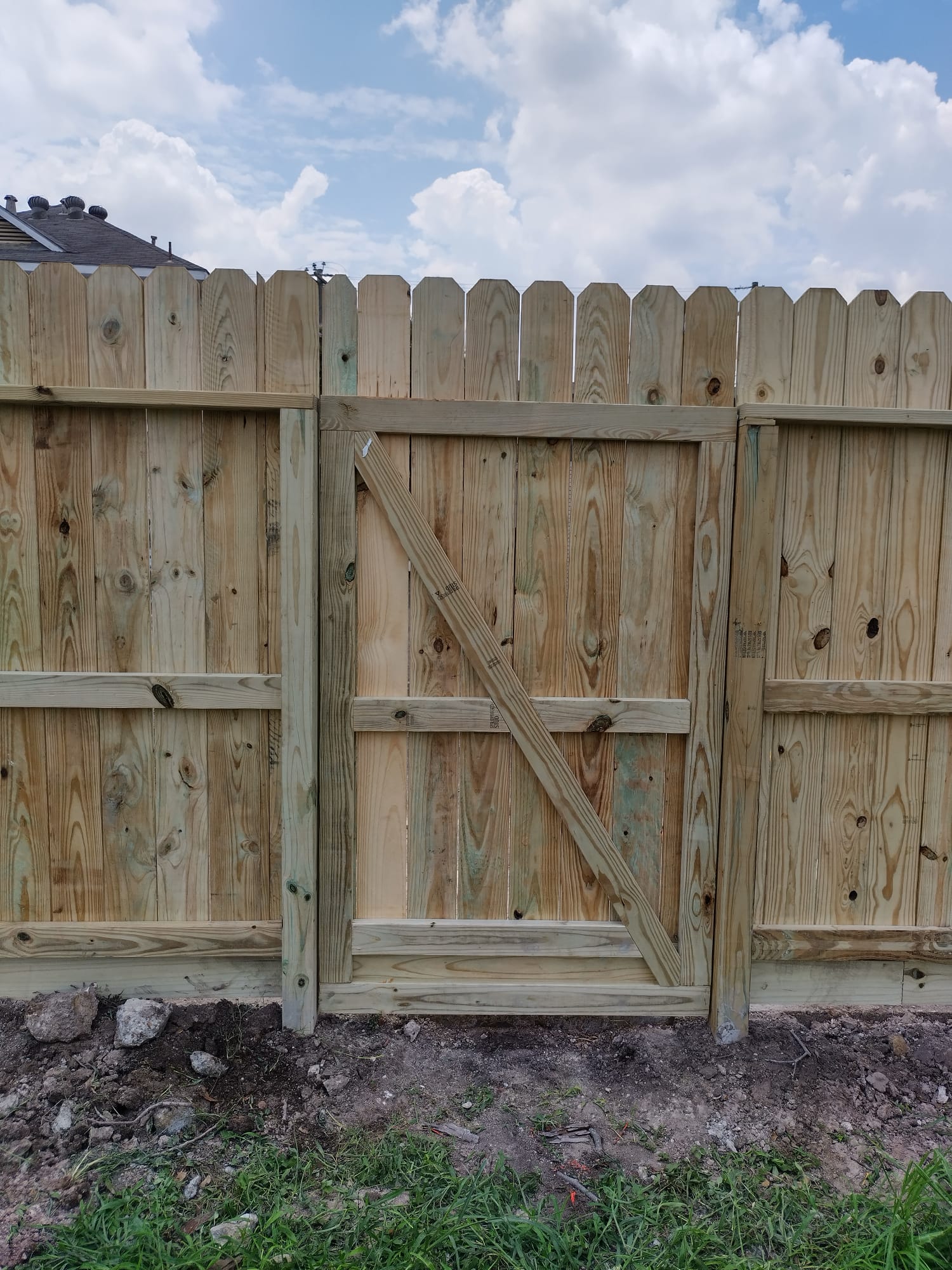
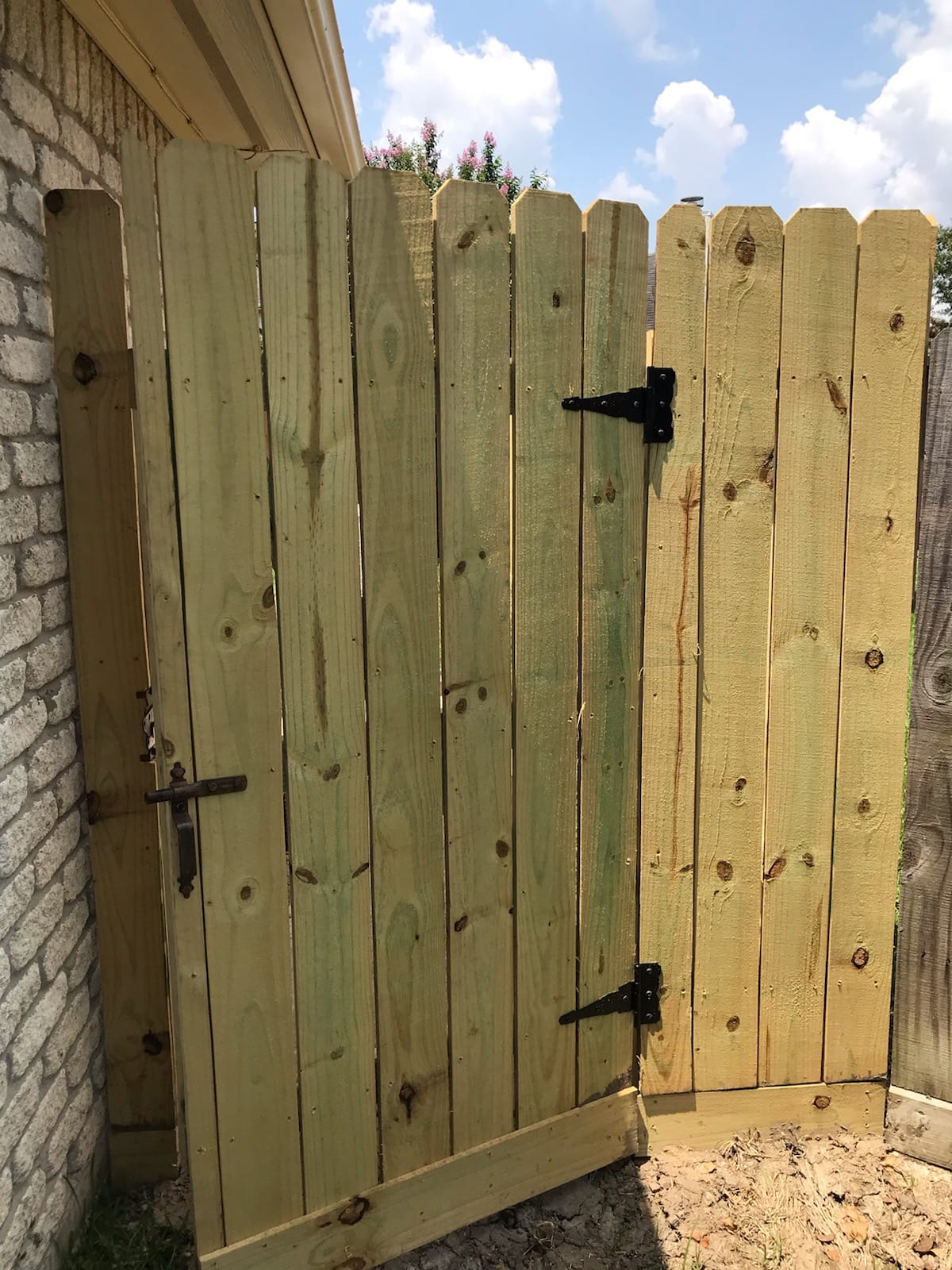
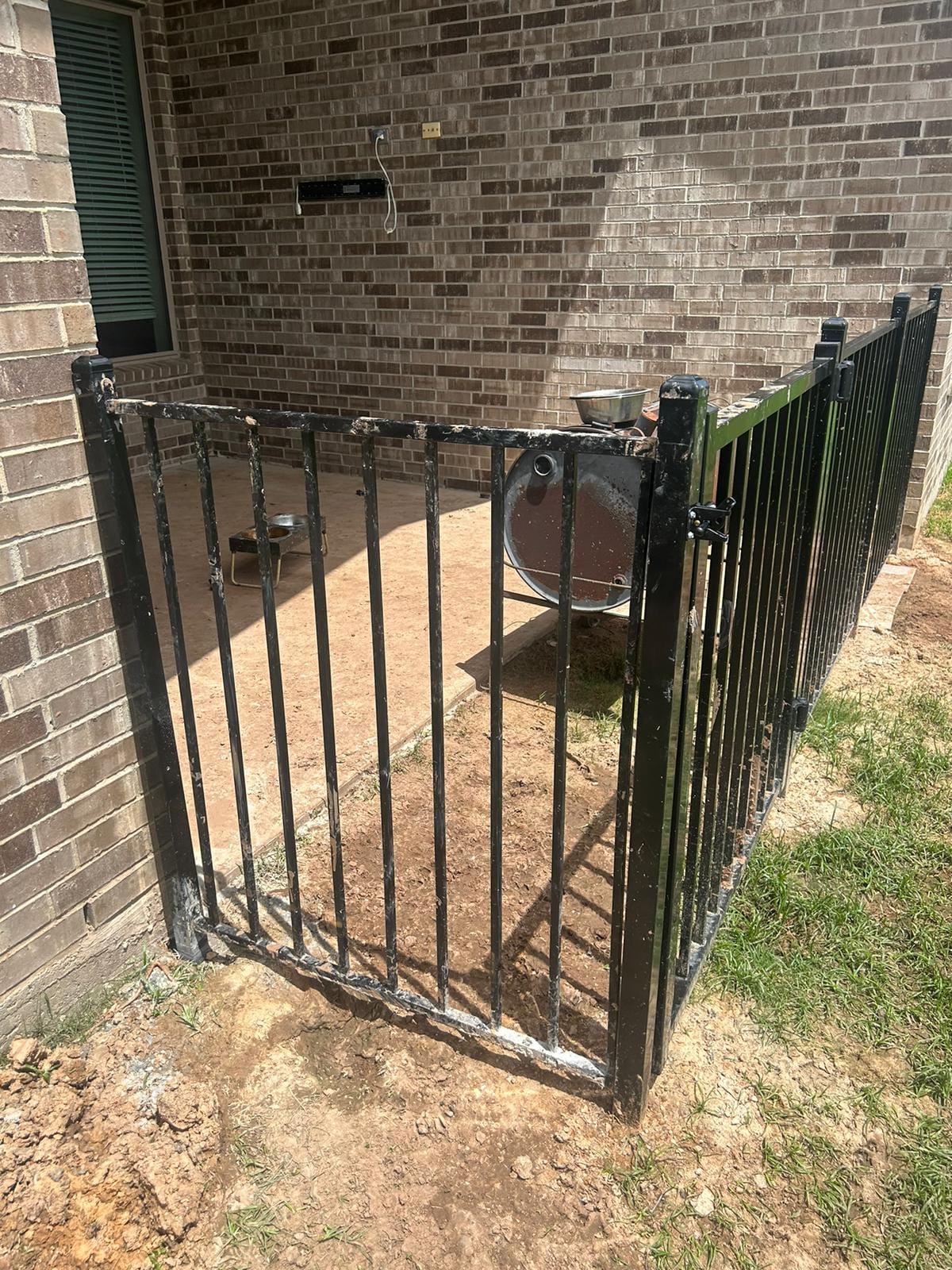
Most gate trouble on the island starts with what is under the gate, not the gate:
- A rise in the swing. A gate is hung level, so if the ground rises inside the gate, the gap under the closed gate has to be as big as that rise plus clearance. On a 14 ft leaf that can be well over a foot. Measure it with a level string before choosing the gate; the method is on the sloped driveway page, and a double gate halves the rise under each leaf.
- Loose surfaces. Sand and shell drift and get topped up, and fresh fill settles. A V-track slide gate is the most sensitive to it, because anything on the track stops the gate.
- Surfaces that come later. If a slab, pavers or a gravel pad are going in after the gate, the gap has to be set to the finished surface. For a pool gate, that finished surface also decides whether the limit is 2 in or 4 in.
- Automatic gates on low lots. The gap under the gate isn’t the only height that matters on a flood-prone lot; the operator and its controls need thought too. See gate openers in a flood zone.
What Galveston customers say
5.091 Google reviews · read them all on Google
Very professional and friendly. Gotten automatic gates done and they are done to perfection! Thank you
had an excellent experience with mustang fencing From the initial consultation to the final installation, the team was professional, punctual, and attentive to detail. They helped me choose the perfect fence style to match my property and ensured everything was installed with precision. The quality of materials is top-notch, and the fence has completely transformed the look and security of my home. I highly recommend mustang services to anyone looking for reliable and high-quality fencing services!
Absolutely loved my fence once i saw the finished product. No hassle, no rude interactions, and no inconveniences everything was just perfect. One of the best fencing companies in Texas
Reviews shown word for word from the Mustang Fencing Services Google Business Profile (Galveston), captured 2026-10-05.
Questions we get about this
How much gap should be under a gate?
What is the maximum gap under a pool gate?
How much gap should be between a gate and the post?
Can an automatic gate have a gap under it?
Why does my gate drag when the gap looks fine?
Sources
Checked September 27, 2026. Rules change, so confirm with the City before you build.
- Chain Link Fence Manufacturers Institute, guide specification 32 31 13 Chain Link Fence and Gates — §3.5.A swing gates: 3 in bottom clearance grade permitting; hinge and latch offset 3 in max. §3.5.B slide gates: 3 in ground clearance. Fabric ground clearance 2 in max.
- 2021 International Swimming Pool and Spa Code, Section 305 (ICC) — 305.2.1: 2 in over grass or gravel, 4 in over a solid surface, measured away from the pool; 305.2.2: 4 in sphere; 305.3: gates open outward, self-closing, self-latching.
- City of Galveston, Swimming Pool Permit Application (Rev. 04/2024) — New pool construction must comply with the 2021 ISPSC; site plan, fence location and height, self-closing gates.
- Texas Health and Safety Code, Chapter 757 (Pool Yard Enclosures) — 757.003(c): no opening under the enclosure that passes a 4 in sphere (multiunit rental complexes and property owners’ associations).
- LiftMaster CSW24UL swing gate operator, installation manual — Gate must not hit or drag across the ground, level, hinges only, wheels removed; bottom-edge contact sensor for a 4–16 in gap; 4 in / 16 in clearances to fixed objects.
- LiftMaster CSL24UL slide gate operator, installation manual (ASTM F2200 provisions) — Smooth bottom edges, vertical bottom protrusions 0.50 in max; 2¼ in max gap between the gate frame and the nearest fixed object by the roadway.
- UFC 4-022-03, Security Fences and Gates (U.S. Department of Defense, 2013 edition) — Double swing vehicle gates: 2 in max clearance to the road surface when closed; fabric within 2 in of firm ground; gates the weakest point of the fence.
- Bufftech (CertainTeed), Molded and Extruded Fence Installation Guideline — About 1½ in between gate and gate post, about 1 in at the end post or between two gates; gate left on blocks 72 hours while concrete sets.
- Trex Seclusions Gate Installation Guide (single, ©2013) — Hinges adjusted for a minimum of 1 in between the gate panel and the gate post.
- Jewett-Cameron, Adjust-A-Gate installation instructions (AG36/AG60) — Gate boards cut 2 in shorter than the fence boards to line up the top and allow clearance under the gate.
- DuraGates, Sliding Gate Systems catalog (2023) — Cantilever gate set high enough to clear the highest point on the ground; a V-track ground track can be obstructed by objects on it.
Want the gap set right the first time?
We’ll check the ground across the whole swing, the surface that will be under the gate, and any pool or automation rules, and put the gate and hardware on one written estimate. Free on-site estimates across Galveston County.