
Will a Pressure-Treated Pine Fence Warp? What Causes It, and What Prevents It
Some movement is built into treated pine: it arrives wet and dries in the fence. Most of the warping you can see traces back to choices made before installation: the lumber, the board width, the grain, the sun and the nails.
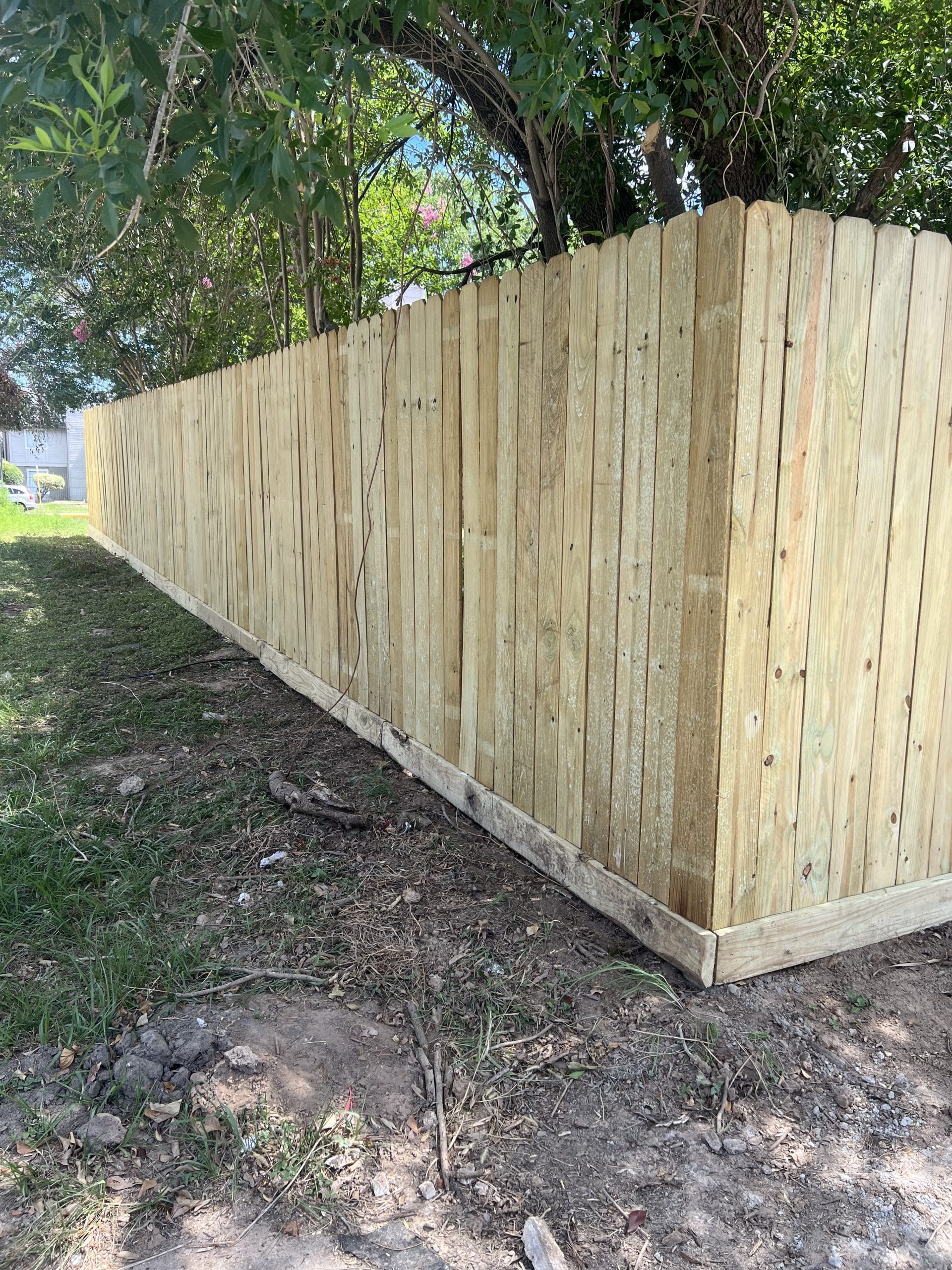
Some cupping and checking is normal in a new treated pine fence, because most treated pine is sold wet and shrinks as it dries. Serious warping (bow, crook, twist) comes mostly from specific boards and choices: lumber from the center of the log, wide, thin boards, one face baking in the sun, and smooth nails that let go as the wood shrinks. Treated pine is still a sound, economical fence wood. Buy it re-dried (KDAT) if flat boards matter to you, and set the worst boards aside before they go up.
Sources: USDA Forest Products Laboratory, Wood Handbook FPL-GTR-282 (2021), Chapters 4, 8, 13 and 16; Southern Forest Products Association, Pressure-Treated Southern Pine (2019) and FAQ.
Why treated pine moves after it goes up
Treated pine starts dry, gets wet, and dries again in your yard. The Southern Forest Products Association (SFPA) says dimension lumber must be at 19% moisture content or less before treatment, can exceed 50% coming out of the treating cylinder, and is mostly delivered without being re-dried. The USDA Wood Handbook states the consequence plainly: with waterborne preservatives, “some drying and shrinkage will occur after installation unless the wood is kiln-dried after treatment.”
Shrinking alone doesn’t warp a board. Uneven shrinking does. The Handbook calls “differential shrinkage caused by differences in radial, tangential, and longitudinal shrinkage” a major cause of warp. SFPA’s FAQ names the other cause, growth stresses in the tree, and says warp is aggravated by irregular grain and by abnormal wood such as juvenile or reaction wood. How far a pine board shrinks in width is worked out in cedar vs pressure-treated pine. This page is about why it bends.
Pine shrinks unevenly in three directions
Shrinkage from green to oven-dry, % of the green dimension
The four things that make a pine board warp
- The grain it was sawn with. The Handbook says wood shrinks about twice as much along the growth rings as across them. A flat-grain board, with the rings running across its face, therefore cups as it dries. Vertical-grain boards “typically have less checking, cup, and warp,” but sawing vertical grain takes large, nearly knot-free logs, and species from small-diameter logs “yield mostly flat-grain lumber.” That describes almost all fence-grade pine.
- Wood from the center of the log. The first 15 or so growth rings are juvenile wood. The Handbook says its early years can change about 2% in length, against 0.1–0.2% for normal wood: a 10-ft board of extreme juvenile wood “attempts to shrink 2.4 in.” When that wood sits along one face or edge and normal wood along the other, the board bows, crooks or twists. You can spot these boards by the pith, the small dark center of the log, showing on the end or face.
- Width for its thickness. “The tendency to cup increases with width/thickness ratio.” A 5½-inch picket that is ⅝ inch thick has a ratio near 9 to 1. A 3½-inch board of the same thickness is under 6 to 1.
- Sun on one face. The Handbook notes a surface in the sun “can dry and shrink quickly,” while the rest of the board lags. On a south- or west-facing run, the outside face of every picket dries first.
How much warp risk is built into your fence plan?
Pick the lumber, boards, grain, sun and fasteners. The checker counts the warp risk factors the USDA Wood Handbook and the Southern Forest Products Association describe. It is a checklist, not a prediction for any single board.
Risk factors from the USDA Forest Products Laboratory, Wood Handbook FPL-GTR-282 (2021), Chapters 4, 8, 13 and 16, and the Southern Forest Products Association, Pressure-Treated Southern Pine (2019) and FAQ. Width-to-thickness uses actual board sizes. The Handbook says cup increases with that ratio but gives no cutoff, so the checker simply flags boards wider than 8 times their thickness.
What actually reduces warping
- Buy re-dried lumber where it matters. SFPA says drying after treatment (KDAT or ADAT) “is recommended when dimensional stability and tightness of fit are important.” It costs more, and it moves most of the shrinkage to before the fence is built. It also lets you finish right away; see when to stain a new treated fence.
- Keep lumber covered until it goes up. SFPA’s FAQ: “Protecting lumber from the elements with proper coverings during storage and at the building site can help minimize warp and crack.” The Handbook likewise says treated wood stored before use “should be covered for protection from the sun and weather.”
- Cull center-of-log boards. Pickets with the pith showing are the likeliest to bow and twist. Put them where they matter least, or leave them out.
- Use threaded nails or screws. The Handbook found smooth-shank nails driven into wood that later dries can lose holding power down to as little as 25% of the starting value. Annularly (ring) or helically (spiral) threaded nails held about four times better in the same conditions. SFPA notes that building codes generally require hot-dip galvanized, stainless steel, silicon bronze or copper fasteners in treated wood, and it lists salt-water exposure among the particularly severe environments. That matters on the island.
- Finish it, both for looks and for movement. The Handbook says well-maintained finishes slow water movement, so “surface checks, warping, and other effects of dimensional changes are less likely.” A finish won’t straighten a bad board, but it evens out the wet-dry swings.
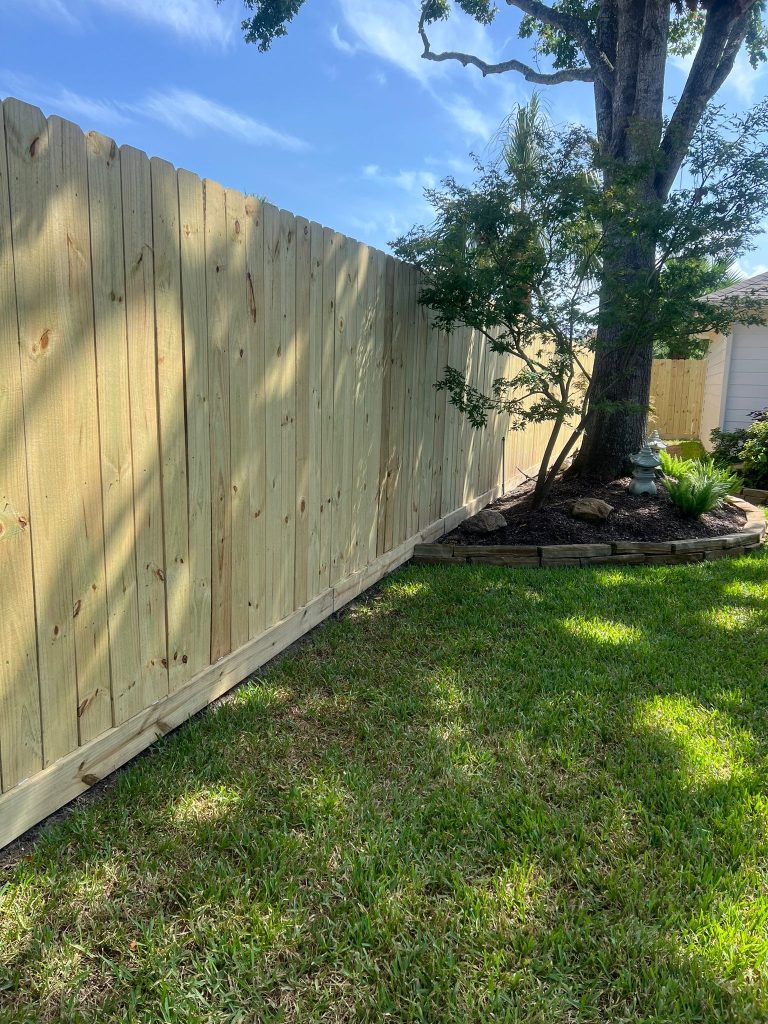
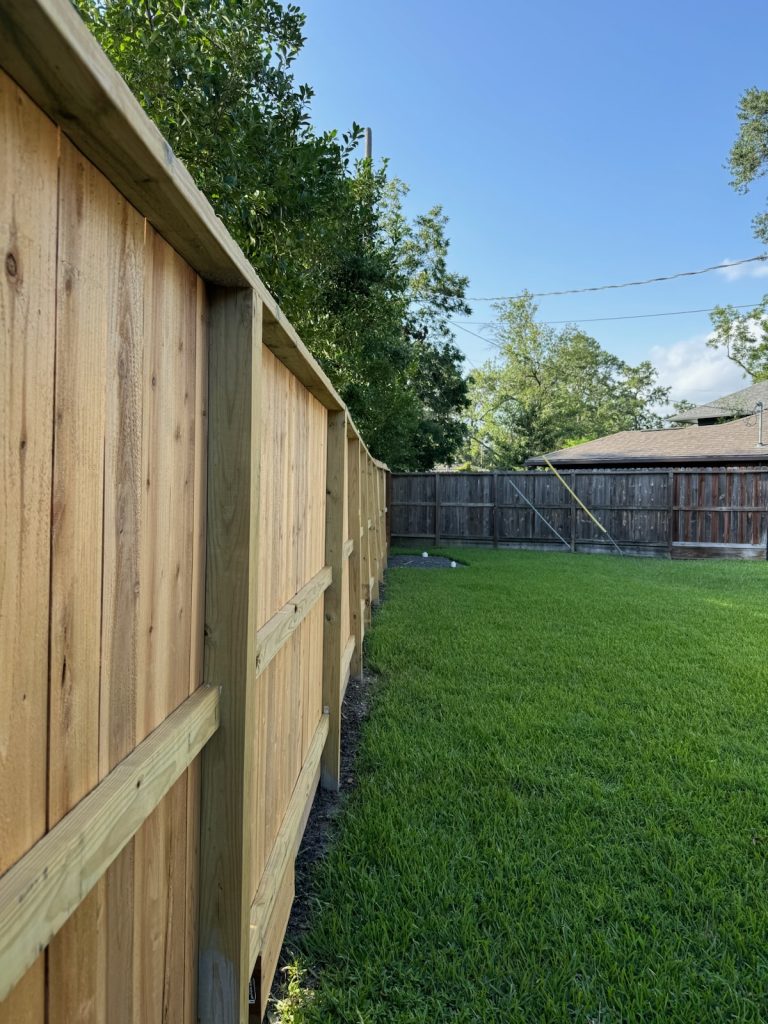
So is treated southern pine a good fence choice?
For most yards, yes, when it is bought for the job. Its durability comes from the treatment, not the tree: the Handbook’s decay table places the heartwood of pines other than a few old-growth types in the slightly-or-nonresistant group, and says untreated sapwood of essentially all species has low resistance. So the use category on the end tag matters. SFPA lists fence posts in ground contact as UC4A, unpainted pickets and rails as UC3B, and painted ones as UC3A. Its deck guidance recommends ground-contact (UC4A) lumber for anything within 6 inches of the soil, so it is worth asking for UC4A on a fence’s bottom rot board as well.
Choose cedar instead if a very flat, stable look matters more than budget. Cedar is a lower-density wood, and the Handbook ties lower density to less swelling, checking and cup. See cedar vs pressure-treated pine for the full comparison and financing if cost is the obstacle. Our southern pine fence page covers styles and options.
What Galveston customers say
5.090 Google reviews · read them all on Google
I chose Mustang Fencing for my backyard due to their reputation for quality and security. Their wood fencing exceeded my expectations, durable and visually appealing. The customer service was top-notch, and the installation was quick and efficient.
had an excellent experience with mustang fencing From the initial consultation to the final installation, the team was professional, punctual, and attentive to detail. They helped me choose the perfect fence style to match my property and ensured everything was installed with precision. The quality of materials is top-notch, and the fence has completely transformed the look and security of my home. I highly recommend mustang services to anyone looking for reliable and high-quality fencing services!
We just installed our fences and love the work!! Thanks to Mustang fencing!
Reviews shown word for word from the Mustang Fencing Services Google Business Profile (Galveston), captured 2026-09-26.
Questions we get about this
Will a pressure-treated pine fence warp?
Why do pressure-treated boards warp?
How do you keep a new pine fence from warping?
Should a pine fence be built with screws or nails?
Is pressure-treated southern pine a good choice for a fence?
Does a warped board mean the fence needs replacing?
Sources
Checked September 26, 2026. Rules change, so confirm with the City before you build.
- USDA Forest Products Laboratory, Wood Handbook: Wood as an Engineering Material, FPL-GTR-282 (2021) — Chapter 4: anisotropic shrinkage, Figure 4-4, reaction and juvenile wood; Table 4-3 shrinkage values. Chapter 8: nail withdrawal after seasoning, threaded nails. Chapter 13: differential shrinkage and warp. Chapter 14, Table 14-1: decay resistance. Chapter 15: shrinkage of waterborne-treated wood, covered storage. Chapter 16: grain angle, juvenile wood, cup and width/thickness ratio, sun-dried surfaces, finishes and moisture movement.
- Southern Forest Products Association, Pressure-Treated Southern Pine (2019 edition) — Moisture content before and after treatment; drying after treatment (KDAT/ADAT); use categories for fence posts, pickets and rails; ground-contact tip; fasteners and corrosive environments.
- Southern Forest Products Association, Frequently Asked Questions — Why lumber warps and cracks; the six major types of warp; covered storage.
Planning a new wood fence?
We’ll walk the line, talk through treated pine, KDAT or cedar, and give you a written price. Free on-site estimates across Galveston County.