
Redwood vs Cedar Fence: Decay, Weathering and Finish, Side by Side
Redwood and cedar are the two premium fence woods, and they are more alike than the price gap suggests. Both are light, stable, tannin-rich softwoods. They differ in how the redwood sold today is rated for decay, and in how fast each wears when left bare.
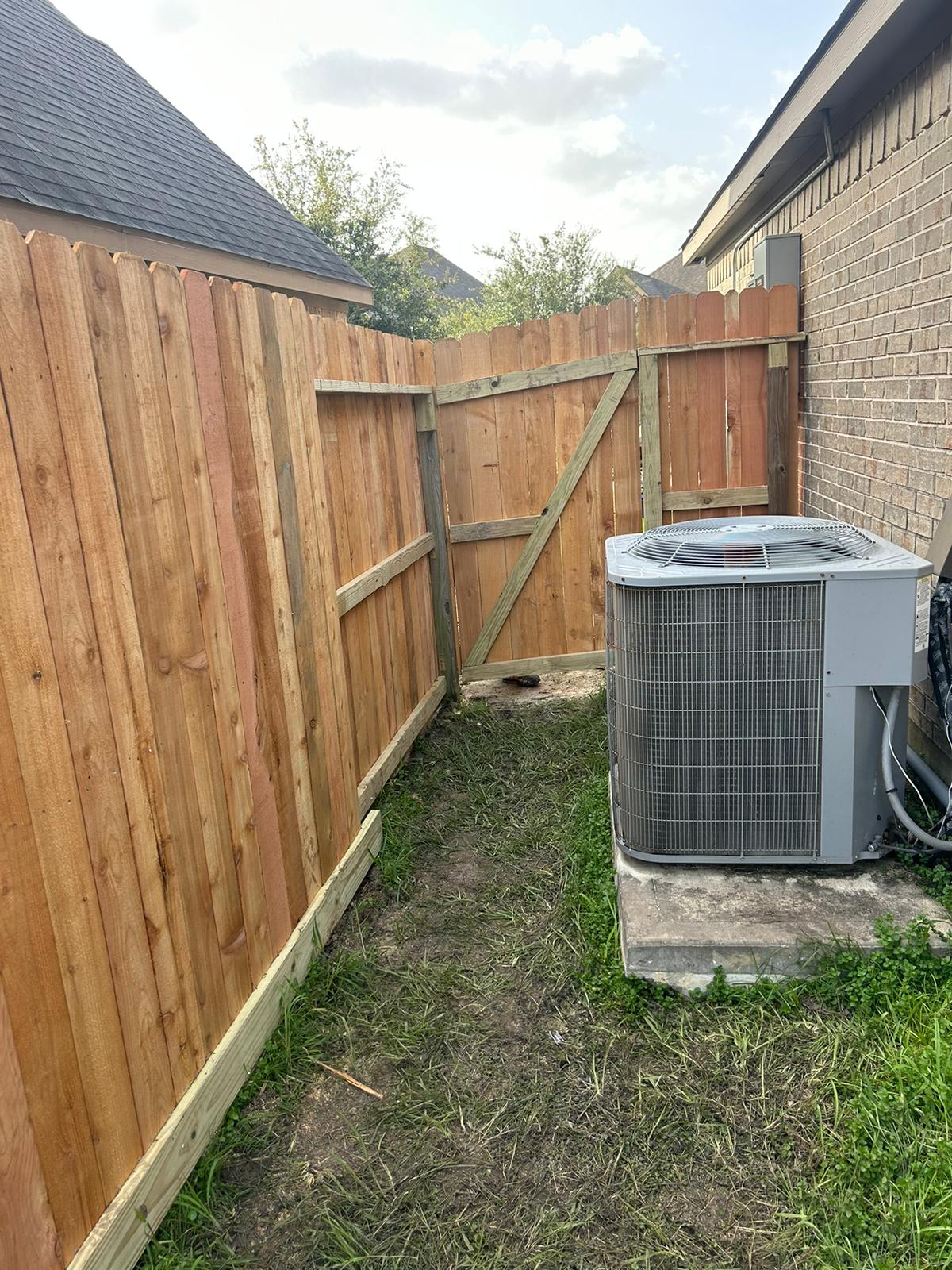
By the USDA Wood Handbook, cedar heartwood is rated resistant to decay. Old-growth redwood is also resistant, but the young-growth redwood sold today is rated moderately resistant. The two shrink almost the same amount, and both need stainless or hot-dip galvanized fasteners to avoid iron stain. Redwood is denser, and in the Handbook’s weathering study its unfinished surface wore away about 30% less than western redcedar’s over 16 years. For decay resistance and price, cedar is the practical premium choice. Redwood buys a deeper color and a harder-wearing bare surface.
Source: USDA Forest Products Laboratory, Wood Handbook FPL-GTR-282 (2021): Table 14-1 (decay), Table 4-3 (shrinkage), Table 16-1 (weathering erosion, specific gravity). 30% less: 1 − 1,385 ÷ 1,945 = 29%.
Redwood and cedar, side by side
| Cedar (western redcedar) | Redwood | |
|---|---|---|
| Heartwood decay rating | Resistant | Old growth: resistant. Young growth, most of what is sold now: moderately resistant |
| Shrinkage across the grain, green to oven-dry | 5.0% (radial 2.4%) | Young growth 4.9% (radial 2.2%); old growth 4.4% |
| Specific gravity in the weathering study | 0.31 | 0.36 |
| Unfinished surface worn away in 16 years (earlywood) | 1.95 mm | 1.39 mm |
| Paint performance | Excellent (thin latewood bands) | Excellent (thin latewood bands) |
| Extractive bleed under paint | Yes: use a stain-blocking primer | Yes: use a stain-blocking primer |
| Iron stain from plain steel fasteners | Yes | Yes |
USDA Wood Handbook FPL-GTR-282 (2021): Table 14-1, Table 4-3, Table 16-1 and Chapter 16 (finishing, extractives, iron stain).
Decay: the old-growth footnote
Most comparisons say both woods “resist rot.” The USDA Forest Products Laboratory is more precise. In its table of heartwood decay resistance, cedars, including western redcedar, are resistant. Redwood appears twice: old growth is resistant, and young growth is moderately resistant. The Handbook adds that wood from old-growth trees is often more resistant than wood from second-growth and younger trees, and that decay resistance may be lower in ground contact and in warm, humid climates, which describes Galveston.
Two practical points follow. First, both ratings apply to heartwood only. The Handbook says untreated sapwood of essentially all species has low resistance to decay, so pale sapwood on either wood doesn’t carry the rating. Second, neither wood is rated for ground contact the way treated posts are. On a redwood or cedar fence, the posts are usually treated for ground contact (AWPA UC4A) or galvanized steel. See cedar vs pressure-treated pine for how that mixed build works.
Weathering: what happens if you never finish it
Left bare, any wood weathers. Sunlight breaks down the surface, and rain washes the loosened fibers away. The softer earlywood in each growth ring goes first, leaving a ridged, washboard face. The Handbook reports measured erosion on smooth, unfinished boards exposed vertically facing south. Its table follows western redcedar (specific gravity 0.31) and redwood (0.36) for 16 years, in the same group of rows:
- after 8 years: cedar earlywood 1.09 mm worn away, redwood 0.65 mm
- after 16 years: cedar 1.95 mm, redwood 1.39 mm
On a 5/8″ picket, that is about 12% of the thickness for cedar and about 9% for redwood at the deepest bands after 16 years, on the exposed face. The study site wasn’t on the Gulf Coast, so use these as a comparison between the two woods rather than a forecast. The direction is clear: the denser redwood wears more slowly when left bare. A finish slows the difference for both.
Surface worn away after 16 years, unfinished
Earlywood erosion on smooth planed boards, millimetres, USDA Table 16-1
Left unfinished, how much wears away?
Pick how many years and the board thickness. The planner reads the USDA Wood Handbook’s outdoor weathering study for western redcedar and redwood, then shows what your finish choice changes.
Data: USDA Forest Products Laboratory, Wood Handbook FPL-GTR-282 (2021), Table 16-1: erosion of smooth planed, unfinished surfaces exposed vertically facing south, averages of nine measurements, western redcedar (specific gravity 0.31) and redwood (0.36), both followed for 16 years. Earlywood is the softer band of each growth ring and wears fastest. Percent of thickness is arithmetic on one exposed face. The study site was not on the Gulf Coast. Treat the numbers as a comparison between the two woods, not a forecast for your fence. Finish notes: Handbook Chapter 16.
Choosing between cedar and redwood?
We’ll measure the line, price both woods side by side, and walk through upkeep before you decide. Free on-site estimates across Galveston County.
Finishing: the two woods behave the same
A common claim is that redwood “resists finishes” and has to stay natural. The Handbook says otherwise. It names western redcedar and redwood, with white pine, as lower-density woods without wide latewood bands, and says these species give excellent paint performance. Its table of exterior finishes rates “cedar and redwood” together.
What both do need is the right primer. Their heartwood carries water-soluble extractives. When the wood gets wet, water carries them to the surface, where they dry as a reddish-brown stain. For opaque coatings on these woods, the Handbook advises a stain-blocking primer. It warns that if bleed appears, another coat of the same finish won’t stop it. You need a stain-blocking primer, then the topcoat.
If you’d rather see the grain, penetrating (non-film-forming) finishes don’t peel, and semitransparent stains perform well on saw-textured wood. Either wood takes them. For cedar in our humidity, see does cedar need sealing here? and how often to restain. For choosing between film and penetrating finishes, see stain vs paint.
Which one should you choose?
- Choose cedar if decay resistance for the money is the priority. Its heartwood rating is higher than young-growth redwood’s. See cedar fences.
- Choose redwood for its deep red-brown color, or if the fence will stay bare and you want a surface that wears more slowly. Ask whether the boards are heartwood. See redwood fences.
- Either way: posts treated for ground contact or galvanized steel posts, and stainless or hot-dip galvanized (ASTM A153) fasteners. The Handbook lists western redcedar and redwood among the high-tannin woods where plain carbon-steel fasteners cause iron stain.
- Mixing them on one property works structurally, since they shrink almost the same. Expect the colors to differ until both weather or are stained to match.
For the whole range of wood options, styles and a board-count planner, see wood fences.
Cedar vs redwood cost: what changes the price
We quote both after a free on-site visit. Redwood is offered on request as the premium option, and lumber prices and availability change, so ask for both numbers side by side. For the same fence, the price moves with:
- Species and grade. All-heartwood grades cost more. The Handbook notes that all-heartwood, vertical-grain cedar and redwood are still available but expensive.
- Style and height. Board-on-board and shadowbox use more boards than a butted privacy fence.
- Posts and hardware. Treated or steel posts, and stainless or hot-dip galvanized fasteners.
- Finish. Bare, penetrating stain, or primer plus paint.
For typical numbers, see wood fence cost per foot. Financing is available through the providers on our financing page, subject to credit approval.
What Galveston customers say
5.091 Google reviews · read them all on Google
Absolutely loved my fence once i saw the finished product. No hassle, no rude interactions, and no inconveniences everything was just perfect. One of the best fencing companies in Texas
Installed Stained cedar wood fence yesterday by mustang fencing, thanks for the beautiful work.
My new fence looks fantastic and has added both privacy and style to my yard. Highly recommend their services for anyone in need of fencing!
Reviews shown word for word from the Mustang Fencing Services Google Business Profile (Galveston), captured 2026-10-05.
Questions we get about this
Is redwood or cedar better for a fence?
Does redwood fade less than cedar?
Can you paint or stain redwood?
Is redwood available for a fence in Galveston?
Can redwood and cedar be mixed on one property?
Do redwood and cedar fences need treated posts?
Sources
Checked September 26, 2026. Rules change, so confirm with the City before you build.
- USDA Forest Products Laboratory, Wood Handbook: Wood as an Engineering Material, FPL-GTR-282 (2021) — Table 4-3 shrinkage; Table 14-1 and p. 14-5 decay resistance (old vs young growth); Table 16-1 weathering erosion and specific gravity; Chapter 16 paint performance, primers, water-soluble extractives, penetrating and semitransparent stains, iron stain; Table 15-6 AWPA use categories.
- City of Galveston Land Development Regulations, §2.501 — residential fence heights: 8 ft; front yard 4 ft solid or 5 ft if at least 60% transparent.
- City of Galveston Fence Permit Application (Rev. 03/2023) — the historic district, Cedar Lawn and 1,000 ft mean-high-tide questions.
Pricing cedar and redwood?
We’ll measure the line, price both woods side by side, and talk through posts, fasteners and finish. Free on-site estimates across Galveston County.