
What Actually Drives Wood Fence Cost Per Foot?
There’s no single honest number for “wood fence cost per foot” — species and decay resistance, the treatment class on the posts, the board style, the fasteners, and the height each change what a foot of fence actually costs to build. The generic national ranges you’ll find elsewhere aren’t sourced to anything. Here’s exactly what each factor changes and why, backed by USDA and AWPA standards, plus a calculator that checks your own written quote’s real per-foot rate.

Wood fence cost per foot depends on five things that each change independently: species and natural decay resistance, the treatment class on the posts versus the pickets and rails, the board style, the fasteners, and the height. Cedar and old-growth redwood heartwood are rated decay-resistant by the USDA and need no chemical treatment; most pine has little natural resistance, so it’s pressure-treated instead — a different cost, not necessarily a higher one. Posts sit in the ground and need a higher-retention, ground-contact treatment (AWPA UC4A) than the above-ground pickets and rails (UC3B), regardless of species. A board-on-board style uses roughly double the boards per foot of a butted solid-privacy style in the same board width. We don’t publish a generic $/ft range here because none of the ones circulating online cite a source — request a free on-site estimate for an exact number for your species, style, and height.
Sources: USDA Forest Products Laboratory, Wood Handbook FPL-GTR-282 (2021), Tables 14-1 and 15-6, Ch. 8; Southern Forest Products Association, Pressure-Treated Southern Pine (2019), Table 3-1.
Why there’s no single honest price per foot
Search “wood fence cost per foot” and you’ll find national ranges with no source attached. The real answer is that several independent factors each change the number: the species and whether it resists decay naturally, the treatment class the posts need versus the boards above them, the style (which decides how many boards a foot of fence actually uses), the fasteners, and the height. Site conditions — old-fence removal, sloped or rocky ground, extra corners and gates — add labor cost on top of all of that, the same as with any fence type. Rather than repeat an unsourced national figure, this page breaks down what each factor actually changes and why.
Why a post costs more per piece than a picket
Whatever the species, the part of the fence in the ground is held to a tougher standard than the part above it. The American Wood Protection Association’s use category system, summarized in the USDA Wood Handbook’s Table 15-6 and in the Southern Forest Products Association’s own product tables, puts fence pickets, rails, slats and trim under UC3A/UC3B (general above-ground use, fully exposed to weather) and fence posts under UC4A (general ground contact). Ground-contact treatment carries a higher preservative retention than above-ground treatment, which is part of why a post is priced differently per piece than a picket of the same size.
If the fence is pressure-treated pine, the treater certifies posts to UC4A and boards to UC3A/UC3B separately — ask to see the end tag. If the fence is naturally resistant heartwood (cedar, old-growth redwood), there’s no AWPA retention step to pay for, but it’s worth confirming the posts are all-heartwood with no sapwood: the Handbook’s own caveat is that untreated sapwood of essentially any species has low decay resistance, resistant species included.
What drives the price within a quote
| Factor | What changes | Why |
|---|---|---|
| Species | Naturally resistant heartwood (cedar, old-growth redwood) vs. pressure-treated pine | Cedar/redwood heartwood is rated decay-resistant with no chemical treatment; most pine is rated slightly or nonresistant and is treated instead (USDA Table 14-1) |
| Post treatment | Posts cost more per piece than pickets of the same size | Posts need ground-contact treatment (AWPA UC4A, higher retention) vs. UC3A/UC3B above-ground boards |
| Board style | Board-on-board and shadowbox use noticeably more lumber than a butted solid-privacy design | Two overlapping layers roughly double the board count per linear foot in the same width |
| Fasteners | Stainless or hot-dip galvanized (ASTM A153) costs more than plain steel | Plain carbon steel causes iron stain on tannin-rich species like cedar and redwood; pine lacks tannins but code-compliant exterior fasteners still cost more than uncoated steel (USDA Ch. 8; SFPA) |
| Height | Taller fencing needs larger posts, deeper footings and more board square footage per linear foot | A back/side yard allows up to 8 ft at a Galveston home; front yards cap at 4 ft solid or 5 ft at 60%+ transparent (LDR §2.501) |
| Site conditions | Old-fence removal, difficult soil, extra corners and gates add labor cost | Added labor beyond the base install, same as any fence type |
Sources: USDA Wood Handbook FPL-GTR-282 Tables 14-1/15-6 and Ch. 8; SFPA Pressure-Treated Southern Pine (2019) Table 3-1; City of Galveston LDR §2.501.
Check your own quote’s real per-foot rate
This does arithmetic on numbers YOU enter from your own written quote — it does not look up or suggest a price. Useful for comparing two quotes with different footage, height or gate counts.
Gates are typically quoted separately from the linear per-foot fence price — entering a gate amount removes it before dividing by footage. The per-square-foot figure divides that rate by height, so you can compare a 6 ft quote against an 8 ft quote on the same basis.
Height is a code question before it is a material one
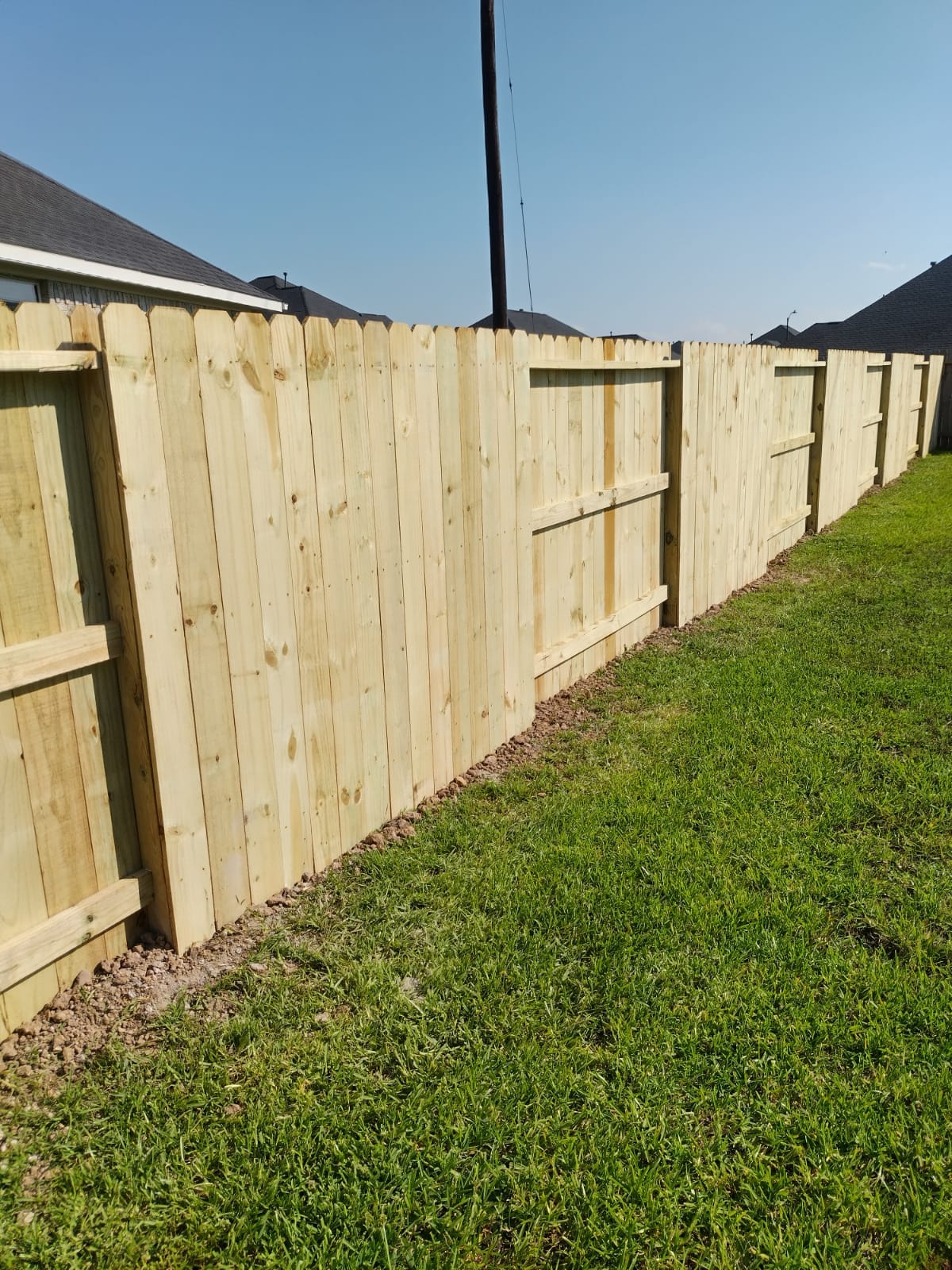
The City of Galveston caps a residential fence at 8 ft, except in a front yard, where a solid fence or wall is limited to 4 ft, or 5 ft if it is at least 60% transparent (LDR §2.501). A taller fence doesn’t just use more board square footage per linear foot — it typically calls for a larger post set deeper, which is priced into the per-foot rate along with everything else above. Decide the height and the front-yard transparency question before pricing styles, since they limit which designs are even allowed at the street.
What Galveston customers say
5.091 Google reviews · read them all on Google
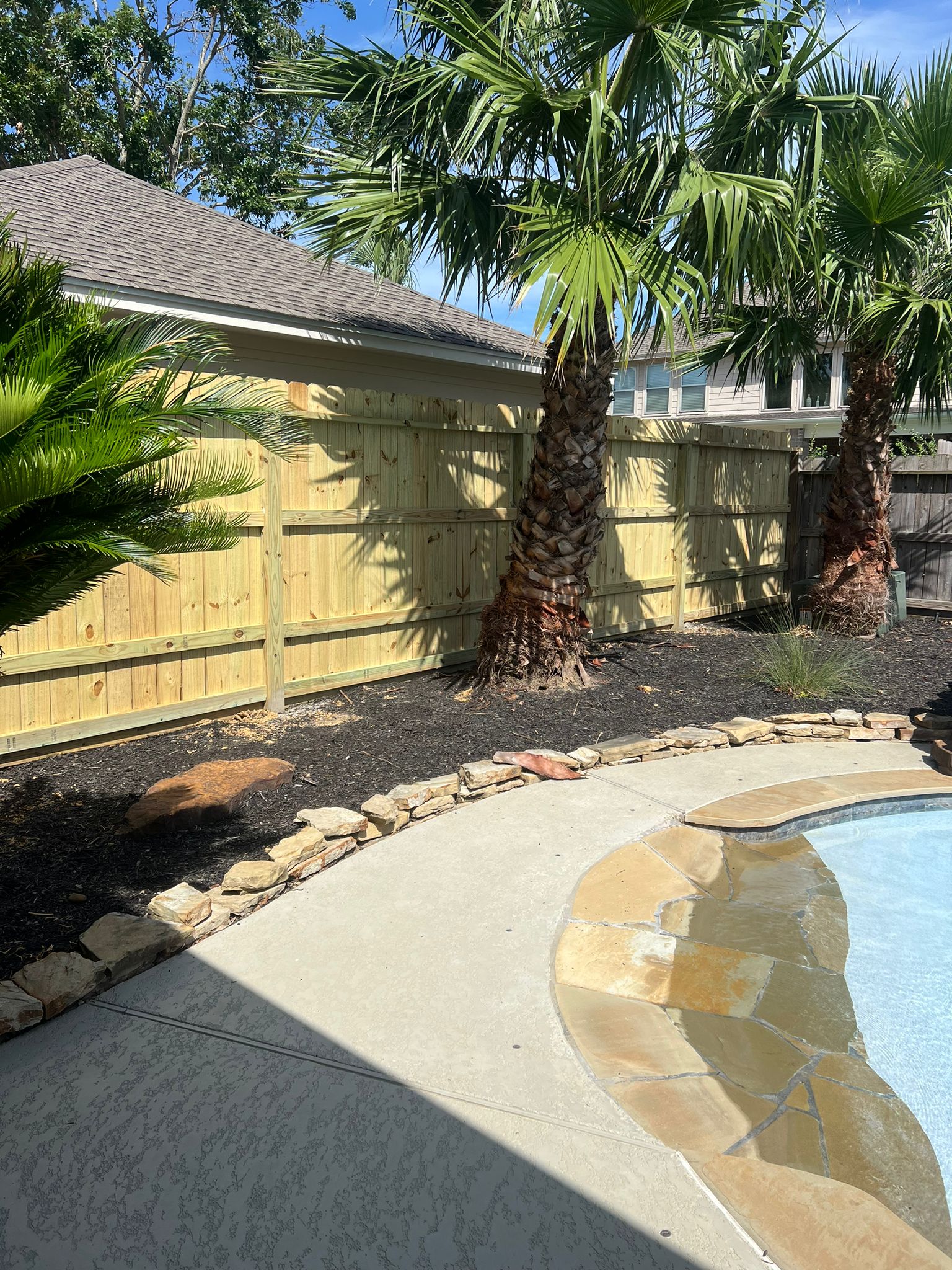
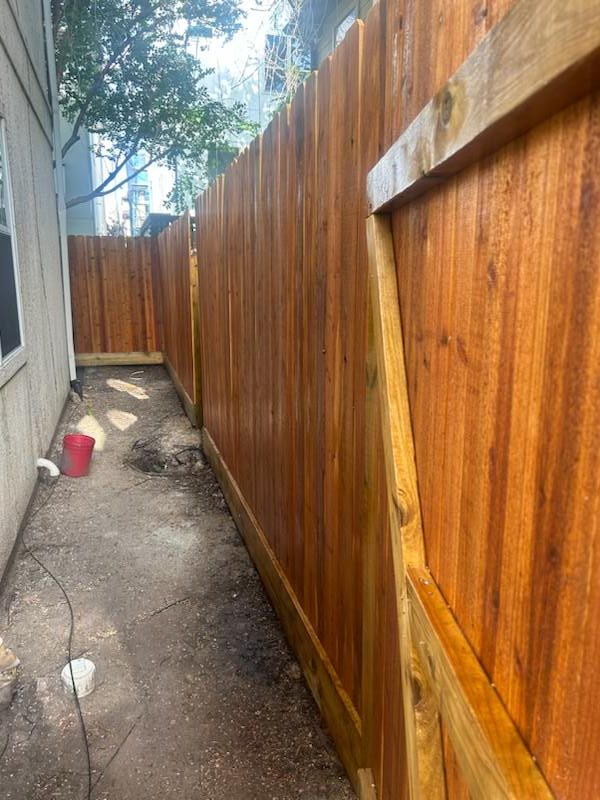
Amazing work will go ahead and recommend everyone in friends and family We installed 8ft tall double sided stained cedar wood fence in our backyard, it’s really looks great, installed perfectly nice finishing and cost effective, thanks mustang fencing.
I have hired Mustang fencing services to fix my backyard fencing. Good wood to used. I really like theirs work. Best of luck
Absolutely loved my fence once i saw the finished product. No hassle, no rude interactions, and no inconveniences everything was just perfect. One of the best fencing companies in Texas
Reviews shown word for word from the Mustang Fencing Services Google Business Profile (Galveston), captured 2026-10-19.
Questions we get about this
How much does a wood fence cost per linear foot?
Is cedar or pine cheaper for a wood fence?
Does fence style change the cost per foot?
Do fence posts cost more than the pickets and rails?
Does a taller wood fence cost more per linear foot?
Sources
Checked October 24, 2026. Rules change, so confirm with the City before you build.
- USDA Forest Products Laboratory, Wood Handbook: Wood as an Engineering Material (FPL-GTR-282, 2021) — Table 14-1 (heartwood decay resistance by species), Table 15-6 (AWPA use categories UC3B/UC4A), Ch. 8 (fastener corrosion and iron staining on tannin-rich species).
- Southern Forest Products Association, Pressure-Treated Southern Pine (2019 edition) — Table 3-1 (fence pickets/rails/trim vs. posts by use category); fastener and connector compatibility by preservative system.
- City of Galveston, Land Development Regulations, Sec. 2.501 — Residential fence height limits: 8 ft general; front yard 4 ft solid or 5 ft at 60%+ transparent.
Want a real per-foot number for your fence?
Tell us the species, style, and height you’re considering and we’ll quote the real number for your run — no generic national range, no guessing.